

Evaluation of Flexible Microdisplay Materials in Electronics
OCT 21, 20259 MIN READ
Generate Your Research Report Instantly with AI Agent
PatSnap Eureka helps you evaluate technical feasibility & market potential.
Flexible Microdisplay Evolution and Objectives
Flexible microdisplay technology has evolved significantly over the past two decades, transitioning from rigid glass-based displays to increasingly flexible and adaptable solutions. The journey began in the early 2000s with the development of thin-film transistor (TFT) technology on flexible substrates, marking a pivotal shift from conventional display manufacturing paradigms. This evolution has been driven by growing demands for portable, wearable, and foldable electronic devices across consumer, medical, and industrial sectors.
The progression of flexible microdisplay materials has followed a clear technological trajectory, moving from early plastic-based substrates with limited flexibility to advanced polymer composites and ultrathin glass that can withstand thousands of bending cycles without performance degradation. Key milestones include the introduction of organic light-emitting diode (OLED) technology on flexible substrates in 2008, the development of quantum dot-enhanced flexible displays in 2015, and the recent emergence of microLED integration with flexible backplanes.
Material science breakthroughs have been fundamental to this evolution, particularly in substrate development. Polyimide films, initially dominant due to their thermal stability and mechanical resilience, have been complemented by novel materials such as polyethylene naphthalate (PEN) and ultrathin flexible glass composites. These advancements have progressively addressed critical challenges including oxygen and moisture permeation, thermal expansion mismatches, and mechanical stress distribution during flexing operations.
The primary objectives of current flexible microdisplay material research center on several interconnected goals. First, enhancing durability to achieve displays capable of withstanding over 200,000 fold cycles without visible degradation. Second, improving optical performance to match or exceed rigid display counterparts in resolution, brightness, and color gamut. Third, reducing power consumption through more efficient materials and optimized electronic architectures. Fourth, developing manufacturing processes that enable cost-effective mass production while maintaining precise tolerances required for high-resolution displays.
Looking forward, the field aims to achieve truly conformable displays that can adapt to complex three-dimensional surfaces while maintaining optical integrity. This requires fundamental innovations in both materials and manufacturing processes. The ultimate vision encompasses displays with paper-like flexibility, self-healing capabilities, and biodegradable components to address growing environmental concerns. These ambitious objectives are driving collaborative research efforts across academic institutions, material science companies, and electronics manufacturers worldwide.
The progression of flexible microdisplay materials has followed a clear technological trajectory, moving from early plastic-based substrates with limited flexibility to advanced polymer composites and ultrathin glass that can withstand thousands of bending cycles without performance degradation. Key milestones include the introduction of organic light-emitting diode (OLED) technology on flexible substrates in 2008, the development of quantum dot-enhanced flexible displays in 2015, and the recent emergence of microLED integration with flexible backplanes.
Material science breakthroughs have been fundamental to this evolution, particularly in substrate development. Polyimide films, initially dominant due to their thermal stability and mechanical resilience, have been complemented by novel materials such as polyethylene naphthalate (PEN) and ultrathin flexible glass composites. These advancements have progressively addressed critical challenges including oxygen and moisture permeation, thermal expansion mismatches, and mechanical stress distribution during flexing operations.
The primary objectives of current flexible microdisplay material research center on several interconnected goals. First, enhancing durability to achieve displays capable of withstanding over 200,000 fold cycles without visible degradation. Second, improving optical performance to match or exceed rigid display counterparts in resolution, brightness, and color gamut. Third, reducing power consumption through more efficient materials and optimized electronic architectures. Fourth, developing manufacturing processes that enable cost-effective mass production while maintaining precise tolerances required for high-resolution displays.
Looking forward, the field aims to achieve truly conformable displays that can adapt to complex three-dimensional surfaces while maintaining optical integrity. This requires fundamental innovations in both materials and manufacturing processes. The ultimate vision encompasses displays with paper-like flexibility, self-healing capabilities, and biodegradable components to address growing environmental concerns. These ambitious objectives are driving collaborative research efforts across academic institutions, material science companies, and electronics manufacturers worldwide.
Market Analysis for Flexible Display Technologies
The flexible display market has witnessed remarkable growth in recent years, driven by increasing consumer demand for portable, durable, and innovative electronic devices. Current market valuations place the global flexible display sector at approximately 8.6 billion USD in 2023, with projections indicating a compound annual growth rate (CAGR) of 33.4% through 2028, potentially reaching 36.2 billion USD by the end of the forecast period.
Consumer electronics remains the dominant application segment, accounting for nearly 62% of market share. Smartphones and wearable devices are the primary drivers within this segment, with major manufacturers like Samsung, LG, and Apple incorporating flexible display technologies into their flagship products. The automotive sector represents the fastest-growing application area, with a projected CAGR of 41.7% as vehicle manufacturers increasingly adopt flexible displays for dashboard interfaces and entertainment systems.
Geographically, Asia-Pacific leads the market with approximately 47% share, primarily due to the concentration of display manufacturing facilities in South Korea, Japan, China, and Taiwan. North America follows with 28% market share, while Europe accounts for 19%. The remaining regions collectively represent about 6% of the global market.
From a materials perspective, OLED (Organic Light Emitting Diode) technology dominates the flexible microdisplay landscape with approximately 73% market share due to its inherent flexibility, superior color reproduction, and energy efficiency. Emerging technologies such as MicroLED and QLED (Quantum Dot LED) are gaining traction, with MicroLED expected to grow at a CAGR of 54.2% over the next five years.
Key market challenges include high production costs, yield issues in manufacturing processes, and durability concerns. The average production cost for flexible displays remains 30-40% higher than conventional rigid displays, though this gap is narrowing as manufacturing processes mature and economies of scale improve.
Consumer willingness to pay premium prices for devices with flexible displays varies significantly by region and device category. Premium smartphones with flexible displays command price premiums of 35-45% compared to their rigid counterparts, while the premium for wearable devices with flexible displays ranges from 20-30%.
Industry analysts predict that as manufacturing processes improve and material costs decrease, flexible displays will reach price parity with conventional displays by 2027-2028, potentially triggering mass market adoption across multiple device categories and opening new application opportunities in sectors such as healthcare, military, and industrial equipment.
Consumer electronics remains the dominant application segment, accounting for nearly 62% of market share. Smartphones and wearable devices are the primary drivers within this segment, with major manufacturers like Samsung, LG, and Apple incorporating flexible display technologies into their flagship products. The automotive sector represents the fastest-growing application area, with a projected CAGR of 41.7% as vehicle manufacturers increasingly adopt flexible displays for dashboard interfaces and entertainment systems.
Geographically, Asia-Pacific leads the market with approximately 47% share, primarily due to the concentration of display manufacturing facilities in South Korea, Japan, China, and Taiwan. North America follows with 28% market share, while Europe accounts for 19%. The remaining regions collectively represent about 6% of the global market.
From a materials perspective, OLED (Organic Light Emitting Diode) technology dominates the flexible microdisplay landscape with approximately 73% market share due to its inherent flexibility, superior color reproduction, and energy efficiency. Emerging technologies such as MicroLED and QLED (Quantum Dot LED) are gaining traction, with MicroLED expected to grow at a CAGR of 54.2% over the next five years.
Key market challenges include high production costs, yield issues in manufacturing processes, and durability concerns. The average production cost for flexible displays remains 30-40% higher than conventional rigid displays, though this gap is narrowing as manufacturing processes mature and economies of scale improve.
Consumer willingness to pay premium prices for devices with flexible displays varies significantly by region and device category. Premium smartphones with flexible displays command price premiums of 35-45% compared to their rigid counterparts, while the premium for wearable devices with flexible displays ranges from 20-30%.
Industry analysts predict that as manufacturing processes improve and material costs decrease, flexible displays will reach price parity with conventional displays by 2027-2028, potentially triggering mass market adoption across multiple device categories and opening new application opportunities in sectors such as healthcare, military, and industrial equipment.
Current Limitations and Technical Barriers
Despite significant advancements in flexible microdisplay technology, several critical limitations and technical barriers continue to impede widespread commercial adoption. Material stability remains a fundamental challenge, as flexible substrates and conductive materials experience performance degradation after repeated bending cycles. Most current flexible displays can withstand between 100,000 to 200,000 bending cycles before showing signs of failure, which falls short of consumer expectations for daily use over multiple years.
Thermal management presents another significant obstacle. Unlike rigid displays with established heat dissipation mechanisms, flexible displays lack efficient thermal pathways, resulting in localized heating that accelerates material degradation and reduces device lifespan. Operating temperatures exceeding 40°C can trigger irreversible damage to organic materials commonly used in flexible displays.
Resolution limitations persist due to manufacturing constraints on flexible substrates. While rigid displays routinely achieve pixel densities exceeding 500 PPI (pixels per inch), flexible microdisplays typically max out at 250-300 PPI, creating a noticeable quality gap. This resolution ceiling stems from difficulties in maintaining precise alignment during high-temperature processes on materials that expand and contract differently.
Power efficiency remains substantially lower in flexible displays compared to their rigid counterparts. Current flexible OLED microdisplays consume approximately 30-40% more power than equivalent rigid displays, creating significant barriers for battery-powered wearable applications where energy constraints are paramount.
Manufacturing scalability continues to challenge mass production efforts. Current yield rates for flexible microdisplays hover between 60-70%, substantially below the 85-90% achieved with rigid displays. This yield gap directly impacts production costs, with flexible displays commanding a 40-60% price premium over comparable rigid alternatives.
Interface integration presents unique challenges, as connecting rigid electronic components to flexible substrates creates stress points vulnerable to mechanical failure. Current connection technologies rely on anisotropic conductive films that demonstrate reliability issues after repeated flexing, with failure rates increasing dramatically after 50,000 bending cycles.
Environmental sensitivity further complicates deployment, as many flexible display materials exhibit accelerated degradation when exposed to oxygen and moisture. Current encapsulation technologies provide barrier properties of 10^-3 to 10^-4 g/m²/day for water vapor transmission, whereas long-term stability requires at least 10^-6 g/m²/day, highlighting a significant protection gap for practical applications.
Thermal management presents another significant obstacle. Unlike rigid displays with established heat dissipation mechanisms, flexible displays lack efficient thermal pathways, resulting in localized heating that accelerates material degradation and reduces device lifespan. Operating temperatures exceeding 40°C can trigger irreversible damage to organic materials commonly used in flexible displays.
Resolution limitations persist due to manufacturing constraints on flexible substrates. While rigid displays routinely achieve pixel densities exceeding 500 PPI (pixels per inch), flexible microdisplays typically max out at 250-300 PPI, creating a noticeable quality gap. This resolution ceiling stems from difficulties in maintaining precise alignment during high-temperature processes on materials that expand and contract differently.
Power efficiency remains substantially lower in flexible displays compared to their rigid counterparts. Current flexible OLED microdisplays consume approximately 30-40% more power than equivalent rigid displays, creating significant barriers for battery-powered wearable applications where energy constraints are paramount.
Manufacturing scalability continues to challenge mass production efforts. Current yield rates for flexible microdisplays hover between 60-70%, substantially below the 85-90% achieved with rigid displays. This yield gap directly impacts production costs, with flexible displays commanding a 40-60% price premium over comparable rigid alternatives.
Interface integration presents unique challenges, as connecting rigid electronic components to flexible substrates creates stress points vulnerable to mechanical failure. Current connection technologies rely on anisotropic conductive films that demonstrate reliability issues after repeated flexing, with failure rates increasing dramatically after 50,000 bending cycles.
Environmental sensitivity further complicates deployment, as many flexible display materials exhibit accelerated degradation when exposed to oxygen and moisture. Current encapsulation technologies provide barrier properties of 10^-3 to 10^-4 g/m²/day for water vapor transmission, whereas long-term stability requires at least 10^-6 g/m²/day, highlighting a significant protection gap for practical applications.
Contemporary Material Solutions
01 Flexible substrate materials for microdisplays
Various flexible substrate materials can be used in microdisplays to achieve flexibility. These include polymer-based substrates, thin-film materials, and specialized flexible films that can bend without breaking. The flexibility of these substrates allows for the creation of curved or bendable display devices while maintaining optical performance. These materials often incorporate elastomeric properties to withstand repeated bending cycles without degradation.- Flexible substrate materials for microdisplays: Various flexible substrate materials can be used in microdisplays to achieve flexibility. These include polymeric films, thin glass, and metal foils that can bend without breaking. The choice of substrate material significantly impacts the overall flexibility, durability, and performance of the microdisplay. These materials must maintain their optical and mechanical properties while being subjected to repeated bending and flexing.
- Flexible electronic components and circuitry: Flexible electronic components and circuitry are essential for creating bendable microdisplays. These include thin-film transistors (TFTs), flexible interconnects, and stretchable conductors that can withstand deformation without losing functionality. Advanced manufacturing techniques allow for the deposition of electronic components on flexible substrates while maintaining electrical performance during bending and flexing operations.
- Flexible display technologies and structures: Various display technologies have been adapted for flexible applications, including OLED, LCD, and e-paper. These technologies require special structural designs to maintain display quality while being flexed. Layered structures with neutral mechanical planes help distribute stress during bending, while specialized encapsulation methods protect sensitive display elements from environmental factors while maintaining flexibility.
- Testing and measurement of flexibility parameters: Specialized testing methods and equipment are used to measure and characterize the flexibility of microdisplays. These include bend radius testing, cycle testing for durability, and optical performance measurement under various bending conditions. Advanced imaging and electrical testing techniques help evaluate how flexibility affects display performance, including pixel integrity, brightness uniformity, and response time.
- Encapsulation and protection technologies: Protective encapsulation technologies are crucial for flexible microdisplays to prevent damage from environmental factors while maintaining flexibility. These include thin-film encapsulation, flexible barrier layers, and edge sealing techniques that protect sensitive electronic components from moisture and oxygen. Advanced materials such as flexible glass composites and hybrid organic-inorganic barriers provide protection while allowing the display to bend and flex.
02 Flexible electronic components and circuitry
Flexible electronic components and circuitry are essential for creating fully flexible microdisplays. These include thin-film transistors (TFTs), flexible interconnects, and stretchable conductive materials that can maintain electrical performance while being bent or flexed. Advanced manufacturing techniques allow these electronic components to be integrated with flexible substrates to create displays that can conform to non-flat surfaces while maintaining functionality.Expand Specific Solutions03 Display technologies compatible with flexible formats
Several display technologies have been adapted for use in flexible formats, including OLED (Organic Light Emitting Diode), LCD (Liquid Crystal Display), and e-paper technologies. These technologies have been modified to work with flexible substrates and components, allowing for bendable and foldable display applications. Special attention is given to the optical layers and light management systems to ensure display quality is maintained when the device is flexed.Expand Specific Solutions04 Testing and reliability of flexible microdisplays
Methods for testing the reliability and durability of flexible microdisplays are crucial for ensuring product longevity. These include bend testing, environmental stress testing, and accelerated aging tests to evaluate how the displays perform under various conditions. Specialized equipment and procedures have been developed to measure the impact of repeated flexing on display performance, pixel integrity, and electrical connectivity over time.Expand Specific Solutions05 Manufacturing processes for flexible displays
Innovative manufacturing processes have been developed specifically for flexible microdisplays. These include roll-to-roll processing, solution-based deposition methods, and low-temperature fabrication techniques that are compatible with heat-sensitive flexible substrates. These manufacturing approaches enable mass production of flexible display components while maintaining precise alignment and integration of the various layers required for proper display function.Expand Specific Solutions
Industry Leaders and Competitive Landscape
The flexible microdisplay materials market is currently in a growth phase, with increasing demand driven by advancements in wearable technology, AR/VR applications, and foldable devices. The global market size is estimated to reach $15-20 billion by 2025, with a CAGR of approximately 15%. Technologically, major players are at varying maturity levels: Samsung Electronics, LG Display, and BOE Technology lead with commercial flexible OLED solutions; Corning and Industrial Technology Research Institute focus on advanced substrate materials; while emerging players like Flexterra and Ares Materials develop next-generation flexible semiconductor technologies. Research institutions including Arizona State University and Nanyang Technological University collaborate with industry leaders to overcome technical challenges in durability, resolution, and manufacturing scalability that currently limit widespread adoption.
Samsung Electronics Co., Ltd.
Technical Solution: Samsung has pioneered flexible microdisplay materials through their YOUM technology platform, which utilizes flexible OLED (Organic Light Emitting Diode) technology. Their approach involves replacing traditional glass substrates with polyimide films that allow for thinner, lighter, and bendable displays. Samsung's flexible display technology incorporates a multi-layer structure with a flexible substrate, TFT (Thin-Film Transistor) backplane, OLED emission layers, and thin-film encapsulation (TFE) to protect against oxygen and moisture. Their proprietary Ultra-Thin Glass (UTG) technology provides enhanced durability while maintaining flexibility, achieving bending radii as small as 1.4mm while supporting over 200,000 fold cycles without significant degradation. Samsung has also developed advanced barrier films with water vapor transmission rates below 10^-6 g/m²/day, essential for preventing OLED degradation in flexible applications. Their displays achieve brightness levels exceeding 1,000 nits while maintaining color accuracy with DCI-P3 coverage above 100%.
Strengths: Industry-leading production capacity and vertical integration from materials to finished displays; proprietary UTG technology offers superior durability compared to plastic-only alternatives; extensive IP portfolio with over 7,000 patents related to flexible display technologies. Weaknesses: Higher production costs compared to conventional displays; limited extreme temperature performance range; challenges with consistent yield rates in mass production.
BOE Technology Group Co., Ltd.
Technical Solution: BOE has developed a comprehensive flexible microdisplay technology platform centered around their OLED-based flexible and foldable display solutions. Their approach utilizes ultra-thin flexible substrates made from modified polyimide materials with thickness below 20μm, combined with low-temperature polysilicon (LTPS) backplanes that enable high electron mobility exceeding 100 cm²/Vs. BOE's flexible displays incorporate a proprietary neutral plane design that minimizes stress during bending, allowing for radii as small as 1mm without performance degradation. Their multi-barrier encapsulation technology achieves water vapor transmission rates below 5×10^-7 g/m²/day, critical for OLED longevity in flexible applications. BOE has also pioneered touch integration directly into the flexible display stack through their on-cell touch technology, reducing overall thickness while maintaining touch sensitivity. Their flexible displays demonstrate operational stability through 200,000+ folding cycles while maintaining over 95% of original brightness and color performance. BOE has implemented specialized compensation algorithms to address non-uniform aging in bent display regions, ensuring consistent visual quality across the entire display surface.
Strengths: Rapid scaling of production capacity with multiple flexible display manufacturing lines; strong vertical integration from materials to modules; competitive cost structure compared to other premium display manufacturers. Weaknesses: Still catching up to Samsung in ultra-premium segment quality metrics; some technical challenges with color shift at extreme viewing angles in flexible configurations; relatively higher power consumption compared to rigid display alternatives.
Key Patents and Technical Innovations
Display device and manufacturing method of display device
PatentActiveUS20180337224A1
Innovation
- A display device with an organic light-emitting diode structure layer, an optical film with an inclined surface, and a resin layer applied by inkjet method, where the resin layer's end is positioned at the midpoint of the inclined surface, ensuring the wiring layer is placed in a neutral plane to cancel out tensile and compressive stresses.


Flexible display and manufacturing method of the same
PatentInactiveUS20110037916A1
Innovation
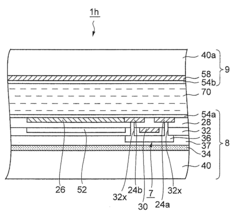
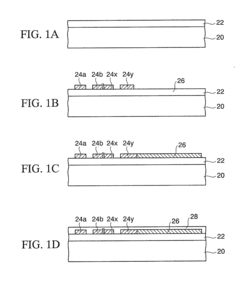
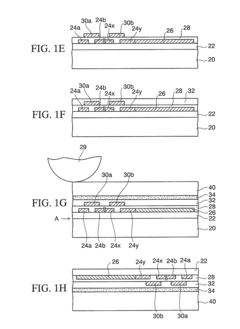
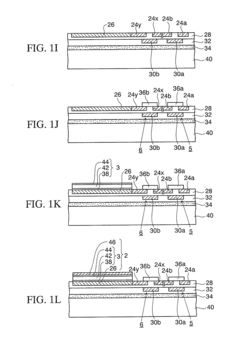
- A method involving the formation of a transfer layer on a heat-resistant substrate with a peelable layer, which is then transferred and inverted onto a plastic film with an adhesive layer, allowing for the formation of organic TFTs and EL layers using mask vapor deposition and ink jet methods, avoiding direct photolithography on the plastic film.
Supply Chain Considerations
The supply chain for flexible microdisplay materials represents a complex ecosystem that significantly impacts product development, manufacturing costs, and market availability. Current supply chains for these specialized materials are characterized by limited supplier diversity, with only a handful of companies globally capable of producing high-quality flexible substrates, transparent conductive films, and specialized encapsulation materials. This concentration creates potential bottlenecks and increases vulnerability to disruptions, as evidenced during recent global semiconductor shortages that affected the entire electronics industry.
Material sourcing presents particular challenges for flexible microdisplay manufacturers. Rare earth elements and specialized polymers essential for these displays often originate from geopolitically sensitive regions, introducing supply uncertainty and price volatility. For instance, indium, a critical component in transparent conductive oxides, faces potential supply constraints due to its limited global production and growing demand across multiple industries.
Manufacturing process integration across the supply chain requires careful coordination between material suppliers, component manufacturers, and system integrators. The specialized nature of flexible display materials often necessitates customized handling procedures and equipment, creating additional complexity in establishing efficient supply networks. Lead times for specialized materials can extend to several months, requiring manufacturers to implement sophisticated inventory management strategies to maintain production continuity.
Sustainability considerations are increasingly influencing supply chain decisions in this sector. The environmental impact of material extraction, processing, and end-of-life disposal presents both challenges and opportunities. Forward-thinking companies are developing closed-loop systems for recovering valuable materials from discarded displays, though these initiatives remain in early stages of implementation.
Regional manufacturing capabilities vary significantly, with East Asia—particularly Japan, South Korea, and Taiwan—dominating production of many critical components. This geographic concentration introduces logistical challenges and potential trade-related risks for global manufacturers. Recent efforts to diversify supply chains have led to emerging production capabilities in North America and Europe, though achieving cost parity with established manufacturing centers remains challenging.
Cost structures throughout the supply chain significantly impact the commercial viability of flexible microdisplay products. Material costs typically represent 40-60% of total production expenses, with specialized substrates and barrier films commanding premium prices due to their technical specifications and limited supplier base. Economies of scale remain difficult to achieve for many specialized materials, creating barriers to cost reduction and wider market adoption of flexible display technologies.
Material sourcing presents particular challenges for flexible microdisplay manufacturers. Rare earth elements and specialized polymers essential for these displays often originate from geopolitically sensitive regions, introducing supply uncertainty and price volatility. For instance, indium, a critical component in transparent conductive oxides, faces potential supply constraints due to its limited global production and growing demand across multiple industries.
Manufacturing process integration across the supply chain requires careful coordination between material suppliers, component manufacturers, and system integrators. The specialized nature of flexible display materials often necessitates customized handling procedures and equipment, creating additional complexity in establishing efficient supply networks. Lead times for specialized materials can extend to several months, requiring manufacturers to implement sophisticated inventory management strategies to maintain production continuity.
Sustainability considerations are increasingly influencing supply chain decisions in this sector. The environmental impact of material extraction, processing, and end-of-life disposal presents both challenges and opportunities. Forward-thinking companies are developing closed-loop systems for recovering valuable materials from discarded displays, though these initiatives remain in early stages of implementation.
Regional manufacturing capabilities vary significantly, with East Asia—particularly Japan, South Korea, and Taiwan—dominating production of many critical components. This geographic concentration introduces logistical challenges and potential trade-related risks for global manufacturers. Recent efforts to diversify supply chains have led to emerging production capabilities in North America and Europe, though achieving cost parity with established manufacturing centers remains challenging.
Cost structures throughout the supply chain significantly impact the commercial viability of flexible microdisplay products. Material costs typically represent 40-60% of total production expenses, with specialized substrates and barrier films commanding premium prices due to their technical specifications and limited supplier base. Economies of scale remain difficult to achieve for many specialized materials, creating barriers to cost reduction and wider market adoption of flexible display technologies.
Environmental Impact Assessment
The environmental impact of flexible microdisplay materials represents a critical consideration in the electronics industry's sustainability efforts. Current manufacturing processes for these advanced materials often involve hazardous chemicals, including solvents, etchants, and heavy metals that pose significant environmental risks when improperly managed. Production of flexible OLED and e-paper displays typically requires substantial energy consumption, contributing to carbon emissions and resource depletion across the supply chain.
Lifecycle assessment studies indicate that flexible display technologies present both challenges and opportunities compared to traditional rigid displays. While their production may initially require specialized materials with higher environmental footprints, their reduced weight and volume can decrease transportation-related emissions. Additionally, their potential for extended product lifespans through enhanced durability could offset initial production impacts over time.
Waste management concerns are particularly pronounced with these emerging materials. The composite nature of flexible displays—often combining organic semiconductors, thin-film transistors, and specialized barrier layers—creates complex end-of-life scenarios. Current recycling infrastructure is largely inadequate for processing these multi-material components, resulting in significant portions entering landfills or requiring energy-intensive specialized processing.
Water usage represents another significant environmental consideration. Manufacturing processes for flexible microdisplays typically require ultra-pure water for cleaning and processing steps, with production facilities consuming millions of gallons annually. Wastewater from these processes often contains trace amounts of specialized chemicals that require advanced treatment before release.
Recent regulatory developments worldwide are increasingly targeting electronic waste and manufacturing emissions. The European Union's Restriction of Hazardous Substances (RoHS) and Registration, Evaluation, Authorization and Restriction of Chemicals (REACH) regulations have direct implications for flexible display materials, while similar frameworks are emerging in North America and Asia. Manufacturers must navigate these evolving requirements while maintaining performance specifications.
Several industry leaders have initiated sustainability programs specifically addressing flexible display environmental impacts. These include closed-loop water recycling systems, energy-efficient manufacturing facilities, and research into biodegradable substrate materials. Promising innovations include water-based processing techniques that reduce solvent usage and bio-derived polymers that maintain performance while reducing petroleum dependence.
The path toward truly sustainable flexible microdisplays will require holistic approaches combining material science innovations, manufacturing process improvements, and comprehensive end-of-life management strategies. Collaborative industry initiatives focusing on standardized environmental impact metrics will be essential for meaningful progress in this rapidly evolving technological domain.
Lifecycle assessment studies indicate that flexible display technologies present both challenges and opportunities compared to traditional rigid displays. While their production may initially require specialized materials with higher environmental footprints, their reduced weight and volume can decrease transportation-related emissions. Additionally, their potential for extended product lifespans through enhanced durability could offset initial production impacts over time.
Waste management concerns are particularly pronounced with these emerging materials. The composite nature of flexible displays—often combining organic semiconductors, thin-film transistors, and specialized barrier layers—creates complex end-of-life scenarios. Current recycling infrastructure is largely inadequate for processing these multi-material components, resulting in significant portions entering landfills or requiring energy-intensive specialized processing.
Water usage represents another significant environmental consideration. Manufacturing processes for flexible microdisplays typically require ultra-pure water for cleaning and processing steps, with production facilities consuming millions of gallons annually. Wastewater from these processes often contains trace amounts of specialized chemicals that require advanced treatment before release.
Recent regulatory developments worldwide are increasingly targeting electronic waste and manufacturing emissions. The European Union's Restriction of Hazardous Substances (RoHS) and Registration, Evaluation, Authorization and Restriction of Chemicals (REACH) regulations have direct implications for flexible display materials, while similar frameworks are emerging in North America and Asia. Manufacturers must navigate these evolving requirements while maintaining performance specifications.
Several industry leaders have initiated sustainability programs specifically addressing flexible display environmental impacts. These include closed-loop water recycling systems, energy-efficient manufacturing facilities, and research into biodegradable substrate materials. Promising innovations include water-based processing techniques that reduce solvent usage and bio-derived polymers that maintain performance while reducing petroleum dependence.
The path toward truly sustainable flexible microdisplays will require holistic approaches combining material science innovations, manufacturing process improvements, and comprehensive end-of-life management strategies. Collaborative industry initiatives focusing on standardized environmental impact metrics will be essential for meaningful progress in this rapidly evolving technological domain.
Unlock deeper insights with PatSnap Eureka Quick Research — get a full tech report to explore trends and direct your research. Try now!
Generate Your Research Report Instantly with AI Agent
Supercharge your innovation with PatSnap Eureka AI Agent Platform!