

Flexible Microdisplay Technologies and Their Regulatory Challenges
OCT 21, 20259 MIN READ
Generate Your Research Report Instantly with AI Agent
PatSnap Eureka helps you evaluate technical feasibility & market potential.
Flexible Microdisplay Evolution and Objectives
Flexible microdisplay technology has evolved significantly over the past two decades, transitioning from rigid display structures to increasingly flexible and adaptable visual interfaces. The journey began in the early 2000s with the development of organic light-emitting diode (OLED) technology, which provided the foundation for flexible display capabilities. By 2010, research institutions and technology companies had demonstrated the first prototypes of bendable displays, though these early versions suffered from limited durability and resolution constraints.
The period between 2010 and 2015 marked a critical transition phase, with significant breakthroughs in materials science enabling more robust flexible substrates and encapsulation techniques. Polyimide films replaced traditional glass substrates, while advanced thin-film transistor (TFT) technologies were adapted for non-rigid applications. These developments allowed for displays that could be bent without compromising electronic performance or visual quality.
From 2015 to 2020, the industry witnessed accelerated commercialization efforts, with major display manufacturers introducing the first consumer products featuring flexible microdisplays. These included curved smartphones, rollable television prototypes, and early wearable display devices. During this period, pixel densities increased dramatically, reaching over 1000 pixels per inch in some laboratory demonstrations, while maintaining flexibility characteristics.
The current technological landscape (2020-2023) has expanded to include stretchable displays, self-healing materials, and ultra-thin form factors below 10 micrometers. These advances have enabled new application domains in medical implants, advanced augmented reality systems, and conformable displays that can adapt to irregular surfaces.
The primary objectives driving flexible microdisplay development include achieving full mechanical flexibility while maintaining high resolution and color performance comparable to rigid displays. Researchers aim to develop displays capable of withstanding over 200,000 folding cycles without degradation, while simultaneously reducing power consumption to enable integration into energy-constrained wearable devices.
Another critical objective is the seamless integration of flexible displays with other flexible electronic components, creating truly conformable systems rather than isolated display elements. This includes developing compatible flexible batteries, sensors, and processing units that can function cohesively within bendable form factors.
Looking forward, the industry is targeting zero-radius folding capabilities, transparency on demand, biodegradable display materials, and adaptive form factors that can change shape based on user requirements or environmental conditions. These ambitious goals represent the next frontier in flexible microdisplay technology, potentially revolutionizing how visual information is presented across healthcare, consumer electronics, and industrial applications.
The period between 2010 and 2015 marked a critical transition phase, with significant breakthroughs in materials science enabling more robust flexible substrates and encapsulation techniques. Polyimide films replaced traditional glass substrates, while advanced thin-film transistor (TFT) technologies were adapted for non-rigid applications. These developments allowed for displays that could be bent without compromising electronic performance or visual quality.
From 2015 to 2020, the industry witnessed accelerated commercialization efforts, with major display manufacturers introducing the first consumer products featuring flexible microdisplays. These included curved smartphones, rollable television prototypes, and early wearable display devices. During this period, pixel densities increased dramatically, reaching over 1000 pixels per inch in some laboratory demonstrations, while maintaining flexibility characteristics.
The current technological landscape (2020-2023) has expanded to include stretchable displays, self-healing materials, and ultra-thin form factors below 10 micrometers. These advances have enabled new application domains in medical implants, advanced augmented reality systems, and conformable displays that can adapt to irregular surfaces.
The primary objectives driving flexible microdisplay development include achieving full mechanical flexibility while maintaining high resolution and color performance comparable to rigid displays. Researchers aim to develop displays capable of withstanding over 200,000 folding cycles without degradation, while simultaneously reducing power consumption to enable integration into energy-constrained wearable devices.
Another critical objective is the seamless integration of flexible displays with other flexible electronic components, creating truly conformable systems rather than isolated display elements. This includes developing compatible flexible batteries, sensors, and processing units that can function cohesively within bendable form factors.
Looking forward, the industry is targeting zero-radius folding capabilities, transparency on demand, biodegradable display materials, and adaptive form factors that can change shape based on user requirements or environmental conditions. These ambitious goals represent the next frontier in flexible microdisplay technology, potentially revolutionizing how visual information is presented across healthcare, consumer electronics, and industrial applications.
Market Demand Analysis for Flexible Display Solutions
The flexible display market has witnessed substantial growth in recent years, driven by increasing consumer demand for portable, durable, and innovative electronic devices. Market research indicates that the global flexible display market is projected to reach $42 billion by 2027, with a compound annual growth rate exceeding 28% from 2022 to 2027. This remarkable growth trajectory is primarily fueled by the expanding applications across multiple industries including consumer electronics, automotive, healthcare, and military sectors.
Consumer electronics remains the dominant application segment, accounting for approximately 65% of the total market share. Within this segment, smartphones and wearable devices are the primary drivers, with major manufacturers increasingly incorporating flexible display technologies into their flagship products. The wearable technology market, particularly smartwatches and fitness trackers, has shown exceptional demand for flexible microdisplays, as these technologies enable more comfortable, lightweight, and aesthetically appealing designs.
The automotive industry represents another significant growth area for flexible display solutions. Modern vehicles are increasingly equipped with curved displays for dashboards, entertainment systems, and heads-up displays. Market analysis suggests that the automotive flexible display segment is growing at 32% annually, outpacing the overall market growth rate. This trend is expected to accelerate with the rising production of electric and autonomous vehicles, which typically feature more advanced display technologies.
Healthcare applications for flexible displays are emerging as a promising market segment, particularly for portable diagnostic equipment, patient monitoring devices, and medical wearables. The healthcare segment is projected to grow at 35% annually through 2027, representing the fastest-growing vertical market for flexible display technologies. The demand is driven by the need for lightweight, conformable displays that can be integrated into medical devices that interface directly with the human body.
Regional analysis reveals that Asia-Pacific dominates the flexible display market, accounting for approximately 58% of global production and consumption. This regional dominance is attributed to the presence of major display manufacturers and electronics companies in countries like South Korea, Japan, China, and Taiwan. North America and Europe follow with 22% and 15% market shares respectively, with particular strength in research and development of next-generation display technologies.
Consumer surveys indicate that flexibility, durability, and energy efficiency are the three most valued attributes in flexible display products. Approximately 78% of smartphone users express interest in devices with flexible or foldable displays, though current adoption is limited by higher price points. As manufacturing processes mature and economies of scale improve, analysts expect a significant reduction in production costs, which will likely accelerate market penetration across all consumer segments.
Consumer electronics remains the dominant application segment, accounting for approximately 65% of the total market share. Within this segment, smartphones and wearable devices are the primary drivers, with major manufacturers increasingly incorporating flexible display technologies into their flagship products. The wearable technology market, particularly smartwatches and fitness trackers, has shown exceptional demand for flexible microdisplays, as these technologies enable more comfortable, lightweight, and aesthetically appealing designs.
The automotive industry represents another significant growth area for flexible display solutions. Modern vehicles are increasingly equipped with curved displays for dashboards, entertainment systems, and heads-up displays. Market analysis suggests that the automotive flexible display segment is growing at 32% annually, outpacing the overall market growth rate. This trend is expected to accelerate with the rising production of electric and autonomous vehicles, which typically feature more advanced display technologies.
Healthcare applications for flexible displays are emerging as a promising market segment, particularly for portable diagnostic equipment, patient monitoring devices, and medical wearables. The healthcare segment is projected to grow at 35% annually through 2027, representing the fastest-growing vertical market for flexible display technologies. The demand is driven by the need for lightweight, conformable displays that can be integrated into medical devices that interface directly with the human body.
Regional analysis reveals that Asia-Pacific dominates the flexible display market, accounting for approximately 58% of global production and consumption. This regional dominance is attributed to the presence of major display manufacturers and electronics companies in countries like South Korea, Japan, China, and Taiwan. North America and Europe follow with 22% and 15% market shares respectively, with particular strength in research and development of next-generation display technologies.
Consumer surveys indicate that flexibility, durability, and energy efficiency are the three most valued attributes in flexible display products. Approximately 78% of smartphone users express interest in devices with flexible or foldable displays, though current adoption is limited by higher price points. As manufacturing processes mature and economies of scale improve, analysts expect a significant reduction in production costs, which will likely accelerate market penetration across all consumer segments.
Technical Barriers and Global Development Status
Flexible microdisplay technologies face significant technical barriers that have hindered their widespread adoption. The miniaturization of display components while maintaining flexibility presents complex engineering challenges. Current flexible displays struggle to achieve the pixel density and resolution comparable to rigid displays, particularly at sizes below one inch diagonal. This resolution limitation directly impacts image quality and application potential in sectors requiring high-precision visualization.
Material science constraints represent another major barrier. The development of substrate materials that combine flexibility, durability, and optical clarity remains challenging. Most flexible substrates exhibit degradation after repeated bending cycles, with performance declining significantly after 100,000-200,000 flexes. Temperature sensitivity also poses problems, as many flexible display materials experience performance variations across normal operating temperature ranges.
Power efficiency presents a persistent challenge, with flexible displays typically consuming 30-40% more power than their rigid counterparts. This increased consumption stems from additional circuitry required to maintain signal integrity across flexible connections and compensate for physical stress-induced performance variations.
Globally, development status varies significantly by region. East Asia leads in flexible microdisplay research and production, with South Korea and Japan holding approximately 65% of relevant patents. Samsung Display and LG Display have established commercial production capabilities for flexible OLED microdisplays, while Japan's JOLED focuses on printed flexible displays for specialized applications.
North American development is primarily driven by research institutions and specialized companies. The United States maintains strong positions in fundamental materials research through university-industry partnerships, though commercial production remains limited. Companies like Royole and Kopin have demonstrated promising prototypes but face scaling challenges.
European efforts center around research consortia, with particular strength in flexible e-paper technologies. The FlexEnable project in the UK and the Holst Centre in the Netherlands represent significant collaborative initiatives advancing flexible display technologies, focusing on low-power applications and novel form factors.
Regulatory frameworks governing flexible microdisplays vary substantially across regions, creating additional barriers to global deployment. Asian markets generally maintain more streamlined approval processes for display technologies, while European regulations impose stricter requirements regarding material composition, particularly concerning potentially hazardous substances in flexible substrates. North American regulations focus primarily on electromagnetic emissions and power consumption standards, creating a fragmented global compliance landscape that increases development costs and time-to-market.
Material science constraints represent another major barrier. The development of substrate materials that combine flexibility, durability, and optical clarity remains challenging. Most flexible substrates exhibit degradation after repeated bending cycles, with performance declining significantly after 100,000-200,000 flexes. Temperature sensitivity also poses problems, as many flexible display materials experience performance variations across normal operating temperature ranges.
Power efficiency presents a persistent challenge, with flexible displays typically consuming 30-40% more power than their rigid counterparts. This increased consumption stems from additional circuitry required to maintain signal integrity across flexible connections and compensate for physical stress-induced performance variations.
Globally, development status varies significantly by region. East Asia leads in flexible microdisplay research and production, with South Korea and Japan holding approximately 65% of relevant patents. Samsung Display and LG Display have established commercial production capabilities for flexible OLED microdisplays, while Japan's JOLED focuses on printed flexible displays for specialized applications.
North American development is primarily driven by research institutions and specialized companies. The United States maintains strong positions in fundamental materials research through university-industry partnerships, though commercial production remains limited. Companies like Royole and Kopin have demonstrated promising prototypes but face scaling challenges.
European efforts center around research consortia, with particular strength in flexible e-paper technologies. The FlexEnable project in the UK and the Holst Centre in the Netherlands represent significant collaborative initiatives advancing flexible display technologies, focusing on low-power applications and novel form factors.
Regulatory frameworks governing flexible microdisplays vary substantially across regions, creating additional barriers to global deployment. Asian markets generally maintain more streamlined approval processes for display technologies, while European regulations impose stricter requirements regarding material composition, particularly concerning potentially hazardous substances in flexible substrates. North American regulations focus primarily on electromagnetic emissions and power consumption standards, creating a fragmented global compliance landscape that increases development costs and time-to-market.
Current Technical Solutions for Flexibility Challenges
01 Flexible display substrates and materials
Flexible microdisplays utilize specialized substrate materials that can bend without compromising display functionality. These substrates often incorporate polymers or thin films that maintain electronic properties while allowing physical flexibility. Advanced manufacturing techniques ensure proper adhesion between layers and maintain pixel integrity during bending. These materials enable displays to be integrated into curved surfaces or foldable devices while preserving image quality and durability.- Flexible display substrate technologies: Flexible microdisplay technologies often utilize specialized substrate materials that can bend without compromising display functionality. These substrates typically incorporate polymer-based materials or ultra-thin glass that maintains electrical connectivity while allowing for physical flexibility. Advanced manufacturing techniques ensure that the pixel structures and circuitry remain intact during bending or folding operations, enabling displays that can conform to curved surfaces or be rolled up when not in use.
- OLED-based flexible microdisplay systems: Organic Light Emitting Diode (OLED) technology is particularly suitable for flexible microdisplays due to its self-emissive nature and thin-film structure. These displays eliminate the need for rigid backlighting components, allowing for ultra-thin and bendable display configurations. The organic semiconductor materials used can be deposited on flexible substrates through various techniques including vapor deposition or solution processing, creating displays with high contrast ratios, wide viewing angles, and excellent flexibility characteristics.
- Thin-film transistor architectures for flexible displays: Advanced thin-film transistor (TFT) architectures are essential for flexible microdisplay operation. These specialized transistor designs use materials and structures that maintain electrical performance while accommodating physical deformation. Low-temperature polysilicon (LTPS), oxide semiconductors, or organic semiconductors are commonly employed to create TFT backplanes that can withstand repeated bending cycles. The transistor layouts are optimized to distribute mechanical stress and prevent performance degradation when the display is flexed.
- Optical systems for flexible microdisplays: Specialized optical systems are developed for flexible microdisplay applications to maintain image quality during bending. These systems include flexible light guides, specialized diffusers, and adaptive optics that compensate for changes in display geometry. Micro-lens arrays and optical films are designed to maintain consistent light distribution across the curved display surface, ensuring uniform brightness and color reproduction regardless of the display's physical configuration.
- Driving and control systems for flexible displays: Specialized driving and control systems are required for flexible microdisplays to accommodate changing pixel geometries during bending. These systems incorporate adaptive algorithms that compensate for distortion and maintain image integrity across curved surfaces. The electronic drivers use flexible printed circuits or direct integration onto the display substrate to maintain reliable electrical connections during flexing. Power management systems are optimized to operate efficiently despite the mechanical stresses inherent in flexible display operation.
02 OLED technology for flexible displays
Organic Light Emitting Diode (OLED) technology is particularly suitable for flexible microdisplays due to its self-emissive properties and thin-film structure. OLED displays eliminate the need for rigid backlighting systems, allowing for ultra-thin and bendable display configurations. The technology enables higher contrast ratios, better color reproduction, and wider viewing angles compared to conventional displays, while maintaining flexibility for various form factors and applications.Expand Specific Solutions03 Backplane technologies for flexible displays
Advanced backplane technologies are essential for flexible microdisplays, with thin-film transistor (TFT) arrays that can withstand bending stress. These backplanes often use amorphous silicon, low-temperature polysilicon, or metal oxide semiconductors that maintain electrical performance during flexing. The design includes specialized interconnects and buffer layers that accommodate mechanical strain while preserving signal integrity across the display, ensuring consistent pixel addressing in various bent configurations.Expand Specific Solutions04 Driving and control systems for flexible displays
Specialized driving and control systems are developed for flexible microdisplays to accommodate changing geometries during bending. These systems include compensation algorithms that adjust pixel addressing based on the display's current shape, ensuring image consistency regardless of curvature. The control electronics often feature flexible printed circuits or stretchable interconnects that maintain reliable connections during flexing, with power management systems optimized for varying display configurations.Expand Specific Solutions05 Optical components for flexible displays
Flexible microdisplays incorporate specialized optical components that maintain visual performance during bending. These include flexible light management films, adaptable polarizers, and deformable optical layers that preserve viewing angles and brightness uniformity when curved. Some designs feature micro-lens arrays or diffractive elements that compensate for optical distortions caused by bending, ensuring consistent image quality across the entire display surface regardless of its shape.Expand Specific Solutions
Industry Leaders and Competitive Landscape
The flexible microdisplay technology market is currently in a growth phase, with increasing demand driven by applications in wearables, AR/VR, and foldable devices. Market size is projected to expand significantly as major players like Samsung Display, LG Display, BOE Technology, and TCL China Star Optoelectronics intensify their R&D efforts. Technologically, the field is advancing rapidly but remains in mid-maturity, with companies like Sharp, Sony, and Intel contributing to innovations in OLED, microLED, and flexible substrate technologies. Regulatory challenges persist around safety standards, electromagnetic emissions, and environmental compliance, creating barriers to market entry while established players leverage their scale to navigate these complexities.
BOE Technology Group Co., Ltd.
Technical Solution: BOE has developed a flexible display technology platform based on low-temperature polysilicon (LTPS) backplanes and flexible OLED frontplanes. Their approach utilizes ultra-thin glass substrates (UTG) with thickness below 30 micrometers, combined with proprietary laser release techniques to separate displays from carrier glass during manufacturing. BOE's flexible displays incorporate a specialized neutral plane design that positions the TFT layer precisely to minimize mechanical stress during bending. For moisture protection, they've implemented advanced thin-film encapsulation using atomic layer deposition (ALD) that creates nanometer-scale barrier layers. BOE has addressed regulatory challenges through a comprehensive materials compliance program that documents the composition of all display components, with particular attention to novel adhesives and barrier materials used in flexible configurations, ensuring compliance with RoHS, REACH, and other international standards.
Strengths: Rapidly expanding production capacity for flexible displays; strong vertical integration from materials to finished displays; competitive pricing strategy. Weaknesses: Less mature technology platform compared to Korean competitors; challenges with yield consistency in mass production; limited track record with ultra-durable flexible products for specialized applications.
Samsung Electronics Co., Ltd.
Technical Solution: Samsung has pioneered flexible AMOLED technology through their "Flex" display series, utilizing low-temperature polycrystalline silicon (LTPS) backplanes combined with organic light-emitting diodes. Their approach involves ultra-thin film encapsulation (TFE) technology that creates multiple inorganic and organic layers to protect the sensitive OLED materials while maintaining flexibility. Samsung's manufacturing process employs a neutral plane concept where the active display components are positioned at the mechanical neutral plane to minimize strain during bending. They've developed specialized barrier films that prevent oxygen and moisture penetration while maintaining optical clarity and flexibility. For regulatory compliance, Samsung has implemented comprehensive materials testing protocols to address concerns about potentially hazardous substances in flexible displays, particularly focusing on the novel adhesives and encapsulation materials required for durability.
Strengths: Industry-leading production capacity for flexible displays; proprietary encapsulation technology providing superior moisture barrier properties; established supply chain for specialized materials. Weaknesses: Higher manufacturing costs compared to conventional displays; limited bendability radius in current commercial products; challenges with color shift at extreme viewing angles in flexible configurations.
Key Patents and Innovations in Flexible Display Materials
Method for manufacturing a flexible display device
PatentActiveUS9131587B2
Innovation
- A method involving the formation of an adhesion layer with a rough surface at the juncture of the releasing layer and the carrier substrate, using metal oxides like indium tin oxide or organic materials with a concave-convex pattern, to enhance adhesion between the carrier and flexible substrates, thereby preventing holiday defects during the fabrication of flexible display devices.


Flexible display device
PatentWO2016052884A1
Innovation
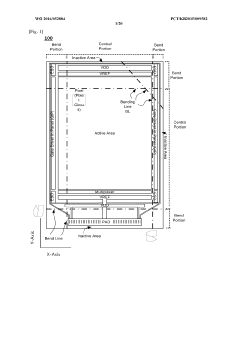
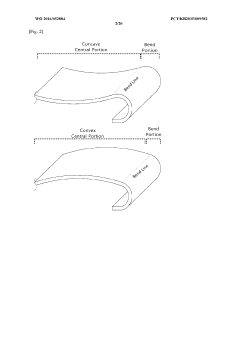
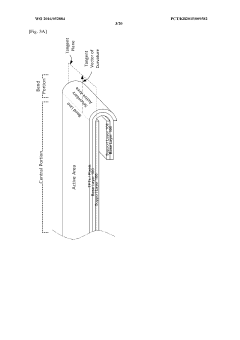
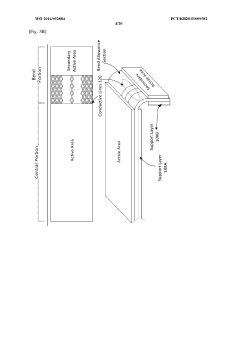
- A flexible display configuration with wire traces designed to withstand bending stress, featuring a base layer with a bend portion, encapsulation, and micro cover layers, along with support films and adhesive layers to minimize inactive area visibility and enhance flexibility.
Regulatory Framework and Compliance Requirements
The regulatory landscape for flexible microdisplay technologies spans multiple jurisdictions and encompasses various compliance frameworks that manufacturers must navigate. In the United States, the Federal Communications Commission (FCC) regulates electronic devices that emit electromagnetic radiation, requiring certification before market entry. Similarly, the European Union enforces the CE marking system under directives such as the Radio Equipment Directive (RED) and Electromagnetic Compatibility Directive (EMC), which flexible display technologies must satisfy to access the European market.
Safety standards represent another critical regulatory dimension, with organizations like Underwriters Laboratories (UL) in the US and the International Electrotechnical Commission (IEC) globally establishing benchmarks for electrical safety, flammability, and mechanical integrity. Flexible displays, due to their novel form factors and materials, often require specialized testing protocols that traditional display certification processes may not adequately address.
Environmental regulations significantly impact flexible microdisplay development and commercialization. The EU's Restriction of Hazardous Substances (RoHS) directive limits the use of certain hazardous materials in electronic equipment, while the Waste Electrical and Electronic Equipment (WEEE) directive mandates recycling requirements. These regulations present particular challenges for flexible display technologies that may incorporate novel materials with limited environmental impact data.
Medical device regulations constitute an additional layer of complexity for flexible displays intended for healthcare applications. The FDA in the US requires premarket approval for medical devices, while the EU's Medical Device Regulation (MDR) imposes strict requirements for clinical evaluation and post-market surveillance. Flexible displays integrated into wearable health monitors or diagnostic equipment must satisfy these stringent regulatory frameworks.
Intellectual property protection represents a crucial consideration in the flexible display ecosystem. Patent landscapes are increasingly complex, with cross-licensing agreements becoming common among major industry players. Regulatory bodies like the US Patent and Trademark Office and the European Patent Office play vital roles in adjudicating IP disputes that can significantly impact technology commercialization timelines.
Emerging regulatory challenges include privacy concerns related to data collection through wearable displays, sustainability requirements for novel materials, and evolving standards for human-machine interfaces. Regulatory harmonization efforts across major markets remain incomplete, creating compliance burdens for manufacturers seeking global distribution of flexible microdisplay products.
Safety standards represent another critical regulatory dimension, with organizations like Underwriters Laboratories (UL) in the US and the International Electrotechnical Commission (IEC) globally establishing benchmarks for electrical safety, flammability, and mechanical integrity. Flexible displays, due to their novel form factors and materials, often require specialized testing protocols that traditional display certification processes may not adequately address.
Environmental regulations significantly impact flexible microdisplay development and commercialization. The EU's Restriction of Hazardous Substances (RoHS) directive limits the use of certain hazardous materials in electronic equipment, while the Waste Electrical and Electronic Equipment (WEEE) directive mandates recycling requirements. These regulations present particular challenges for flexible display technologies that may incorporate novel materials with limited environmental impact data.
Medical device regulations constitute an additional layer of complexity for flexible displays intended for healthcare applications. The FDA in the US requires premarket approval for medical devices, while the EU's Medical Device Regulation (MDR) imposes strict requirements for clinical evaluation and post-market surveillance. Flexible displays integrated into wearable health monitors or diagnostic equipment must satisfy these stringent regulatory frameworks.
Intellectual property protection represents a crucial consideration in the flexible display ecosystem. Patent landscapes are increasingly complex, with cross-licensing agreements becoming common among major industry players. Regulatory bodies like the US Patent and Trademark Office and the European Patent Office play vital roles in adjudicating IP disputes that can significantly impact technology commercialization timelines.
Emerging regulatory challenges include privacy concerns related to data collection through wearable displays, sustainability requirements for novel materials, and evolving standards for human-machine interfaces. Regulatory harmonization efforts across major markets remain incomplete, creating compliance burdens for manufacturers seeking global distribution of flexible microdisplay products.
Environmental Impact and Sustainability Considerations
The development of flexible microdisplay technologies presents significant environmental challenges that must be addressed to ensure sustainable industry growth. These displays typically incorporate rare earth elements, heavy metals, and specialized polymers that pose extraction and disposal concerns. The manufacturing processes for flexible displays often require substantial energy consumption and chemical treatments, resulting in considerable carbon footprints and potential toxic emissions if not properly managed.
Production waste management represents a critical environmental challenge, as flexible display manufacturing generates specialized chemical byproducts that require advanced treatment protocols. Current industry practices show varying levels of commitment to waste reduction and recycling initiatives, with leading manufacturers implementing closed-loop systems that recover valuable materials while minimizing environmental discharge.
End-of-life considerations for flexible microdisplays present unique challenges due to their composite material nature. Unlike traditional rigid displays, the integration of organic materials, thin-film transistors, and flexible substrates complicates recycling processes. The industry currently lacks standardized disassembly and material recovery protocols specifically designed for these advanced display technologies, resulting in potential resource loss and environmental contamination.
Several manufacturers have begun implementing eco-design principles, focusing on reducing hazardous substance content and improving material separability. These approaches align with emerging regulatory frameworks such as extended producer responsibility (EPR) programs being adopted in the European Union, Japan, and South Korea. Such initiatives place greater responsibility on manufacturers for the entire lifecycle of their products, including collection and recycling.
Energy efficiency during operation represents a positive environmental aspect of flexible microdisplay technologies. Their typically lower power requirements compared to conventional displays contribute to reduced energy consumption in end-use applications. This advantage becomes particularly significant in wearable and portable devices where battery life extension translates to fewer charging cycles and potentially extended product lifespans.
Looking forward, the industry faces mounting pressure to develop more sustainable manufacturing processes and material selections. Biobased polymers, water-based processing techniques, and design-for-disassembly approaches are emerging as promising pathways toward improved environmental performance. Regulatory bodies worldwide are increasingly incorporating sustainability metrics into approval processes for new display technologies, signaling a shift toward more comprehensive environmental assessment frameworks.
Production waste management represents a critical environmental challenge, as flexible display manufacturing generates specialized chemical byproducts that require advanced treatment protocols. Current industry practices show varying levels of commitment to waste reduction and recycling initiatives, with leading manufacturers implementing closed-loop systems that recover valuable materials while minimizing environmental discharge.
End-of-life considerations for flexible microdisplays present unique challenges due to their composite material nature. Unlike traditional rigid displays, the integration of organic materials, thin-film transistors, and flexible substrates complicates recycling processes. The industry currently lacks standardized disassembly and material recovery protocols specifically designed for these advanced display technologies, resulting in potential resource loss and environmental contamination.
Several manufacturers have begun implementing eco-design principles, focusing on reducing hazardous substance content and improving material separability. These approaches align with emerging regulatory frameworks such as extended producer responsibility (EPR) programs being adopted in the European Union, Japan, and South Korea. Such initiatives place greater responsibility on manufacturers for the entire lifecycle of their products, including collection and recycling.
Energy efficiency during operation represents a positive environmental aspect of flexible microdisplay technologies. Their typically lower power requirements compared to conventional displays contribute to reduced energy consumption in end-use applications. This advantage becomes particularly significant in wearable and portable devices where battery life extension translates to fewer charging cycles and potentially extended product lifespans.
Looking forward, the industry faces mounting pressure to develop more sustainable manufacturing processes and material selections. Biobased polymers, water-based processing techniques, and design-for-disassembly approaches are emerging as promising pathways toward improved environmental performance. Regulatory bodies worldwide are increasingly incorporating sustainability metrics into approval processes for new display technologies, signaling a shift toward more comprehensive environmental assessment frameworks.
Unlock deeper insights with PatSnap Eureka Quick Research — get a full tech report to explore trends and direct your research. Try now!
Generate Your Research Report Instantly with AI Agent
Supercharge your innovation with PatSnap Eureka AI Agent Platform!