
How Spin Qubits in Silicon Affect Quantum Circuit Design
OCT 10, 20259 MIN READ
Generate Your Research Report Instantly with AI Agent
Patsnap Eureka helps you evaluate technical feasibility & market potential.
Silicon Spin Qubit Evolution and Objectives
Silicon spin qubits have evolved significantly since their theoretical conception in the late 1990s, when Bruce Kane proposed using nuclear spins of phosphorus donors in silicon as quantum bits. This groundbreaking proposal leveraged silicon's established manufacturing infrastructure while promising exceptional coherence times due to silicon's weak spin-orbit coupling and the possibility of isotopic purification to remove nuclear spins.
The early 2000s marked the first experimental demonstrations of single-electron spin control in silicon quantum dots, though these early implementations faced significant challenges in fabrication precision and qubit manipulation. By 2010-2015, researchers achieved important milestones including single-shot readout of electron spins and the first demonstrations of two-qubit gates in silicon, establishing the fundamental building blocks for silicon-based quantum computing.
Recent years (2016-2023) have witnessed remarkable progress in silicon spin qubit technology. Coherence times have improved from microseconds to milliseconds and even seconds in isotopically purified silicon-28. Gate fidelities have surpassed the threshold for quantum error correction in single-qubit operations, while two-qubit gate fidelities continue to improve steadily. Fabrication techniques have advanced to enable arrays of multiple qubits with increasingly precise control.
The current technological trajectory aims to address several critical objectives. First, scaling beyond current small qubit arrays (typically <10 qubits) to medium-scale systems of 50-100 qubits while maintaining high coherence and control fidelity. Second, improving two-qubit gate fidelities to match the impressive performance of single-qubit operations, which remains a significant challenge for quantum circuit design.
Another key objective involves developing integrated control electronics that can operate at cryogenic temperatures, reducing the complexity of external wiring that currently limits scalability. Researchers are also focused on standardizing fabrication processes to improve yield and reproducibility, essential for commercial viability.
The long-term vision for silicon spin qubits includes their integration with conventional CMOS technology, potentially enabling hybrid classical-quantum systems on a single chip. This integration represents a unique advantage of silicon-based approaches compared to other quantum computing platforms.
As the field progresses, researchers aim to demonstrate quantum advantage in specific applications, particularly in quantum simulation of materials and chemical processes, where the natural physics of spin qubits may offer advantages. The ultimate objective remains building fault-tolerant quantum computers with millions of physical qubits, though this goal likely remains a decade or more in the future.
The early 2000s marked the first experimental demonstrations of single-electron spin control in silicon quantum dots, though these early implementations faced significant challenges in fabrication precision and qubit manipulation. By 2010-2015, researchers achieved important milestones including single-shot readout of electron spins and the first demonstrations of two-qubit gates in silicon, establishing the fundamental building blocks for silicon-based quantum computing.
Recent years (2016-2023) have witnessed remarkable progress in silicon spin qubit technology. Coherence times have improved from microseconds to milliseconds and even seconds in isotopically purified silicon-28. Gate fidelities have surpassed the threshold for quantum error correction in single-qubit operations, while two-qubit gate fidelities continue to improve steadily. Fabrication techniques have advanced to enable arrays of multiple qubits with increasingly precise control.
The current technological trajectory aims to address several critical objectives. First, scaling beyond current small qubit arrays (typically <10 qubits) to medium-scale systems of 50-100 qubits while maintaining high coherence and control fidelity. Second, improving two-qubit gate fidelities to match the impressive performance of single-qubit operations, which remains a significant challenge for quantum circuit design.
Another key objective involves developing integrated control electronics that can operate at cryogenic temperatures, reducing the complexity of external wiring that currently limits scalability. Researchers are also focused on standardizing fabrication processes to improve yield and reproducibility, essential for commercial viability.
The long-term vision for silicon spin qubits includes their integration with conventional CMOS technology, potentially enabling hybrid classical-quantum systems on a single chip. This integration represents a unique advantage of silicon-based approaches compared to other quantum computing platforms.
As the field progresses, researchers aim to demonstrate quantum advantage in specific applications, particularly in quantum simulation of materials and chemical processes, where the natural physics of spin qubits may offer advantages. The ultimate objective remains building fault-tolerant quantum computers with millions of physical qubits, though this goal likely remains a decade or more in the future.
Quantum Computing Market Analysis
The quantum computing market is experiencing unprecedented growth, driven by significant advancements in qubit technologies, particularly silicon-based spin qubits. Current market valuations place the global quantum computing sector at approximately $866 million in 2023, with projections indicating a compound annual growth rate (CAGR) of 38.3% through 2030, potentially reaching $7.6 billion by decade's end.
Silicon spin qubits represent a particularly promising segment within this market, attracting substantial investment due to their compatibility with existing semiconductor manufacturing infrastructure. This compatibility offers a critical advantage in scalability and potential cost reduction compared to competing qubit technologies such as superconducting qubits or trapped ions.
Market demand for quantum computing solutions is primarily concentrated in sectors requiring complex computational capabilities, including pharmaceuticals, materials science, financial services, and cryptography. The pharmaceutical industry alone is estimated to account for 23% of current quantum computing applications, with financial modeling representing another 18% of market demand.
Geographically, North America dominates the quantum computing market with approximately 42% market share, followed by Europe (28%) and Asia-Pacific (24%). However, the Asia-Pacific region is demonstrating the fastest growth rate at 41.2% CAGR, largely driven by substantial government investments in China, Japan, and South Korea specifically targeting silicon-based quantum technologies.
Corporate investment in silicon spin qubit research has increased by 156% since 2020, with major semiconductor companies redirecting significant R&D resources toward quantum circuit design optimization. This trend reflects growing recognition that silicon spin qubits may offer the most viable path to commercially practical quantum computers.
The market for quantum circuit design tools specifically optimized for silicon spin qubits is emerging as a distinct subsegment, currently valued at approximately $112 million and expected to grow at 45% annually through 2028. This specialized tooling market addresses the unique challenges of designing circuits that can effectively manage the coherence properties and coupling mechanisms specific to spin qubits in silicon.
Consumer-facing quantum computing services, primarily delivered through cloud platforms, represent the fastest-growing market segment at 52% annual growth, with silicon-based quantum processors increasingly featured in these offerings due to their operational stability and longer coherence times compared to alternative technologies.
Silicon spin qubits represent a particularly promising segment within this market, attracting substantial investment due to their compatibility with existing semiconductor manufacturing infrastructure. This compatibility offers a critical advantage in scalability and potential cost reduction compared to competing qubit technologies such as superconducting qubits or trapped ions.
Market demand for quantum computing solutions is primarily concentrated in sectors requiring complex computational capabilities, including pharmaceuticals, materials science, financial services, and cryptography. The pharmaceutical industry alone is estimated to account for 23% of current quantum computing applications, with financial modeling representing another 18% of market demand.
Geographically, North America dominates the quantum computing market with approximately 42% market share, followed by Europe (28%) and Asia-Pacific (24%). However, the Asia-Pacific region is demonstrating the fastest growth rate at 41.2% CAGR, largely driven by substantial government investments in China, Japan, and South Korea specifically targeting silicon-based quantum technologies.
Corporate investment in silicon spin qubit research has increased by 156% since 2020, with major semiconductor companies redirecting significant R&D resources toward quantum circuit design optimization. This trend reflects growing recognition that silicon spin qubits may offer the most viable path to commercially practical quantum computers.
The market for quantum circuit design tools specifically optimized for silicon spin qubits is emerging as a distinct subsegment, currently valued at approximately $112 million and expected to grow at 45% annually through 2028. This specialized tooling market addresses the unique challenges of designing circuits that can effectively manage the coherence properties and coupling mechanisms specific to spin qubits in silicon.
Consumer-facing quantum computing services, primarily delivered through cloud platforms, represent the fastest-growing market segment at 52% annual growth, with silicon-based quantum processors increasingly featured in these offerings due to their operational stability and longer coherence times compared to alternative technologies.
Silicon Spin Qubit Challenges and Limitations
Despite the promising attributes of silicon spin qubits for quantum computing, several significant challenges and limitations impede their widespread implementation in quantum circuit design. One of the primary obstacles is the coherence time constraint. While silicon provides a relatively clean environment for qubits compared to other materials, decoherence still occurs due to interactions with nuclear spins, charge noise, and phonons in the silicon lattice. These interactions limit the operational window for quantum gates and increase error rates in quantum circuits.
Qubit control precision represents another substantial challenge. The manipulation of spin qubits requires precise magnetic or electric field control at the nanoscale level. Current technologies struggle to achieve the necessary precision for reliable qubit operations, particularly when scaling to multiple qubits. This imprecision directly impacts gate fidelity and ultimately constrains the complexity of implementable quantum circuits.
Variability between qubits poses a significant manufacturing challenge. The fabrication process for silicon spin qubits often results in variations in qubit properties, requiring individual calibration and characterization. This variability complicates the design of standardized quantum circuits and increases the complexity of control systems needed to manage these differences.
The coupling strength between adjacent spin qubits remains relatively weak compared to other quantum computing platforms. This weakness necessitates qubits to be positioned in extremely close proximity for effective two-qubit gates, creating layout constraints for circuit designers and limiting the connectivity options in quantum circuit architectures.
Temperature dependency presents operational challenges as silicon spin qubits typically require extremely low temperatures (below 100 mK) to function properly. This requirement imposes significant constraints on the supporting infrastructure and increases system complexity, affecting the overall quantum circuit design and integration with classical control electronics.
Readout fidelity limitations affect measurement accuracy. Current readout mechanisms for silicon spin qubits have not yet achieved the high fidelity necessary for complex quantum algorithms, introducing additional error sources that must be accounted for in circuit design through error correction or mitigation techniques.
Scaling challenges persist despite silicon's compatibility with existing semiconductor manufacturing. As the number of qubits increases, issues related to wiring, cross-talk, and control signal distribution become increasingly problematic, requiring novel approaches to quantum circuit layout and control architecture that differ significantly from classical integrated circuit design methodologies.
Qubit control precision represents another substantial challenge. The manipulation of spin qubits requires precise magnetic or electric field control at the nanoscale level. Current technologies struggle to achieve the necessary precision for reliable qubit operations, particularly when scaling to multiple qubits. This imprecision directly impacts gate fidelity and ultimately constrains the complexity of implementable quantum circuits.
Variability between qubits poses a significant manufacturing challenge. The fabrication process for silicon spin qubits often results in variations in qubit properties, requiring individual calibration and characterization. This variability complicates the design of standardized quantum circuits and increases the complexity of control systems needed to manage these differences.
The coupling strength between adjacent spin qubits remains relatively weak compared to other quantum computing platforms. This weakness necessitates qubits to be positioned in extremely close proximity for effective two-qubit gates, creating layout constraints for circuit designers and limiting the connectivity options in quantum circuit architectures.
Temperature dependency presents operational challenges as silicon spin qubits typically require extremely low temperatures (below 100 mK) to function properly. This requirement imposes significant constraints on the supporting infrastructure and increases system complexity, affecting the overall quantum circuit design and integration with classical control electronics.
Readout fidelity limitations affect measurement accuracy. Current readout mechanisms for silicon spin qubits have not yet achieved the high fidelity necessary for complex quantum algorithms, introducing additional error sources that must be accounted for in circuit design through error correction or mitigation techniques.
Scaling challenges persist despite silicon's compatibility with existing semiconductor manufacturing. As the number of qubits increases, issues related to wiring, cross-talk, and control signal distribution become increasingly problematic, requiring novel approaches to quantum circuit layout and control architecture that differ significantly from classical integrated circuit design methodologies.
Current Silicon-Based Quantum Circuit Architectures
01 Silicon-based spin qubit architectures
Silicon provides an excellent platform for implementing spin qubits due to its compatibility with existing semiconductor manufacturing processes. Various architectures have been developed for silicon-based spin qubits, including quantum dots, donor atoms, and hybrid systems. These architectures leverage the electron or nuclear spin states in silicon to encode quantum information, offering long coherence times and scalability potential for quantum circuit design.- Silicon-based spin qubit architectures: Silicon-based spin qubits offer advantages for quantum computing due to their compatibility with existing semiconductor manufacturing processes. These architectures utilize electron or nuclear spins in silicon as quantum bits, providing long coherence times and scalability potential. Various designs include quantum dots, donor atoms, and hybrid systems that can be integrated into quantum circuit designs for information processing and quantum operations.
- Quantum gate operations and control mechanisms: Effective control mechanisms for spin qubits in silicon involve precise manipulation of quantum gates to perform operations. These include techniques for single and two-qubit gates, pulse sequences for spin manipulation, and methods to reduce decoherence effects. Advanced control systems enable high-fidelity quantum operations through electrical, magnetic, or microwave control signals that can be integrated into silicon-based quantum circuit designs.
- Readout and measurement techniques: Accurate readout and measurement of spin qubit states is crucial for quantum computation. Various techniques have been developed including spin-to-charge conversion, dispersive readout, and gate-based sensing. These methods enable high-fidelity state detection while minimizing measurement-induced decoherence, which is essential for error correction and quantum algorithm implementation in silicon quantum circuits.
- Scalable quantum processor design: Scaling up silicon spin qubit systems requires innovative circuit designs that address interconnect challenges, control line routing, and integration with classical electronics. Approaches include modular architectures, quantum buses for long-distance entanglement, and multiplexed control systems. These designs aim to maintain qubit performance while enabling the fabrication of processors with increasing numbers of qubits for practical quantum computing applications.
- Error correction and noise mitigation: Addressing errors and noise in silicon spin qubit systems is essential for reliable quantum computation. Techniques include dynamical decoupling sequences, materials engineering to reduce noise sources, and implementation of quantum error correction codes. Circuit designs incorporate specialized components for error detection and correction, enabling fault-tolerant operation even in the presence of environmental disturbances and control imperfections.
02 Quantum gate operations and control mechanisms
Effective control of spin qubits in silicon requires precise manipulation of individual spins. This includes techniques for initializing qubit states, implementing single and two-qubit gates, and reading out qubit states. Advanced control mechanisms utilize microwave pulses, magnetic field gradients, and electric field modulation to achieve high-fidelity quantum operations while minimizing decoherence effects.Expand Specific Solutions03 Scalable quantum circuit integration
Scaling up silicon quantum circuits requires innovative approaches to integrate multiple qubits while maintaining coherence and control. This includes the development of multi-qubit arrays, interconnect technologies, and control electronics that can operate at cryogenic temperatures. Architectural solutions address challenges related to qubit addressing, crosstalk mitigation, and efficient signal routing to enable larger-scale quantum processors.Expand Specific Solutions04 Error correction and noise mitigation
Maintaining quantum information integrity in silicon spin qubit systems requires sophisticated error correction techniques. These include dynamical decoupling sequences, composite pulse sequences, and quantum error correction codes specifically adapted for spin qubits. Advanced noise characterization and mitigation strategies address issues arising from charge noise, nuclear spin bath fluctuations, and other decoherence mechanisms inherent to the silicon environment.Expand Specific Solutions05 Hybrid quantum-classical computing systems
Integration of silicon spin qubits with classical electronics enables practical quantum computing applications. These hybrid systems combine the quantum processing capabilities of spin qubits with classical control and readout circuitry. Approaches include cryogenic CMOS integration, quantum-classical interfaces, and co-designed algorithms that efficiently partition computational tasks between quantum and classical resources to solve practical problems.Expand Specific Solutions
Leading Quantum Computing Companies and Research Groups
Silicon spin qubits are emerging as a promising quantum computing platform, with the market currently in an early growth phase characterized by significant research momentum but limited commercial deployment. The global quantum computing market, valued at approximately $500 million, is expected to grow exponentially as silicon-based approaches mature. Companies like IBM, Intel, and specialized players such as Silicon Quantum Computing and Quantum Motion Technologies are advancing the technology's maturity through significant R&D investments. Academic-industry partnerships involving MIT, University of Copenhagen, and UNSW are accelerating progress in addressing key challenges of qubit coherence, scalability, and integration with conventional semiconductor manufacturing processes, positioning silicon spin qubits as a potentially dominant architecture for practical quantum circuit implementation.
Origin Quantum Computing Technology (Hefei) Co., Ltd.
Technical Solution: Origin Quantum has developed a comprehensive approach to silicon spin qubit circuit design that addresses both fundamental physics challenges and practical implementation concerns. Their technology utilizes electron spins in silicon quantum dots, with a focus on isotopically purified silicon substrates to minimize decoherence from nuclear spins[1]. Origin's circuit architecture incorporates specialized gate structures that enable high-fidelity single and two-qubit operations while maintaining compatibility with semiconductor manufacturing processes. Their design includes innovative charge sensing mechanisms for qubit readout and initialization, utilizing radio-frequency reflectometry techniques for improved signal-to-noise ratios. Origin Quantum has pioneered pulse sequence optimization methods specifically tailored for silicon spin qubits, which directly impacts circuit design by reducing control complexity while maintaining operation fidelity[2]. Their quantum circuits feature integrated microwave resonators for qubit control and readout, designed to minimize crosstalk between adjacent qubits. The company has also developed specialized error correction schemes that account for the unique error channels in silicon spin qubit systems, influencing both the physical layout and control architecture of their quantum processors[3]. Origin's approach includes careful consideration of thermal management in circuit design, addressing the challenges of operating quantum processors at millikelvin temperatures.
Strengths: Strong integration of hardware and software development; focus on practical implementation challenges; balanced approach to performance and manufacturability. Weaknesses: Less public demonstration of large-scale systems compared to some competitors; challenges in achieving uniform qubit properties across wafers; requires sophisticated cryogenic infrastructure.
Massachusetts Institute of Technology
Technical Solution: MIT has pioneered fundamental research in silicon spin qubit technology that has profoundly influenced quantum circuit design approaches. Their work focuses on understanding and mitigating decoherence mechanisms in silicon environments, which has led to novel circuit architectures that preserve quantum information more effectively[1]. MIT researchers have developed specialized gate structures for spin qubit manipulation that minimize charge noise while enabling precise control of quantum states. Their circuit designs incorporate innovative readout mechanisms using dispersive gate sensing, which reduces the footprint of measurement apparatus and improves scalability. MIT has made significant contributions to understanding the impact of materials interfaces on qubit performance, leading to circuit designs that strategically position qubits away from sources of noise and defects[2]. Their research has demonstrated the importance of isotopic purification in silicon substrates, showing quantitative improvements in coherence times that directly influence circuit design parameters. MIT has also pioneered the development of two-qubit gates for silicon spin qubits using exchange coupling mechanisms, establishing fundamental design principles for creating entangling operations in silicon quantum processors[3]. Their work includes comprehensive modeling of the electromagnetic environment in quantum circuits, leading to improved control line geometries and filtering strategies that preserve quantum coherence while allowing for fast qubit manipulation.
Strengths: Cutting-edge fundamental research that addresses core physics challenges; innovative approaches to qubit control and readout; strong focus on understanding and mitigating decoherence mechanisms. Weaknesses: Less focus on commercial implementation compared to industry players; research prototypes may require significant engineering development for practical deployment; some approaches may prioritize performance over manufacturability.
Key Patents and Breakthroughs in Spin Qubit Technology
BACK GRID FOR QUANTUM DEVICE
PatentActiveFR3131086A1
Innovation
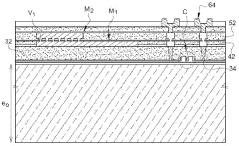
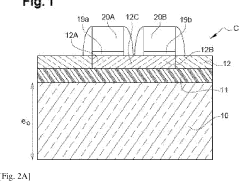
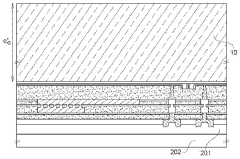
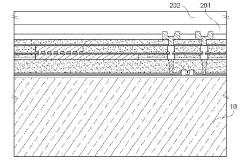
- A quantum device with a rear electrostatic control grid formed by a conductive layer lining the side walls and bottom of an opening in a semiconductor support layer, extending to an insulating layer, which maintains mechanical strength and reduces stress, using a semiconductor-on-insulator substrate with a conductive layer deposited through the opening.
Quantum Error Correction Strategies
Quantum Error Correction (QEC) strategies are essential for mitigating the inherent fragility of spin qubits in silicon quantum circuits. The unique properties of silicon spin qubits—including their long coherence times but susceptibility to environmental noise—necessitate specialized error correction approaches. Traditional QEC codes such as surface codes and Steane codes have been adapted specifically for silicon-based quantum architectures, with modifications addressing the particular decoherence mechanisms affecting spin qubits.
The surface code implementation in silicon spin qubit systems has shown promising results due to its high error threshold and relatively simple nearest-neighbor interactions. However, the physical layout constraints imposed by silicon fabrication technologies require careful consideration when mapping these codes onto actual devices. Recent advancements have demonstrated modified surface codes that account for the limited connectivity often present in silicon quantum dot arrays.
Dynamical decoupling sequences represent another critical QEC strategy for silicon spin qubits. These techniques, including Carr-Purcell-Meiboom-Gill (CPMG) and Uhrig dynamical decoupling (UDD), effectively combat the dominant noise sources in silicon environments, particularly those arising from nuclear spin baths and charge fluctuations. Research indicates that customized decoupling sequences designed specifically for silicon's noise spectrum can extend coherence times by orders of magnitude.
Hardware-efficient QEC codes have emerged as particularly valuable for near-term silicon quantum processors. These codes minimize resource requirements while providing meaningful error protection, making them suitable for the current generation of devices with limited qubit counts. The development of specialized microcode operations that leverage silicon's native gate operations has further enhanced the efficiency of error correction implementations.
Leakage errors—where quantum information escapes the computational subspace—present unique challenges in silicon spin qubit systems. Advanced leakage reduction units (LRUs) have been developed to address this issue, with recent designs incorporating silicon-specific considerations such as valley and orbital state leakage pathways. These LRUs have demonstrated significant improvements in maintaining computational integrity during extended quantum circuit operations.
Looking forward, hybrid QEC approaches combining hardware and software strategies show particular promise for silicon platforms. These methods integrate physical error suppression techniques with algorithmic error correction, creating a multi-layered defense against decoherence. As silicon quantum processors scale up, the development of fault-tolerant protocols specifically optimized for spin qubit characteristics will be crucial for achieving the error rates required for practical quantum computing applications.
The surface code implementation in silicon spin qubit systems has shown promising results due to its high error threshold and relatively simple nearest-neighbor interactions. However, the physical layout constraints imposed by silicon fabrication technologies require careful consideration when mapping these codes onto actual devices. Recent advancements have demonstrated modified surface codes that account for the limited connectivity often present in silicon quantum dot arrays.
Dynamical decoupling sequences represent another critical QEC strategy for silicon spin qubits. These techniques, including Carr-Purcell-Meiboom-Gill (CPMG) and Uhrig dynamical decoupling (UDD), effectively combat the dominant noise sources in silicon environments, particularly those arising from nuclear spin baths and charge fluctuations. Research indicates that customized decoupling sequences designed specifically for silicon's noise spectrum can extend coherence times by orders of magnitude.
Hardware-efficient QEC codes have emerged as particularly valuable for near-term silicon quantum processors. These codes minimize resource requirements while providing meaningful error protection, making them suitable for the current generation of devices with limited qubit counts. The development of specialized microcode operations that leverage silicon's native gate operations has further enhanced the efficiency of error correction implementations.
Leakage errors—where quantum information escapes the computational subspace—present unique challenges in silicon spin qubit systems. Advanced leakage reduction units (LRUs) have been developed to address this issue, with recent designs incorporating silicon-specific considerations such as valley and orbital state leakage pathways. These LRUs have demonstrated significant improvements in maintaining computational integrity during extended quantum circuit operations.
Looking forward, hybrid QEC approaches combining hardware and software strategies show particular promise for silicon platforms. These methods integrate physical error suppression techniques with algorithmic error correction, creating a multi-layered defense against decoherence. As silicon quantum processors scale up, the development of fault-tolerant protocols specifically optimized for spin qubit characteristics will be crucial for achieving the error rates required for practical quantum computing applications.
Scalability and Integration Considerations
Scalability represents one of the most critical challenges in transitioning silicon spin qubit technology from laboratory demonstrations to practical quantum computing systems. The inherent atomic-scale nature of spin qubits offers significant advantages for large-scale integration compared to other quantum computing platforms. Silicon spin qubits typically occupy physical dimensions in the range of 10-100 nanometers, potentially enabling the integration of millions of qubits within a square centimeter of chip area - a density that superconducting qubits cannot match due to their millimeter-scale dimensions.
However, this theoretical density advantage faces substantial engineering hurdles. The wiring challenge presents a fundamental bottleneck, as each qubit requires multiple control lines for initialization, manipulation, and readout. Current approaches using conventional metal interconnects would create prohibitive routing congestion as qubit counts scale beyond hundreds. Advanced multiplexing schemes and crossbar architectures are being developed to address this constraint, potentially allowing n² qubits to be controlled with just 2n control lines.
Thermal management emerges as another critical consideration for silicon spin qubit integration. While operating at dilution refrigerator temperatures (below 100 mK), the heat dissipation from classical control electronics can disrupt qubit coherence. This necessitates careful partitioning of control functions between cryogenic and room-temperature electronics, with ongoing research into cryogenic CMOS circuits that can operate adjacent to the qubit layer.
The fabrication compatibility between spin qubits and conventional CMOS processes represents a significant integration advantage. Many leading semiconductor manufacturers, including Intel, Samsung, and TSMC, have initiated quantum computing research programs leveraging their existing silicon fabrication infrastructure. This compatibility potentially enables the co-integration of quantum processing elements with classical control electronics on the same die or package, reducing signal latency and improving system performance.
Architectural considerations for scalable spin qubit systems must address the limited range of qubit-qubit interactions. Unlike superconducting systems where long-range coupling is possible, spin qubits typically interact only with nearest neighbors. This constraint influences quantum circuit design, requiring careful qubit mapping and extensive SWAP operations that increase circuit depth and error rates. Quantum error correction schemes must be adapted to these architectural constraints, with surface codes and other topological approaches showing promise for silicon-based quantum processors.
However, this theoretical density advantage faces substantial engineering hurdles. The wiring challenge presents a fundamental bottleneck, as each qubit requires multiple control lines for initialization, manipulation, and readout. Current approaches using conventional metal interconnects would create prohibitive routing congestion as qubit counts scale beyond hundreds. Advanced multiplexing schemes and crossbar architectures are being developed to address this constraint, potentially allowing n² qubits to be controlled with just 2n control lines.
Thermal management emerges as another critical consideration for silicon spin qubit integration. While operating at dilution refrigerator temperatures (below 100 mK), the heat dissipation from classical control electronics can disrupt qubit coherence. This necessitates careful partitioning of control functions between cryogenic and room-temperature electronics, with ongoing research into cryogenic CMOS circuits that can operate adjacent to the qubit layer.
The fabrication compatibility between spin qubits and conventional CMOS processes represents a significant integration advantage. Many leading semiconductor manufacturers, including Intel, Samsung, and TSMC, have initiated quantum computing research programs leveraging their existing silicon fabrication infrastructure. This compatibility potentially enables the co-integration of quantum processing elements with classical control electronics on the same die or package, reducing signal latency and improving system performance.
Architectural considerations for scalable spin qubit systems must address the limited range of qubit-qubit interactions. Unlike superconducting systems where long-range coupling is possible, spin qubits typically interact only with nearest neighbors. This constraint influences quantum circuit design, requiring careful qubit mapping and extensive SWAP operations that increase circuit depth and error rates. Quantum error correction schemes must be adapted to these architectural constraints, with surface codes and other topological approaches showing promise for silicon-based quantum processors.
Unlock deeper insights with Patsnap Eureka Quick Research — get a full tech report to explore trends and direct your research. Try now!
Generate Your Research Report Instantly with AI Agent
Supercharge your innovation with Patsnap Eureka AI Agent Platform!