Regulatory Aspects of Spin Qubits in Silicon Systems
OCT 10, 202510 MIN READ
Generate Your Research Report Instantly with AI Agent
Patsnap Eureka helps you evaluate technical feasibility & market potential.
Spin Qubit Technology Background and Objectives
Spin qubits in silicon systems represent a promising platform for quantum computing due to their compatibility with existing semiconductor manufacturing infrastructure. The evolution of this technology can be traced back to the early 2000s when researchers first demonstrated the ability to isolate and manipulate single electron spins in silicon quantum dots. Since then, significant progress has been made in improving coherence times, gate fidelities, and scalability of these systems, positioning silicon spin qubits as a leading contender for practical quantum computing implementations.
The technological trajectory of spin qubits has been characterized by steady improvements in material purity, fabrication techniques, and control electronics. Early challenges included achieving sufficient isolation from environmental noise, developing reliable methods for qubit initialization and readout, and implementing high-fidelity quantum gates. Recent advancements have addressed many of these issues, with coherence times now reaching milliseconds and gate fidelities exceeding 99% in some experimental demonstrations.
The regulatory landscape surrounding spin qubit technology is evolving alongside technical developments. As quantum computing moves closer to practical applications, regulatory frameworks are beginning to emerge that address issues such as export controls on quantum technologies, standardization of performance metrics, and security implications for cryptographic systems. These regulatory considerations are becoming increasingly important as spin qubit technology matures and approaches commercial viability.
The primary technical objectives in the field include scaling up to systems with hundreds or thousands of qubits while maintaining high coherence and gate fidelities, developing efficient error correction protocols specifically tailored to silicon spin qubits, and integrating control electronics with qubit arrays to create complete quantum processing units. Additionally, there is significant focus on improving the reliability and reproducibility of fabrication processes to enable mass production of quantum devices.
From a regulatory perspective, key objectives include establishing clear guidelines for the development and deployment of quantum technologies, ensuring appropriate safeguards for sensitive applications, and fostering international cooperation on standards and protocols. There is also growing interest in addressing potential ethical implications of advanced quantum computing capabilities, particularly in areas such as cryptography and data security.
The convergence of technological advancement and regulatory development will shape the future trajectory of spin qubit technology. Success will require balancing innovation with responsible governance, ensuring that the potential benefits of quantum computing can be realized while managing associated risks. This balance will be particularly important as spin qubits in silicon systems move from research laboratories toward practical applications in industries ranging from pharmaceuticals to finance to national security.
The technological trajectory of spin qubits has been characterized by steady improvements in material purity, fabrication techniques, and control electronics. Early challenges included achieving sufficient isolation from environmental noise, developing reliable methods for qubit initialization and readout, and implementing high-fidelity quantum gates. Recent advancements have addressed many of these issues, with coherence times now reaching milliseconds and gate fidelities exceeding 99% in some experimental demonstrations.
The regulatory landscape surrounding spin qubit technology is evolving alongside technical developments. As quantum computing moves closer to practical applications, regulatory frameworks are beginning to emerge that address issues such as export controls on quantum technologies, standardization of performance metrics, and security implications for cryptographic systems. These regulatory considerations are becoming increasingly important as spin qubit technology matures and approaches commercial viability.
The primary technical objectives in the field include scaling up to systems with hundreds or thousands of qubits while maintaining high coherence and gate fidelities, developing efficient error correction protocols specifically tailored to silicon spin qubits, and integrating control electronics with qubit arrays to create complete quantum processing units. Additionally, there is significant focus on improving the reliability and reproducibility of fabrication processes to enable mass production of quantum devices.
From a regulatory perspective, key objectives include establishing clear guidelines for the development and deployment of quantum technologies, ensuring appropriate safeguards for sensitive applications, and fostering international cooperation on standards and protocols. There is also growing interest in addressing potential ethical implications of advanced quantum computing capabilities, particularly in areas such as cryptography and data security.
The convergence of technological advancement and regulatory development will shape the future trajectory of spin qubit technology. Success will require balancing innovation with responsible governance, ensuring that the potential benefits of quantum computing can be realized while managing associated risks. This balance will be particularly important as spin qubits in silicon systems move from research laboratories toward practical applications in industries ranging from pharmaceuticals to finance to national security.
Market Analysis for Silicon-Based Quantum Computing
The silicon-based quantum computing market is experiencing significant growth, driven by the potential of spin qubits to revolutionize computing capabilities. Current market projections indicate the global quantum computing market will reach approximately $1.7 billion by 2026, with silicon-based approaches capturing an increasing share due to their compatibility with existing semiconductor manufacturing infrastructure.
Silicon spin qubits represent a particularly promising segment within this market, offering advantages in scalability and integration with conventional electronics. Market research indicates that investments in silicon-based quantum technologies have grown at a compound annual rate of 30% over the past five years, reflecting strong industry confidence in this approach.
Demand for silicon-based quantum computing solutions is emerging across multiple sectors. Financial services organizations are exploring applications in portfolio optimization and risk assessment, while pharmaceutical companies are investigating drug discovery acceleration. The cybersecurity sector shows particular interest due to the potential impact on encryption standards, creating a specialized market segment estimated at $300 million annually.
Geographic distribution of market demand shows concentration in North America (38%), Europe (29%), and Asia-Pacific (27%), with emerging interest in other regions. Government investment patterns closely mirror this distribution, with national quantum initiatives providing substantial funding in these key regions.
Market adoption faces several barriers, including regulatory uncertainty regarding export controls on quantum technologies, data security standards, and intellectual property protection frameworks. The regulatory landscape remains fragmented, with different jurisdictions implementing varying approaches to quantum technology governance.
Industry analysis reveals a competitive landscape divided between established semiconductor giants leveraging their manufacturing expertise, specialized quantum computing startups focusing on silicon architectures, and research institutions commercializing academic breakthroughs. This diverse ecosystem is driving both collaboration and competition, accelerating market development.
Customer segments show varying adoption timelines, with research institutions and government agencies representing early adopters, followed by financial services and pharmaceuticals in the medium term. Mass market adoption remains distant, with a projected timeline of 8-10 years before widespread commercial deployment.
Market forecasts suggest silicon-based approaches may achieve quantum advantage in specific applications within 3-5 years, potentially creating early commercial opportunities worth $500 million annually before broader market penetration occurs.
Silicon spin qubits represent a particularly promising segment within this market, offering advantages in scalability and integration with conventional electronics. Market research indicates that investments in silicon-based quantum technologies have grown at a compound annual rate of 30% over the past five years, reflecting strong industry confidence in this approach.
Demand for silicon-based quantum computing solutions is emerging across multiple sectors. Financial services organizations are exploring applications in portfolio optimization and risk assessment, while pharmaceutical companies are investigating drug discovery acceleration. The cybersecurity sector shows particular interest due to the potential impact on encryption standards, creating a specialized market segment estimated at $300 million annually.
Geographic distribution of market demand shows concentration in North America (38%), Europe (29%), and Asia-Pacific (27%), with emerging interest in other regions. Government investment patterns closely mirror this distribution, with national quantum initiatives providing substantial funding in these key regions.
Market adoption faces several barriers, including regulatory uncertainty regarding export controls on quantum technologies, data security standards, and intellectual property protection frameworks. The regulatory landscape remains fragmented, with different jurisdictions implementing varying approaches to quantum technology governance.
Industry analysis reveals a competitive landscape divided between established semiconductor giants leveraging their manufacturing expertise, specialized quantum computing startups focusing on silicon architectures, and research institutions commercializing academic breakthroughs. This diverse ecosystem is driving both collaboration and competition, accelerating market development.
Customer segments show varying adoption timelines, with research institutions and government agencies representing early adopters, followed by financial services and pharmaceuticals in the medium term. Mass market adoption remains distant, with a projected timeline of 8-10 years before widespread commercial deployment.
Market forecasts suggest silicon-based approaches may achieve quantum advantage in specific applications within 3-5 years, potentially creating early commercial opportunities worth $500 million annually before broader market penetration occurs.
Current Challenges in Silicon Spin Qubit Development
Despite significant advancements in silicon spin qubit technology, several critical challenges continue to impede the full realization of quantum computing systems based on this platform. One of the most pressing issues is the coherence time limitation, with current silicon spin qubits typically maintaining quantum states for microseconds to milliseconds—insufficient for complex quantum algorithms requiring millions of operations. This limitation stems primarily from environmental noise, magnetic field fluctuations, and interactions with nuclear spins in the silicon lattice.
Fabrication consistency presents another substantial hurdle. The manufacturing of silicon spin qubits demands atomic-level precision, as even minor variations in dopant placement or oxide interface quality can dramatically alter qubit performance. Current semiconductor fabrication techniques struggle to achieve the required uniformity across multiple qubits, resulting in significant device-to-device variability that complicates scaling efforts.
Scalability remains perhaps the most formidable challenge. While individual or small arrays of spin qubits have been demonstrated successfully, scaling to hundreds or thousands of qubits—necessary for practical quantum computing applications—introduces complex engineering problems related to wiring, control electronics, and cross-talk between qubits. The dense integration of control lines becomes physically prohibitive as qubit counts increase.
Qubit coupling mechanisms also present significant technical difficulties. Creating reliable, controllable interactions between spin qubits while maintaining isolation from environmental noise requires sophisticated engineering solutions. Current approaches using exchange coupling or cavity-mediated interactions each have limitations in terms of operation fidelity, speed, or scalability.
Temperature dependence further complicates silicon spin qubit development. While these systems offer advantages over superconducting qubits by operating at higher temperatures (approximately 1K versus millikelvin), achieving reliable operation still requires complex cryogenic systems. The development of qubits capable of functioning at even higher temperatures would significantly reduce infrastructure requirements.
Control electronics integration represents another major challenge. The current paradigm of using room-temperature electronics connected to cryogenic qubits via attenuated lines introduces latency and heating issues. Developing cryogenic control electronics that can operate in close proximity to qubits without introducing noise or heating effects remains an active research area with significant technical barriers.
Finally, error correction implementation for silicon spin qubits lags behind theoretical requirements. While quantum error correction codes exist conceptually, their practical implementation in silicon systems faces challenges related to qubit connectivity, measurement fidelity, and the overhead of physical qubits required per logical qubit.
Fabrication consistency presents another substantial hurdle. The manufacturing of silicon spin qubits demands atomic-level precision, as even minor variations in dopant placement or oxide interface quality can dramatically alter qubit performance. Current semiconductor fabrication techniques struggle to achieve the required uniformity across multiple qubits, resulting in significant device-to-device variability that complicates scaling efforts.
Scalability remains perhaps the most formidable challenge. While individual or small arrays of spin qubits have been demonstrated successfully, scaling to hundreds or thousands of qubits—necessary for practical quantum computing applications—introduces complex engineering problems related to wiring, control electronics, and cross-talk between qubits. The dense integration of control lines becomes physically prohibitive as qubit counts increase.
Qubit coupling mechanisms also present significant technical difficulties. Creating reliable, controllable interactions between spin qubits while maintaining isolation from environmental noise requires sophisticated engineering solutions. Current approaches using exchange coupling or cavity-mediated interactions each have limitations in terms of operation fidelity, speed, or scalability.
Temperature dependence further complicates silicon spin qubit development. While these systems offer advantages over superconducting qubits by operating at higher temperatures (approximately 1K versus millikelvin), achieving reliable operation still requires complex cryogenic systems. The development of qubits capable of functioning at even higher temperatures would significantly reduce infrastructure requirements.
Control electronics integration represents another major challenge. The current paradigm of using room-temperature electronics connected to cryogenic qubits via attenuated lines introduces latency and heating issues. Developing cryogenic control electronics that can operate in close proximity to qubits without introducing noise or heating effects remains an active research area with significant technical barriers.
Finally, error correction implementation for silicon spin qubits lags behind theoretical requirements. While quantum error correction codes exist conceptually, their practical implementation in silicon systems faces challenges related to qubit connectivity, measurement fidelity, and the overhead of physical qubits required per logical qubit.
Current Spin Qubit Implementation Approaches
01 Silicon-based quantum dot spin qubits
Silicon quantum dots can be engineered to trap and manipulate electron spins as qubits. These systems offer long coherence times due to silicon's weak spin-orbit coupling and the possibility of isotopic purification to remove nuclear spins. The fabrication typically involves creating potential wells in silicon where individual electrons can be confined and controlled using gate electrodes. These quantum dot spin qubits form the building blocks for scalable quantum computing architectures in silicon.- Silicon-based quantum dot spin qubits: Silicon-based quantum dot systems provide a promising platform for implementing spin qubits. These systems confine electrons in quantum dots formed in silicon substrates, allowing for manipulation of electron spin states as quantum bits. The silicon environment offers advantages such as long coherence times due to low nuclear spin density and compatibility with existing semiconductor manufacturing processes. Various techniques for creating, controlling, and reading out these quantum dots enable the development of scalable quantum computing architectures.
- Multi-qubit systems and entanglement in silicon: Advanced silicon-based quantum computing systems implement multi-qubit architectures that enable quantum entanglement between spin qubits. These systems utilize various coupling mechanisms between neighboring qubits, including exchange interactions and long-range couplings. The ability to create and control entangled states in silicon platforms is crucial for implementing quantum algorithms and error correction protocols. Techniques for scaling up from single qubits to multi-qubit arrays while maintaining coherence and control fidelity are essential for practical quantum computing applications.
- Control and readout mechanisms for silicon spin qubits: Various control and readout mechanisms have been developed for silicon spin qubits, including electrical gate control, microwave pulse sequences, and spin-to-charge conversion techniques. These mechanisms allow for precise manipulation of quantum states and reliable measurement of qubit states. Advanced control systems incorporate error mitigation techniques and dynamic decoupling protocols to extend coherence times. Single-shot readout capabilities with high fidelity are crucial for implementing quantum error correction and performing complex quantum algorithms on silicon-based quantum processors.
- Integration of silicon spin qubits with classical electronics: Integration of quantum and classical systems is essential for practical quantum computing architectures. Silicon spin qubits offer advantages for this integration due to their compatibility with CMOS technology. Hybrid quantum-classical systems incorporate control electronics, signal processing, and error correction circuits alongside quantum processing elements. These integrated systems address challenges in signal routing, thermal management, and electromagnetic isolation while enabling scalable quantum computing architectures that can interface with existing computing infrastructure.
- Fabrication techniques for silicon spin qubit devices: Advanced fabrication techniques for silicon spin qubit devices include precision lithography, ion implantation, and epitaxial growth methods. These techniques enable the creation of precisely positioned quantum dots with controlled coupling between neighboring sites. Manufacturing processes focus on reducing variability between qubits and minimizing defects that can cause decoherence. Isotopically purified silicon (Si-28) substrates are often used to reduce nuclear spin noise and improve coherence times. Scalable fabrication approaches compatible with industrial semiconductor manufacturing are being developed to enable large-scale quantum processors.
02 Multi-qubit operations and entanglement in silicon systems
Achieving controlled interactions between multiple spin qubits is essential for quantum computing. Silicon-based systems enable various coupling mechanisms between neighboring qubits, including exchange coupling and capacitive coupling. These interactions can be precisely controlled using gate voltages to implement two-qubit gates such as CNOT and SWAP operations. The ability to entangle multiple qubits while maintaining coherence is crucial for quantum error correction and scaling up silicon quantum processors.Expand Specific Solutions03 Readout and measurement techniques for silicon spin qubits
Various methods have been developed to read out the quantum state of spin qubits in silicon. These include spin-to-charge conversion techniques, dispersive gate sensing, and radio-frequency reflectometry. Single-shot readout with high fidelity is essential for quantum error correction and quantum information processing. Advanced measurement protocols can distinguish between different qubit states while minimizing measurement back-action and maintaining qubit coherence.Expand Specific Solutions04 Integration of silicon spin qubits with classical electronics
Integrating quantum and classical systems on the same chip is a significant advantage of silicon-based quantum computing platforms. This integration enables on-chip control electronics, reducing latency and improving scalability. CMOS-compatible fabrication processes allow for the manufacturing of both quantum devices and their control electronics using established semiconductor industry techniques. This approach facilitates the development of large-scale quantum processors with thousands of qubits operating at cryogenic temperatures.Expand Specific Solutions05 Error correction and fault tolerance in silicon quantum systems
Implementing quantum error correction is essential for building fault-tolerant quantum computers. Silicon spin qubit systems can be designed with specific architectures to support error correction codes such as surface codes or Steane codes. These approaches require the ability to perform high-fidelity gate operations and measurements across multiple qubits. Advanced control techniques and optimized qubit layouts help minimize errors and enable the implementation of logical qubits with enhanced coherence properties compared to physical qubits.Expand Specific Solutions
Key Industry Players in Spin Qubit Research
The regulatory landscape for silicon-based spin qubits is evolving rapidly as the technology transitions from early research to commercial development. Currently, the field is in an early growth phase, with significant academic-industrial partnerships forming the backbone of advancement. Companies like Intel, GlobalFoundries, and Quantum Motion Technologies are leading industrial efforts, while research institutions such as CEA, IMEC, and Delft University of Technology provide crucial scientific foundations. The market remains relatively small but is experiencing accelerated growth due to increasing government investments. Technologically, silicon spin qubits are approaching medium maturity, with Origin Quantum, Huawei, and C12 Quantum Electronics making notable progress in addressing coherence times and control fidelity challenges. Regulatory frameworks are still developing, with different approaches emerging across North America, Europe, and Asia.
Origin Quantum Computing Technology (Hefei) Co., Ltd.
Technical Solution: Origin Quantum has developed a comprehensive regulatory framework for silicon-based spin qubits that addresses both technical and compliance challenges. Their approach includes a multi-layered verification system for quantum gate operations in silicon systems, ensuring compliance with international quantum computing standards while maintaining high fidelity qubit operations. The company has implemented specialized protocols for managing electromagnetic interference in silicon spin qubit systems, which is crucial for meeting regulatory requirements in sensitive research environments. Their silicon spin qubit architecture incorporates built-in error correction mechanisms that align with emerging quantum computing safety standards, allowing for scalable quantum systems that can pass regulatory scrutiny[1]. Origin Quantum also maintains active participation in international quantum computing standardization efforts, helping shape the regulatory landscape for silicon spin qubits.
Strengths: Strong integration with China's quantum computing ecosystem and regulatory framework; comprehensive approach to compliance verification. Weaknesses: Potential challenges with international regulatory alignment outside of China; relatively newer entrant compared to some academic institutions with longer research histories in spin qubits.
Commissariat à l´énergie atomique et aux énergies Alternatives
Technical Solution: CEA has pioneered a regulatory-compliant silicon spin qubit platform that integrates with existing semiconductor manufacturing standards. Their approach focuses on CMOS-compatible spin qubit architectures that can be manufactured in industrial facilities while meeting strict European regulatory requirements. CEA's silicon spin qubit systems incorporate specialized shielding and isolation techniques to minimize electromagnetic emissions, ensuring compliance with both scientific precision requirements and regulatory standards for electronic equipment. The organization has developed comprehensive characterization protocols for silicon spin qubits that align with European metrology standards, providing a pathway for certification of quantum computing components[2][3]. CEA actively collaborates with European regulatory bodies to establish frameworks for quantum technology certification, particularly for silicon-based quantum computing systems that interface with classical computing infrastructure. Their silicon spin qubit designs include features specifically addressing radiation hardness requirements for space and critical infrastructure applications.
Strengths: Deep integration with European regulatory frameworks; strong industrial partnerships for manufacturing compliance; extensive experience with semiconductor regulation. Weaknesses: Regulatory approach may be overly focused on European standards rather than global harmonization; complex bureaucratic processes may slow adaptation to emerging regulatory changes.
Critical Patents and Research in Silicon Spin Qubits
Spin qubit devices comprising qubit gates and self-aligned barrier gates
PatentPendingEP4531112A1
Innovation
- The implementation of self-aligned barrier gates interdigitated with spin qubit gates, using polysilicon or metal fill, which reduces alignment variations and improves manufacturing complexity, allowing for improved qubit gate alignment and reduced variation.
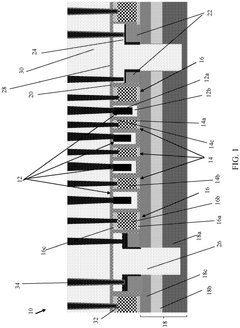
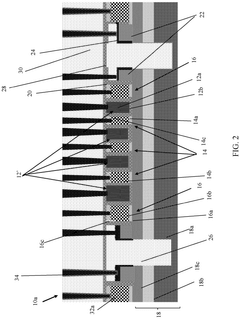
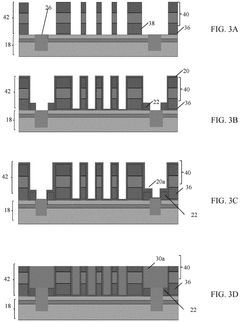
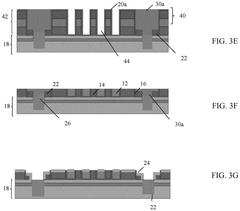
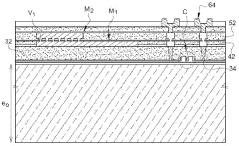
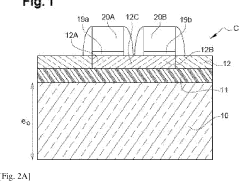
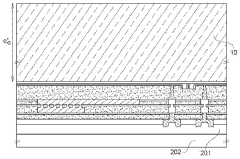
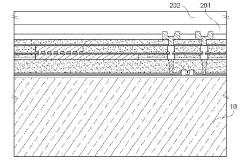
BACK GRID FOR QUANTUM DEVICE
PatentActiveFR3131086A1
Innovation
- A quantum device with a rear electrostatic control grid formed by a conductive layer lining the side walls and bottom of an opening in a semiconductor support layer, extending to an insulating layer, which maintains mechanical strength and reduces stress, using a semiconductor-on-insulator substrate with a conductive layer deposited through the opening.
Regulatory Framework for Quantum Computing Technologies
The regulatory landscape for quantum computing technologies, particularly for spin qubits in silicon systems, is still in its nascent stages but rapidly evolving. Current regulatory frameworks primarily focus on three key areas: export controls, intellectual property protection, and standardization efforts. These frameworks vary significantly across different jurisdictions, creating a complex global environment for researchers and companies working with silicon-based quantum technologies.
In the United States, quantum computing technologies including spin qubits are subject to the Export Administration Regulations (EAR) administered by the Bureau of Industry and Security. Silicon-based quantum computing systems exceeding certain performance thresholds may be classified as dual-use technologies, requiring export licenses when shipped to certain countries. The European Union has implemented similar controls through its Dual-Use Regulation (Regulation 2021/821), which was updated in 2021 to address emerging technologies including quantum computing.
Intellectual property protection for spin qubit technologies presents unique challenges due to the fundamental nature of quantum phenomena. Patent offices worldwide are developing specialized examination guidelines for quantum technologies. The European Patent Office has established a dedicated task force for quantum technology patents, while the USPTO has expanded its examination resources in this domain. China has also prioritized quantum technology patents in its national IP strategy.
Standardization efforts are being led by organizations such as the IEEE Quantum Initiative and the International Telecommunication Union's Focus Group on Quantum Information Technology for Networks. These groups are working to establish common terminology, performance metrics, and interoperability standards specifically relevant to silicon-based quantum systems. The National Institute of Standards and Technology (NIST) in the US has launched a Quantum Economic Development Consortium that includes working groups focused on regulatory considerations.
Data protection regulations also intersect with quantum computing development, as quantum technologies may eventually challenge current encryption standards. The EU's GDPR includes provisions for maintaining "state of the art" security measures, which may necessitate quantum-resistant cryptography as the technology matures. Similarly, healthcare regulations governing patient data security may require updates to address quantum computing capabilities.
Research funding regulations represent another important aspect of the regulatory framework. Government programs supporting quantum research often include compliance requirements related to technology transfer, foreign collaboration restrictions, and commercialization pathways. These regulations can significantly impact the development trajectory of spin qubit technologies in academic and industrial settings.
In the United States, quantum computing technologies including spin qubits are subject to the Export Administration Regulations (EAR) administered by the Bureau of Industry and Security. Silicon-based quantum computing systems exceeding certain performance thresholds may be classified as dual-use technologies, requiring export licenses when shipped to certain countries. The European Union has implemented similar controls through its Dual-Use Regulation (Regulation 2021/821), which was updated in 2021 to address emerging technologies including quantum computing.
Intellectual property protection for spin qubit technologies presents unique challenges due to the fundamental nature of quantum phenomena. Patent offices worldwide are developing specialized examination guidelines for quantum technologies. The European Patent Office has established a dedicated task force for quantum technology patents, while the USPTO has expanded its examination resources in this domain. China has also prioritized quantum technology patents in its national IP strategy.
Standardization efforts are being led by organizations such as the IEEE Quantum Initiative and the International Telecommunication Union's Focus Group on Quantum Information Technology for Networks. These groups are working to establish common terminology, performance metrics, and interoperability standards specifically relevant to silicon-based quantum systems. The National Institute of Standards and Technology (NIST) in the US has launched a Quantum Economic Development Consortium that includes working groups focused on regulatory considerations.
Data protection regulations also intersect with quantum computing development, as quantum technologies may eventually challenge current encryption standards. The EU's GDPR includes provisions for maintaining "state of the art" security measures, which may necessitate quantum-resistant cryptography as the technology matures. Similarly, healthcare regulations governing patient data security may require updates to address quantum computing capabilities.
Research funding regulations represent another important aspect of the regulatory framework. Government programs supporting quantum research often include compliance requirements related to technology transfer, foreign collaboration restrictions, and commercialization pathways. These regulations can significantly impact the development trajectory of spin qubit technologies in academic and industrial settings.
International Standards and Compliance for Quantum Systems
The quantum computing landscape is rapidly evolving, necessitating the development of comprehensive international standards and regulatory frameworks specifically for silicon-based spin qubit systems. Currently, the International Organization for Standardization (ISO) and the International Electrotechnical Commission (IEC) are collaborating through Joint Technical Committee 1 (JTC 1) to establish quantum computing standards, with Working Group 14 specifically focused on quantum technologies. These efforts aim to create a unified approach to quantum system certification and compliance.
In the United States, the National Institute of Standards and Technology (NIST) has initiated the Quantum Economic Development Consortium (QED-C) to facilitate standards development for quantum technologies, including silicon spin qubits. Similarly, the European Telecommunications Standards Institute (ETSI) has established a Quantum-Safe Cryptography working group addressing security implications of quantum computing technologies. These regional initiatives contribute significantly to the global standardization landscape.
Regulatory considerations for silicon spin qubits encompass several critical domains. Export control regulations, particularly the Wassenaar Arrangement and country-specific export administration regulations, impose restrictions on quantum technologies with potential dual-use applications. Silicon spin qubit systems, especially those exceeding certain performance thresholds, may fall under these controls, requiring appropriate licensing for international collaboration and commercialization.
Safety standards for quantum systems are emerging through IEEE P7130 (Standard for Quantum Computing Definitions) and IEEE P7131 (Standard for Quantum Computing Performance Metrics & Performance Benchmarking). These standards aim to establish consistent terminology and performance evaluation methodologies essential for regulatory compliance and market development. Additionally, electromagnetic compatibility (EMC) standards are particularly relevant for silicon spin qubit systems due to their sensitivity to electromagnetic interference.
Intellectual property protection presents unique challenges in the quantum domain. Patent offices worldwide are developing specialized examination guidelines for quantum technology patents, with the European Patent Office and the United States Patent and Trademark Office leading these efforts. Companies developing silicon spin qubit technologies must navigate this evolving IP landscape while ensuring compliance with standards-essential patents.
Looking forward, the quantum industry is moving toward self-regulation through industry consortia like the Quantum Industry Consortium (QuIC) in Europe and the Quantum Industry Coalition in North America. These organizations are developing best practices and voluntary standards that often precede formal regulatory requirements. Companies working with silicon spin qubits should actively participate in these consortia to influence emerging standards and ensure their technologies remain compliant with evolving regulatory frameworks.
In the United States, the National Institute of Standards and Technology (NIST) has initiated the Quantum Economic Development Consortium (QED-C) to facilitate standards development for quantum technologies, including silicon spin qubits. Similarly, the European Telecommunications Standards Institute (ETSI) has established a Quantum-Safe Cryptography working group addressing security implications of quantum computing technologies. These regional initiatives contribute significantly to the global standardization landscape.
Regulatory considerations for silicon spin qubits encompass several critical domains. Export control regulations, particularly the Wassenaar Arrangement and country-specific export administration regulations, impose restrictions on quantum technologies with potential dual-use applications. Silicon spin qubit systems, especially those exceeding certain performance thresholds, may fall under these controls, requiring appropriate licensing for international collaboration and commercialization.
Safety standards for quantum systems are emerging through IEEE P7130 (Standard for Quantum Computing Definitions) and IEEE P7131 (Standard for Quantum Computing Performance Metrics & Performance Benchmarking). These standards aim to establish consistent terminology and performance evaluation methodologies essential for regulatory compliance and market development. Additionally, electromagnetic compatibility (EMC) standards are particularly relevant for silicon spin qubit systems due to their sensitivity to electromagnetic interference.
Intellectual property protection presents unique challenges in the quantum domain. Patent offices worldwide are developing specialized examination guidelines for quantum technology patents, with the European Patent Office and the United States Patent and Trademark Office leading these efforts. Companies developing silicon spin qubit technologies must navigate this evolving IP landscape while ensuring compliance with standards-essential patents.
Looking forward, the quantum industry is moving toward self-regulation through industry consortia like the Quantum Industry Consortium (QuIC) in Europe and the Quantum Industry Coalition in North America. These organizations are developing best practices and voluntary standards that often precede formal regulatory requirements. Companies working with silicon spin qubits should actively participate in these consortia to influence emerging standards and ensure their technologies remain compliant with evolving regulatory frameworks.
Unlock deeper insights with Patsnap Eureka Quick Research — get a full tech report to explore trends and direct your research. Try now!
Generate Your Research Report Instantly with AI Agent
Supercharge your innovation with Patsnap Eureka AI Agent Platform!