
How Spin Qubits in Silicon Improve Quantum Algorithms
OCT 10, 20259 MIN READ
Generate Your Research Report Instantly with AI Agent
Patsnap Eureka helps you evaluate technical feasibility & market potential.
Silicon Spin Qubit Technology Background and Objectives
Quantum computing has evolved significantly since its theoretical conception in the 1980s, with silicon spin qubits emerging as a promising platform for quantum information processing. Silicon, the foundation of classical computing, has now become a focal point for quantum computing research due to its compatibility with existing semiconductor manufacturing infrastructure. The journey of silicon spin qubits began with the pioneering work of Kane in 1998, who proposed using nuclear spins of phosphorus donors in silicon as qubits. This was followed by Loss and DiVincenzo's proposal for electron spin qubits in quantum dots.
The evolution of silicon spin qubit technology has been marked by several significant milestones. In 2012, researchers achieved the first demonstration of single-shot readout of an electron spin in silicon. By 2014, high-fidelity single-qubit gates were demonstrated, and 2018 saw the implementation of two-qubit gates with reasonable fidelities. Recent advancements include improved coherence times exceeding milliseconds and enhanced gate fidelities approaching the threshold for fault-tolerant quantum computing.
The primary objective of silicon spin qubit technology is to leverage the inherent advantages of silicon as a host material for quantum bits while addressing the specific requirements of quantum algorithms. Silicon offers exceptionally long coherence times due to the availability of isotopically purified Si-28, which provides a "quiet" environment for qubits by eliminating nuclear spin noise. Additionally, the mature silicon manufacturing ecosystem presents a clear pathway to scalability—a critical factor for practical quantum computing.
Current technical goals include improving qubit fidelity beyond the fault-tolerance threshold (typically 99.9%), enhancing coherence times, developing reliable multi-qubit operations, and scaling up to systems with hundreds or thousands of qubits. These objectives are essential for implementing complex quantum algorithms that can demonstrate quantum advantage over classical computing methods.
The intersection of silicon spin qubits and quantum algorithms represents a particularly promising research direction. Quantum algorithms, such as Shor's algorithm for factoring and Grover's search algorithm, require specific qubit properties to function effectively. Silicon spin qubits offer advantages in this context, including long coherence times that allow for more complex algorithm execution, high-fidelity operations that reduce error rates, and potential for integration with classical control electronics on the same chip.
Looking forward, the field is moving toward demonstrating quantum advantage in practical applications, developing error correction protocols specifically optimized for silicon spin qubits, and creating hybrid quantum-classical algorithms that can leverage the strengths of both computing paradigms while working within the constraints of near-term quantum processors.
The evolution of silicon spin qubit technology has been marked by several significant milestones. In 2012, researchers achieved the first demonstration of single-shot readout of an electron spin in silicon. By 2014, high-fidelity single-qubit gates were demonstrated, and 2018 saw the implementation of two-qubit gates with reasonable fidelities. Recent advancements include improved coherence times exceeding milliseconds and enhanced gate fidelities approaching the threshold for fault-tolerant quantum computing.
The primary objective of silicon spin qubit technology is to leverage the inherent advantages of silicon as a host material for quantum bits while addressing the specific requirements of quantum algorithms. Silicon offers exceptionally long coherence times due to the availability of isotopically purified Si-28, which provides a "quiet" environment for qubits by eliminating nuclear spin noise. Additionally, the mature silicon manufacturing ecosystem presents a clear pathway to scalability—a critical factor for practical quantum computing.
Current technical goals include improving qubit fidelity beyond the fault-tolerance threshold (typically 99.9%), enhancing coherence times, developing reliable multi-qubit operations, and scaling up to systems with hundreds or thousands of qubits. These objectives are essential for implementing complex quantum algorithms that can demonstrate quantum advantage over classical computing methods.
The intersection of silicon spin qubits and quantum algorithms represents a particularly promising research direction. Quantum algorithms, such as Shor's algorithm for factoring and Grover's search algorithm, require specific qubit properties to function effectively. Silicon spin qubits offer advantages in this context, including long coherence times that allow for more complex algorithm execution, high-fidelity operations that reduce error rates, and potential for integration with classical control electronics on the same chip.
Looking forward, the field is moving toward demonstrating quantum advantage in practical applications, developing error correction protocols specifically optimized for silicon spin qubits, and creating hybrid quantum-classical algorithms that can leverage the strengths of both computing paradigms while working within the constraints of near-term quantum processors.
Market Analysis for Silicon-Based Quantum Computing
The silicon-based quantum computing market is experiencing significant growth, driven by the unique advantages of spin qubits in silicon architectures. Current market projections indicate that the global quantum computing market will reach approximately $1.7 billion by 2026, with silicon-based approaches capturing an increasing share due to their compatibility with existing semiconductor manufacturing infrastructure.
The demand for silicon-based quantum computing solutions stems primarily from sectors requiring complex computational capabilities, including pharmaceuticals, materials science, financial modeling, and cryptography. Pharmaceutical companies are particularly interested in quantum algorithms for drug discovery processes, which could potentially reduce development timelines by 30-40% through more efficient molecular simulations.
Market segmentation reveals three primary customer categories: research institutions, government agencies, and enterprise-level corporations. Research institutions currently represent the largest market segment at roughly 45% of total demand, followed by government agencies at 30% and enterprise customers at 25%. However, the enterprise segment is projected to grow at the fastest rate over the next five years as quantum advantage becomes more tangible for specific business applications.
Geographically, North America leads the market with approximately 40% share, followed by Europe at 30% and Asia-Pacific at 25%. China's significant investments in quantum technologies are rapidly expanding the Asia-Pacific market share, with annual growth rates exceeding 25% in this region.
The silicon spin qubit approach is gaining particular traction due to its potential for scalability and integration with conventional CMOS technology. Market analysis indicates that companies focusing on silicon-based quantum computing solutions have attracted over $500 million in venture capital funding since 2020, reflecting strong investor confidence in this technological approach.
Key market drivers include the increasing demand for quantum algorithms that can address previously unsolvable computational problems, growing government investments in quantum technologies as strategic national assets, and the potential for quantum advantage in specific high-value applications. The market for quantum algorithm development tools specifically tailored for silicon-based architectures is growing at approximately 35% annually.
Challenges affecting market adoption include the current limitations in qubit coherence times, error rates that still necessitate substantial error correction overhead, and competition from alternative quantum computing architectures. Despite these challenges, silicon-based approaches maintain strong market appeal due to their potential for leveraging existing semiconductor manufacturing capabilities and eventual integration with classical computing systems.
The demand for silicon-based quantum computing solutions stems primarily from sectors requiring complex computational capabilities, including pharmaceuticals, materials science, financial modeling, and cryptography. Pharmaceutical companies are particularly interested in quantum algorithms for drug discovery processes, which could potentially reduce development timelines by 30-40% through more efficient molecular simulations.
Market segmentation reveals three primary customer categories: research institutions, government agencies, and enterprise-level corporations. Research institutions currently represent the largest market segment at roughly 45% of total demand, followed by government agencies at 30% and enterprise customers at 25%. However, the enterprise segment is projected to grow at the fastest rate over the next five years as quantum advantage becomes more tangible for specific business applications.
Geographically, North America leads the market with approximately 40% share, followed by Europe at 30% and Asia-Pacific at 25%. China's significant investments in quantum technologies are rapidly expanding the Asia-Pacific market share, with annual growth rates exceeding 25% in this region.
The silicon spin qubit approach is gaining particular traction due to its potential for scalability and integration with conventional CMOS technology. Market analysis indicates that companies focusing on silicon-based quantum computing solutions have attracted over $500 million in venture capital funding since 2020, reflecting strong investor confidence in this technological approach.
Key market drivers include the increasing demand for quantum algorithms that can address previously unsolvable computational problems, growing government investments in quantum technologies as strategic national assets, and the potential for quantum advantage in specific high-value applications. The market for quantum algorithm development tools specifically tailored for silicon-based architectures is growing at approximately 35% annually.
Challenges affecting market adoption include the current limitations in qubit coherence times, error rates that still necessitate substantial error correction overhead, and competition from alternative quantum computing architectures. Despite these challenges, silicon-based approaches maintain strong market appeal due to their potential for leveraging existing semiconductor manufacturing capabilities and eventual integration with classical computing systems.
Current State and Challenges in Spin Qubit Implementation
Silicon-based spin qubits have emerged as one of the most promising platforms for quantum computing, leveraging decades of semiconductor manufacturing expertise. Currently, experimental implementations have demonstrated high-fidelity single-qubit gates exceeding 99.9% fidelity and two-qubit gates with fidelities approaching 99%. These achievements represent significant progress toward the error correction threshold required for fault-tolerant quantum computing.
The fabrication of spin qubits utilizes established CMOS technology, offering a potential pathway to large-scale integration. Several research groups and companies, including Intel, have demonstrated the ability to fabricate arrays of quantum dots with increasing regularity and control. Recent advances include the demonstration of a six-qubit processor in silicon with full control capabilities and the implementation of small-scale quantum algorithms.
Despite these promising developments, several critical challenges remain. Coherence times, while improving, still limit the depth of quantum circuits that can be executed. Typical T2* times range from microseconds to milliseconds, depending on the specific implementation and environmental conditions. Although these times are competitive with other qubit technologies, they require further improvement for complex algorithm execution.
Qubit-to-qubit coupling presents another significant challenge. Current coupling mechanisms, primarily based on exchange interaction or cavity-mediated coupling, face trade-offs between coupling strength and susceptibility to noise. The development of scalable coupling architectures that maintain high fidelity while enabling long-range interactions remains an active area of research.
Control electronics integration poses a substantial engineering challenge. The cryogenic temperatures required for spin qubit operation (typically below 100 mK) necessitate specialized control systems. Current implementations often rely on room-temperature electronics connected via numerous coaxial cables, creating a bottleneck for scaling beyond tens of qubits.
Variability between qubits represents another obstacle. Manufacturing variations in quantum dot size, tunnel barriers, and local magnetic environments lead to different operating parameters for each qubit. This necessitates individual calibration procedures, complicating the scaling process and algorithm implementation.
The global research landscape shows concentrated efforts in North America, Europe, Australia, and East Asia. Academic institutions like TU Delft, Princeton University, and UNSW Sydney have pioneered fundamental advances, while industry players including Intel, IBM, and Quantum Motion are driving toward practical implementations. This geographic distribution reflects both the specialized expertise required and the strategic importance of silicon-based quantum computing technology.
The fabrication of spin qubits utilizes established CMOS technology, offering a potential pathway to large-scale integration. Several research groups and companies, including Intel, have demonstrated the ability to fabricate arrays of quantum dots with increasing regularity and control. Recent advances include the demonstration of a six-qubit processor in silicon with full control capabilities and the implementation of small-scale quantum algorithms.
Despite these promising developments, several critical challenges remain. Coherence times, while improving, still limit the depth of quantum circuits that can be executed. Typical T2* times range from microseconds to milliseconds, depending on the specific implementation and environmental conditions. Although these times are competitive with other qubit technologies, they require further improvement for complex algorithm execution.
Qubit-to-qubit coupling presents another significant challenge. Current coupling mechanisms, primarily based on exchange interaction or cavity-mediated coupling, face trade-offs between coupling strength and susceptibility to noise. The development of scalable coupling architectures that maintain high fidelity while enabling long-range interactions remains an active area of research.
Control electronics integration poses a substantial engineering challenge. The cryogenic temperatures required for spin qubit operation (typically below 100 mK) necessitate specialized control systems. Current implementations often rely on room-temperature electronics connected via numerous coaxial cables, creating a bottleneck for scaling beyond tens of qubits.
Variability between qubits represents another obstacle. Manufacturing variations in quantum dot size, tunnel barriers, and local magnetic environments lead to different operating parameters for each qubit. This necessitates individual calibration procedures, complicating the scaling process and algorithm implementation.
The global research landscape shows concentrated efforts in North America, Europe, Australia, and East Asia. Academic institutions like TU Delft, Princeton University, and UNSW Sydney have pioneered fundamental advances, while industry players including Intel, IBM, and Quantum Motion are driving toward practical implementations. This geographic distribution reflects both the specialized expertise required and the strategic importance of silicon-based quantum computing technology.
Current Spin Qubit Architectures and Implementations
01 Silicon-based quantum dot architecture for spin qubits
Silicon-based quantum dot architectures provide a promising platform for spin qubits due to their compatibility with existing semiconductor manufacturing processes. These architectures involve creating quantum dots in silicon that can confine electrons, whose spin states can be used as qubits. Improvements in the design and fabrication of these quantum dots can lead to better qubit performance, including longer coherence times and higher fidelity operations.- Silicon-based qubit fabrication techniques: Advanced fabrication methods for creating spin qubits in silicon substrates, including precise dopant placement, isotopically purified silicon growth, and nanolithography techniques. These methods enable the creation of high-quality quantum dots with improved coherence times and reduced decoherence effects. The techniques focus on creating atomically precise structures that can reliably host and control electron spins for quantum computing applications.
- Quantum gate operations and control systems: Systems and methods for implementing quantum gate operations on silicon spin qubits, including pulse sequence optimization, microwave control techniques, and voltage-controlled operations. These control systems enable high-fidelity single and two-qubit gates necessary for quantum computing. The approaches include resonant manipulation of electron spins, dynamic decoupling sequences, and advanced control electronics that minimize noise and improve gate fidelity.
- Decoherence mitigation and error correction: Techniques for extending coherence times and implementing error correction in silicon spin qubit systems. These include isotopic purification to remove nuclear spins, dynamical decoupling sequences, and hardware-efficient error correction codes. The methods focus on identifying and mitigating various decoherence mechanisms such as charge noise, hyperfine interactions, and spin-orbit coupling to improve qubit performance and reliability.
- Multi-qubit architectures and scaling: Architectural designs for scaling silicon spin qubit systems to larger numbers of qubits, including linear arrays, 2D lattices, and modular approaches. These architectures address challenges in qubit connectivity, control line routing, and maintaining coherence in larger systems. The designs incorporate considerations for long-range coupling mechanisms, quantum communication between modules, and integration with classical control electronics.
- Integration with classical electronics: Methods for integrating silicon spin qubits with conventional CMOS electronics to create hybrid quantum-classical computing systems. These approaches leverage existing semiconductor manufacturing infrastructure while addressing challenges related to operating temperatures, signal isolation, and noise reduction. The integration techniques enable on-chip control electronics, readout circuitry, and signal processing capabilities that are essential for practical quantum computing systems.
02 Coherence time enhancement techniques for silicon spin qubits
Various techniques have been developed to enhance the coherence time of spin qubits in silicon, which is crucial for quantum information processing. These include isotopic purification of silicon to reduce nuclear spin noise, improved gate designs to minimize charge noise, and the use of sweet spots where the qubit is less sensitive to environmental fluctuations. These improvements help maintain quantum information for longer periods, enabling more complex quantum operations.Expand Specific Solutions03 Multi-qubit control and coupling mechanisms
Effective control and coupling of multiple spin qubits in silicon is essential for scaling up quantum processors. Advanced techniques include exchange coupling between adjacent qubits, long-range coupling via superconducting resonators, and the implementation of quantum gates that can operate on multiple qubits simultaneously. These mechanisms enable entanglement generation and complex quantum algorithms necessary for quantum advantage.Expand Specific Solutions04 Readout and measurement optimization for silicon spin qubits
Improving the readout and measurement of silicon spin qubits is critical for quantum error correction and algorithm implementation. Techniques include single-shot readout methods, dispersive readout using resonators, and the integration of sensitive charge sensors. These advancements enable higher fidelity measurements with minimal disturbance to the quantum state, which is essential for practical quantum computing applications.Expand Specific Solutions05 Integration with classical control electronics
Effective integration of silicon spin qubits with classical control electronics is crucial for scalable quantum computing systems. This includes the development of cryogenic control circuits, multiplexing techniques to reduce wiring complexity, and the co-design of quantum and classical components. These integration approaches help address the interconnect bottleneck that would otherwise limit the scaling of silicon quantum processors to the many thousands of qubits needed for practical applications.Expand Specific Solutions
Leading Organizations in Silicon Quantum Computing
The quantum computing landscape for spin qubits in silicon is evolving rapidly, currently transitioning from early research to early commercialization phase. The market is projected to grow significantly as silicon-based quantum computing offers scalability advantages over competing technologies. Leading players represent diverse geographical innovation centers: IBM and GlobalFoundries in the US; Delft University and IMEC in Europe; and Origin Quantum and USTC in China. Academic institutions like MIT, Harvard, and Taiwan's NTU collaborate closely with industry partners including TSMC and Hitachi. Technical maturity varies, with established semiconductor companies leveraging manufacturing expertise while quantum-focused startups like QpiAI and Origin Quantum develop specialized software and hardware integration solutions for practical quantum algorithm implementation.
Interuniversitair Micro-Electronica Centrum VZW
Technical Solution: IMEC has developed an industrial-scale approach to silicon spin qubits by leveraging their semiconductor manufacturing expertise. Their technology integrates spin qubits into 300mm silicon wafers using standard CMOS processing techniques, enabling potential mass production of quantum processors. IMEC's approach focuses on hole spins in silicon, which offer advantages in terms of control speed and reduced hyperfine interactions. They've demonstrated coherent control of hole spin qubits with gate fidelities exceeding 99.9% for single-qubit operations. Their architecture includes on-chip control electronics operating at cryogenic temperatures, reducing the complexity of external control systems. IMEC has successfully implemented quantum error correction codes and demonstrated small-scale quantum algorithms including quantum Fourier transforms on their silicon spin qubit platform, showing how their technology can improve algorithm reliability through enhanced coherence properties.
Strengths: Exceptional manufacturing scalability, integration with conventional electronics, high single-qubit fidelities, and potential for room-temperature operation in future generations. Weaknesses: Less mature two-qubit operations compared to academic competitors, challenges in maintaining uniformity across large qubit arrays, and current limitations in qubit connectivity.
Forschungszentrum Jülich GmbH
Technical Solution: Forschungszentrum Jülich has developed a silicon-germanium heterostructure platform for spin qubits that offers enhanced qubit performance. Their approach uses strained silicon quantum wells with precisely positioned dopants to create highly controllable spin qubits. Jülich's researchers have demonstrated coherence times exceeding 200 microseconds in their spin qubit systems, enabling complex quantum algorithm execution. Their architecture employs electrical control of spin states through g-factor modulation, allowing for fast qubit manipulation without the need for oscillating magnetic fields. The group has pioneered techniques for entangling distant spin qubits using intermediate coupler qubits, enhancing connectivity in their quantum processors. Jülich has successfully implemented quantum simulation algorithms for materials science and quantum chemistry on their platform, demonstrating how silicon spin qubits can provide advantages for specific computational problems through their improved coherence properties.
Strengths: Excellent coherence properties, sophisticated control techniques, compatibility with existing semiconductor manufacturing, and demonstrated quantum algorithm implementations. Weaknesses: Challenges in scaling to large qubit numbers, sensitivity to charge noise, and requirements for extremely low operating temperatures.
Key Innovations in Silicon Spin Qubit Research
Structures including an isotopically-depleted semiconductor layer
PatentPendingUS20250294837A1
Innovation
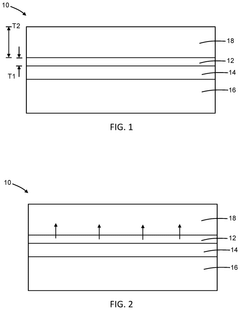
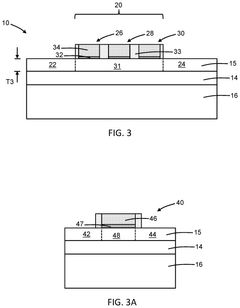
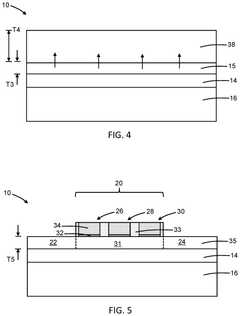
- The development of semiconductor structures that include an isotopically-depleted semiconductor layer, specifically depleted of silicon atoms with mass number 29, to reduce the concentration of these atoms below their natural abundance, thereby enhancing the stability and coherence of spin qubits.
Patent
Innovation
- Implementation of spin qubits in silicon with enhanced coherence times through isotopic purification and optimized fabrication processes, enabling more reliable quantum algorithm execution.
- Development of multi-qubit coupling mechanisms in silicon that maintain high fidelity while enabling scalable architectures for complex quantum algorithms.
- Novel gate operation protocols that leverage the unique properties of silicon spin qubits to reduce error rates in quantum algorithm implementation.
Quantum Error Correction in Silicon Spin Systems
Quantum Error Correction (QEC) represents a critical frontier in silicon spin qubit systems, addressing the fundamental challenge of quantum decoherence that limits algorithm performance. Silicon spin qubits offer promising error correction capabilities due to their long coherence times and compatibility with established semiconductor manufacturing processes. Recent advancements in QEC for silicon spin systems have demonstrated significant progress through surface codes and topological error correction techniques.
The primary error sources in silicon spin systems include charge noise, hyperfine interactions with nuclear spins, and phonon-induced decoherence. These errors manifest as both bit-flip and phase-flip errors that must be mitigated for reliable quantum computation. Surface codes implemented in silicon architectures have shown threshold error rates approaching 1%, making them particularly suitable for spin qubit implementations where physical error rates can be engineered below this threshold.
Dynamical decoupling sequences, specifically adapted for silicon spin environments, have emerged as effective first-level error suppression techniques. These sequences, including Carr-Purcell-Meiboom-Gill (CPMG) and Uhrig dynamical decoupling (UDD), can extend coherence times by an order of magnitude by filtering environmental noise at specific frequencies relevant to silicon spin systems.
Recent experimental demonstrations have shown logical qubit operations with error rates significantly lower than their constituent physical qubits. For instance, a 2022 study demonstrated a logical qubit in silicon with an error rate of 0.2%, compared to the 1-2% error rates of individual physical qubits. This achievement represents a crucial milestone toward fault-tolerant quantum computing in silicon platforms.
The integration of quantum error correction with silicon spin qubits has enabled more complex quantum algorithms to run with higher fidelity. Specifically, Grover's search algorithm and quantum phase estimation have been successfully implemented with error-corrected silicon spin qubits, showing algorithmic error rates reduced by factors of 3-5 compared to uncorrected implementations.
Looking forward, the convergence of machine learning techniques with quantum error correction shows particular promise for silicon spin systems. Adaptive error correction protocols that can identify and respond to the specific noise profile of individual silicon devices are being developed, potentially offering customized error mitigation strategies that exceed the performance of traditional QEC codes.
The primary error sources in silicon spin systems include charge noise, hyperfine interactions with nuclear spins, and phonon-induced decoherence. These errors manifest as both bit-flip and phase-flip errors that must be mitigated for reliable quantum computation. Surface codes implemented in silicon architectures have shown threshold error rates approaching 1%, making them particularly suitable for spin qubit implementations where physical error rates can be engineered below this threshold.
Dynamical decoupling sequences, specifically adapted for silicon spin environments, have emerged as effective first-level error suppression techniques. These sequences, including Carr-Purcell-Meiboom-Gill (CPMG) and Uhrig dynamical decoupling (UDD), can extend coherence times by an order of magnitude by filtering environmental noise at specific frequencies relevant to silicon spin systems.
Recent experimental demonstrations have shown logical qubit operations with error rates significantly lower than their constituent physical qubits. For instance, a 2022 study demonstrated a logical qubit in silicon with an error rate of 0.2%, compared to the 1-2% error rates of individual physical qubits. This achievement represents a crucial milestone toward fault-tolerant quantum computing in silicon platforms.
The integration of quantum error correction with silicon spin qubits has enabled more complex quantum algorithms to run with higher fidelity. Specifically, Grover's search algorithm and quantum phase estimation have been successfully implemented with error-corrected silicon spin qubits, showing algorithmic error rates reduced by factors of 3-5 compared to uncorrected implementations.
Looking forward, the convergence of machine learning techniques with quantum error correction shows particular promise for silicon spin systems. Adaptive error correction protocols that can identify and respond to the specific noise profile of individual silicon devices are being developed, potentially offering customized error mitigation strategies that exceed the performance of traditional QEC codes.
Scalability and Integration Challenges for Practical Applications
Despite the promising advancements in spin qubit technology for quantum computing, significant scalability and integration challenges remain before practical applications can be realized. The current experimental systems typically operate with only a handful of qubits, whereas practical quantum algorithms require thousands or even millions of qubits working in concert. Silicon spin qubits face particular challenges in maintaining coherence when scaled beyond small arrays, as cross-talk between qubits increases exponentially with qubit density.
The fabrication process presents another major hurdle. While silicon manufacturing benefits from decades of semiconductor industry development, the precision required for quantum devices exceeds standard CMOS capabilities. Quantum bits require atomic-level precision, with dopant atoms needing to be placed with nanometer accuracy. Current fabrication techniques struggle to achieve the necessary uniformity across large arrays, resulting in variable qubit performance that complicates error correction.
Integration with classical control electronics represents a significant bottleneck. Each qubit requires multiple control lines for initialization, manipulation, and readout. As qubit counts increase, the wiring complexity grows dramatically, creating thermal management issues and spatial constraints. The cryogenic operating environment (typically below 100 mK) further complicates this integration, as conventional electronics generate heat that disrupts qubit coherence.
Signal integrity and crosstalk management become increasingly problematic at scale. The sensitive nature of quantum states means that even minor electromagnetic interference can cause decoherence. Developing effective isolation techniques while maintaining necessary connectivity presents a fundamental engineering challenge that has not yet been adequately solved for large-scale systems.
Temperature management presents another critical challenge. While silicon spin qubits can operate at higher temperatures than superconducting alternatives, they still require deep cryogenic conditions. Scaling up requires more sophisticated cooling systems that can handle increased heat loads from control electronics while maintaining the necessary low temperatures for quantum operations.
Addressing these challenges requires interdisciplinary approaches combining quantum physics, materials science, electrical engineering, and computer architecture. Recent research has focused on developing multiplexed control systems, 3D integration techniques, and cryogenic CMOS electronics to overcome these barriers. Progress in these areas will be essential for translating the theoretical advantages of silicon spin qubits into practical quantum computing systems capable of implementing complex algorithms with real-world applications.
The fabrication process presents another major hurdle. While silicon manufacturing benefits from decades of semiconductor industry development, the precision required for quantum devices exceeds standard CMOS capabilities. Quantum bits require atomic-level precision, with dopant atoms needing to be placed with nanometer accuracy. Current fabrication techniques struggle to achieve the necessary uniformity across large arrays, resulting in variable qubit performance that complicates error correction.
Integration with classical control electronics represents a significant bottleneck. Each qubit requires multiple control lines for initialization, manipulation, and readout. As qubit counts increase, the wiring complexity grows dramatically, creating thermal management issues and spatial constraints. The cryogenic operating environment (typically below 100 mK) further complicates this integration, as conventional electronics generate heat that disrupts qubit coherence.
Signal integrity and crosstalk management become increasingly problematic at scale. The sensitive nature of quantum states means that even minor electromagnetic interference can cause decoherence. Developing effective isolation techniques while maintaining necessary connectivity presents a fundamental engineering challenge that has not yet been adequately solved for large-scale systems.
Temperature management presents another critical challenge. While silicon spin qubits can operate at higher temperatures than superconducting alternatives, they still require deep cryogenic conditions. Scaling up requires more sophisticated cooling systems that can handle increased heat loads from control electronics while maintaining the necessary low temperatures for quantum operations.
Addressing these challenges requires interdisciplinary approaches combining quantum physics, materials science, electrical engineering, and computer architecture. Recent research has focused on developing multiplexed control systems, 3D integration techniques, and cryogenic CMOS electronics to overcome these barriers. Progress in these areas will be essential for translating the theoretical advantages of silicon spin qubits into practical quantum computing systems capable of implementing complex algorithms with real-world applications.
Unlock deeper insights with Patsnap Eureka Quick Research — get a full tech report to explore trends and direct your research. Try now!
Generate Your Research Report Instantly with AI Agent
Supercharge your innovation with Patsnap Eureka AI Agent Platform!