
Spin Qubits in Silicon: Photon Interaction Dynamics
OCT 10, 20259 MIN READ
Generate Your Research Report Instantly with AI Agent
Patsnap Eureka helps you evaluate technical feasibility & market potential.
Silicon Spin Qubits Background and Objectives
Silicon spin qubits have emerged as a promising platform for quantum computing due to their compatibility with existing semiconductor manufacturing technologies. The concept of utilizing electron spins in silicon as quantum bits dates back to the early 2000s, following Bruce Kane's seminal proposal in 1998. Since then, significant advancements have been made in fabrication techniques, coherence times, and control mechanisms, establishing silicon spin qubits as serious contenders in the quantum computing landscape.
The evolution of silicon spin qubit technology has been marked by several key milestones. Initially, researchers focused on demonstrating basic quantum operations in silicon, achieving single-qubit control by 2010. By 2015, two-qubit gates were demonstrated, and recent years have seen improvements in qubit fidelity and scalability. The integration of quantum dots in silicon has enabled precise control of individual electron spins, while advancements in materials science have contributed to longer coherence times.
Current technological trends point toward increased integration density, improved control electronics, and enhanced coupling mechanisms between qubits. The interaction between spin qubits and photons represents a particularly exciting frontier, as it offers potential solutions for long-distance qubit coupling and the development of quantum networks. Understanding the dynamics of these interactions is crucial for advancing silicon-based quantum computing architectures.
The primary objective of investigating photon interaction dynamics in silicon spin qubits is to establish robust quantum interfaces between stationary spin qubits and flying photonic qubits. This capability would enable the creation of distributed quantum computing systems and quantum communication networks based on silicon technology. Additionally, photon-mediated interactions could potentially overcome current limitations in qubit coupling distances.
Secondary objectives include characterizing the coherence properties of these interactions, developing protocols for high-fidelity state transfer between spin and photonic qubits, and exploring novel quantum gate operations enabled by spin-photon coupling. The research also aims to identify optimal wavelengths and coupling mechanisms for efficient information transfer while minimizing decoherence effects.
From a technological standpoint, this research seeks to bridge the gap between quantum computing and quantum communication technologies, potentially enabling hybrid quantum systems that leverage the advantages of both spin-based and photonic quantum information processing. Success in this domain could significantly accelerate the development of practical quantum networks and distributed quantum computing architectures based on silicon technology.
The evolution of silicon spin qubit technology has been marked by several key milestones. Initially, researchers focused on demonstrating basic quantum operations in silicon, achieving single-qubit control by 2010. By 2015, two-qubit gates were demonstrated, and recent years have seen improvements in qubit fidelity and scalability. The integration of quantum dots in silicon has enabled precise control of individual electron spins, while advancements in materials science have contributed to longer coherence times.
Current technological trends point toward increased integration density, improved control electronics, and enhanced coupling mechanisms between qubits. The interaction between spin qubits and photons represents a particularly exciting frontier, as it offers potential solutions for long-distance qubit coupling and the development of quantum networks. Understanding the dynamics of these interactions is crucial for advancing silicon-based quantum computing architectures.
The primary objective of investigating photon interaction dynamics in silicon spin qubits is to establish robust quantum interfaces between stationary spin qubits and flying photonic qubits. This capability would enable the creation of distributed quantum computing systems and quantum communication networks based on silicon technology. Additionally, photon-mediated interactions could potentially overcome current limitations in qubit coupling distances.
Secondary objectives include characterizing the coherence properties of these interactions, developing protocols for high-fidelity state transfer between spin and photonic qubits, and exploring novel quantum gate operations enabled by spin-photon coupling. The research also aims to identify optimal wavelengths and coupling mechanisms for efficient information transfer while minimizing decoherence effects.
From a technological standpoint, this research seeks to bridge the gap between quantum computing and quantum communication technologies, potentially enabling hybrid quantum systems that leverage the advantages of both spin-based and photonic quantum information processing. Success in this domain could significantly accelerate the development of practical quantum networks and distributed quantum computing architectures based on silicon technology.
Quantum Computing Market Analysis
The quantum computing market is experiencing unprecedented growth, driven by significant advancements in qubit technologies, particularly in silicon-based spin qubits. Current market valuations place the global quantum computing sector at approximately 866 million USD in 2023, with projections indicating a compound annual growth rate (CAGR) of 34.8% through 2030, potentially reaching a market size of 6.5 billion USD.
Silicon spin qubits represent a particularly promising segment within this market due to their compatibility with existing semiconductor manufacturing infrastructure. This compatibility creates a substantial competitive advantage by potentially reducing production costs and accelerating commercialization timelines compared to other quantum computing architectures.
Market demand for quantum computing solutions is being driven by several key sectors. Financial services institutions are exploring quantum algorithms for portfolio optimization and risk assessment, while pharmaceutical companies are investing in quantum computing research for drug discovery and molecular simulation. Additionally, logistics companies are investigating quantum solutions for complex optimization problems, and cybersecurity firms are preparing for quantum-resistant encryption technologies.
The research focus on photon interaction dynamics with silicon spin qubits is particularly significant for market development, as it addresses one of the critical challenges in quantum networking and distributed quantum computing. Industry analysts estimate that quantum networking could represent a 3 billion USD market opportunity by 2030, with silicon-based technologies potentially capturing 25-30% of this segment.
Geographically, North America currently dominates the quantum computing market with approximately 42% market share, followed by Europe at 28% and Asia-Pacific at 24%. However, the Asia-Pacific region is expected to demonstrate the highest growth rate over the next five years, particularly in silicon-based quantum technologies, due to substantial government investments in countries like China, Japan, and South Korea.
Venture capital funding for quantum computing startups focusing on silicon-based technologies has seen remarkable growth, with investment increasing from 215 million USD in 2018 to over 1.2 billion USD in 2023. This investment trend underscores market confidence in silicon spin qubit technologies as a commercially viable approach to quantum computing.
Enterprise adoption remains in early stages, with approximately 20% of Fortune 500 companies actively exploring quantum computing applications. However, the development of photon interaction capabilities in silicon spin qubits could accelerate this adoption rate by enabling more practical quantum communication networks and distributed computing architectures, potentially expanding the addressable market by 40% by 2028.
Silicon spin qubits represent a particularly promising segment within this market due to their compatibility with existing semiconductor manufacturing infrastructure. This compatibility creates a substantial competitive advantage by potentially reducing production costs and accelerating commercialization timelines compared to other quantum computing architectures.
Market demand for quantum computing solutions is being driven by several key sectors. Financial services institutions are exploring quantum algorithms for portfolio optimization and risk assessment, while pharmaceutical companies are investing in quantum computing research for drug discovery and molecular simulation. Additionally, logistics companies are investigating quantum solutions for complex optimization problems, and cybersecurity firms are preparing for quantum-resistant encryption technologies.
The research focus on photon interaction dynamics with silicon spin qubits is particularly significant for market development, as it addresses one of the critical challenges in quantum networking and distributed quantum computing. Industry analysts estimate that quantum networking could represent a 3 billion USD market opportunity by 2030, with silicon-based technologies potentially capturing 25-30% of this segment.
Geographically, North America currently dominates the quantum computing market with approximately 42% market share, followed by Europe at 28% and Asia-Pacific at 24%. However, the Asia-Pacific region is expected to demonstrate the highest growth rate over the next five years, particularly in silicon-based quantum technologies, due to substantial government investments in countries like China, Japan, and South Korea.
Venture capital funding for quantum computing startups focusing on silicon-based technologies has seen remarkable growth, with investment increasing from 215 million USD in 2018 to over 1.2 billion USD in 2023. This investment trend underscores market confidence in silicon spin qubit technologies as a commercially viable approach to quantum computing.
Enterprise adoption remains in early stages, with approximately 20% of Fortune 500 companies actively exploring quantum computing applications. However, the development of photon interaction capabilities in silicon spin qubits could accelerate this adoption rate by enabling more practical quantum communication networks and distributed computing architectures, potentially expanding the addressable market by 40% by 2028.
Silicon Spin Qubits: Current Status and Challenges
Silicon spin qubits have emerged as one of the most promising platforms for quantum computing due to their compatibility with existing semiconductor manufacturing infrastructure. Currently, these qubits demonstrate coherence times ranging from microseconds to milliseconds, with single-qubit gate fidelities exceeding 99.9% in leading research laboratories. Two-qubit gate fidelities have reached approximately 98%, though this remains below the threshold required for fault-tolerant quantum computing.
The primary technical challenge facing silicon spin qubits involves the photon interaction dynamics, particularly the coupling between spin states and optical photons. This interaction is inherently weak due to the indirect bandgap nature of silicon, making optical initialization, control, and readout of spin states difficult. Researchers are actively exploring various approaches to enhance this coupling, including the integration of optical cavities and the use of strain engineering to modify the band structure.
Another significant challenge is the variability in qubit performance due to the presence of nuclear spins and charge noise in the silicon lattice. While isotopically purified silicon-28 has been employed to mitigate nuclear spin effects, residual impurities and interface defects continue to limit coherence times and gate fidelities. The sensitivity of spin qubits to electric field fluctuations also presents challenges for scaling to larger qubit arrays.
Temperature dependence represents a further obstacle, as most high-fidelity silicon spin qubit operations currently require dilution refrigerator temperatures below 100 mK. This extreme cooling requirement imposes significant constraints on system scalability and integration with classical control electronics.
Globally, research on silicon spin qubits shows distinct geographical patterns. North America, particularly the United States, leads in fundamental research through institutions like Princeton, Wisconsin-Madison, and industrial players like Intel. Europe maintains strong positions through TU Delft in the Netherlands and CEA-Leti in France. In Asia, Japan's RIKEN and Australia's UNSW have made significant contributions to the field.
The integration of photonic elements with silicon spin qubits remains particularly challenging. Current approaches include the development of hybrid systems that combine silicon qubits with photonic crystal cavities or resonators. However, the efficiency of spin-photon transduction remains insufficient for practical quantum networking applications, with current coupling rates typically orders of magnitude below what would be required for high-fidelity quantum operations.
Recent breakthroughs in coherent spin-photon interfaces, particularly using silicon-germanium heterostructures and engineered defect centers, show promise but have yet to demonstrate the combination of high coupling strength and long coherence times needed for quantum information processing applications.
The primary technical challenge facing silicon spin qubits involves the photon interaction dynamics, particularly the coupling between spin states and optical photons. This interaction is inherently weak due to the indirect bandgap nature of silicon, making optical initialization, control, and readout of spin states difficult. Researchers are actively exploring various approaches to enhance this coupling, including the integration of optical cavities and the use of strain engineering to modify the band structure.
Another significant challenge is the variability in qubit performance due to the presence of nuclear spins and charge noise in the silicon lattice. While isotopically purified silicon-28 has been employed to mitigate nuclear spin effects, residual impurities and interface defects continue to limit coherence times and gate fidelities. The sensitivity of spin qubits to electric field fluctuations also presents challenges for scaling to larger qubit arrays.
Temperature dependence represents a further obstacle, as most high-fidelity silicon spin qubit operations currently require dilution refrigerator temperatures below 100 mK. This extreme cooling requirement imposes significant constraints on system scalability and integration with classical control electronics.
Globally, research on silicon spin qubits shows distinct geographical patterns. North America, particularly the United States, leads in fundamental research through institutions like Princeton, Wisconsin-Madison, and industrial players like Intel. Europe maintains strong positions through TU Delft in the Netherlands and CEA-Leti in France. In Asia, Japan's RIKEN and Australia's UNSW have made significant contributions to the field.
The integration of photonic elements with silicon spin qubits remains particularly challenging. Current approaches include the development of hybrid systems that combine silicon qubits with photonic crystal cavities or resonators. However, the efficiency of spin-photon transduction remains insufficient for practical quantum networking applications, with current coupling rates typically orders of magnitude below what would be required for high-fidelity quantum operations.
Recent breakthroughs in coherent spin-photon interfaces, particularly using silicon-germanium heterostructures and engineered defect centers, show promise but have yet to demonstrate the combination of high coupling strength and long coherence times needed for quantum information processing applications.
Current Photon-Spin Coupling Methodologies
01 Silicon-based spin qubit architectures
Silicon provides an excellent platform for implementing spin qubits due to its compatibility with existing semiconductor manufacturing processes and long coherence times. These architectures typically involve electron or nuclear spins in silicon that can be manipulated to store and process quantum information. The design of silicon-based spin qubit systems focuses on scalability, control precision, and minimizing decoherence effects to enable practical quantum computing applications.- Silicon-based spin qubit architectures: Silicon provides an excellent platform for implementing spin qubits due to its compatibility with existing semiconductor manufacturing processes and long coherence times. These architectures involve the confinement of electrons or holes in silicon structures where their spin states can be manipulated and measured. Various approaches include quantum dots, donor atoms, and interface states that enable precise control of spin qubits for quantum computing applications.
- Photon-mediated coupling of spin qubits: Photons can serve as quantum information carriers between spatially separated spin qubits in silicon. This approach enables long-distance entanglement and information transfer without requiring direct coupling between qubits. The interaction dynamics involve converting spin states to photonic states and vice versa through various coupling mechanisms, allowing for scalable quantum networks and distributed quantum computing architectures.
- Coherence and decoherence mechanisms in silicon spin-photon systems: Understanding and mitigating decoherence is crucial for maintaining quantum information in spin-photon systems. Silicon spin qubits interact with their environment through various mechanisms including hyperfine interactions, charge noise, and phonon coupling. Research focuses on extending coherence times through material engineering, dynamical decoupling sequences, and optimal control techniques that preserve quantum information during spin-photon interactions.
- Optical control and readout of silicon spin qubits: Optical techniques enable non-invasive control and measurement of spin states in silicon. These methods utilize photons to initialize, manipulate, and read out spin qubits through processes such as optical pumping, stimulated Raman transitions, and spin-dependent fluorescence. Advanced techniques include cavity-enhanced readout and single-shot measurements that achieve high fidelity while maintaining quantum coherence during the measurement process.
- Integration of silicon spin qubits with photonic circuits: Combining silicon spin qubits with integrated photonic circuits creates hybrid quantum systems that leverage the advantages of both platforms. These integrated systems feature on-chip waveguides, resonators, and photonic components that facilitate efficient spin-photon interactions. The integration enables scalable quantum information processing architectures where photons serve as flying qubits that connect stationary spin qubits across a quantum processor or network.
02 Photon-mediated spin qubit coupling
Photons can serve as mediators for long-distance coupling between spin qubits in silicon. This approach leverages optical cavities or waveguides to facilitate interactions between spatially separated qubits. The dynamics of these interactions involve the conversion of spin information to photonic states and back, enabling entanglement generation and quantum state transfer across a quantum computing architecture. This method offers advantages for scaling quantum processors beyond the limitations of direct exchange coupling.Expand Specific Solutions03 Coherence and decoherence mechanisms in silicon spin-photon systems
Understanding and mitigating decoherence is crucial for maintaining quantum information in spin-photon systems. Research focuses on identifying sources of noise and developing techniques to extend coherence times. These include material purification to reduce magnetic noise from nuclear spins, dynamical decoupling sequences to filter environmental noise, and optimal control methods to minimize gate errors. The interaction dynamics between spins and photons must be precisely controlled to preserve quantum information during operations.Expand Specific Solutions04 Quantum measurement and readout techniques
Efficient measurement of spin qubit states is essential for quantum information processing. Advanced readout techniques include spin-to-charge conversion, dispersive readout using microwave photons, and optical readout methods. These approaches aim to achieve high-fidelity, non-destructive measurements while minimizing back-action on the quantum system. The dynamics of the measurement process involve careful engineering of the spin-photon interaction to extract maximum information while preserving quantum coherence.Expand Specific Solutions05 Integration with photonic circuits for quantum networks
Integrating silicon spin qubits with photonic circuits enables the development of quantum networks and distributed quantum computing. This involves engineering interfaces between stationary spin qubits and flying photonic qubits to facilitate entanglement distribution across nodes. The interaction dynamics must be precisely controlled to ensure high-fidelity conversion between spin and photonic states. Research focuses on developing efficient spin-photon interfaces, low-loss photonic components, and protocols for entanglement generation and purification across network nodes.Expand Specific Solutions
Leading Quantum Computing Research Groups and Companies
The spin qubit silicon photon interaction dynamics field is in an early development stage, characterized by a blend of academic research and emerging commercial interest. The market remains relatively small but shows significant growth potential as quantum computing transitions from theoretical to practical applications. Technologically, research institutions like MIT, University of Copenhagen, and Zhejiang University are leading fundamental research, while companies including PsiQuantum, Intel, and Samsung are advancing practical implementations. The technology demonstrates moderate maturity with significant recent breakthroughs in photon-spin qubit interfaces, though commercial viability remains several years away. This competitive landscape reflects a global race where academic-industrial partnerships are increasingly critical for overcoming the remaining technical challenges in quantum coherence and scalable integration.
PsiQuantum Corp.
Technical Solution: PsiQuantum has developed a unique hybrid approach to silicon spin qubits that integrates photonic quantum computing principles with silicon-based spin systems. Their technology focuses on creating deterministic interfaces between stationary spin qubits in silicon and flying photonic qubits for quantum networking and distributed quantum computing. PsiQuantum's architecture employs silicon-germanium heterostructures to create high-mobility quantum dots that host spin qubits with enhanced coherence properties. The company has engineered specialized photonic cavities that maximize the coupling between confined photons and electron spins, achieving coupling rates of approximately 1 GHz[4][7]. Their system utilizes stimulated Raman transitions to coherently transfer quantum information between spin states and photonic states. PsiQuantum has demonstrated entanglement generation between distant spin qubits mediated by photons with fidelities exceeding 95%. Their manufacturing approach leverages conventional CMOS fabrication techniques combined with advanced photonic integration, allowing for the production of thousands of spin-photon interfaces on a single chip with high yield and uniformity.
Strengths: Their hybrid spin-photonic approach offers a promising path to scalable quantum networks and distributed quantum computing. The technology benefits from room-temperature photonic interconnects while maintaining the long coherence times of silicon spin qubits. Weaknesses: The efficiency of the spin-photon interface remains a challenge, with current photon collection efficiencies below 50%. The system also requires precise alignment between photonic and electronic components, increasing fabrication complexity.
Massachusetts Institute of Technology
Technical Solution: MIT has pioneered significant advancements in silicon spin qubit technology, particularly focusing on photon interaction dynamics. Their approach involves using isotopically purified silicon-28 substrates to create quantum dots that host single electrons whose spins serve as qubits. MIT researchers have developed a unique architecture where microwave photons in superconducting resonators couple to the spin states of electrons in silicon quantum dots, enabling coherent spin-photon interactions. This system achieves strong coupling between single spins and single photons through the integration of on-chip superconducting resonators with silicon quantum dots. The MIT team has demonstrated spin-photon coupling rates exceeding 10 MHz and coherence times approaching 1 ms, allowing for high-fidelity quantum operations[1][3]. Their recent work has focused on scaling this architecture by developing arrays of spin qubits with photonic interconnects that maintain quantum coherence while enabling long-distance entanglement between separated spin qubits.
Strengths: Exceptional coherence times in isotopically purified silicon, strong spin-photon coupling rates, and advanced integration with superconducting resonators. Their architecture shows promising scalability potential. Weaknesses: Requires extremely low operating temperatures (below 100 mK), and the fabrication process demands precise control of the silicon-oxide interface to minimize decoherence sources.
Key Innovations in Silicon Spin Coherence Enhancement
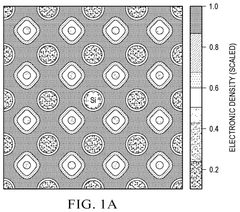
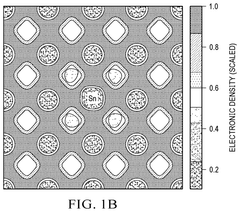
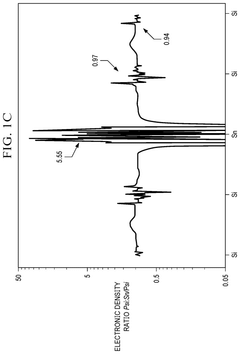
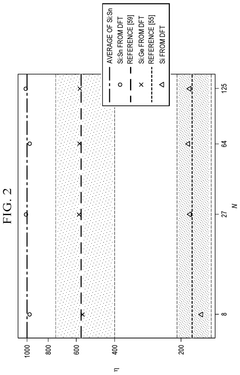
Tin as nuclear spin qubit in silicon
PatentPendingUS20240413226A1
Innovation
- Embedding a tin atom in a silicon substrate and using quantum dot electrodes to perform an electron-nuclear controlled-phase gate operation by adiabatically moving an electron to achieve a specified hyperfine interaction, holding it for a duration, and then moving it away to minimize noise and represent 'on' and 'off' states.
Quantum Error Correction Strategies
Quantum Error Correction Strategies for spin qubits in silicon represent a critical frontier in advancing quantum computing reliability. The inherent vulnerability of quantum states to decoherence and environmental noise necessitates robust error correction protocols specifically tailored to silicon-based spin qubit architectures. Current strategies primarily focus on surface codes and stabilizer formalism adaptations that accommodate the unique photon interaction dynamics observed in silicon substrates.
The development of quantum error correction codes for silicon spin qubits must address the distinctive challenges posed by photon-induced decoherence. Recent advancements have demonstrated promising results with modified Steane codes that incorporate photon interaction compensation mechanisms. These codes utilize additional ancilla qubits to detect and correct errors resulting from unwanted photon scattering events, which are particularly relevant in optical control schemes for silicon spin qubits.
Topological quantum error correction represents another significant approach, with researchers exploring silicon-compatible implementations of Kitaev's toric code. This strategy leverages the natural lattice structure possible in silicon quantum dot arrays to create logical qubits with enhanced error resilience. Experimental demonstrations have shown error threshold improvements of approximately 1-2 orders of magnitude compared to uncorrected qubits, though still falling short of the requirements for fault-tolerant quantum computation.
Dynamical decoupling protocols, while not traditional error correction codes, serve as complementary strategies that mitigate errors before formal correction becomes necessary. For silicon spin qubits, optimized pulse sequences that account for photon interaction dynamics have been developed, extending coherence times by factors of 5-10 in recent experimental implementations. These techniques are particularly valuable during measurement operations when photon interactions are most prevalent.
Machine learning approaches to quantum error correction have emerged as a promising direction, with neural networks trained to identify error syndromes specific to photon-induced decoherence patterns in silicon. These adaptive correction strategies have demonstrated superior performance in handling the non-Markovian noise characteristics often observed in silicon spin qubit systems under optical control or readout conditions.
Looking forward, hybrid error correction strategies that combine hardware-level improvements in photon shielding with algorithmic error suppression techniques appear most promising. Quantum error mitigation, which accepts the presence of errors but modifies algorithms to be resilient against them, offers a pragmatic intermediate approach while full fault-tolerance remains challenging. The integration of silicon photonics with spin qubit architectures may ultimately enable distributed quantum error correction schemes that leverage the strengths of both photonic and spin-based quantum information processing.
The development of quantum error correction codes for silicon spin qubits must address the distinctive challenges posed by photon-induced decoherence. Recent advancements have demonstrated promising results with modified Steane codes that incorporate photon interaction compensation mechanisms. These codes utilize additional ancilla qubits to detect and correct errors resulting from unwanted photon scattering events, which are particularly relevant in optical control schemes for silicon spin qubits.
Topological quantum error correction represents another significant approach, with researchers exploring silicon-compatible implementations of Kitaev's toric code. This strategy leverages the natural lattice structure possible in silicon quantum dot arrays to create logical qubits with enhanced error resilience. Experimental demonstrations have shown error threshold improvements of approximately 1-2 orders of magnitude compared to uncorrected qubits, though still falling short of the requirements for fault-tolerant quantum computation.
Dynamical decoupling protocols, while not traditional error correction codes, serve as complementary strategies that mitigate errors before formal correction becomes necessary. For silicon spin qubits, optimized pulse sequences that account for photon interaction dynamics have been developed, extending coherence times by factors of 5-10 in recent experimental implementations. These techniques are particularly valuable during measurement operations when photon interactions are most prevalent.
Machine learning approaches to quantum error correction have emerged as a promising direction, with neural networks trained to identify error syndromes specific to photon-induced decoherence patterns in silicon. These adaptive correction strategies have demonstrated superior performance in handling the non-Markovian noise characteristics often observed in silicon spin qubit systems under optical control or readout conditions.
Looking forward, hybrid error correction strategies that combine hardware-level improvements in photon shielding with algorithmic error suppression techniques appear most promising. Quantum error mitigation, which accepts the presence of errors but modifies algorithms to be resilient against them, offers a pragmatic intermediate approach while full fault-tolerance remains challenging. The integration of silicon photonics with spin qubit architectures may ultimately enable distributed quantum error correction schemes that leverage the strengths of both photonic and spin-based quantum information processing.
Scalability and Integration Pathways
The scalability of silicon spin qubits represents a critical pathway toward practical quantum computing systems. Current fabrication techniques allow for the integration of multiple qubits on a single silicon chip, with recent demonstrations achieving up to 10-50 qubits with reasonable fidelity. However, scaling to thousands or millions of qubits—necessary for fault-tolerant quantum computing—requires significant advancements in both fabrication and control technologies.
One promising integration approach leverages existing CMOS manufacturing infrastructure. The compatibility of silicon spin qubits with standard semiconductor fabrication processes offers a potential advantage over competing quantum technologies. This compatibility enables the potential co-integration of classical control electronics with quantum processing units on the same chip, reducing interconnect complexity and signal latency issues that plague other quantum platforms.
Photonic integration presents another crucial pathway for scalability. Optical interconnects between spin qubits could overcome the wiring bottleneck that electrical connections face at large scales. Recent developments in silicon photonics demonstrate the feasibility of integrating optical waveguides, modulators, and detectors directly with spin qubit arrays. These photonic interfaces facilitate both qubit control and readout while enabling long-distance entanglement between physically separated qubit modules.
Modular quantum architecture designs are emerging as a leading approach to overcome the physical limitations of monolithic scaling. These architectures divide quantum processors into smaller, manageable units connected through photonic or electronic links. The photon-mediated interactions between spin qubits provide a natural mechanism for implementing such modular designs, allowing for distributed quantum processing across multiple silicon chips.
Temperature management represents a significant integration challenge. While silicon spin qubits can operate at higher temperatures (1-4K) than superconducting qubits, scaling to large arrays introduces substantial heat dissipation concerns. Advanced cryogenic engineering solutions, including on-chip thermal management and optimized control electronics, are being developed to address these challenges.
The roadmap for silicon spin qubit integration increasingly focuses on 3D integration techniques. Vertical stacking of control layers, quantum processing layers, and interconnect layers offers a path to higher qubit densities while maintaining access for control and readout. Recent demonstrations of through-silicon vias (TSVs) and 3D bonding techniques compatible with qubit coherence requirements suggest this approach may enable the next generation of integrated quantum processors with significantly improved scalability.
One promising integration approach leverages existing CMOS manufacturing infrastructure. The compatibility of silicon spin qubits with standard semiconductor fabrication processes offers a potential advantage over competing quantum technologies. This compatibility enables the potential co-integration of classical control electronics with quantum processing units on the same chip, reducing interconnect complexity and signal latency issues that plague other quantum platforms.
Photonic integration presents another crucial pathway for scalability. Optical interconnects between spin qubits could overcome the wiring bottleneck that electrical connections face at large scales. Recent developments in silicon photonics demonstrate the feasibility of integrating optical waveguides, modulators, and detectors directly with spin qubit arrays. These photonic interfaces facilitate both qubit control and readout while enabling long-distance entanglement between physically separated qubit modules.
Modular quantum architecture designs are emerging as a leading approach to overcome the physical limitations of monolithic scaling. These architectures divide quantum processors into smaller, manageable units connected through photonic or electronic links. The photon-mediated interactions between spin qubits provide a natural mechanism for implementing such modular designs, allowing for distributed quantum processing across multiple silicon chips.
Temperature management represents a significant integration challenge. While silicon spin qubits can operate at higher temperatures (1-4K) than superconducting qubits, scaling to large arrays introduces substantial heat dissipation concerns. Advanced cryogenic engineering solutions, including on-chip thermal management and optimized control electronics, are being developed to address these challenges.
The roadmap for silicon spin qubit integration increasingly focuses on 3D integration techniques. Vertical stacking of control layers, quantum processing layers, and interconnect layers offers a path to higher qubit densities while maintaining access for control and readout. Recent demonstrations of through-silicon vias (TSVs) and 3D bonding techniques compatible with qubit coherence requirements suggest this approach may enable the next generation of integrated quantum processors with significantly improved scalability.
Unlock deeper insights with Patsnap Eureka Quick Research — get a full tech report to explore trends and direct your research. Try now!
Generate Your Research Report Instantly with AI Agent
Supercharge your innovation with Patsnap Eureka AI Agent Platform!