
Spin Qubits in Silicon: Optical Control Mechanisms
OCT 10, 20259 MIN READ
Generate Your Research Report Instantly with AI Agent
Patsnap Eureka helps you evaluate technical feasibility & market potential.
Silicon Spin Qubits Background and Objectives
Silicon spin qubits have emerged as a promising platform for quantum computing due to their compatibility with existing semiconductor manufacturing technologies. The journey of silicon-based quantum computing began in the late 1990s when Bruce Kane proposed using nuclear spins of phosphorus donors in silicon as qubits. This seminal work sparked significant interest in the field, leading to the development of various silicon qubit architectures over the subsequent decades.
The evolution of silicon spin qubits has progressed through several key phases, from initial theoretical proposals to experimental demonstrations of single-qubit operations, and more recently, to two-qubit gates with fidelities approaching the threshold for fault-tolerant quantum computing. The field has witnessed remarkable advancements in fabrication techniques, control mechanisms, and coherence times, positioning silicon as a competitive platform for scalable quantum processors.
Traditional control mechanisms for silicon spin qubits have primarily relied on electrical and magnetic fields. However, optical control methods represent an emerging frontier with potential advantages in terms of scalability, speed, and integration with photonic networks. The optical manipulation of spin states in silicon offers a pathway to overcome some of the limitations associated with conventional control techniques.
The primary technical objective of exploring optical control mechanisms for silicon spin qubits is to develop robust methods for initializing, manipulating, and reading out spin states using light. This includes investigating phenomena such as spin-photon coupling, optically driven spin resonance, and photon-mediated entanglement between distant qubits.
Current research aims to enhance the coherence properties of optically controlled spin qubits, improve the fidelity of quantum operations, and develop integrated photonic interfaces for scalable quantum information processing. Additionally, there is significant interest in exploring hybrid approaches that combine the advantages of electrical and optical control methods.
The long-term vision for silicon spin qubits encompasses the development of large-scale quantum processors capable of executing quantum algorithms with practical applications. This requires addressing challenges related to qubit uniformity, control precision, and system integration. Optical control mechanisms may play a crucial role in realizing this vision by enabling high-fidelity operations across distributed quantum networks.
As the field continues to mature, researchers are increasingly focusing on the fundamental physics of light-matter interactions in silicon-based quantum systems. Understanding these interactions is essential for designing optimized control protocols and developing novel qubit architectures that leverage the unique properties of silicon as a host material for quantum bits.
The evolution of silicon spin qubits has progressed through several key phases, from initial theoretical proposals to experimental demonstrations of single-qubit operations, and more recently, to two-qubit gates with fidelities approaching the threshold for fault-tolerant quantum computing. The field has witnessed remarkable advancements in fabrication techniques, control mechanisms, and coherence times, positioning silicon as a competitive platform for scalable quantum processors.
Traditional control mechanisms for silicon spin qubits have primarily relied on electrical and magnetic fields. However, optical control methods represent an emerging frontier with potential advantages in terms of scalability, speed, and integration with photonic networks. The optical manipulation of spin states in silicon offers a pathway to overcome some of the limitations associated with conventional control techniques.
The primary technical objective of exploring optical control mechanisms for silicon spin qubits is to develop robust methods for initializing, manipulating, and reading out spin states using light. This includes investigating phenomena such as spin-photon coupling, optically driven spin resonance, and photon-mediated entanglement between distant qubits.
Current research aims to enhance the coherence properties of optically controlled spin qubits, improve the fidelity of quantum operations, and develop integrated photonic interfaces for scalable quantum information processing. Additionally, there is significant interest in exploring hybrid approaches that combine the advantages of electrical and optical control methods.
The long-term vision for silicon spin qubits encompasses the development of large-scale quantum processors capable of executing quantum algorithms with practical applications. This requires addressing challenges related to qubit uniformity, control precision, and system integration. Optical control mechanisms may play a crucial role in realizing this vision by enabling high-fidelity operations across distributed quantum networks.
As the field continues to mature, researchers are increasingly focusing on the fundamental physics of light-matter interactions in silicon-based quantum systems. Understanding these interactions is essential for designing optimized control protocols and developing novel qubit architectures that leverage the unique properties of silicon as a host material for quantum bits.
Market Analysis for Optically Controlled Quantum Computing
The quantum computing market is experiencing unprecedented growth, with the global market value projected to reach $1.3 billion by 2025 and potentially $65 billion by 2030, according to recent industry analyses. Within this expanding landscape, optically controlled quantum computing—particularly systems based on spin qubits in silicon—represents a rapidly emerging segment with distinctive market characteristics and growth potential.
Silicon-based quantum computing offers significant advantages that align with market demands, including scalability potential, compatibility with existing semiconductor manufacturing infrastructure, and longer coherence times. The optical control mechanism for spin qubits specifically addresses key technical bottlenecks that have limited commercial viability of quantum systems, potentially accelerating time-to-market for practical quantum computers.
Current market demand is primarily driven by research institutions, national laboratories, and technology giants investing in quantum computing research. However, the addressable market is expanding to include pharmaceutical companies seeking drug discovery applications, financial institutions exploring portfolio optimization, and materials science companies investigating new compounds. These sectors collectively represent a potential market value of $10 billion by 2028 for specialized quantum computing solutions.
Regional analysis reveals that North America currently dominates the quantum computing market with approximately 40% share, followed by Europe at 30% and Asia-Pacific at 25%. However, Asia-Pacific, particularly China, Japan, and South Korea, is showing the fastest growth rate at 32% annually, driven by substantial government investments and strong semiconductor manufacturing capabilities that align well with silicon-based quantum technologies.
The market for optically controlled quantum computing faces several demand-side challenges, including high implementation costs, technical complexity requiring specialized expertise, and competition from alternative quantum computing architectures. Nevertheless, industry surveys indicate that 62% of Fortune 500 companies are exploring quantum computing applications, with 28% specifically interested in silicon-based approaches due to their potential for integration with existing computing infrastructure.
From an investment perspective, venture capital funding for quantum computing startups reached $1.02 billion in 2022, with approximately 15% directed toward silicon-based quantum technologies. Strategic partnerships between academic institutions, technology companies, and semiconductor manufacturers are increasingly common, creating a complex ecosystem that supports market growth while establishing entry barriers for new competitors.
The market trajectory suggests that optically controlled spin qubits in silicon could achieve commercial viability earlier than competing technologies, potentially capturing 20-25% of the quantum computing market by 2030 if current technical progress continues at its present pace.
Silicon-based quantum computing offers significant advantages that align with market demands, including scalability potential, compatibility with existing semiconductor manufacturing infrastructure, and longer coherence times. The optical control mechanism for spin qubits specifically addresses key technical bottlenecks that have limited commercial viability of quantum systems, potentially accelerating time-to-market for practical quantum computers.
Current market demand is primarily driven by research institutions, national laboratories, and technology giants investing in quantum computing research. However, the addressable market is expanding to include pharmaceutical companies seeking drug discovery applications, financial institutions exploring portfolio optimization, and materials science companies investigating new compounds. These sectors collectively represent a potential market value of $10 billion by 2028 for specialized quantum computing solutions.
Regional analysis reveals that North America currently dominates the quantum computing market with approximately 40% share, followed by Europe at 30% and Asia-Pacific at 25%. However, Asia-Pacific, particularly China, Japan, and South Korea, is showing the fastest growth rate at 32% annually, driven by substantial government investments and strong semiconductor manufacturing capabilities that align well with silicon-based quantum technologies.
The market for optically controlled quantum computing faces several demand-side challenges, including high implementation costs, technical complexity requiring specialized expertise, and competition from alternative quantum computing architectures. Nevertheless, industry surveys indicate that 62% of Fortune 500 companies are exploring quantum computing applications, with 28% specifically interested in silicon-based approaches due to their potential for integration with existing computing infrastructure.
From an investment perspective, venture capital funding for quantum computing startups reached $1.02 billion in 2022, with approximately 15% directed toward silicon-based quantum technologies. Strategic partnerships between academic institutions, technology companies, and semiconductor manufacturers are increasingly common, creating a complex ecosystem that supports market growth while establishing entry barriers for new competitors.
The market trajectory suggests that optically controlled spin qubits in silicon could achieve commercial viability earlier than competing technologies, potentially capturing 20-25% of the quantum computing market by 2030 if current technical progress continues at its present pace.
Current Challenges in Silicon Spin Qubit Optical Control
Despite significant advancements in silicon spin qubit technology, optical control mechanisms face several critical challenges that impede their widespread implementation. The primary obstacle remains the weak interaction between photons and electron spins in silicon, resulting in inefficient optical addressing of individual qubits. This fundamental limitation stems from silicon's indirect bandgap nature, which inherently reduces optical transition probabilities compared to direct bandgap materials.
Temperature dependence presents another significant hurdle, as many optical control schemes require operation at extremely low temperatures (below 100 mK) to maintain coherence. This requirement substantially increases system complexity and operational costs, limiting scalability for practical quantum computing applications.
Integration challenges between optical components and silicon-based quantum devices further complicate implementation. The nanoscale precision required for targeting individual qubits with optical pulses demands sophisticated fabrication techniques that are difficult to scale. Additionally, the introduction of optical elements can disrupt the pristine environment necessary for maintaining long coherence times in spin qubits.
Wavelength compatibility issues persist between optimal optical control frequencies and silicon's transparency window. Many control schemes require wavelengths that experience significant absorption or scattering in silicon substrates, reducing control fidelity and increasing unwanted heating effects that degrade qubit performance.
Fidelity limitations represent perhaps the most pressing challenge. Current optical control mechanisms struggle to achieve the 99.9% fidelity threshold required for fault-tolerant quantum computing. This shortfall stems from multiple factors including imprecise pulse shaping, environmental noise coupling, and the inherent limitations of silicon's spin-photon interaction strength.
Scalability concerns emerge when considering large qubit arrays. As system size increases, maintaining uniform optical addressing across all qubits becomes exponentially more difficult, leading to variations in control quality that undermine computational reliability.
Coherence degradation during optical manipulation remains problematic, as the introduction of photons can inadvertently excite unwanted transitions or create local heating that disrupts the delicate quantum state. This effect is particularly pronounced in silicon systems where thermal isolation is already challenging.
Finally, the lack of standardized protocols for optical control in silicon spin qubits hampers progress across the field. Different research groups employ varied approaches, making it difficult to establish benchmarks and hindering collaborative advancement toward practical quantum computing systems based on optically controlled silicon spin qubits.
Temperature dependence presents another significant hurdle, as many optical control schemes require operation at extremely low temperatures (below 100 mK) to maintain coherence. This requirement substantially increases system complexity and operational costs, limiting scalability for practical quantum computing applications.
Integration challenges between optical components and silicon-based quantum devices further complicate implementation. The nanoscale precision required for targeting individual qubits with optical pulses demands sophisticated fabrication techniques that are difficult to scale. Additionally, the introduction of optical elements can disrupt the pristine environment necessary for maintaining long coherence times in spin qubits.
Wavelength compatibility issues persist between optimal optical control frequencies and silicon's transparency window. Many control schemes require wavelengths that experience significant absorption or scattering in silicon substrates, reducing control fidelity and increasing unwanted heating effects that degrade qubit performance.
Fidelity limitations represent perhaps the most pressing challenge. Current optical control mechanisms struggle to achieve the 99.9% fidelity threshold required for fault-tolerant quantum computing. This shortfall stems from multiple factors including imprecise pulse shaping, environmental noise coupling, and the inherent limitations of silicon's spin-photon interaction strength.
Scalability concerns emerge when considering large qubit arrays. As system size increases, maintaining uniform optical addressing across all qubits becomes exponentially more difficult, leading to variations in control quality that undermine computational reliability.
Coherence degradation during optical manipulation remains problematic, as the introduction of photons can inadvertently excite unwanted transitions or create local heating that disrupts the delicate quantum state. This effect is particularly pronounced in silicon systems where thermal isolation is already challenging.
Finally, the lack of standardized protocols for optical control in silicon spin qubits hampers progress across the field. Different research groups employ varied approaches, making it difficult to establish benchmarks and hindering collaborative advancement toward practical quantum computing systems based on optically controlled silicon spin qubits.
Current Optical Control Mechanisms for Silicon Spin Qubits
01 Optical control mechanisms for silicon spin qubits
Optical control mechanisms enable precise manipulation of spin qubits in silicon through light-matter interactions. These techniques use photons to control the quantum state of electron spins, allowing for faster and more efficient qubit operations compared to traditional electrical control methods. The optical control can be achieved through direct excitation of spin transitions or via intermediate states, enabling coherent manipulation of quantum information in silicon-based quantum computing platforms.- Optical control mechanisms for silicon spin qubits: Optical control mechanisms enable precise manipulation of spin qubits in silicon through light-matter interactions. These mechanisms utilize photons to control the quantum state of electron or nuclear spins in silicon-based quantum computing architectures. Optical techniques offer advantages such as fast operation times and the ability to address individual qubits without disturbing neighboring ones, which is crucial for quantum information processing.
- Silicon quantum dot architectures for spin qubits: Silicon quantum dot architectures provide a scalable platform for implementing spin qubits. These structures confine electrons in nanoscale regions, allowing their spin states to be used as quantum bits. The architecture includes gate-defined quantum dots, donor atoms in silicon, or silicon/silicon-germanium heterostructures. These designs enable precise control over qubit properties while leveraging the established silicon manufacturing infrastructure of the semiconductor industry.
- Coherent manipulation and readout of silicon spin qubits: Techniques for coherent manipulation and readout of spin qubits in silicon involve methods to initialize, control, and measure quantum states with high fidelity. These include resonant microwave control, adiabatic passage techniques, and various readout mechanisms such as spin-to-charge conversion. Advanced pulse sequences and error correction protocols help maintain quantum coherence by mitigating the effects of noise and decoherence, which are critical challenges in quantum computing.
- Integration of photonic and electronic components for spin qubit control: Integration of photonic and electronic components creates hybrid quantum systems that combine the advantages of both domains for controlling silicon spin qubits. This approach incorporates optical waveguides, resonators, and modulators alongside electronic control circuitry on the same chip. The integration enables efficient conversion between optical and electronic signals, facilitating long-distance quantum communication while maintaining local electronic control of spin states.
- Scalable quantum computing architectures using silicon spin qubits: Scalable quantum computing architectures based on silicon spin qubits address the challenges of building large-scale quantum processors. These designs incorporate methods for qubit addressing, coupling, and error correction while maintaining compatibility with semiconductor manufacturing processes. The architectures include strategies for managing quantum interconnects, implementing fault-tolerant operations, and organizing qubits in modular structures to enable practical quantum computing applications.
02 Silicon quantum dot architectures for spin qubits
Silicon quantum dot architectures provide a scalable platform for implementing spin qubits. These structures confine electrons in nanoscale regions, allowing their spin states to be used as quantum bits. The architecture includes gate-defined quantum dots, donor atoms in silicon, or hybrid approaches that combine both. These designs enable precise control over electron placement, coupling between qubits, and integration with optical control mechanisms, making them promising candidates for practical quantum computing systems.Expand Specific Solutions03 Photonic interfaces for silicon spin qubits
Photonic interfaces facilitate the interaction between optical signals and spin qubits in silicon, enabling long-distance quantum communication and distributed quantum computing. These interfaces include optical cavities, waveguides, and resonators that enhance light-matter coupling. By integrating photonic structures with silicon spin qubits, quantum information can be transferred between stationary qubits and flying photonic qubits, creating the foundation for quantum networks while maintaining the advantages of silicon-based quantum computing.Expand Specific Solutions04 Coherence protection and error correction in optically controlled spin qubits
Techniques for protecting quantum coherence and implementing error correction are essential for optically controlled spin qubits in silicon. These methods include dynamical decoupling sequences, decoherence-free subspaces, and quantum error correction codes specifically adapted for optically controlled systems. By mitigating the effects of environmental noise and control imperfections, these approaches extend qubit coherence times and improve the fidelity of quantum operations, enabling more complex quantum algorithms and fault-tolerant quantum computation.Expand Specific Solutions05 Integration of silicon spin qubits with classical control electronics
The integration of silicon spin qubits with classical control electronics enables scalable quantum computing architectures. This approach leverages existing semiconductor manufacturing techniques to create systems where quantum and classical components work together. The integration includes on-chip electronics for qubit control and readout, cryogenic control circuits, and interfaces between optical control systems and electronic components. This hybrid approach addresses the challenges of scaling quantum computers while maintaining the benefits of silicon-based fabrication and optical control mechanisms.Expand Specific Solutions
Leading Research Groups and Companies in Spin Qubit Technology
Spin qubits in silicon for optical control mechanisms represent an emerging frontier in quantum computing, currently in the early development stage. The market is growing rapidly, with projections suggesting significant expansion as quantum technologies mature. Technologically, the field shows promising advancements but remains in pre-commercial phases. Leading players include IBM, which has made substantial investments in silicon-based quantum computing, alongside specialized research from Delft University of Technology and CEA. Origin Quantum and Huawei are emerging as significant Asian competitors, while university research centers at Maryland, Chicago, and Northwestern contribute fundamental breakthroughs. The collaboration between academic institutions and industry players like GlobalFoundries and Raytheon indicates the field's strategic importance for future computing paradigms.
Origin Quantum Computing Technology (Hefei) Co., Ltd.
Technical Solution: Origin Quantum has developed a distinctive approach to optical control of silicon spin qubits that leverages China's expertise in integrated photonics. Their technology combines traditional silicon quantum dot architectures with advanced photonic circuits for precise optical manipulation of spin states. The company's solution incorporates specially designed silicon-compatible optical resonators that enhance the coupling between light and spin qubits, enabling efficient state manipulation with lower power requirements. Origin Quantum's researchers have demonstrated a novel technique using polarization-selective optical pulses to achieve selective addressing of individual spin qubits within dense arrays. Their platform integrates on-chip optical modulators and beam splitters to generate and route the complex optical pulse sequences required for quantum gate operations. A key innovation in their approach is the use of optically active rare-earth dopants in the silicon substrate that serve as quantum transducers, converting optical signals to localized magnetic fields that can control nearby spin qubits. This indirect control mechanism helps preserve the long coherence times of silicon spin qubits while enabling optical addressability.
Strengths: Efficient optical-to-spin transduction through innovative materials engineering; scalable manufacturing using modified semiconductor fabrication techniques; potential for room-temperature control electronics with cryogenic qubit operation; reduced susceptibility to electrical noise. Weaknesses: Limited demonstration of multi-qubit operations; challenges in achieving uniform optical coupling across large arrays; higher complexity in system integration compared to purely electronic approaches; potential thermal management issues from optical components.
International Business Machines Corp.
Technical Solution: IBM has pioneered significant advancements in silicon spin qubit optical control mechanisms. Their approach integrates photonic components directly with silicon-based spin qubits, enabling precise optical manipulation of quantum states. IBM's researchers have developed a hybrid architecture where optical pulses are used to control electron spins in silicon quantum dots. This system utilizes resonant optical excitation to achieve faster and more precise qubit manipulation compared to traditional microwave-based control methods. The technology incorporates on-chip photonic waveguides that deliver precisely tuned laser pulses to target specific spin transitions. IBM has demonstrated coherent control of spin qubits using optical techniques that achieve operation times in the picosecond range, significantly faster than conventional electronic control methods. Their integrated photonics approach also enables multiplexed control of multiple qubits from a single optical source, improving scalability prospects for silicon-based quantum computing architectures.
Strengths: Superior operation speeds in picosecond range; enhanced coherence times through optical isolation; potential for parallel manipulation of multiple qubits; compatibility with existing silicon fabrication infrastructure. Weaknesses: Requires precise alignment of optical components; thermal management challenges from laser integration; increased system complexity compared to purely electronic approaches; potential crosstalk between adjacent optically-controlled qubits.
Key Patents and Breakthroughs in Optical Spin Control
Optomechanical interface for spin qubits
PatentActiveUS20230066365A1
Innovation
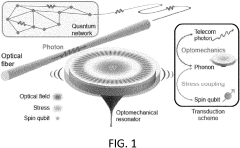
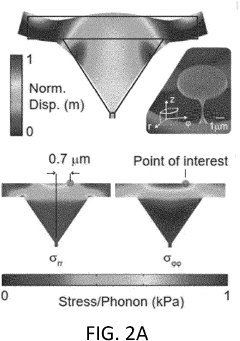
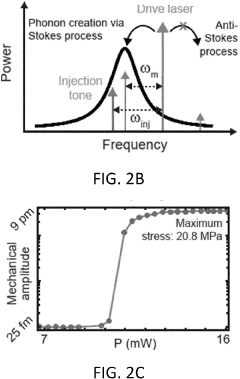
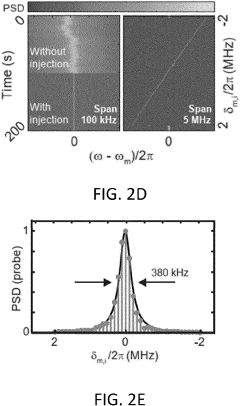
- A cavity-optomechanical device is used to create an interface that increases photon-phonon interaction time and optomechanical coupling rate, allowing for the manipulation of spin qubits through a stress field generated by mechanical oscillations driven by an optical field, using telecommunication wavelength photons and operating at room temperature.
Silicon-based spin-qubit quantum magnetometer and radar system with all electrical control
PatentActiveUS11894475B2
Innovation
- A silicon-based spin-qubit quantum radar system with all-electrical control, utilizing FETs with Back-Gates and Front-Gates to induce spin qubit rotation and measure echo signals, allowing for scalable 4-Dimension target detection through multiple range bins and antenna configurations.

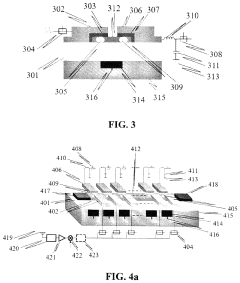

Quantum Coherence and Decoherence Considerations
Quantum coherence represents the fundamental property that enables quantum systems to exist in multiple states simultaneously, a critical feature for quantum computing operations. In spin qubits implemented in silicon, maintaining coherence is particularly challenging due to the complex interactions between electron spins and their environment. The primary decoherence mechanisms include hyperfine interactions with nuclear spins, spin-orbit coupling, and charge noise from nearby impurities or interfaces.
When implementing optical control mechanisms for silicon spin qubits, these decoherence factors become even more significant. Optical pulses can inadvertently generate phonons and free carriers, introducing additional decoherence channels. Recent experimental data indicates that coherence times (T2) for optically controlled silicon spin qubits typically range from microseconds to milliseconds, substantially shorter than electrically controlled counterparts which can reach seconds under optimal conditions.
The temperature dependence of decoherence processes presents another critical consideration. At higher temperatures, phonon-mediated spin relaxation becomes dominant, while at lower temperatures (below 100 mK), nuclear spin fluctuations often limit coherence. Optical control methods must therefore incorporate sophisticated cooling techniques to mitigate thermal decoherence effects while maintaining optical access to the qubit system.
Dynamic decoupling sequences have emerged as powerful tools for extending coherence times in optically controlled spin qubits. Techniques such as Carr-Purcell-Meiboom-Gill (CPMG) sequences, when adapted for optical control pulses, have demonstrated up to 50-fold improvements in coherence times. These approaches effectively filter out low-frequency noise components that would otherwise lead to phase errors in qubit operations.
Material engineering strategies also play a crucial role in addressing decoherence. Isotopically purified silicon (28Si) substantially reduces hyperfine interactions by eliminating 29Si nuclear spins. Recent studies have shown that optical control of spin qubits in isotopically purified silicon can achieve coherence times approaching 10 milliseconds, representing a significant advancement toward practical quantum computing applications.
Interface engineering between silicon and its surrounding materials presents another frontier in coherence preservation. Silicon-germanium heterostructures and carefully designed oxide interfaces have demonstrated reduced charge noise, a critical factor when optical excitation generates additional carriers in the system. These material innovations, combined with optimized optical pulse sequences, offer promising pathways toward maintaining quantum coherence during optical manipulation of silicon spin qubits.
When implementing optical control mechanisms for silicon spin qubits, these decoherence factors become even more significant. Optical pulses can inadvertently generate phonons and free carriers, introducing additional decoherence channels. Recent experimental data indicates that coherence times (T2) for optically controlled silicon spin qubits typically range from microseconds to milliseconds, substantially shorter than electrically controlled counterparts which can reach seconds under optimal conditions.
The temperature dependence of decoherence processes presents another critical consideration. At higher temperatures, phonon-mediated spin relaxation becomes dominant, while at lower temperatures (below 100 mK), nuclear spin fluctuations often limit coherence. Optical control methods must therefore incorporate sophisticated cooling techniques to mitigate thermal decoherence effects while maintaining optical access to the qubit system.
Dynamic decoupling sequences have emerged as powerful tools for extending coherence times in optically controlled spin qubits. Techniques such as Carr-Purcell-Meiboom-Gill (CPMG) sequences, when adapted for optical control pulses, have demonstrated up to 50-fold improvements in coherence times. These approaches effectively filter out low-frequency noise components that would otherwise lead to phase errors in qubit operations.
Material engineering strategies also play a crucial role in addressing decoherence. Isotopically purified silicon (28Si) substantially reduces hyperfine interactions by eliminating 29Si nuclear spins. Recent studies have shown that optical control of spin qubits in isotopically purified silicon can achieve coherence times approaching 10 milliseconds, representing a significant advancement toward practical quantum computing applications.
Interface engineering between silicon and its surrounding materials presents another frontier in coherence preservation. Silicon-germanium heterostructures and carefully designed oxide interfaces have demonstrated reduced charge noise, a critical factor when optical excitation generates additional carriers in the system. These material innovations, combined with optimized optical pulse sequences, offer promising pathways toward maintaining quantum coherence during optical manipulation of silicon spin qubits.
Integration Challenges with Conventional Silicon Technology
The integration of spin qubits with conventional silicon technology represents a significant challenge in the advancement of quantum computing systems. Despite silicon's dominance in the semiconductor industry, the precise requirements for quantum operations create substantial engineering hurdles. The ultra-high purity silicon needed for maintaining quantum coherence differs significantly from commercial silicon used in classical computing, necessitating specialized fabrication processes that are not readily available in standard CMOS facilities.
Temperature compatibility presents another major obstacle. While conventional silicon electronics operate at room temperature, spin qubits typically require extremely low temperatures (below 100 mK) to maintain quantum coherence. This thermal disparity complicates the co-integration of classical control electronics with quantum processing units, often requiring complex interconnect solutions that can traverse significant temperature gradients without compromising performance.
The dimensional precision required for spin qubit fabrication exceeds that of conventional silicon processing. Quantum devices demand atomic-level precision in dopant placement and gate definition, pushing the boundaries of even the most advanced lithography techniques. This precision requirement creates yield challenges that impact scalability and economic viability of integrated quantum-classical systems.
Signal integrity represents a further integration challenge. The optical control mechanisms for spin qubits are highly sensitive to electromagnetic interference, which is abundant in conventional silicon circuits. Isolating the quantum system from noise generated by classical components requires sophisticated shielding and filtering techniques that add complexity to the overall system architecture.
Manufacturing compatibility issues also arise from the divergent process flows. Spin qubit fabrication often involves specialized steps like isotopically purified silicon growth or single-ion implantation that are not standard in commercial semiconductor manufacturing. Adapting these processes to work within existing fabrication facilities requires significant retooling and process development.
The packaging of integrated quantum-classical systems presents unique challenges as well. Optical access requirements for spin qubit control must be accommodated while maintaining the vacuum and cryogenic environment necessary for operation. This often necessitates custom packaging solutions that are difficult to scale using conventional semiconductor assembly techniques.
Despite these challenges, recent advances in silicon photonics and cryogenic CMOS technologies offer promising pathways toward more seamless integration. Research efforts focusing on intermediate temperature operation and improved optical interfaces are gradually bridging the gap between quantum and classical silicon technologies, potentially enabling more practical hybrid computing architectures in the future.
Temperature compatibility presents another major obstacle. While conventional silicon electronics operate at room temperature, spin qubits typically require extremely low temperatures (below 100 mK) to maintain quantum coherence. This thermal disparity complicates the co-integration of classical control electronics with quantum processing units, often requiring complex interconnect solutions that can traverse significant temperature gradients without compromising performance.
The dimensional precision required for spin qubit fabrication exceeds that of conventional silicon processing. Quantum devices demand atomic-level precision in dopant placement and gate definition, pushing the boundaries of even the most advanced lithography techniques. This precision requirement creates yield challenges that impact scalability and economic viability of integrated quantum-classical systems.
Signal integrity represents a further integration challenge. The optical control mechanisms for spin qubits are highly sensitive to electromagnetic interference, which is abundant in conventional silicon circuits. Isolating the quantum system from noise generated by classical components requires sophisticated shielding and filtering techniques that add complexity to the overall system architecture.
Manufacturing compatibility issues also arise from the divergent process flows. Spin qubit fabrication often involves specialized steps like isotopically purified silicon growth or single-ion implantation that are not standard in commercial semiconductor manufacturing. Adapting these processes to work within existing fabrication facilities requires significant retooling and process development.
The packaging of integrated quantum-classical systems presents unique challenges as well. Optical access requirements for spin qubit control must be accommodated while maintaining the vacuum and cryogenic environment necessary for operation. This often necessitates custom packaging solutions that are difficult to scale using conventional semiconductor assembly techniques.
Despite these challenges, recent advances in silicon photonics and cryogenic CMOS technologies offer promising pathways toward more seamless integration. Research efforts focusing on intermediate temperature operation and improved optical interfaces are gradually bridging the gap between quantum and classical silicon technologies, potentially enabling more practical hybrid computing architectures in the future.
Unlock deeper insights with Patsnap Eureka Quick Research — get a full tech report to explore trends and direct your research. Try now!
Generate Your Research Report Instantly with AI Agent
Supercharge your innovation with Patsnap Eureka AI Agent Platform!