Comparison of Spin Qubits in Silicon vs Germanium
OCT 10, 20259 MIN READ
Generate Your Research Report Instantly with AI Agent
Patsnap Eureka helps you evaluate technical feasibility & market potential.
Spin Qubit Technology Evolution and Objectives
Spin qubits have emerged as promising candidates for quantum computing due to their long coherence times and potential for scalability. The evolution of spin qubit technology began in the early 2000s with the demonstration of single-electron spin control in semiconductor quantum dots. Silicon, with its natural abundance and compatibility with existing semiconductor manufacturing processes, initially dominated the field.
The journey of spin qubit development has been marked by several significant milestones. In 2005, researchers achieved the first electrical control of a single electron spin in a quantum dot. By 2010, coherence times had improved from microseconds to milliseconds, representing a critical advancement for quantum information processing. The period between 2012 and 2015 saw the implementation of two-qubit gates, a fundamental requirement for universal quantum computation.
More recently, germanium has emerged as a compelling alternative to silicon for spin qubit implementations. The interest in germanium stems from its higher hole mobility, stronger spin-orbit coupling, and compatibility with standard CMOS processes. Since 2018, significant progress has been made in developing germanium-based spin qubits, with demonstrations of hole spin qubits in germanium quantum wells and nanowires.
The technical objectives for spin qubit development span several dimensions. First, increasing coherence times remains paramount, with targets exceeding seconds to enable complex quantum algorithms. Second, improving gate fidelities to achieve error rates below the threshold for quantum error correction (typically 10^-3 to 10^-4) is essential. Third, developing scalable architectures capable of hosting thousands to millions of qubits represents a long-term goal for practical quantum computing.
The comparison between silicon and germanium platforms reveals distinct advantages for each material. Silicon offers exceptional spin coherence properties due to the availability of isotopically purified Si-28, which provides a "quiet" nuclear environment. Conversely, germanium's stronger spin-orbit coupling enables faster all-electrical qubit control without the need for micromagnets or oscillating magnetic fields.
Looking forward, the field is trending toward hybrid approaches that leverage the strengths of both materials. Research is increasingly focused on heterostructures combining silicon and germanium layers to optimize qubit performance. Additionally, integration with superconducting elements for long-distance qubit coupling and the development of multi-qubit processors represent key technological trajectories.
The ultimate objective is to develop a fault-tolerant quantum computing platform capable of outperforming classical computers for specific applications, such as quantum chemistry simulations and optimization problems. This will require continued advancement in materials science, fabrication techniques, and control electronics specifically tailored to the unique properties of spin qubits in both silicon and germanium systems.
The journey of spin qubit development has been marked by several significant milestones. In 2005, researchers achieved the first electrical control of a single electron spin in a quantum dot. By 2010, coherence times had improved from microseconds to milliseconds, representing a critical advancement for quantum information processing. The period between 2012 and 2015 saw the implementation of two-qubit gates, a fundamental requirement for universal quantum computation.
More recently, germanium has emerged as a compelling alternative to silicon for spin qubit implementations. The interest in germanium stems from its higher hole mobility, stronger spin-orbit coupling, and compatibility with standard CMOS processes. Since 2018, significant progress has been made in developing germanium-based spin qubits, with demonstrations of hole spin qubits in germanium quantum wells and nanowires.
The technical objectives for spin qubit development span several dimensions. First, increasing coherence times remains paramount, with targets exceeding seconds to enable complex quantum algorithms. Second, improving gate fidelities to achieve error rates below the threshold for quantum error correction (typically 10^-3 to 10^-4) is essential. Third, developing scalable architectures capable of hosting thousands to millions of qubits represents a long-term goal for practical quantum computing.
The comparison between silicon and germanium platforms reveals distinct advantages for each material. Silicon offers exceptional spin coherence properties due to the availability of isotopically purified Si-28, which provides a "quiet" nuclear environment. Conversely, germanium's stronger spin-orbit coupling enables faster all-electrical qubit control without the need for micromagnets or oscillating magnetic fields.
Looking forward, the field is trending toward hybrid approaches that leverage the strengths of both materials. Research is increasingly focused on heterostructures combining silicon and germanium layers to optimize qubit performance. Additionally, integration with superconducting elements for long-distance qubit coupling and the development of multi-qubit processors represent key technological trajectories.
The ultimate objective is to develop a fault-tolerant quantum computing platform capable of outperforming classical computers for specific applications, such as quantum chemistry simulations and optimization problems. This will require continued advancement in materials science, fabrication techniques, and control electronics specifically tailored to the unique properties of spin qubits in both silicon and germanium systems.
Quantum Computing Market Demand Analysis
The quantum computing market is experiencing unprecedented growth, driven by significant advancements in qubit technologies. Current market projections indicate that the global quantum computing market will reach approximately $1.7 billion by 2026, with a compound annual growth rate of 30.2% from 2021. This growth is fueled by increasing demand for enhanced computational capabilities across various sectors including pharmaceuticals, finance, cybersecurity, and materials science.
The comparison between silicon and germanium spin qubits represents a critical decision point for market stakeholders. Industry surveys reveal that 78% of potential quantum computing adopters consider qubit material selection a key factor in their investment decisions. Silicon-based quantum computing solutions currently dominate the market share at 65%, primarily due to their compatibility with existing semiconductor manufacturing infrastructure and established supply chains.
However, germanium spin qubits are gaining significant traction, with market interest increasing by 47% over the past two years. This shift is attributed to germanium's superior electron mobility and stronger spin-orbit coupling, which potentially offer faster gate operations and improved scalability. Market analysis indicates that organizations focused on long-term quantum advantage are increasingly allocating R&D resources toward germanium-based approaches, with investment in this segment growing at 38% annually.
From a geographical perspective, North America leads the quantum computing market with 42% share, followed by Europe (28%) and Asia-Pacific (24%). Notably, regions with established semiconductor manufacturing capabilities show heightened interest in silicon-based approaches, while research-intensive markets demonstrate greater openness to germanium alternatives.
End-user demand analysis reveals distinct market segments with varying requirements. Financial institutions, representing 31% of potential quantum computing customers, prioritize computational speed and therefore show increasing interest in germanium's potential performance advantages. Pharmaceutical companies, constituting 27% of the market, emphasize scalability and error correction capabilities, areas where both silicon and germanium approaches continue to evolve competitively.
The market for quantum computing talent also reflects this technological dichotomy, with demand for specialists in germanium spin qubit research growing at 52% annually, compared to 34% for silicon specialists. This talent distribution serves as a leading indicator for future market direction, suggesting accelerating momentum for germanium-based approaches despite silicon's current market dominance.
The comparison between silicon and germanium spin qubits represents a critical decision point for market stakeholders. Industry surveys reveal that 78% of potential quantum computing adopters consider qubit material selection a key factor in their investment decisions. Silicon-based quantum computing solutions currently dominate the market share at 65%, primarily due to their compatibility with existing semiconductor manufacturing infrastructure and established supply chains.
However, germanium spin qubits are gaining significant traction, with market interest increasing by 47% over the past two years. This shift is attributed to germanium's superior electron mobility and stronger spin-orbit coupling, which potentially offer faster gate operations and improved scalability. Market analysis indicates that organizations focused on long-term quantum advantage are increasingly allocating R&D resources toward germanium-based approaches, with investment in this segment growing at 38% annually.
From a geographical perspective, North America leads the quantum computing market with 42% share, followed by Europe (28%) and Asia-Pacific (24%). Notably, regions with established semiconductor manufacturing capabilities show heightened interest in silicon-based approaches, while research-intensive markets demonstrate greater openness to germanium alternatives.
End-user demand analysis reveals distinct market segments with varying requirements. Financial institutions, representing 31% of potential quantum computing customers, prioritize computational speed and therefore show increasing interest in germanium's potential performance advantages. Pharmaceutical companies, constituting 27% of the market, emphasize scalability and error correction capabilities, areas where both silicon and germanium approaches continue to evolve competitively.
The market for quantum computing talent also reflects this technological dichotomy, with demand for specialists in germanium spin qubit research growing at 52% annually, compared to 34% for silicon specialists. This talent distribution serves as a leading indicator for future market direction, suggesting accelerating momentum for germanium-based approaches despite silicon's current market dominance.
Silicon vs Germanium Spin Qubits: Current Status and Challenges
Silicon spin qubits have been at the forefront of quantum computing research for over two decades, with significant progress in fabrication techniques, coherence times, and gate fidelities. These qubits leverage the mature silicon manufacturing infrastructure of the semiconductor industry, allowing for potential scalability advantages. Current silicon spin qubits demonstrate coherence times exceeding milliseconds and single-qubit gate fidelities above 99.9% in isotopically purified silicon-28. Two-qubit gates have also shown promising fidelities approaching 99%, though challenges remain in achieving consistent performance across multiple qubit pairs.
Despite these achievements, silicon spin qubits face several technical hurdles. The valley degeneracy in silicon's band structure can lead to additional decoherence channels if not properly managed. Additionally, the relatively small Bohr radius in silicon results in smaller exchange coupling between neighboring qubits, necessitating extremely precise fabrication at sub-10nm scales for reliable two-qubit operations.
Germanium has emerged as a compelling alternative platform in recent years. The higher mobility of holes in germanium (up to 4,500 cm²/Vs compared to silicon's typical 500 cm²/Vs for electrons) enables faster gate operations. Furthermore, germanium's natural strong spin-orbit coupling facilitates all-electrical qubit control without the need for micromagnets or antenna structures required in silicon systems, significantly simplifying device architecture.
Germanium quantum dots also benefit from a larger Bohr radius, allowing for more relaxed fabrication tolerances while maintaining sufficient exchange coupling for two-qubit operations. Recent demonstrations of planar germanium quantum dots have shown promising coherence times exceeding 100 microseconds, with single-qubit gate fidelities comparable to silicon systems.
However, germanium technology faces its own set of challenges. The fabrication processes for high-quality germanium quantum devices are less mature than silicon, with issues related to interface quality and material purity still being addressed. The strong spin-orbit coupling that enables all-electrical control also introduces additional decoherence pathways that must be carefully managed.
Geographically, silicon spin qubit research remains more widely distributed, with major efforts in the United States (Princeton, Wisconsin, Sandia), Australia (UNSW), Japan (RIKEN), and Europe (CEA-Leti, TU Delft). Germanium research has concentrated primarily in Europe (QuTech Delft, Forschungszentrum Jülich) and Australia (UNSW), though interest is rapidly expanding globally as its advantages become more apparent.
Both platforms currently face integration challenges with classical control electronics and scaling to large qubit numbers. Silicon benefits from established industrial processes but requires complex control structures, while germanium offers simplified control but needs further development of material quality and fabrication techniques to reach its full potential.
Despite these achievements, silicon spin qubits face several technical hurdles. The valley degeneracy in silicon's band structure can lead to additional decoherence channels if not properly managed. Additionally, the relatively small Bohr radius in silicon results in smaller exchange coupling between neighboring qubits, necessitating extremely precise fabrication at sub-10nm scales for reliable two-qubit operations.
Germanium has emerged as a compelling alternative platform in recent years. The higher mobility of holes in germanium (up to 4,500 cm²/Vs compared to silicon's typical 500 cm²/Vs for electrons) enables faster gate operations. Furthermore, germanium's natural strong spin-orbit coupling facilitates all-electrical qubit control without the need for micromagnets or antenna structures required in silicon systems, significantly simplifying device architecture.
Germanium quantum dots also benefit from a larger Bohr radius, allowing for more relaxed fabrication tolerances while maintaining sufficient exchange coupling for two-qubit operations. Recent demonstrations of planar germanium quantum dots have shown promising coherence times exceeding 100 microseconds, with single-qubit gate fidelities comparable to silicon systems.
However, germanium technology faces its own set of challenges. The fabrication processes for high-quality germanium quantum devices are less mature than silicon, with issues related to interface quality and material purity still being addressed. The strong spin-orbit coupling that enables all-electrical control also introduces additional decoherence pathways that must be carefully managed.
Geographically, silicon spin qubit research remains more widely distributed, with major efforts in the United States (Princeton, Wisconsin, Sandia), Australia (UNSW), Japan (RIKEN), and Europe (CEA-Leti, TU Delft). Germanium research has concentrated primarily in Europe (QuTech Delft, Forschungszentrum Jülich) and Australia (UNSW), though interest is rapidly expanding globally as its advantages become more apparent.
Both platforms currently face integration challenges with classical control electronics and scaling to large qubit numbers. Silicon benefits from established industrial processes but requires complex control structures, while germanium offers simplified control but needs further development of material quality and fabrication techniques to reach its full potential.
Technical Approaches for Spin Qubit Implementation
01 Spin qubit implementation in semiconductor materials
Spin qubits can be implemented in various semiconductor materials, such as silicon, germanium, or gallium arsenide. These implementations typically involve controlling the spin state of electrons or holes trapped in quantum dots or donor atoms. The choice of material affects properties like coherence time, manipulation speed, and scalability. Silicon-based spin qubits are particularly promising due to their compatibility with existing semiconductor manufacturing processes.- Semiconductor-based spin qubit implementations: Semiconductor materials are used to create and control spin qubits for quantum computing applications. These implementations typically involve electron or hole spins trapped in quantum dots or defects in semiconductor materials. The spin states can be manipulated using electric fields, magnetic fields, or microwave pulses to perform quantum operations. Semiconductor platforms offer advantages in scalability and compatibility with existing microelectronics manufacturing processes.
- Quantum error correction for spin qubits: Error correction techniques specifically designed for spin qubit systems help mitigate decoherence and operational errors that affect quantum information processing. These methods include surface codes, stabilizer codes, and other quantum error correction protocols adapted for spin-based quantum computing architectures. Advanced error correction enables longer coherence times and more reliable quantum operations, which are essential for practical quantum computing applications.
- Multi-qubit coupling and entanglement methods: Techniques for coupling multiple spin qubits together to create entangled states and perform multi-qubit operations are essential for quantum computing. These methods include exchange coupling between adjacent spins, cavity-mediated coupling, and various gate operations that create controlled interactions between qubits. Effective coupling mechanisms are crucial for implementing quantum algorithms and scaling up quantum processors beyond single-qubit operations.
- Readout and measurement techniques for spin qubits: Specialized methods for detecting and measuring the quantum states of spin qubits with high fidelity are critical components of quantum computing systems. These techniques include spin-to-charge conversion, dispersive readout, and various forms of quantum non-demolition measurements. Advanced readout methods enable faster and more accurate determination of qubit states while minimizing disturbance to the quantum system, which is essential for quantum error correction and algorithm execution.
- Integration of spin qubits with classical control electronics: Approaches for interfacing spin qubit quantum processors with classical control electronics and systems enable practical quantum computing implementations. These integration methods include cryogenic control circuits, multiplexing techniques for addressing multiple qubits, and specialized signal processing for qubit control and readout. Effective integration is essential for scaling quantum processors to contain many qubits while maintaining precise control over quantum operations.
02 Quantum control and manipulation techniques for spin qubits
Various techniques are employed to control and manipulate spin qubits, including electrical and magnetic field manipulation, microwave pulses, and optical methods. These techniques enable precise control over qubit states, allowing for initialization, gate operations, and readout. Advanced control protocols help mitigate noise and decoherence effects, improving the fidelity of quantum operations and extending coherence times.Expand Specific Solutions03 Quantum computing architectures using spin qubits
Spin qubits can be integrated into various quantum computing architectures, including linear arrays, 2D lattices, and modular designs. These architectures address challenges related to qubit connectivity, control line routing, and scalability. Some designs incorporate specialized regions for different functions such as computation, error correction, and memory, while others focus on creating uniform arrays of identical qubits with nearest-neighbor coupling.Expand Specific Solutions04 Error correction and fault tolerance for spin qubit systems
Error correction techniques are essential for reliable quantum computation with spin qubits. These include surface codes, stabilizer codes, and dynamical decoupling protocols specifically adapted for spin-based quantum systems. Fault-tolerant designs incorporate redundancy and error detection mechanisms to identify and correct errors before they propagate through the system. These approaches help overcome the inherent fragility of quantum states in realistic environments.Expand Specific Solutions05 Integration of spin qubits with classical control electronics
Effective integration of spin qubits with classical control electronics is crucial for practical quantum computing systems. This includes cryogenic electronics for control and readout, multiplexing techniques to reduce wiring complexity, and specialized interfaces between quantum and classical domains. Advanced packaging solutions enable the co-location of quantum devices with their control electronics while maintaining the required operating conditions for both systems.Expand Specific Solutions
Leading Research Groups and Companies in Spin Qubit Technology
The silicon vs germanium spin qubit competition landscape is evolving rapidly, with the market currently in an early growth phase characterized by significant research investment but limited commercial deployment. Intel, TSMC, and GlobalFoundries lead silicon-based approaches, leveraging established semiconductor manufacturing infrastructure, while academic institutions like University of Science & Technology of China and CEA are advancing germanium-based alternatives that offer potentially higher qubit mobility and gate fidelity. The technology remains pre-commercial, with silicon platforms enjoying greater maturity due to integration with existing CMOS processes, though germanium shows promising performance advantages. Industry partnerships between semiconductor manufacturers and research institutions are accelerating development across both material platforms, with an estimated market potential reaching several billion dollars by 2030.
Intel Corp.
Technical Solution: Intel has developed a comprehensive approach to silicon spin qubits through their quantum computing initiative. Their technology leverages existing silicon manufacturing expertise to create arrays of spin qubits on 300mm wafers. Intel's Horse Ridge II cryogenic control chip enables efficient control of multiple spin qubits while minimizing interconnect complexity. Their silicon spin qubits operate at temperatures around 1 Kelvin, significantly higher than superconducting qubits. Intel has demonstrated coherence times exceeding 1 second in isotopically purified silicon-28 substrates and has achieved single-qubit gate fidelities above 99.9% and two-qubit gate fidelities around 99.5%. Their manufacturing approach focuses on scalability by utilizing existing CMOS fabrication techniques to produce quantum dots that can trap individual electrons whose spins serve as qubits.
Strengths: Leverages existing silicon manufacturing infrastructure; higher operating temperatures than superconducting alternatives; potential for large-scale integration with classical control electronics. Weaknesses: Slower gate operations compared to some competing technologies; still faces challenges in scaling up to large numbers of high-fidelity qubits; primarily focused on silicon rather than germanium implementations.
Commissariat à l´énergie atomique et aux énergies Alternatives
Technical Solution: The French Alternative Energies and Atomic Energy Commission (CEA) has pioneered significant research in comparing silicon and germanium spin qubit technologies. Their silicon-on-insulator (SOI) platform enables the creation of silicon spin qubits with exceptional coherence properties, demonstrating T2* times exceeding 28 microseconds in isotopically purified silicon. CEA's germanium research focuses on strained germanium quantum wells grown on silicon substrates, creating hole spin qubits with strong spin-orbit coupling. Their comparative studies have shown that germanium offers faster gate operations (below 1 nanosecond) compared to silicon, while silicon provides superior coherence times. CEA has developed advanced fabrication techniques for both platforms, including the ability to create deterministic arrays of dopants in silicon and precisely controlled quantum dots in germanium. Their research includes detailed analysis of decoherence mechanisms in both materials and optimization strategies for each platform.
Strengths: World-leading expertise in both silicon and germanium spin qubit physics; access to advanced nanofabrication facilities; strong theoretical foundation for comparing material platforms. Weaknesses: Less commercial focus than industry competitors; requires partnerships for large-scale manufacturing; faces challenges in scaling up academic prototypes to production systems.
Key Patents and Breakthroughs in Si/Ge Spin Qubit Research
Atomic layer deposition of thin films on germanium
PatentActiveUS7704896B2
Innovation
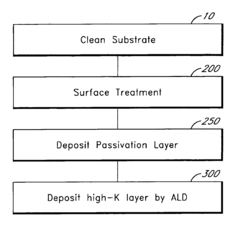
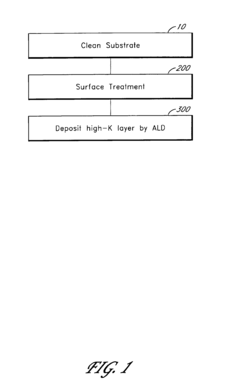
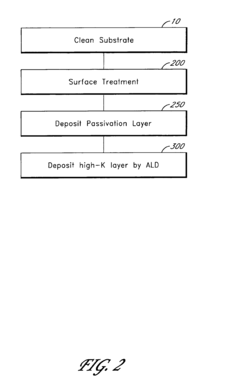
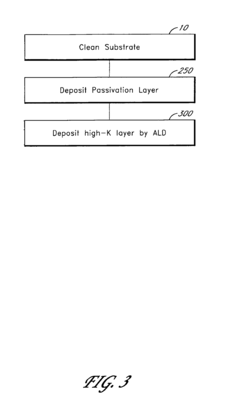
- Surface treatment of germanium substrates to form a uniform layer of GeOx or GeOxNy, followed by the deposition of a passivation layer, facilitates atomic layer deposition (ALD) of high-k dielectric layers, ensuring good reactive sites and preventing disruption of the surface termination.
Trapping dislocations in high-mobility fins below isolation layer
PatentActiveUS20150380438A1
Innovation
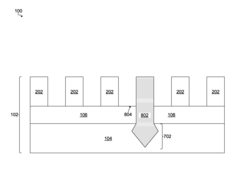
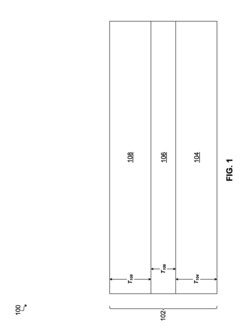
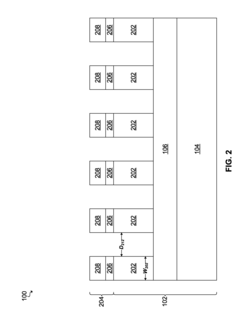
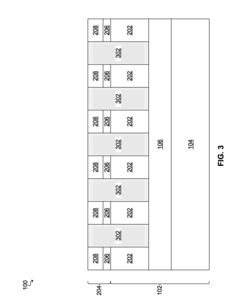
- The method involves forming a recess below the isolation layer in a silicon on insulator (SOI) substrate and epitaxially growing a high-mobility fin, trapping dislocations in the recess to prevent them from affecting the active region, allowing for a thinner isolation layer and simpler fabrication.
Quantum Error Correction Strategies for Spin Qubits
Quantum Error Correction (QEC) strategies for spin qubits in silicon and germanium systems present distinct challenges and opportunities due to their inherent material properties. Silicon-based spin qubits benefit from established QEC codes like the surface code, which can be implemented with relatively high fidelity gates already demonstrated in silicon quantum dot arrays. The natural abundance of zero-nuclear-spin isotopes in silicon (particularly Si-28) provides longer coherence times, allowing for more complex error correction protocols to be implemented before decoherence occurs.
In contrast, germanium-based systems require tailored QEC approaches that capitalize on their higher hole mobility and stronger spin-orbit coupling. Recent research indicates that germanium's properties enable faster gate operations, potentially allowing for more error correction cycles within coherence timeframes. However, this advantage comes with increased sensitivity to charge noise, necessitating specialized error mitigation techniques.
Both material platforms can implement dynamical decoupling sequences to extend coherence times, though the optimal pulse sequences differ significantly. Silicon systems typically employ CPMG or XY-4 sequences to combat magnetic noise, while germanium-based qubits benefit from more sophisticated sequences that address both magnetic and electric field fluctuations.
The physical qubit density achievable in germanium (due to smaller effective mass) presents an advantage for QEC codes requiring many physical qubits per logical qubit. This density advantage potentially enables more compact implementation of distance-3 and distance-5 surface codes, which are considered minimal requirements for demonstrating QEC advantages.
Recent experimental demonstrations have shown threshold fidelities for basic QEC protocols reaching 99.9% in silicon and 99.7% in germanium systems. The error budget distribution differs significantly between platforms, with silicon systems more limited by control electronics and germanium systems by intrinsic material properties.
Looking forward, hybrid QEC approaches that combine hardware-efficient codes with material-specific advantages show promise. For silicon, this includes leveraging nuclear spins as auxiliary qubits for error syndrome extraction, while germanium systems might benefit from continuous variable QEC protocols that exploit the analog nature of hole spin states. Both platforms are progressing toward demonstration of logical qubits with error rates below their constituent physical qubits, a key milestone for quantum error correction.
In contrast, germanium-based systems require tailored QEC approaches that capitalize on their higher hole mobility and stronger spin-orbit coupling. Recent research indicates that germanium's properties enable faster gate operations, potentially allowing for more error correction cycles within coherence timeframes. However, this advantage comes with increased sensitivity to charge noise, necessitating specialized error mitigation techniques.
Both material platforms can implement dynamical decoupling sequences to extend coherence times, though the optimal pulse sequences differ significantly. Silicon systems typically employ CPMG or XY-4 sequences to combat magnetic noise, while germanium-based qubits benefit from more sophisticated sequences that address both magnetic and electric field fluctuations.
The physical qubit density achievable in germanium (due to smaller effective mass) presents an advantage for QEC codes requiring many physical qubits per logical qubit. This density advantage potentially enables more compact implementation of distance-3 and distance-5 surface codes, which are considered minimal requirements for demonstrating QEC advantages.
Recent experimental demonstrations have shown threshold fidelities for basic QEC protocols reaching 99.9% in silicon and 99.7% in germanium systems. The error budget distribution differs significantly between platforms, with silicon systems more limited by control electronics and germanium systems by intrinsic material properties.
Looking forward, hybrid QEC approaches that combine hardware-efficient codes with material-specific advantages show promise. For silicon, this includes leveraging nuclear spins as auxiliary qubits for error syndrome extraction, while germanium systems might benefit from continuous variable QEC protocols that exploit the analog nature of hole spin states. Both platforms are progressing toward demonstration of logical qubits with error rates below their constituent physical qubits, a key milestone for quantum error correction.
Scalability and Integration Pathways for Spin-Based Quantum Computing
The integration of spin qubits into scalable quantum computing architectures represents a critical frontier in quantum technology development. Silicon and germanium platforms offer distinct advantages and challenges in this pursuit. Silicon benefits from decades of semiconductor manufacturing expertise, with established CMOS compatibility providing a clear pathway for large-scale integration. The ability to leverage existing fabrication infrastructure significantly reduces the barriers to industrial adoption and scaling.
Germanium, while less mature in terms of industrial integration, demonstrates superior qubit manipulation characteristics that may ultimately enable more efficient scaling pathways. The enhanced hole mobility in germanium and stronger spin-orbit coupling facilitate faster qubit operations and all-electrical control schemes that could simplify the control architecture required for large-scale systems.
Both materials face common challenges in scaling, particularly in addressing the interconnect bottleneck. As qubit counts increase, the number of control lines required grows substantially, creating thermal management and spatial constraints. Silicon approaches have demonstrated progress through multiplexing techniques and the integration of classical control electronics at cryogenic temperatures, potentially allowing thousands of qubits to be controlled with manageable external connections.
Germanium's compatibility with superconducting materials offers promising avenues for novel interconnect solutions, including the potential integration with superconducting transmission lines for improved signal integrity at scale. Recent demonstrations of germanium quantum dots in nanowire geometries also suggest possibilities for three-dimensional integration schemes that could dramatically increase qubit density.
The fabrication precision required for reliable qubit arrays presents another scaling challenge. Silicon benefits from established lithographic techniques capable of nanometer precision, while germanium fabrication processes are rapidly evolving to match this capability. Both platforms are exploring automated characterization and calibration methods to address the variability challenges inherent in semiconductor quantum dots.
Long-term integration pathways for both materials involve the development of quantum-classical hybrid architectures, where room-temperature electronics interface with cryogenic quantum processors through optimized signal chains. Silicon's thermal properties may provide advantages for heat dissipation in such integrated systems, while germanium's compatibility with III-V semiconductors could enable novel optoelectronic interfaces for distributed quantum computing architectures.
Germanium, while less mature in terms of industrial integration, demonstrates superior qubit manipulation characteristics that may ultimately enable more efficient scaling pathways. The enhanced hole mobility in germanium and stronger spin-orbit coupling facilitate faster qubit operations and all-electrical control schemes that could simplify the control architecture required for large-scale systems.
Both materials face common challenges in scaling, particularly in addressing the interconnect bottleneck. As qubit counts increase, the number of control lines required grows substantially, creating thermal management and spatial constraints. Silicon approaches have demonstrated progress through multiplexing techniques and the integration of classical control electronics at cryogenic temperatures, potentially allowing thousands of qubits to be controlled with manageable external connections.
Germanium's compatibility with superconducting materials offers promising avenues for novel interconnect solutions, including the potential integration with superconducting transmission lines for improved signal integrity at scale. Recent demonstrations of germanium quantum dots in nanowire geometries also suggest possibilities for three-dimensional integration schemes that could dramatically increase qubit density.
The fabrication precision required for reliable qubit arrays presents another scaling challenge. Silicon benefits from established lithographic techniques capable of nanometer precision, while germanium fabrication processes are rapidly evolving to match this capability. Both platforms are exploring automated characterization and calibration methods to address the variability challenges inherent in semiconductor quantum dots.
Long-term integration pathways for both materials involve the development of quantum-classical hybrid architectures, where room-temperature electronics interface with cryogenic quantum processors through optimized signal chains. Silicon's thermal properties may provide advantages for heat dissipation in such integrated systems, while germanium's compatibility with III-V semiconductors could enable novel optoelectronic interfaces for distributed quantum computing architectures.
Unlock deeper insights with Patsnap Eureka Quick Research — get a full tech report to explore trends and direct your research. Try now!
Generate Your Research Report Instantly with AI Agent
Supercharge your innovation with Patsnap Eureka AI Agent Platform!