How to Enhance Phased Array Functionality in Smart Cities
SEP 22, 20259 MIN READ
Generate Your Research Report Instantly with AI Agent
Patsnap Eureka helps you evaluate technical feasibility & market potential.
Phased Array Technology Evolution and Objectives
Phased array technology has evolved significantly over the past several decades, transitioning from primarily military applications to becoming a cornerstone technology in modern telecommunications and sensing systems. Originally developed for radar systems during World War II, phased arrays have undergone substantial miniaturization and cost reduction, enabling their integration into commercial applications. The fundamental principle—electronically steering radio waves without mechanical movement—remains unchanged, but implementation has evolved from analog to digital beamforming, dramatically increasing flexibility and performance.
In smart city contexts, phased array technology has emerged as a critical enabler for multiple infrastructure systems. The evolution path shows clear progression from single-function, fixed-beam arrays to today's multi-functional, software-defined systems capable of supporting multiple simultaneous beams and applications. This technological maturation coincides with the growing demands of urban environments for high-bandwidth communications, intelligent transportation systems, and comprehensive environmental monitoring.
Recent advancements in semiconductor technology, particularly in silicon-based RF components and GaN (Gallium Nitride) technology, have accelerated phased array development by reducing power consumption while improving performance. The integration of AI and machine learning algorithms has further enhanced adaptive beamforming capabilities, allowing systems to optimize performance in real-time based on environmental conditions and usage patterns.
The primary objective for enhancing phased array functionality in smart cities is to develop unified sensing and communication platforms that can simultaneously serve multiple urban applications. This includes creating systems capable of supporting high-bandwidth 5G/6G communications while simultaneously providing environmental sensing, traffic monitoring, and public safety applications through the same physical infrastructure.
Technical objectives include increasing spectral efficiency through advanced beamforming techniques, reducing energy consumption through more efficient RF components, and developing multi-band arrays capable of operating across diverse frequency ranges. Additionally, there is a strong focus on creating cost-effective deployment models that leverage existing urban infrastructure for mounting and powering these systems.
Looking forward, the technology roadmap aims to achieve fully integrated, autonomous phased array networks that can self-optimize based on changing urban conditions. This includes developing systems with enhanced interference mitigation capabilities, improved weather resilience, and the ability to dynamically allocate resources between communication and sensing functions based on real-time demand patterns. The ultimate goal is to create an invisible but omnipresent technological layer that enhances urban living while minimizing visual impact and energy consumption.
In smart city contexts, phased array technology has emerged as a critical enabler for multiple infrastructure systems. The evolution path shows clear progression from single-function, fixed-beam arrays to today's multi-functional, software-defined systems capable of supporting multiple simultaneous beams and applications. This technological maturation coincides with the growing demands of urban environments for high-bandwidth communications, intelligent transportation systems, and comprehensive environmental monitoring.
Recent advancements in semiconductor technology, particularly in silicon-based RF components and GaN (Gallium Nitride) technology, have accelerated phased array development by reducing power consumption while improving performance. The integration of AI and machine learning algorithms has further enhanced adaptive beamforming capabilities, allowing systems to optimize performance in real-time based on environmental conditions and usage patterns.
The primary objective for enhancing phased array functionality in smart cities is to develop unified sensing and communication platforms that can simultaneously serve multiple urban applications. This includes creating systems capable of supporting high-bandwidth 5G/6G communications while simultaneously providing environmental sensing, traffic monitoring, and public safety applications through the same physical infrastructure.
Technical objectives include increasing spectral efficiency through advanced beamforming techniques, reducing energy consumption through more efficient RF components, and developing multi-band arrays capable of operating across diverse frequency ranges. Additionally, there is a strong focus on creating cost-effective deployment models that leverage existing urban infrastructure for mounting and powering these systems.
Looking forward, the technology roadmap aims to achieve fully integrated, autonomous phased array networks that can self-optimize based on changing urban conditions. This includes developing systems with enhanced interference mitigation capabilities, improved weather resilience, and the ability to dynamically allocate resources between communication and sensing functions based on real-time demand patterns. The ultimate goal is to create an invisible but omnipresent technological layer that enhances urban living while minimizing visual impact and energy consumption.
Smart City Market Demand Analysis
The smart city market is experiencing unprecedented growth, driven by increasing urbanization and the need for efficient resource management. According to recent market research, the global smart city market is projected to reach $2.5 trillion by 2025, with a compound annual growth rate of approximately 18.9% from 2020. This substantial growth reflects the increasing demand for integrated technological solutions that can address urban challenges effectively.
Phased array technology, particularly in the context of smart cities, addresses several critical market needs. Urban security and surveillance systems require advanced sensing capabilities that can adapt to changing environmental conditions and threat scenarios. Phased arrays offer dynamic beam steering and multiple target tracking, making them ideal for comprehensive security coverage across urban environments without the need for multiple fixed installations.
Traffic management represents another significant market demand, with cities worldwide struggling to optimize vehicle flow and reduce congestion. Phased array radar systems can simultaneously monitor multiple traffic lanes and intersections, providing real-time data on vehicle density, speed, and movement patterns. This capability enables adaptive traffic signal control and proactive congestion management, potentially reducing commute times by up to 25% in heavily congested urban areas.
Environmental monitoring has emerged as a priority for urban planners and city administrators. Phased array sensors can detect air quality parameters, noise levels, and weather conditions across wide urban areas with high precision. The market for environmental monitoring solutions in smart cities is growing at 22% annually, reflecting increasing public concern about urban pollution and its health impacts.
Public safety applications represent a substantial market segment, with cities investing heavily in early warning systems for natural disasters and emergency response infrastructure. Phased array technology enables wide-area monitoring for flood detection, seismic activity, and other potential hazards, while facilitating rapid communication during emergencies through adaptive wireless networks.
The telecommunications sector is driving significant demand for phased array technology, particularly with the ongoing deployment of 5G networks. Smart cities require ubiquitous connectivity to support IoT devices, autonomous vehicles, and public services. Phased array antennas enable dynamic beam forming that can optimize signal strength and coverage in dense urban environments, addressing the growing bandwidth demands of connected city infrastructure.
Energy efficiency initiatives are creating market opportunities for phased array applications in smart grid management and building automation. These systems can monitor power distribution networks and optimize energy consumption patterns across urban areas, supporting sustainability goals while reducing operational costs for municipalities.
Phased array technology, particularly in the context of smart cities, addresses several critical market needs. Urban security and surveillance systems require advanced sensing capabilities that can adapt to changing environmental conditions and threat scenarios. Phased arrays offer dynamic beam steering and multiple target tracking, making them ideal for comprehensive security coverage across urban environments without the need for multiple fixed installations.
Traffic management represents another significant market demand, with cities worldwide struggling to optimize vehicle flow and reduce congestion. Phased array radar systems can simultaneously monitor multiple traffic lanes and intersections, providing real-time data on vehicle density, speed, and movement patterns. This capability enables adaptive traffic signal control and proactive congestion management, potentially reducing commute times by up to 25% in heavily congested urban areas.
Environmental monitoring has emerged as a priority for urban planners and city administrators. Phased array sensors can detect air quality parameters, noise levels, and weather conditions across wide urban areas with high precision. The market for environmental monitoring solutions in smart cities is growing at 22% annually, reflecting increasing public concern about urban pollution and its health impacts.
Public safety applications represent a substantial market segment, with cities investing heavily in early warning systems for natural disasters and emergency response infrastructure. Phased array technology enables wide-area monitoring for flood detection, seismic activity, and other potential hazards, while facilitating rapid communication during emergencies through adaptive wireless networks.
The telecommunications sector is driving significant demand for phased array technology, particularly with the ongoing deployment of 5G networks. Smart cities require ubiquitous connectivity to support IoT devices, autonomous vehicles, and public services. Phased array antennas enable dynamic beam forming that can optimize signal strength and coverage in dense urban environments, addressing the growing bandwidth demands of connected city infrastructure.
Energy efficiency initiatives are creating market opportunities for phased array applications in smart grid management and building automation. These systems can monitor power distribution networks and optimize energy consumption patterns across urban areas, supporting sustainability goals while reducing operational costs for municipalities.
Current Phased Array Implementation Challenges
Despite the promising potential of phased array technology in smart cities, several significant implementation challenges currently hinder its widespread adoption and optimal functionality. The most pressing issue is the high cost associated with traditional phased array systems, which typically require expensive components such as phase shifters, power amplifiers, and specialized RF circuitry. This cost barrier makes large-scale deployment across urban environments economically prohibitive for many municipalities and service providers.
Power consumption presents another major challenge, as conventional phased array systems demand substantial energy to operate effectively. This is particularly problematic in smart city applications where numerous arrays would need to function continuously across distributed locations, often with limited access to power infrastructure. The resulting energy demands conflict with sustainability goals that are central to many smart city initiatives.
Size and form factor limitations also constrain implementation possibilities. Current phased array hardware tends to be bulky and difficult to integrate unobtrusively into urban landscapes. This creates both aesthetic concerns and practical installation challenges when attempting to incorporate these systems into existing city infrastructure without disrupting architectural integrity or public spaces.
Environmental resilience represents a significant technical hurdle, as phased arrays deployed in urban settings must withstand diverse and often harsh conditions including temperature fluctuations, precipitation, pollution, and vibration. Many existing systems lack the robustness required for long-term outdoor deployment without frequent maintenance or performance degradation.
Interference management poses increasingly complex challenges in densely populated urban environments saturated with wireless signals. Phased arrays must operate reliably amidst this electromagnetic congestion while avoiding disruption to other critical communication systems. Current solutions often struggle to maintain performance in such crowded spectral environments.
Scalability and network integration difficulties further complicate implementation. Existing phased array technologies frequently lack standardized interfaces and protocols for seamless integration with other smart city systems and data platforms. This interoperability gap prevents the creation of truly cohesive smart city networks that can leverage the full potential of phased array capabilities.
Technical expertise requirements create operational barriers, as the installation, calibration, and maintenance of phased array systems typically demand specialized knowledge that may not be readily available within municipal workforces. This expertise gap can lead to suboptimal performance or increased operational costs when external specialists must be contracted.
Power consumption presents another major challenge, as conventional phased array systems demand substantial energy to operate effectively. This is particularly problematic in smart city applications where numerous arrays would need to function continuously across distributed locations, often with limited access to power infrastructure. The resulting energy demands conflict with sustainability goals that are central to many smart city initiatives.
Size and form factor limitations also constrain implementation possibilities. Current phased array hardware tends to be bulky and difficult to integrate unobtrusively into urban landscapes. This creates both aesthetic concerns and practical installation challenges when attempting to incorporate these systems into existing city infrastructure without disrupting architectural integrity or public spaces.
Environmental resilience represents a significant technical hurdle, as phased arrays deployed in urban settings must withstand diverse and often harsh conditions including temperature fluctuations, precipitation, pollution, and vibration. Many existing systems lack the robustness required for long-term outdoor deployment without frequent maintenance or performance degradation.
Interference management poses increasingly complex challenges in densely populated urban environments saturated with wireless signals. Phased arrays must operate reliably amidst this electromagnetic congestion while avoiding disruption to other critical communication systems. Current solutions often struggle to maintain performance in such crowded spectral environments.
Scalability and network integration difficulties further complicate implementation. Existing phased array technologies frequently lack standardized interfaces and protocols for seamless integration with other smart city systems and data platforms. This interoperability gap prevents the creation of truly cohesive smart city networks that can leverage the full potential of phased array capabilities.
Technical expertise requirements create operational barriers, as the installation, calibration, and maintenance of phased array systems typically demand specialized knowledge that may not be readily available within municipal workforces. This expertise gap can lead to suboptimal performance or increased operational costs when external specialists must be contracted.
Current Phased Array Solutions for Urban Environments
01 Phased array antenna design and beam steering
Phased array antennas utilize multiple radiating elements with electronically controlled phase shifters to steer the beam direction without mechanical movement. These systems enable dynamic beam forming and steering capabilities for applications in radar, communications, and sensing. The technology allows for rapid scanning across different directions and can form multiple simultaneous beams, significantly enhancing system flexibility and performance in various environments.- Phased array antenna design and beam steering: Phased array antennas utilize multiple radiating elements with electronically controlled phase shifters to direct the beam in desired directions without mechanical movement. These systems enable dynamic beam steering by adjusting the phase relationships between elements, allowing for rapid scanning across different directions. Advanced designs incorporate digital beamforming techniques to create multiple simultaneous beams and adaptive nulling capabilities to mitigate interference.
- Memory architecture for phased array systems: Specialized memory architectures support the high-bandwidth data processing requirements of phased array systems. These include distributed memory configurations, parallel processing structures, and dedicated buffer systems that facilitate real-time signal processing. Memory management techniques optimize data flow between array elements and processing units, reducing latency and improving system performance for applications requiring rapid beam steering and signal analysis.
- Signal processing techniques for phased arrays: Advanced signal processing algorithms enhance phased array functionality through digital beamforming, adaptive filtering, and interference cancellation. These techniques enable improved target detection, tracking precision, and system performance in challenging electromagnetic environments. Modern implementations utilize FPGA and ASIC technologies to perform complex computations in real-time, supporting applications in radar, communications, and imaging systems.
- Power management in phased array systems: Efficient power distribution and management are critical for phased array functionality, particularly in portable or space-constrained applications. Techniques include dynamic power allocation to active elements, thermal management systems, and low-power operational modes. Advanced designs incorporate energy harvesting, power cycling, and intelligent power distribution networks to optimize performance while minimizing energy consumption.
- Calibration and synchronization methods: Precise calibration and synchronization mechanisms ensure optimal phased array performance by compensating for manufacturing variations, environmental effects, and aging. These methods include automated self-calibration routines, phase and amplitude correction algorithms, and reference signal distribution networks. Real-time monitoring and adjustment capabilities maintain system accuracy over time and across varying operational conditions, ensuring consistent beam pattern formation and direction finding capabilities.
02 Memory architecture for phased array systems
Specialized memory architectures are implemented in phased array systems to handle the high-speed data processing requirements. These architectures include optimized data storage and retrieval mechanisms that support real-time signal processing for beam forming operations. The memory systems are designed to manage parallel data streams from multiple array elements, with features like distributed memory access and specialized addressing schemes to reduce latency and improve throughput in phased array applications.Expand Specific Solutions03 Signal processing techniques for phased arrays
Advanced signal processing techniques are essential for optimizing phased array performance. These include digital beamforming algorithms, interference cancellation methods, and adaptive filtering to enhance signal quality and system sensitivity. Signal processing implementations enable features such as spatial filtering, target tracking, and environmental adaptation, allowing phased array systems to operate effectively in complex electromagnetic environments with multiple signals and noise sources.Expand Specific Solutions04 Power management in phased array systems
Efficient power management is critical in phased array systems due to their distributed nature and high component count. Techniques include selective element activation, dynamic power allocation based on operational requirements, and advanced cooling solutions. Power distribution networks are designed to deliver consistent performance across the array while minimizing power consumption, heat generation, and system complexity, which is particularly important for mobile or space-based applications.Expand Specific Solutions05 Integration and packaging technologies for phased arrays
Innovative integration and packaging technologies enable compact, reliable phased array implementations. These include multi-chip modules, system-in-package solutions, and advanced interconnect technologies that combine RF components, control circuitry, and thermal management in dense configurations. Miniaturization techniques allow for the development of highly integrated phased arrays with reduced size, weight, and power requirements while maintaining or improving performance characteristics.Expand Specific Solutions
Leading Smart City Technology Providers
The phased array technology market in smart cities is currently in a growth phase, with an expanding market size driven by increasing urban connectivity demands. The competitive landscape is characterized by established telecommunications giants like Huawei, ZTE, and Ericsson leading commercial deployments, while defense contractors such as Raytheon and Rafael Advanced Defense Systems contribute specialized expertise. Technical maturity varies across applications, with companies like IBM and Samsung advancing integration with AI and IoT platforms. Research institutions including MIT and Arizona State University are pushing boundaries in novel phased array implementations. The ecosystem shows a blend of mature technologies for conventional communications and emerging innovations for smart city applications, with companies like InterDigital and MaxLinear developing specialized components to enhance functionality and efficiency.
Huawei Technologies Co., Ltd.
Technical Solution: Huawei has developed an advanced phased array system for smart cities that integrates 5G massive MIMO technology with intelligent beamforming capabilities. Their solution employs a distributed architecture where multiple small-cell phased arrays work in coordination across urban environments, creating a mesh network that enhances coverage and capacity. The system utilizes AI-driven predictive algorithms to dynamically adjust beam patterns based on traffic patterns, population density, and time-of-day usage metrics[1]. Huawei's phased arrays incorporate over 128 antenna elements per unit, enabling precise spatial filtering and interference mitigation in dense urban environments. Their proprietary chipsets support multi-band operation (sub-6GHz and mmWave) with integrated power amplifiers that optimize energy consumption while maintaining signal integrity across varying atmospheric conditions[3]. The system also features self-calibration mechanisms that compensate for environmental changes and aging components, ensuring consistent performance over extended deployment periods.
Strengths: Superior integration with existing 5G infrastructure, industry-leading power efficiency, and advanced AI-driven beam management. Their solution offers exceptional scalability for varying city sizes and densities. Weaknesses: Higher initial deployment costs compared to conventional systems, and potential vendor lock-in due to proprietary hardware and software components.
Massachusetts Institute of Technology
Technical Solution: MIT has pioneered a revolutionary approach to phased array technology for smart cities through their "Urban Sensing Network" (USN) platform. Unlike conventional solutions that focus primarily on communications, MIT's approach integrates sensing, communications, and computing into a unified phased array architecture. Their system employs metamaterial-based electronically scanned arrays that achieve wide scanning angles (±70°) while maintaining high gain across the entire field of view[1]. MIT's phased arrays incorporate novel signal processing techniques that enable simultaneous operation as communication nodes and distributed radar sensors, providing real-time environmental awareness for applications ranging from traffic monitoring to public safety. The USN platform features cognitive radio capabilities that dynamically adapt to the electromagnetic environment, automatically selecting optimal frequencies and waveforms to maximize performance while minimizing interference[4]. MIT researchers have developed specialized machine learning algorithms that enable the phased arrays to identify and track objects of interest, from vehicles to pedestrians, while preserving privacy through edge-based processing that extracts only anonymized metadata. Their system architecture supports federated learning across distributed nodes, enabling continuous improvement of sensing and communication performance without centralizing sensitive data.
Strengths: Unparalleled integration of sensing and communication functions, cutting-edge research-driven algorithms, and strong focus on privacy preservation. Weaknesses: Less mature commercial deployment experience compared to industry players, and potentially higher implementation complexity requiring specialized expertise for deployment and maintenance.
Key Patents in Smart City Phased Array Systems
Distribution stage for enabling efficient expansion of a switching network
PatentActiveUS7672301B2
Innovation
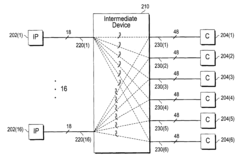
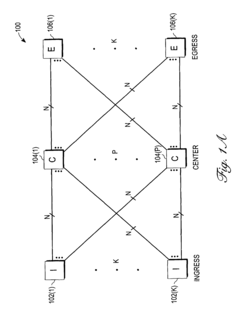
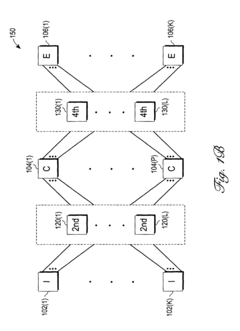
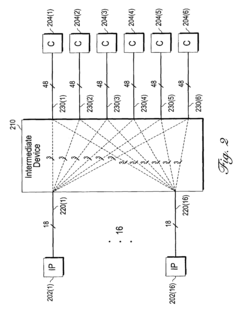
- The introduction of a distribution stage between the first and second stages of a switching network, which distributes bandwidth units from each first stage switching device to each second stage switching device, ensuring each second stage device receives at least one unit, thereby allowing the center stage and overall array to be more freely expanded without degrading switching performance or increasing complexity.
Urban Infrastructure Integration Strategies
Integrating phased array systems into urban infrastructure requires a strategic approach that balances technological capabilities with existing city frameworks. Smart cities can leverage phased array technology by embedding these systems into streetlights, traffic signals, building facades, and public transportation hubs. This integration creates a comprehensive network that enhances communication capabilities while maintaining aesthetic and functional harmony with the urban landscape.
The deployment strategy should prioritize high-traffic areas and critical infrastructure nodes first, creating a backbone network that can be gradually expanded. Modular installation designs allow for scalable implementation, enabling cities to adapt the technology according to budgetary constraints and evolving needs. Standardized mounting interfaces across different urban fixtures facilitate consistent deployment and simplify maintenance procedures.
Power management represents a significant integration challenge. Phased array systems require reliable power sources, which can be addressed through hybrid solutions combining grid connections with renewable energy sources such as solar panels integrated into streetlights or wind turbines on building rooftops. These sustainable power solutions reduce operational costs while enhancing system resilience during grid outages.
Data backhaul infrastructure must be carefully planned to handle the increased bandwidth demands of phased array systems. Fiber optic networks serve as the primary backbone, with strategic wireless backhaul points to ensure comprehensive coverage. Edge computing nodes positioned at key integration points can process data locally, reducing latency and bandwidth requirements for the central network.
Weatherproofing and environmental hardening are essential considerations for outdoor phased array deployments. Protective enclosures must shield sensitive electronics while allowing radio frequency signals to pass unimpeded. Advanced materials and design techniques can mitigate the effects of temperature fluctuations, precipitation, and urban pollution on system performance.
Regulatory compliance presents another integration challenge, particularly regarding electromagnetic emissions and visual impact. Camouflage techniques and architectural integration approaches can minimize the visual footprint of phased array systems. Working closely with urban planning departments ensures that deployments comply with local ordinances while meeting technical requirements for optimal performance.
Multi-stakeholder coordination frameworks facilitate collaboration between technology providers, city administrators, utility companies, and community representatives. These partnerships are crucial for addressing concerns about privacy, security, and equitable access to the benefits of phased array technology across diverse urban neighborhoods.
The deployment strategy should prioritize high-traffic areas and critical infrastructure nodes first, creating a backbone network that can be gradually expanded. Modular installation designs allow for scalable implementation, enabling cities to adapt the technology according to budgetary constraints and evolving needs. Standardized mounting interfaces across different urban fixtures facilitate consistent deployment and simplify maintenance procedures.
Power management represents a significant integration challenge. Phased array systems require reliable power sources, which can be addressed through hybrid solutions combining grid connections with renewable energy sources such as solar panels integrated into streetlights or wind turbines on building rooftops. These sustainable power solutions reduce operational costs while enhancing system resilience during grid outages.
Data backhaul infrastructure must be carefully planned to handle the increased bandwidth demands of phased array systems. Fiber optic networks serve as the primary backbone, with strategic wireless backhaul points to ensure comprehensive coverage. Edge computing nodes positioned at key integration points can process data locally, reducing latency and bandwidth requirements for the central network.
Weatherproofing and environmental hardening are essential considerations for outdoor phased array deployments. Protective enclosures must shield sensitive electronics while allowing radio frequency signals to pass unimpeded. Advanced materials and design techniques can mitigate the effects of temperature fluctuations, precipitation, and urban pollution on system performance.
Regulatory compliance presents another integration challenge, particularly regarding electromagnetic emissions and visual impact. Camouflage techniques and architectural integration approaches can minimize the visual footprint of phased array systems. Working closely with urban planning departments ensures that deployments comply with local ordinances while meeting technical requirements for optimal performance.
Multi-stakeholder coordination frameworks facilitate collaboration between technology providers, city administrators, utility companies, and community representatives. These partnerships are crucial for addressing concerns about privacy, security, and equitable access to the benefits of phased array technology across diverse urban neighborhoods.
Data Privacy and Security Considerations
The implementation of phased array systems in smart cities introduces significant data privacy and security challenges that must be addressed comprehensively. As these systems collect vast amounts of real-time data across urban environments, they create potential vulnerabilities that could compromise citizen privacy and critical infrastructure security.
Phased array technologies in smart cities typically gather location data, movement patterns, and potentially identifiable information through their sensing capabilities. This data collection raises serious privacy concerns regarding surveillance and tracking of individuals without consent. Implementing robust anonymization techniques becomes essential, including data masking, aggregation methods, and privacy-preserving analytics that can maintain utility while protecting individual identities.
Security vulnerabilities in phased array networks present another critical concern. These systems often form part of critical infrastructure monitoring networks, making them potential targets for cyber attacks. Adversaries could attempt signal jamming, spoofing, or unauthorized access to manipulate traffic management systems, emergency response coordination, or public safety monitoring. The distributed nature of these arrays across urban environments increases the attack surface and complicates security management.
Encryption protocols specifically designed for phased array communications must be implemented to protect data both in transit and at rest. This includes securing the communication channels between array elements, edge processing units, and central management systems. Advanced encryption standards combined with secure key management practices are necessary to prevent unauthorized interception of sensitive urban monitoring data.
Access control mechanisms represent another essential security layer, requiring multi-factor authentication for system administrators and strict role-based access controls. Regular security audits and penetration testing should be conducted to identify and remediate vulnerabilities before they can be exploited. Additionally, implementing anomaly detection systems can help identify unusual patterns that might indicate security breaches or system tampering.
Regulatory compliance presents a further challenge, as phased array deployments must adhere to evolving privacy laws such as GDPR in Europe, CCPA in California, and other regional data protection regulations. This necessitates implementing privacy-by-design principles from the earliest stages of system development, including data minimization strategies, purpose limitation, and transparent data governance policies that clearly communicate to citizens how their data is being collected and used.
Establishing public trust through transparency is equally important for successful implementation. Cities must develop clear communication strategies about the purpose, scope, and safeguards of phased array systems, potentially including public oversight committees and regular reporting on system operations and security measures.
Phased array technologies in smart cities typically gather location data, movement patterns, and potentially identifiable information through their sensing capabilities. This data collection raises serious privacy concerns regarding surveillance and tracking of individuals without consent. Implementing robust anonymization techniques becomes essential, including data masking, aggregation methods, and privacy-preserving analytics that can maintain utility while protecting individual identities.
Security vulnerabilities in phased array networks present another critical concern. These systems often form part of critical infrastructure monitoring networks, making them potential targets for cyber attacks. Adversaries could attempt signal jamming, spoofing, or unauthorized access to manipulate traffic management systems, emergency response coordination, or public safety monitoring. The distributed nature of these arrays across urban environments increases the attack surface and complicates security management.
Encryption protocols specifically designed for phased array communications must be implemented to protect data both in transit and at rest. This includes securing the communication channels between array elements, edge processing units, and central management systems. Advanced encryption standards combined with secure key management practices are necessary to prevent unauthorized interception of sensitive urban monitoring data.
Access control mechanisms represent another essential security layer, requiring multi-factor authentication for system administrators and strict role-based access controls. Regular security audits and penetration testing should be conducted to identify and remediate vulnerabilities before they can be exploited. Additionally, implementing anomaly detection systems can help identify unusual patterns that might indicate security breaches or system tampering.
Regulatory compliance presents a further challenge, as phased array deployments must adhere to evolving privacy laws such as GDPR in Europe, CCPA in California, and other regional data protection regulations. This necessitates implementing privacy-by-design principles from the earliest stages of system development, including data minimization strategies, purpose limitation, and transparent data governance policies that clearly communicate to citizens how their data is being collected and used.
Establishing public trust through transparency is equally important for successful implementation. Cities must develop clear communication strategies about the purpose, scope, and safeguards of phased array systems, potentially including public oversight committees and regular reporting on system operations and security measures.
Unlock deeper insights with Patsnap Eureka Quick Research — get a full tech report to explore trends and direct your research. Try now!
Generate Your Research Report Instantly with AI Agent
Supercharge your innovation with Patsnap Eureka AI Agent Platform!