How to Increase RRAM Energy Efficiency for Green Computing
SEP 10, 20259 MIN READ
Generate Your Research Report Instantly with AI Agent
Patsnap Eureka helps you evaluate technical feasibility & market potential.
RRAM Technology Background and Energy Efficiency Goals
Resistive Random Access Memory (RRAM) has emerged as a promising non-volatile memory technology over the past two decades, offering significant advantages in terms of scalability, endurance, and power consumption compared to traditional memory technologies. RRAM operates based on the principle of resistive switching, where the resistance of a dielectric material can be altered between high and low states by applying appropriate voltage pulses, enabling binary data storage.
The evolution of RRAM technology has been marked by several key milestones. Initially developed in the early 2000s, RRAM has progressed from simple metal-insulator-metal structures to more complex architectures incorporating various oxide materials such as HfOx, TaOx, and TiOx. These advancements have significantly improved performance metrics including switching speed, retention time, and energy efficiency.
In the context of green computing, RRAM presents a compelling case due to its inherently low power consumption characteristics. Unlike DRAM, which requires constant refreshing to maintain stored data, RRAM is non-volatile and consumes power only during read and write operations. This fundamental property positions RRAM as a potential cornerstone for energy-efficient computing systems.
The current technological trajectory of RRAM is focused on addressing several critical challenges, including reducing operating voltages, minimizing switching current, and enhancing reliability while maintaining performance. Recent research indicates a growing emphasis on materials engineering and device architecture optimization to achieve these goals.
The primary energy efficiency targets for RRAM in green computing applications include reducing write energy to sub-pJ levels per bit, decreasing read energy to femtojoule ranges, and minimizing standby power consumption to near-zero levels. These ambitious targets are driven by the increasing demand for energy-efficient data storage and processing solutions in data centers, edge computing devices, and IoT applications.
Beyond mere energy reduction, RRAM technology aims to enable new computing paradigms such as in-memory computing and neuromorphic systems. These approaches can potentially eliminate the energy-intensive data movement between processing and memory units that dominates power consumption in conventional von Neumann architectures.
Industry roadmaps project that achieving these energy efficiency goals could reduce computing system power consumption by up to 80% compared to conventional memory technologies, representing a significant contribution to sustainable computing initiatives. The convergence of material science advances, novel device structures, and innovative circuit designs is expected to drive RRAM technology toward these ambitious energy efficiency targets in the coming years.
The evolution of RRAM technology has been marked by several key milestones. Initially developed in the early 2000s, RRAM has progressed from simple metal-insulator-metal structures to more complex architectures incorporating various oxide materials such as HfOx, TaOx, and TiOx. These advancements have significantly improved performance metrics including switching speed, retention time, and energy efficiency.
In the context of green computing, RRAM presents a compelling case due to its inherently low power consumption characteristics. Unlike DRAM, which requires constant refreshing to maintain stored data, RRAM is non-volatile and consumes power only during read and write operations. This fundamental property positions RRAM as a potential cornerstone for energy-efficient computing systems.
The current technological trajectory of RRAM is focused on addressing several critical challenges, including reducing operating voltages, minimizing switching current, and enhancing reliability while maintaining performance. Recent research indicates a growing emphasis on materials engineering and device architecture optimization to achieve these goals.
The primary energy efficiency targets for RRAM in green computing applications include reducing write energy to sub-pJ levels per bit, decreasing read energy to femtojoule ranges, and minimizing standby power consumption to near-zero levels. These ambitious targets are driven by the increasing demand for energy-efficient data storage and processing solutions in data centers, edge computing devices, and IoT applications.
Beyond mere energy reduction, RRAM technology aims to enable new computing paradigms such as in-memory computing and neuromorphic systems. These approaches can potentially eliminate the energy-intensive data movement between processing and memory units that dominates power consumption in conventional von Neumann architectures.
Industry roadmaps project that achieving these energy efficiency goals could reduce computing system power consumption by up to 80% compared to conventional memory technologies, representing a significant contribution to sustainable computing initiatives. The convergence of material science advances, novel device structures, and innovative circuit designs is expected to drive RRAM technology toward these ambitious energy efficiency targets in the coming years.
Market Demand Analysis for Green Computing Solutions
The global market for green computing solutions is experiencing unprecedented growth, driven by increasing environmental concerns and regulatory pressures. Data centers alone consume approximately 1% of global electricity, with projections indicating this figure could rise to 3-5% by 2030 without significant efficiency improvements. This escalating energy consumption creates substantial market demand for energy-efficient computing technologies like RRAM (Resistive Random-Access Memory).
Corporate sustainability initiatives represent a major market driver, with over 60% of Fortune 500 companies having established carbon neutrality goals for 2030-2050. These commitments translate directly into procurement requirements for energy-efficient computing infrastructure, creating a robust market for RRAM-based solutions that can demonstrate measurable power savings.
The financial incentives for green computing adoption are compelling. Energy costs typically constitute 40-60% of data center operational expenses, making energy-efficient technologies like RRAM attractive from both environmental and economic perspectives. Market analysis indicates that solutions delivering 30% energy savings can achieve return on investment within 18-24 months, a timeframe increasingly acceptable to enterprise customers.
Geographically, North America and Europe currently lead in green computing adoption, driven by stringent regulatory frameworks and corporate sustainability policies. However, the Asia-Pacific region shows the highest growth potential, with China's commitment to carbon neutrality by 2060 creating substantial market opportunities for energy-efficient computing technologies.
Industry-specific demand varies significantly. Financial services, healthcare, and cloud service providers demonstrate the strongest immediate demand due to their intensive computing requirements and regulatory pressures. The edge computing segment represents a particularly promising growth area, with projections indicating a 30% compound annual growth rate through 2028 and specific requirements for low-power memory solutions like RRAM.
Consumer awareness of electronic waste and energy consumption is also influencing market dynamics. The "right to repair" movement and increasing focus on product lifecycle environmental impact are creating demand for more durable, energy-efficient computing components. This trend favors RRAM technology, which offers potential advantages in both power consumption and device longevity.
Market research indicates that customers prioritize solutions offering comprehensive efficiency metrics rather than isolated improvements. Technologies that address both operational energy consumption and embodied carbon (energy used in manufacturing) position themselves advantageously in this evolving marketplace.
Corporate sustainability initiatives represent a major market driver, with over 60% of Fortune 500 companies having established carbon neutrality goals for 2030-2050. These commitments translate directly into procurement requirements for energy-efficient computing infrastructure, creating a robust market for RRAM-based solutions that can demonstrate measurable power savings.
The financial incentives for green computing adoption are compelling. Energy costs typically constitute 40-60% of data center operational expenses, making energy-efficient technologies like RRAM attractive from both environmental and economic perspectives. Market analysis indicates that solutions delivering 30% energy savings can achieve return on investment within 18-24 months, a timeframe increasingly acceptable to enterprise customers.
Geographically, North America and Europe currently lead in green computing adoption, driven by stringent regulatory frameworks and corporate sustainability policies. However, the Asia-Pacific region shows the highest growth potential, with China's commitment to carbon neutrality by 2060 creating substantial market opportunities for energy-efficient computing technologies.
Industry-specific demand varies significantly. Financial services, healthcare, and cloud service providers demonstrate the strongest immediate demand due to their intensive computing requirements and regulatory pressures. The edge computing segment represents a particularly promising growth area, with projections indicating a 30% compound annual growth rate through 2028 and specific requirements for low-power memory solutions like RRAM.
Consumer awareness of electronic waste and energy consumption is also influencing market dynamics. The "right to repair" movement and increasing focus on product lifecycle environmental impact are creating demand for more durable, energy-efficient computing components. This trend favors RRAM technology, which offers potential advantages in both power consumption and device longevity.
Market research indicates that customers prioritize solutions offering comprehensive efficiency metrics rather than isolated improvements. Technologies that address both operational energy consumption and embodied carbon (energy used in manufacturing) position themselves advantageously in this evolving marketplace.
Current RRAM Energy Efficiency Challenges
Despite significant advancements in RRAM (Resistive Random-Access Memory) technology, several critical energy efficiency challenges persist that hinder its widespread adoption for green computing applications. The primary challenge lies in the high programming current requirements during write operations, which can be orders of magnitude higher than read operations. This asymmetry in energy consumption creates a significant bottleneck for applications requiring frequent write cycles.
The sneak path current problem represents another major energy efficiency challenge in RRAM arrays. In crossbar architectures, unintended current paths through neighboring cells cause parasitic power consumption and reduce the reliability of read operations. While selector devices can mitigate this issue, they introduce additional complexity and energy overhead to the system architecture.
Resistance drift over time presents a persistent challenge for RRAM energy efficiency. The gradual change in resistance states requires periodic refresh operations or more complex error correction mechanisms, both of which consume additional energy and reduce the overall efficiency of the memory system. This phenomenon becomes particularly problematic in multi-level cell implementations where precise resistance levels must be maintained.
Variability in switching behavior across different cells and even within the same cell over multiple programming cycles necessitates the use of higher operating voltages and currents to ensure reliable operation. This overprogramming approach guarantees functionality but significantly reduces energy efficiency, creating a fundamental trade-off between reliability and power consumption.
The peripheral circuitry supporting RRAM operation, including sense amplifiers, write drivers, and address decoders, contributes substantially to the overall energy footprint. Current designs often prioritize performance over efficiency, resulting in power-hungry components that diminish the inherent energy advantages of the RRAM cells themselves.
Scaling challenges further complicate energy efficiency improvements. As RRAM devices scale down to smaller technology nodes, quantum effects and material constraints begin to dominate, often requiring higher voltages to maintain reliable switching. This scaling-voltage paradox directly contradicts the energy reduction goals of green computing initiatives.
The lack of standardized fabrication processes for RRAM leads to inconsistent device characteristics, requiring conservative operating parameters that sacrifice energy efficiency for manufacturing yield and reliability. Additionally, the integration of RRAM with conventional CMOS technology introduces interface challenges that can degrade performance and increase energy consumption.
The sneak path current problem represents another major energy efficiency challenge in RRAM arrays. In crossbar architectures, unintended current paths through neighboring cells cause parasitic power consumption and reduce the reliability of read operations. While selector devices can mitigate this issue, they introduce additional complexity and energy overhead to the system architecture.
Resistance drift over time presents a persistent challenge for RRAM energy efficiency. The gradual change in resistance states requires periodic refresh operations or more complex error correction mechanisms, both of which consume additional energy and reduce the overall efficiency of the memory system. This phenomenon becomes particularly problematic in multi-level cell implementations where precise resistance levels must be maintained.
Variability in switching behavior across different cells and even within the same cell over multiple programming cycles necessitates the use of higher operating voltages and currents to ensure reliable operation. This overprogramming approach guarantees functionality but significantly reduces energy efficiency, creating a fundamental trade-off between reliability and power consumption.
The peripheral circuitry supporting RRAM operation, including sense amplifiers, write drivers, and address decoders, contributes substantially to the overall energy footprint. Current designs often prioritize performance over efficiency, resulting in power-hungry components that diminish the inherent energy advantages of the RRAM cells themselves.
Scaling challenges further complicate energy efficiency improvements. As RRAM devices scale down to smaller technology nodes, quantum effects and material constraints begin to dominate, often requiring higher voltages to maintain reliable switching. This scaling-voltage paradox directly contradicts the energy reduction goals of green computing initiatives.
The lack of standardized fabrication processes for RRAM leads to inconsistent device characteristics, requiring conservative operating parameters that sacrifice energy efficiency for manufacturing yield and reliability. Additionally, the integration of RRAM with conventional CMOS technology introduces interface challenges that can degrade performance and increase energy consumption.
Current Energy Optimization Techniques for RRAM
01 Low-power operation techniques for RRAM
Various techniques have been developed to reduce power consumption in RRAM devices. These include optimizing switching voltages, implementing pulse width modulation, and designing low-power write/read circuits. By carefully controlling the electrical parameters during operation, significant energy savings can be achieved while maintaining reliable data storage capabilities. These approaches enable RRAM to operate at lower voltages and currents compared to conventional memory technologies.- Low-power operation and energy-efficient design: RRAM devices can be designed to operate at low voltages and currents, significantly reducing power consumption compared to conventional memory technologies. Energy-efficient designs incorporate optimized switching materials, electrode configurations, and control circuitry to minimize the energy required for read and write operations. These designs often focus on reducing the SET/RESET voltages and currents while maintaining reliable data retention and endurance characteristics.
- Material selection and interface engineering: The choice of resistive switching materials and electrode interfaces significantly impacts RRAM energy efficiency. Advanced materials such as metal oxides, chalcogenides, and two-dimensional materials can be engineered to achieve lower switching energies. Interface engineering between the switching layer and electrodes can reduce contact resistance and improve electron transport efficiency, leading to lower operational power requirements and faster switching speeds.
- Novel device architectures and scaling: Innovative RRAM architectures, including 3D stacking, crossbar arrays, and vertical integration, enable higher density memory with improved energy efficiency. Scaling down device dimensions reduces the active switching volume, thereby decreasing the energy required for resistive switching. Advanced architectures also incorporate selector devices and isolation techniques to minimize sneak path currents in arrays, which further enhances energy efficiency in large memory systems.
- Pulse engineering and programming techniques: Optimized programming schemes using precisely controlled voltage or current pulses can significantly reduce the energy consumption of RRAM devices. Techniques such as adaptive programming, incremental step pulse programming, and verify-after-write schemes adjust the pulse parameters based on the device's response, preventing over-programming and reducing wasted energy. These approaches balance switching reliability with energy efficiency by using the minimum energy required for successful state transitions.
- Circuit-level optimization and peripheral components: Energy-efficient peripheral circuits, including sense amplifiers, drivers, and control logic, are crucial for minimizing the overall power consumption of RRAM systems. Circuit-level techniques such as charge recycling, voltage boosting, and adaptive biasing schemes can reduce the energy overhead of memory operations. Additionally, integrating RRAM with low-power CMOS technology and optimizing the memory hierarchy can lead to significant system-level energy savings in computing applications.
02 Material engineering for energy-efficient RRAM
The choice and engineering of resistive switching materials significantly impact RRAM energy efficiency. Advanced materials including metal oxides, chalcogenides, and novel 2D materials have been developed to lower switching energy requirements. By controlling material composition, doping, and interface properties, researchers have created RRAM cells that require minimal energy for state transitions while maintaining good retention and endurance characteristics.Expand Specific Solutions03 Architectural innovations for energy-efficient RRAM systems
Novel memory architectures have been designed to maximize RRAM energy efficiency at the system level. These include crossbar arrays, 3D stacking, and hybrid memory hierarchies that leverage RRAM's unique properties. By optimizing the memory organization, peripheral circuitry, and data access patterns, these architectural innovations reduce overall system power consumption while maintaining or improving performance metrics such as access speed and data throughput.Expand Specific Solutions04 Multi-level cell RRAM for improved energy efficiency
Multi-level cell (MLC) technology in RRAM allows storing multiple bits per memory cell, significantly improving energy efficiency per bit stored. By precisely controlling the resistance states of RRAM cells, multiple distinct resistance levels can be achieved and reliably detected. This approach increases storage density without proportionally increasing power consumption, resulting in better overall energy efficiency compared to conventional binary storage approaches.Expand Specific Solutions05 Integration of RRAM with low-power computing paradigms
RRAM has been integrated with emerging low-power computing paradigms such as neuromorphic computing and in-memory computing. By leveraging RRAM's analog switching characteristics and low energy operation, these integrated systems can perform computational tasks with significantly reduced energy consumption compared to conventional von Neumann architectures. This approach eliminates energy-intensive data movement between separate memory and processing units, enabling highly efficient AI and edge computing applications.Expand Specific Solutions
Key Players in RRAM and Green Computing Industry
The RRAM energy efficiency market for green computing is in a growth phase, with increasing demand driven by sustainability imperatives in data centers. The competitive landscape features established semiconductor giants like Intel, Samsung, and SK Hynix investing heavily in RRAM technology alongside specialized startups such as TetraMem and SuperMem. Research institutions including Tsinghua University, KAIST, and IMEC are accelerating innovation through academic-industry partnerships. The technology is approaching commercial maturity, with companies like NVIDIA, Qualcomm, and IBM integrating RRAM solutions into their product roadmaps to address power consumption challenges. Market differentiation occurs through novel materials, architecture designs, and manufacturing processes that optimize the power-performance tradeoff in memory systems.
Samsung Electronics Co., Ltd.
Technical Solution: Samsung has developed advanced RRAM technologies focused on energy efficiency through their vertical 3D integration approach. Their solution incorporates high-density crossbar RRAM arrays with selector devices that minimize sneak path currents, a major source of energy waste in resistive memory architectures[1]. Samsung's RRAM technology features ultra-low operating voltages (below 1V) and reduced switching currents in the microampere range, significantly decreasing energy consumption during write operations[2]. They've implemented innovative materials engineering, utilizing oxygen-deficient metal oxides that enable more efficient resistive switching mechanisms. Samsung has also pioneered a unique multi-layered RRAM structure that increases storage density without proportionally increasing power consumption. Their recent advancements include self-rectifying RRAM cells that eliminate the need for separate selector devices, reducing circuit complexity and associated energy overhead[3]. Samsung has integrated these RRAM technologies with their advanced process nodes to create highly energy-efficient memory solutions for edge computing and IoT applications.
Strengths: Samsung's vertical integration capabilities allow them to optimize the entire memory stack from materials to system architecture, achieving superior energy efficiency. Their high-volume manufacturing expertise enables cost-effective production. Weaknesses: Their solutions may face challenges with variability between cells and retention issues at smaller process nodes, potentially requiring additional compensation circuits that consume extra power.
International Business Machines Corp.
Technical Solution: IBM has developed a comprehensive approach to increase RRAM energy efficiency through their Analog AI initiative. Their technology utilizes phase-change memory (PCM) and resistive RAM for in-memory computing, significantly reducing energy consumption in AI workloads. IBM's RRAM solution features multi-level cell capabilities that allow for storing multiple bits per cell, increasing memory density while maintaining low power operation[1]. Their TrueNorth and subsequent neuromorphic computing architectures leverage RRAM to perform matrix operations directly within memory arrays, eliminating energy-intensive data movement between processing and memory units[2]. IBM has also pioneered non-volatile computing techniques using RRAM that maintain computational states without continuous power, further reducing standby power consumption. Their recent advancements include precision-scalable RRAM cells that dynamically adjust precision based on computational requirements, optimizing the energy-accuracy tradeoff for different workloads[3].
Strengths: IBM's approach excels in energy efficiency for AI workloads, achieving up to 100x improvement over conventional computing architectures. Their mature fabrication processes enable reliable integration with existing CMOS technology. Weaknesses: Their solutions may face challenges with long-term reliability and endurance limitations of RRAM cells, potentially requiring additional error correction mechanisms that add overhead.
Critical Patents and Research in RRAM Energy Efficiency
High operating speed resistive random access memory
PatentWO2013177566A1
Innovation
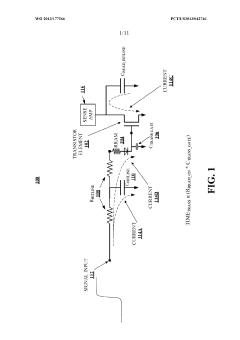
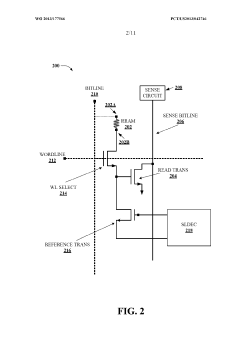
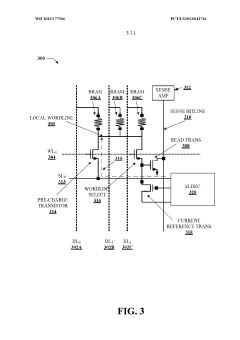
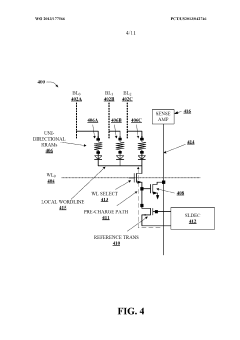
- The development of a high-speed RRAM architecture that connects multiple RRAM devices to a single read transistor, utilizing a reference transistor to apply a bias voltage and mitigate off-current, and employing a sensing circuit to quickly detect changes in electrical characteristics, enabling fast programming, reading, and erasing operations while reducing the number of read transistors and associated circuitry.
Systems and methods for increasing the read sensitivity of a resistive random access memory (RRAM)
PatentInactiveUS9275731B1
Innovation
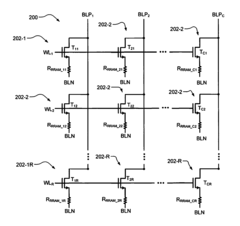
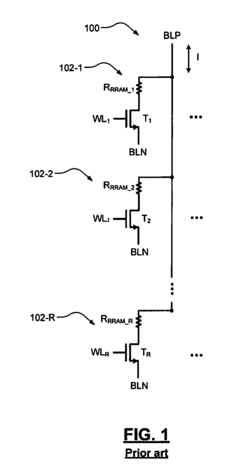
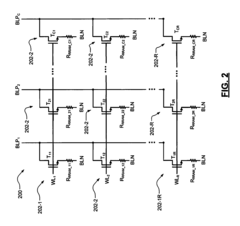
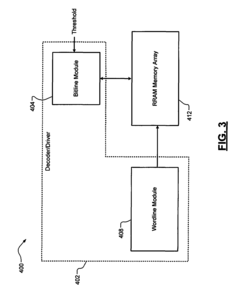
- Configuring RRAM memory cells with a common gate configuration and using only one polarity of current flow during read operations to improve sensitivity and reduce read disturbance, while naturally limiting voltage across the cells without additional circuit components.
Material Science Advancements for Low-Power RRAM
Recent advancements in material science have opened promising pathways for significantly reducing power consumption in Resistive Random Access Memory (RRAM) technologies. The exploration of novel materials with superior switching characteristics has become a central focus in the quest for energy-efficient RRAM solutions. Particularly, transition metal oxides such as HfOx, TaOx, and TiOx have demonstrated remarkable potential due to their excellent resistive switching properties and compatibility with existing semiconductor manufacturing processes.
The incorporation of two-dimensional (2D) materials represents another breakthrough direction. Materials like graphene, MoS2, and h-BN have shown exceptional capabilities as interfacial layers or electrodes in RRAM structures, facilitating more efficient electron transport mechanisms while requiring lower operating voltages. These materials exhibit unique quantum confinement effects that can be leveraged to control filament formation with unprecedented precision.
Doping strategies have emerged as a powerful approach to tailor the electrical properties of switching materials. Strategic introduction of dopants such as Al, Gd, or N into metal oxide matrices has been demonstrated to lower forming voltages and reduce variability in switching behavior. Recent studies have shown that co-doping techniques can further optimize the trade-off between retention time and switching energy, achieving up to 40% reduction in power consumption compared to conventional structures.
Interface engineering has become increasingly sophisticated, with researchers developing multi-layer stacks that create engineered defect distributions. These carefully designed interfaces control oxygen vacancy migration pathways, resulting in more deterministic and energy-efficient switching processes. Advanced atomic layer deposition (ALD) and molecular beam epitaxy (MBE) techniques now enable atomic-level precision in creating these optimized interfaces.
Strain engineering represents an emerging approach where mechanical strain is deliberately introduced to modify the band structure and defect formation energies in the switching material. Initial experiments with strained HfO2 films have demonstrated switching voltage reductions of up to 30%, translating directly to lower energy consumption during operation.
The development of self-rectifying materials that inherently limit sneak path currents without additional selector devices presents another promising direction. These materials exhibit non-linear I-V characteristics that effectively suppress leakage currents in crossbar arrays, eliminating the energy overhead associated with conventional selector components while maintaining reliable operation.
The incorporation of two-dimensional (2D) materials represents another breakthrough direction. Materials like graphene, MoS2, and h-BN have shown exceptional capabilities as interfacial layers or electrodes in RRAM structures, facilitating more efficient electron transport mechanisms while requiring lower operating voltages. These materials exhibit unique quantum confinement effects that can be leveraged to control filament formation with unprecedented precision.
Doping strategies have emerged as a powerful approach to tailor the electrical properties of switching materials. Strategic introduction of dopants such as Al, Gd, or N into metal oxide matrices has been demonstrated to lower forming voltages and reduce variability in switching behavior. Recent studies have shown that co-doping techniques can further optimize the trade-off between retention time and switching energy, achieving up to 40% reduction in power consumption compared to conventional structures.
Interface engineering has become increasingly sophisticated, with researchers developing multi-layer stacks that create engineered defect distributions. These carefully designed interfaces control oxygen vacancy migration pathways, resulting in more deterministic and energy-efficient switching processes. Advanced atomic layer deposition (ALD) and molecular beam epitaxy (MBE) techniques now enable atomic-level precision in creating these optimized interfaces.
Strain engineering represents an emerging approach where mechanical strain is deliberately introduced to modify the band structure and defect formation energies in the switching material. Initial experiments with strained HfO2 films have demonstrated switching voltage reductions of up to 30%, translating directly to lower energy consumption during operation.
The development of self-rectifying materials that inherently limit sneak path currents without additional selector devices presents another promising direction. These materials exhibit non-linear I-V characteristics that effectively suppress leakage currents in crossbar arrays, eliminating the energy overhead associated with conventional selector components while maintaining reliable operation.
Carbon Footprint Assessment of RRAM Technologies
The carbon footprint assessment of RRAM technologies reveals significant environmental advantages compared to conventional memory solutions. RRAM manufacturing processes generally require fewer material inputs and less energy-intensive fabrication steps than traditional DRAM or flash memory technologies. Life cycle assessments indicate that RRAM devices can reduce embodied carbon by approximately 35-45% compared to equivalent DRAM modules, primarily due to simplified production processes and reduced rare earth element requirements.
Energy consumption during operation represents the most substantial environmental impact factor for memory technologies. RRAM demonstrates promising metrics in this regard, with typical power consumption ranging from 10-100 pJ per bit operation, significantly lower than DRAM's 200-400 pJ per bit. When scaled to data center operations, this efficiency translates to potential carbon emission reductions of 12-18% for memory subsystems alone.
The end-of-life environmental impact of RRAM also presents advantages. The simpler material composition, with fewer toxic substances compared to conventional memory technologies, facilitates more straightforward recycling processes. Studies estimate that properly recycled RRAM components can recover up to 85% of precious metals used in their construction, compared to 60-70% recovery rates for conventional memory technologies.
Manufacturing location significantly influences the carbon footprint of RRAM technologies. Production facilities powered by renewable energy sources can reduce the carbon footprint by an additional 20-30%. Several leading RRAM manufacturers have already committed to carbon-neutral production targets by 2030, implementing renewable energy integration and carbon offset programs.
When examining the total environmental cost over a five-year operational lifespan, RRAM technologies demonstrate a carbon footprint approximately 40% smaller than equivalent conventional memory solutions. This calculation incorporates manufacturing emissions, operational energy consumption, and end-of-life processing requirements. The reduced thermal management requirements of RRAM further enhance this advantage, as lower heat generation translates to reduced cooling needs in data center environments.
For green computing initiatives, these carbon footprint reductions represent a compelling argument for RRAM adoption, particularly as data centers face increasing pressure to minimize environmental impacts while managing exponential growth in computational demands.
Energy consumption during operation represents the most substantial environmental impact factor for memory technologies. RRAM demonstrates promising metrics in this regard, with typical power consumption ranging from 10-100 pJ per bit operation, significantly lower than DRAM's 200-400 pJ per bit. When scaled to data center operations, this efficiency translates to potential carbon emission reductions of 12-18% for memory subsystems alone.
The end-of-life environmental impact of RRAM also presents advantages. The simpler material composition, with fewer toxic substances compared to conventional memory technologies, facilitates more straightforward recycling processes. Studies estimate that properly recycled RRAM components can recover up to 85% of precious metals used in their construction, compared to 60-70% recovery rates for conventional memory technologies.
Manufacturing location significantly influences the carbon footprint of RRAM technologies. Production facilities powered by renewable energy sources can reduce the carbon footprint by an additional 20-30%. Several leading RRAM manufacturers have already committed to carbon-neutral production targets by 2030, implementing renewable energy integration and carbon offset programs.
When examining the total environmental cost over a five-year operational lifespan, RRAM technologies demonstrate a carbon footprint approximately 40% smaller than equivalent conventional memory solutions. This calculation incorporates manufacturing emissions, operational energy consumption, and end-of-life processing requirements. The reduced thermal management requirements of RRAM further enhance this advantage, as lower heat generation translates to reduced cooling needs in data center environments.
For green computing initiatives, these carbon footprint reductions represent a compelling argument for RRAM adoption, particularly as data centers face increasing pressure to minimize environmental impacts while managing exponential growth in computational demands.
Unlock deeper insights with Patsnap Eureka Quick Research — get a full tech report to explore trends and direct your research. Try now!
Generate Your Research Report Instantly with AI Agent
Supercharge your innovation with Patsnap Eureka AI Agent Platform!