

How to Minimize Inductive Reactance in Half Wave Rectifiers?
JUL 15, 20259 MIN READ
Generate Your Research Report Instantly with AI Agent
PatSnap Eureka helps you evaluate technical feasibility & market potential.
Rectifier Reactance Background and Objectives
Half-wave rectifiers are fundamental components in power electronics, widely used for converting alternating current (AC) to pulsating direct current (DC). However, the presence of inductive reactance in these circuits can significantly impact their performance and efficiency. The evolution of rectifier technology has been driven by the need to minimize this reactance and improve overall system performance.
The concept of rectification dates back to the early 20th century, with the invention of vacuum tube diodes. As semiconductor technology advanced, solid-state rectifiers became prevalent, offering improved reliability and efficiency. Throughout this progression, engineers have consistently sought ways to mitigate the effects of inductive reactance, which can cause voltage spikes, reduce power factor, and increase harmonic distortion.
The primary objective in minimizing inductive reactance in half-wave rectifiers is to enhance power quality and efficiency. This involves reducing the phase shift between voltage and current, minimizing voltage drops across the rectifier, and improving the overall power factor of the system. Additionally, reducing reactance can lead to smaller, more cost-effective designs and improved electromagnetic compatibility.
Current trends in rectifier technology focus on high-frequency operation, advanced semiconductor materials, and innovative circuit topologies. These developments aim to push the boundaries of rectifier performance, with particular emphasis on reducing size, increasing power density, and improving efficiency across a wide range of operating conditions.
The challenges in minimizing inductive reactance are multifaceted, involving both circuit design and component selection. Engineers must balance various factors, including switching speed, reverse recovery characteristics of diodes, and parasitic inductances in circuit layouts. Moreover, as applications demand higher power levels and frequencies, the impact of inductive reactance becomes increasingly critical.
Looking ahead, the field of rectifier design is poised for significant advancements. Emerging technologies such as wide-bandgap semiconductors, integrated magnetics, and advanced control algorithms promise to revolutionize rectifier performance. These innovations are expected to enable new applications in renewable energy systems, electric vehicle charging, and high-efficiency power supplies.
As we delve deeper into the technical aspects of minimizing inductive reactance in half-wave rectifiers, it is essential to consider both the historical context and future potential of this technology. The ongoing quest for improved efficiency and power quality continues to drive research and development in this critical area of power electronics.
The concept of rectification dates back to the early 20th century, with the invention of vacuum tube diodes. As semiconductor technology advanced, solid-state rectifiers became prevalent, offering improved reliability and efficiency. Throughout this progression, engineers have consistently sought ways to mitigate the effects of inductive reactance, which can cause voltage spikes, reduce power factor, and increase harmonic distortion.
The primary objective in minimizing inductive reactance in half-wave rectifiers is to enhance power quality and efficiency. This involves reducing the phase shift between voltage and current, minimizing voltage drops across the rectifier, and improving the overall power factor of the system. Additionally, reducing reactance can lead to smaller, more cost-effective designs and improved electromagnetic compatibility.
Current trends in rectifier technology focus on high-frequency operation, advanced semiconductor materials, and innovative circuit topologies. These developments aim to push the boundaries of rectifier performance, with particular emphasis on reducing size, increasing power density, and improving efficiency across a wide range of operating conditions.
The challenges in minimizing inductive reactance are multifaceted, involving both circuit design and component selection. Engineers must balance various factors, including switching speed, reverse recovery characteristics of diodes, and parasitic inductances in circuit layouts. Moreover, as applications demand higher power levels and frequencies, the impact of inductive reactance becomes increasingly critical.
Looking ahead, the field of rectifier design is poised for significant advancements. Emerging technologies such as wide-bandgap semiconductors, integrated magnetics, and advanced control algorithms promise to revolutionize rectifier performance. These innovations are expected to enable new applications in renewable energy systems, electric vehicle charging, and high-efficiency power supplies.
As we delve deeper into the technical aspects of minimizing inductive reactance in half-wave rectifiers, it is essential to consider both the historical context and future potential of this technology. The ongoing quest for improved efficiency and power quality continues to drive research and development in this critical area of power electronics.
Market Analysis for Low-Reactance Rectifiers
The market for low-reactance rectifiers, particularly those designed to minimize inductive reactance in half-wave rectifiers, has been experiencing steady growth due to the increasing demand for efficient power conversion solutions across various industries. This market segment is primarily driven by the need for improved energy efficiency, reduced electromagnetic interference (EMI), and enhanced overall performance in power supply systems.
In the consumer electronics sector, the demand for compact and efficient power supplies for smartphones, laptops, and other portable devices has been a significant factor in the growth of low-reactance rectifier technologies. As these devices continue to shrink in size while demanding more power, the need for rectifiers with minimal inductive reactance becomes increasingly critical.
The automotive industry represents another key market for low-reactance rectifiers. With the rapid adoption of electric and hybrid vehicles, there is a growing requirement for high-efficiency power conversion systems. Low-reactance rectifiers play a crucial role in optimizing the charging and power management systems of these vehicles, contributing to improved range and overall performance.
Industrial applications, including factory automation, robotics, and renewable energy systems, also contribute substantially to the market demand for low-reactance rectifiers. These sectors require reliable and efficient power conversion solutions to enhance productivity and reduce energy losses.
The telecommunications industry, with its ongoing expansion of 5G networks and data centers, presents a significant opportunity for low-reactance rectifier technologies. The need for high-efficiency power supplies in these applications drives the demand for advanced rectifier solutions that can minimize inductive reactance and improve overall system performance.
Market analysts project a compound annual growth rate (CAGR) of 6-8% for the low-reactance rectifier market over the next five years. This growth is attributed to the increasing adoption of power electronics in various applications and the continuous push for energy efficiency improvements across industries.
Geographically, Asia-Pacific is expected to dominate the market, driven by the region's strong presence in consumer electronics manufacturing and rapid industrialization. North America and Europe follow closely, with their focus on automotive electrification and renewable energy technologies.
Key market players in this segment include established semiconductor manufacturers and power electronics companies. These firms are investing heavily in research and development to create innovative solutions that address the challenges of minimizing inductive reactance in half-wave rectifiers. The competitive landscape is characterized by a focus on product differentiation through improved efficiency, reduced size, and enhanced thermal management capabilities.
As the market for low-reactance rectifiers continues to evolve, emerging trends such as the integration of wide-bandgap semiconductors and advanced control algorithms are expected to further drive innovation and market growth. These developments promise to deliver even more efficient and compact rectifier solutions, meeting the ever-increasing demands of modern power electronics applications.
In the consumer electronics sector, the demand for compact and efficient power supplies for smartphones, laptops, and other portable devices has been a significant factor in the growth of low-reactance rectifier technologies. As these devices continue to shrink in size while demanding more power, the need for rectifiers with minimal inductive reactance becomes increasingly critical.
The automotive industry represents another key market for low-reactance rectifiers. With the rapid adoption of electric and hybrid vehicles, there is a growing requirement for high-efficiency power conversion systems. Low-reactance rectifiers play a crucial role in optimizing the charging and power management systems of these vehicles, contributing to improved range and overall performance.
Industrial applications, including factory automation, robotics, and renewable energy systems, also contribute substantially to the market demand for low-reactance rectifiers. These sectors require reliable and efficient power conversion solutions to enhance productivity and reduce energy losses.
The telecommunications industry, with its ongoing expansion of 5G networks and data centers, presents a significant opportunity for low-reactance rectifier technologies. The need for high-efficiency power supplies in these applications drives the demand for advanced rectifier solutions that can minimize inductive reactance and improve overall system performance.
Market analysts project a compound annual growth rate (CAGR) of 6-8% for the low-reactance rectifier market over the next five years. This growth is attributed to the increasing adoption of power electronics in various applications and the continuous push for energy efficiency improvements across industries.
Geographically, Asia-Pacific is expected to dominate the market, driven by the region's strong presence in consumer electronics manufacturing and rapid industrialization. North America and Europe follow closely, with their focus on automotive electrification and renewable energy technologies.
Key market players in this segment include established semiconductor manufacturers and power electronics companies. These firms are investing heavily in research and development to create innovative solutions that address the challenges of minimizing inductive reactance in half-wave rectifiers. The competitive landscape is characterized by a focus on product differentiation through improved efficiency, reduced size, and enhanced thermal management capabilities.
As the market for low-reactance rectifiers continues to evolve, emerging trends such as the integration of wide-bandgap semiconductors and advanced control algorithms are expected to further drive innovation and market growth. These developments promise to deliver even more efficient and compact rectifier solutions, meeting the ever-increasing demands of modern power electronics applications.
Current Challenges in Half Wave Rectifier Design
Half wave rectifiers, while simple in design, face several challenges that limit their efficiency and performance. One of the primary issues is the presence of inductive reactance, which can significantly impact the rectifier's output and overall functionality.
The inductive reactance in half wave rectifiers arises from the inherent inductance present in the circuit components, particularly in the transformer windings and load. This reactance creates a phase shift between voltage and current, leading to reduced power factor and decreased efficiency. As a result, the rectifier's output becomes less stable and prone to distortions.
Another challenge is the voltage drop across the rectifying diode. In half wave rectifiers, only one half of the AC cycle is utilized, which means the diode conducts for only half the time. This leads to a higher average voltage drop across the diode, reducing the overall efficiency of the rectification process.
The ripple factor in half wave rectifiers is also a significant concern. Due to the rectification of only one half of the AC cycle, the output waveform contains a large ripple component. This ripple can cause unwanted fluctuations in the DC output, requiring additional filtering stages to achieve a smoother voltage.
Heat dissipation is another challenge faced in half wave rectifier design. The rectifying diode conducts high currents during its conduction period, leading to increased power losses and heat generation. This necessitates proper thermal management techniques to prevent component failure and ensure long-term reliability.
The limited current handling capacity of half wave rectifiers poses a challenge in high-power applications. Since only one half of the AC cycle is utilized, the peak current through the rectifying diode is higher compared to full wave rectifiers. This limitation restricts the use of half wave rectifiers in applications requiring high output currents.
Electromagnetic interference (EMI) generation is also a concern in half wave rectifier designs. The abrupt switching of the diode during rectification can produce high-frequency harmonics, leading to electromagnetic noise that may interfere with nearby electronic systems.
Addressing these challenges requires innovative approaches in circuit design and component selection. Techniques such as snubber circuits, soft-switching topologies, and advanced semiconductor materials are being explored to mitigate the effects of inductive reactance and improve overall rectifier performance.
The inductive reactance in half wave rectifiers arises from the inherent inductance present in the circuit components, particularly in the transformer windings and load. This reactance creates a phase shift between voltage and current, leading to reduced power factor and decreased efficiency. As a result, the rectifier's output becomes less stable and prone to distortions.
Another challenge is the voltage drop across the rectifying diode. In half wave rectifiers, only one half of the AC cycle is utilized, which means the diode conducts for only half the time. This leads to a higher average voltage drop across the diode, reducing the overall efficiency of the rectification process.
The ripple factor in half wave rectifiers is also a significant concern. Due to the rectification of only one half of the AC cycle, the output waveform contains a large ripple component. This ripple can cause unwanted fluctuations in the DC output, requiring additional filtering stages to achieve a smoother voltage.
Heat dissipation is another challenge faced in half wave rectifier design. The rectifying diode conducts high currents during its conduction period, leading to increased power losses and heat generation. This necessitates proper thermal management techniques to prevent component failure and ensure long-term reliability.
The limited current handling capacity of half wave rectifiers poses a challenge in high-power applications. Since only one half of the AC cycle is utilized, the peak current through the rectifying diode is higher compared to full wave rectifiers. This limitation restricts the use of half wave rectifiers in applications requiring high output currents.
Electromagnetic interference (EMI) generation is also a concern in half wave rectifier designs. The abrupt switching of the diode during rectification can produce high-frequency harmonics, leading to electromagnetic noise that may interfere with nearby electronic systems.
Addressing these challenges requires innovative approaches in circuit design and component selection. Techniques such as snubber circuits, soft-switching topologies, and advanced semiconductor materials are being explored to mitigate the effects of inductive reactance and improve overall rectifier performance.
Existing Techniques for Reactance Reduction
01 Half-wave rectifier circuit design
Half-wave rectifiers are designed to convert AC to pulsating DC by allowing current flow in only one direction. The circuit typically includes a diode and may incorporate inductive components to improve efficiency and reduce ripple. The inductive reactance in these circuits plays a crucial role in smoothing the output voltage and current.- Half-wave rectifier circuit design: Half-wave rectifiers are designed to convert AC to pulsating DC by allowing current flow in only one direction. The circuit typically includes a diode and may incorporate inductive components to improve efficiency and reduce ripple. The inductive reactance in these circuits plays a crucial role in smoothing the output voltage and current.
- Inductive reactance effects on rectifier performance: The inductive reactance in half-wave rectifiers affects the circuit's behavior, particularly in terms of power factor and harmonic distortion. It can help reduce current spikes and improve the overall efficiency of the rectification process. Understanding and optimizing the inductive reactance is crucial for designing high-performance rectifier circuits.
- Power factor correction in half-wave rectifiers: Incorporating power factor correction techniques in half-wave rectifiers with inductive components can significantly improve the circuit's efficiency and reduce harmonic distortion. This may involve the use of additional passive or active components to shape the input current waveform and minimize the phase difference between voltage and current.
- Ripple reduction techniques: Various methods can be employed to reduce ripple in half-wave rectifier outputs, particularly when dealing with inductive loads. These techniques may include the use of filter capacitors, choke coils, or more advanced electronic filtering circuits. The goal is to smooth out the pulsating DC and provide a more stable output voltage.
- Applications of half-wave rectifiers with inductive loads: Half-wave rectifiers with inductive components find applications in various fields, including power supplies, motor drives, and renewable energy systems. The specific design and component selection depend on the application requirements, such as power rating, efficiency, and output voltage stability. These rectifiers can be optimized for different load types and operating conditions.
02 Inductive reactance effects in half-wave rectifiers
Inductive reactance in half-wave rectifiers affects the phase relationship between voltage and current, potentially leading to improved power factor and reduced harmonic distortion. The presence of inductance can also help in energy storage and smoothing of the rectified output, which is particularly beneficial in power supply applications.Expand Specific Solutions03 Power factor correction in half-wave rectifiers
Incorporating inductive elements in half-wave rectifier circuits can contribute to power factor correction. By carefully selecting the inductive reactance, the phase difference between voltage and current can be minimized, leading to improved overall system efficiency and reduced stress on power distribution systems.Expand Specific Solutions04 Ripple reduction techniques
Inductive reactance in half-wave rectifiers can be utilized for ripple reduction in the output. By adding appropriate inductance, the circuit can store energy during the conductive half-cycle and release it during the non-conductive half-cycle, resulting in a smoother DC output with reduced ripple content.Expand Specific Solutions05 Application-specific half-wave rectifier designs
Half-wave rectifiers with specific inductive reactance characteristics are designed for various applications such as power supplies, battery chargers, and motor drives. These designs take into account the unique requirements of each application, optimizing the inductive reactance to achieve desired performance metrics like efficiency, output stability, and electromagnetic compatibility.Expand Specific Solutions
Key Players in Power Electronics Industry
The market for minimizing inductive reactance in half wave rectifiers is in a mature stage, with established technologies and players. The global power electronics market, which includes rectifiers, is projected to reach $40 billion by 2027. Technologically, the field is well-developed, with ongoing incremental improvements. Key players like Robert Bosch GmbH, Mitsubishi Electric Corp., and Infineon Technologies AG are leading innovation in this area, focusing on enhancing efficiency and reducing component size. Universities such as the University of Electronic Science & Technology of China and Massachusetts Institute of Technology contribute to research advancements, while companies like TE Connectivity Corp. and STMicroelectronics A/S provide specialized components for these applications.
Robert Bosch GmbH
Technical Solution: Bosch has developed innovative half-wave rectifier solutions for automotive and industrial applications, focusing on minimizing inductive reactance. Their approach combines advanced semiconductor technology with sophisticated circuit design. Bosch utilizes wide bandgap materials like silicon carbide (SiC) in their rectifiers, enabling higher switching frequencies and faster recovery times[5]. They have implemented resonant switching techniques to reduce switching losses and minimize inductive effects. Bosch's rectifiers also feature optimized magnetic component designs, including the use of planar transformers and low-profile inductors. Additionally, they have developed advanced control algorithms that dynamically adjust switching patterns to minimize inductive reactance under varying load conditions[6].
Strengths: Robust design suitable for harsh environments, high reliability, and efficiency. Weaknesses: Potentially higher cost, may require specialized cooling solutions in some applications.
Mitsubishi Electric Corp.
Technical Solution: Mitsubishi Electric has focused on developing high-efficiency half-wave rectifier solutions with minimized inductive reactance for power electronics applications. Their approach combines advanced semiconductor devices with innovative circuit topologies. Mitsubishi utilizes their proprietary DIPIPM (Dual Inline Package Intelligent Power Module) technology, which integrates control circuits, protection features, and power devices in a compact package[7]. This integration helps reduce parasitic inductances in the circuit. They have also implemented soft-switching techniques and zero-voltage transition (ZVT) topologies to minimize switching losses and inductive effects. Mitsubishi's rectifiers incorporate advanced magnetic core materials and winding techniques to reduce leakage inductance in transformers and inductors[8].
Strengths: High power density, excellent thermal management, suitable for a wide range of applications. Weaknesses: May have higher initial cost, potential complexity in implementation for some users.
Innovative Approaches to Minimize Inductive Reactance
Electric circuit and household appliance
PatentWO2010000767A1
Innovation
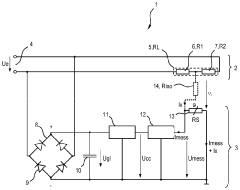
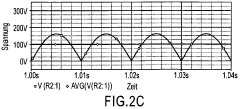
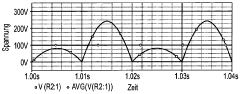
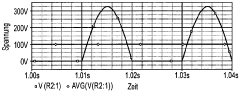
- The implementation of a half-wave rectifier in the DC circuit, which can include a single diode or triac, reduces or eliminates the influence of AC currents on measurement accuracy by minimizing leakage currents, and the use of a low-pass filter further enhances measurement precision by filtering out ripple effects.
A method and system for driving a voice coil of a loudspeaker
PatentActiveGB2591767A
Innovation
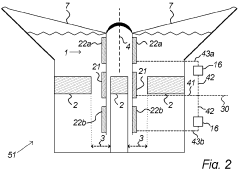
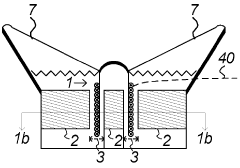
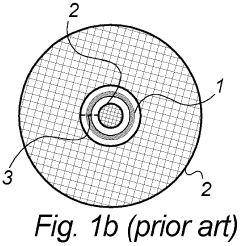
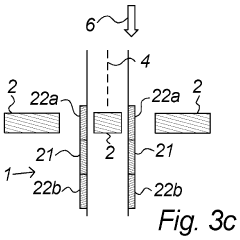
- A voice coil driving system with segmented voice coil sections, where a centre voice coil section and auxiliary voice coil sections are driven by centre and auxiliary driving signals, respectively, with rectifying units attenuating or blocking currents in specific directions to minimize power consumption and heating by only powering sections within the air gap.
Efficiency and Power Quality Considerations
Efficiency and power quality are critical considerations in the design and implementation of half-wave rectifiers, particularly when addressing the challenge of minimizing inductive reactance. The efficiency of a half-wave rectifier is inherently limited due to its operational principle, where only one half of the AC cycle is utilized for power conversion. This results in a lower overall power output compared to full-wave rectifiers.
To improve efficiency, designers must focus on reducing power losses associated with inductive reactance. One approach is to optimize the selection of components, particularly the diode and transformer. Using fast-recovery diodes with low forward voltage drop can significantly reduce switching losses and improve overall efficiency. Additionally, employing transformers with low leakage inductance helps minimize the inductive reactance in the circuit.
Power quality is another crucial aspect that requires attention when minimizing inductive reactance in half-wave rectifiers. The pulsating nature of the output current in these circuits can lead to harmonic distortion and poor power factor. These issues not only affect the performance of the rectifier but can also impact the power quality of the entire electrical system.
To address power quality concerns, various techniques can be employed. One effective method is the use of passive filters, such as LC filters, to smooth out the rectified waveform and reduce harmonic content. Active power factor correction (PFC) circuits can also be integrated to improve the power factor and reduce harmonic distortion. These solutions help in meeting regulatory standards for power quality and electromagnetic compatibility.
The implementation of snubber circuits is another strategy to enhance both efficiency and power quality. Snubbers help suppress voltage spikes and reduce electromagnetic interference (EMI) caused by rapid current changes in the inductive components. By dampening these transients, snubbers contribute to improved overall system reliability and reduced stress on components.
Advanced control strategies, such as pulse-width modulation (PWM) techniques, can be applied to half-wave rectifiers to further optimize efficiency and power quality. These methods allow for precise control of the rectification process, enabling better management of inductive reactance and its associated effects.
It is important to note that while these measures can significantly improve the performance of half-wave rectifiers, there are inherent limitations to their efficiency due to the fundamental operation principle. In applications where high efficiency and superior power quality are paramount, alternative topologies such as full-wave rectifiers or more advanced power conversion systems may be more suitable.
To improve efficiency, designers must focus on reducing power losses associated with inductive reactance. One approach is to optimize the selection of components, particularly the diode and transformer. Using fast-recovery diodes with low forward voltage drop can significantly reduce switching losses and improve overall efficiency. Additionally, employing transformers with low leakage inductance helps minimize the inductive reactance in the circuit.
Power quality is another crucial aspect that requires attention when minimizing inductive reactance in half-wave rectifiers. The pulsating nature of the output current in these circuits can lead to harmonic distortion and poor power factor. These issues not only affect the performance of the rectifier but can also impact the power quality of the entire electrical system.
To address power quality concerns, various techniques can be employed. One effective method is the use of passive filters, such as LC filters, to smooth out the rectified waveform and reduce harmonic content. Active power factor correction (PFC) circuits can also be integrated to improve the power factor and reduce harmonic distortion. These solutions help in meeting regulatory standards for power quality and electromagnetic compatibility.
The implementation of snubber circuits is another strategy to enhance both efficiency and power quality. Snubbers help suppress voltage spikes and reduce electromagnetic interference (EMI) caused by rapid current changes in the inductive components. By dampening these transients, snubbers contribute to improved overall system reliability and reduced stress on components.
Advanced control strategies, such as pulse-width modulation (PWM) techniques, can be applied to half-wave rectifiers to further optimize efficiency and power quality. These methods allow for precise control of the rectification process, enabling better management of inductive reactance and its associated effects.
It is important to note that while these measures can significantly improve the performance of half-wave rectifiers, there are inherent limitations to their efficiency due to the fundamental operation principle. In applications where high efficiency and superior power quality are paramount, alternative topologies such as full-wave rectifiers or more advanced power conversion systems may be more suitable.
Thermal Management in Low-Reactance Rectifiers
Thermal management is a critical aspect of designing low-reactance rectifiers, particularly when minimizing inductive reactance in half-wave rectifiers. As the reduction of inductive reactance often involves increasing current flow and power density, effective heat dissipation becomes paramount to ensure reliable operation and longevity of the rectifier components.
One of the primary challenges in thermal management for low-reactance rectifiers is the concentrated heat generation in semiconductor devices, such as diodes or thyristors. These components experience significant power losses during the rectification process, which manifests as heat. To address this issue, designers often employ heat sinks with optimized fin structures to maximize surface area for heat dissipation. The selection of heat sink material is crucial, with copper and aluminum being popular choices due to their excellent thermal conductivity.
In addition to passive cooling methods, active cooling techniques may be necessary for high-power applications. Forced-air cooling using fans or blowers can significantly enhance heat transfer from the heat sink to the surrounding environment. For even more demanding scenarios, liquid cooling systems can be implemented, offering superior heat dissipation capabilities compared to air-cooled solutions.
Thermal interface materials (TIMs) play a vital role in minimizing thermal resistance between the semiconductor devices and heat sinks. High-performance thermal greases, phase-change materials, or thermally conductive adhesives are commonly used to ensure efficient heat transfer across interfaces. The selection of appropriate TIMs depends on factors such as thermal conductivity, ease of application, and long-term reliability.
Proper component layout and PCB design are essential for effective thermal management in low-reactance rectifiers. Designers must consider the thermal paths and ensure adequate spacing between heat-generating components to prevent localized hot spots. The use of thermal vias and copper planes in PCB designs can help distribute heat more evenly across the board, reducing thermal stress on individual components.
Advanced thermal simulation tools and computational fluid dynamics (CFD) software are increasingly employed in the design process to optimize thermal management strategies. These tools allow engineers to model and analyze heat distribution, airflow patterns, and temperature profiles, enabling iterative design improvements before physical prototyping.
Monitoring and control systems are often integrated into low-reactance rectifier designs to ensure safe operation under varying thermal conditions. Temperature sensors strategically placed near critical components can provide real-time feedback, allowing for dynamic adjustment of cooling systems or implementation of thermal protection mechanisms to prevent overheating and potential failure.
One of the primary challenges in thermal management for low-reactance rectifiers is the concentrated heat generation in semiconductor devices, such as diodes or thyristors. These components experience significant power losses during the rectification process, which manifests as heat. To address this issue, designers often employ heat sinks with optimized fin structures to maximize surface area for heat dissipation. The selection of heat sink material is crucial, with copper and aluminum being popular choices due to their excellent thermal conductivity.
In addition to passive cooling methods, active cooling techniques may be necessary for high-power applications. Forced-air cooling using fans or blowers can significantly enhance heat transfer from the heat sink to the surrounding environment. For even more demanding scenarios, liquid cooling systems can be implemented, offering superior heat dissipation capabilities compared to air-cooled solutions.
Thermal interface materials (TIMs) play a vital role in minimizing thermal resistance between the semiconductor devices and heat sinks. High-performance thermal greases, phase-change materials, or thermally conductive adhesives are commonly used to ensure efficient heat transfer across interfaces. The selection of appropriate TIMs depends on factors such as thermal conductivity, ease of application, and long-term reliability.
Proper component layout and PCB design are essential for effective thermal management in low-reactance rectifiers. Designers must consider the thermal paths and ensure adequate spacing between heat-generating components to prevent localized hot spots. The use of thermal vias and copper planes in PCB designs can help distribute heat more evenly across the board, reducing thermal stress on individual components.
Advanced thermal simulation tools and computational fluid dynamics (CFD) software are increasingly employed in the design process to optimize thermal management strategies. These tools allow engineers to model and analyze heat distribution, airflow patterns, and temperature profiles, enabling iterative design improvements before physical prototyping.
Monitoring and control systems are often integrated into low-reactance rectifier designs to ensure safe operation under varying thermal conditions. Temperature sensors strategically placed near critical components can provide real-time feedback, allowing for dynamic adjustment of cooling systems or implementation of thermal protection mechanisms to prevent overheating and potential failure.
Unlock deeper insights with PatSnap Eureka Quick Research — get a full tech report to explore trends and direct your research. Try now!
Generate Your Research Report Instantly with AI Agent
Supercharge your innovation with PatSnap Eureka AI Agent Platform!