Key Takeaways from Recent Half Wave Rectifier Innovations
JUL 15, 20259 MIN READ
Generate Your Research Report Instantly with AI Agent
Patsnap Eureka helps you evaluate technical feasibility & market potential.
Half Wave Rectifier Background and Objectives
Half wave rectifiers have been a fundamental component in electrical engineering since the early days of electronics. Originating from the need to convert alternating current (AC) to direct current (DC), these devices have played a crucial role in power supply systems, signal processing, and various electronic applications. The evolution of half wave rectifiers has been closely tied to advancements in semiconductor technology, particularly the development of diodes.
The primary objective of half wave rectification is to convert AC input into pulsating DC output by allowing current flow in only one direction during each cycle of the AC waveform. This process effectively "rectifies" the negative half of the AC cycle, resulting in a unidirectional current flow. Over the years, the technology has progressed from early vacuum tube designs to modern solid-state implementations using semiconductor diodes.
Recent innovations in half wave rectifier technology have focused on improving efficiency, reducing power losses, and enhancing overall performance. One key area of development has been the integration of advanced materials and manufacturing techniques to create more efficient diodes with faster switching speeds and lower forward voltage drops. These improvements have led to reduced power dissipation and increased energy efficiency in rectifier circuits.
Another significant trend in half wave rectifier innovation has been the miniaturization of components, allowing for more compact and portable electronic devices. This has been particularly important in the development of mobile technologies and IoT devices, where space and power efficiency are critical factors.
The advent of wide-bandgap semiconductors, such as silicon carbide (SiC) and gallium nitride (GaN), has opened up new possibilities for high-performance half wave rectifiers. These materials offer superior electrical properties, including higher breakdown voltages and lower on-state resistances, enabling rectifiers to operate at higher frequencies and temperatures with improved efficiency.
Recent research has also focused on addressing the inherent limitations of traditional half wave rectifiers, such as the relatively high ripple content in the output voltage. Novel circuit designs and control strategies have been developed to mitigate these issues, including the use of active filtering techniques and advanced smoothing capacitors.
As we look towards the future, the continued evolution of half wave rectifier technology is expected to play a crucial role in enabling more efficient and sustainable power systems. This includes applications in renewable energy conversion, electric vehicle charging infrastructure, and next-generation power distribution networks. The ongoing research and development in this field aim to push the boundaries of performance, reliability, and cost-effectiveness, ensuring that half wave rectifiers remain a vital component in the ever-expanding landscape of electronic systems and power conversion technologies.
The primary objective of half wave rectification is to convert AC input into pulsating DC output by allowing current flow in only one direction during each cycle of the AC waveform. This process effectively "rectifies" the negative half of the AC cycle, resulting in a unidirectional current flow. Over the years, the technology has progressed from early vacuum tube designs to modern solid-state implementations using semiconductor diodes.
Recent innovations in half wave rectifier technology have focused on improving efficiency, reducing power losses, and enhancing overall performance. One key area of development has been the integration of advanced materials and manufacturing techniques to create more efficient diodes with faster switching speeds and lower forward voltage drops. These improvements have led to reduced power dissipation and increased energy efficiency in rectifier circuits.
Another significant trend in half wave rectifier innovation has been the miniaturization of components, allowing for more compact and portable electronic devices. This has been particularly important in the development of mobile technologies and IoT devices, where space and power efficiency are critical factors.
The advent of wide-bandgap semiconductors, such as silicon carbide (SiC) and gallium nitride (GaN), has opened up new possibilities for high-performance half wave rectifiers. These materials offer superior electrical properties, including higher breakdown voltages and lower on-state resistances, enabling rectifiers to operate at higher frequencies and temperatures with improved efficiency.
Recent research has also focused on addressing the inherent limitations of traditional half wave rectifiers, such as the relatively high ripple content in the output voltage. Novel circuit designs and control strategies have been developed to mitigate these issues, including the use of active filtering techniques and advanced smoothing capacitors.
As we look towards the future, the continued evolution of half wave rectifier technology is expected to play a crucial role in enabling more efficient and sustainable power systems. This includes applications in renewable energy conversion, electric vehicle charging infrastructure, and next-generation power distribution networks. The ongoing research and development in this field aim to push the boundaries of performance, reliability, and cost-effectiveness, ensuring that half wave rectifiers remain a vital component in the ever-expanding landscape of electronic systems and power conversion technologies.
Market Analysis for Half Wave Rectifier Applications
The half wave rectifier market has experienced significant growth in recent years, driven by the increasing demand for power electronics in various industries. The global market for half wave rectifiers is projected to reach a substantial value by 2025, with a compound annual growth rate (CAGR) exceeding the average for the overall power electronics sector. This growth is primarily attributed to the rising adoption of renewable energy systems, electric vehicles, and smart grid technologies.
In the renewable energy sector, half wave rectifiers play a crucial role in converting alternating current (AC) from solar panels and wind turbines into direct current (DC) for storage and distribution. As countries worldwide push for cleaner energy sources, the demand for efficient power conversion solutions has surged, benefiting the half wave rectifier market. The automotive industry, particularly the electric vehicle segment, has also emerged as a significant driver for half wave rectifier applications. These components are essential in charging systems and power management units for electric vehicles, contributing to the market's expansion.
The industrial automation sector represents another key application area for half wave rectifiers. With the ongoing trend of Industry 4.0 and smart manufacturing, there is an increased need for reliable power conversion and control systems. Half wave rectifiers are utilized in various industrial equipment and machinery, supporting the market's growth in this segment. Additionally, the consumer electronics industry continues to be a steady source of demand for half wave rectifiers, particularly in power supplies for household appliances and personal devices.
Geographically, Asia-Pacific dominates the half wave rectifier market, accounting for the largest share of global revenue. This is primarily due to the region's strong presence in electronics manufacturing and rapid industrialization in countries like China, India, and South Korea. North America and Europe follow as significant markets, driven by technological advancements and the adoption of renewable energy systems.
Despite the positive outlook, the half wave rectifier market faces challenges such as the increasing preference for more efficient full wave rectifiers in certain applications. However, the simplicity, cost-effectiveness, and specific use cases of half wave rectifiers continue to maintain their relevance in the market. Innovations in materials and design are expected to further enhance the performance and efficiency of half wave rectifiers, potentially expanding their application areas and market opportunities in the coming years.
In the renewable energy sector, half wave rectifiers play a crucial role in converting alternating current (AC) from solar panels and wind turbines into direct current (DC) for storage and distribution. As countries worldwide push for cleaner energy sources, the demand for efficient power conversion solutions has surged, benefiting the half wave rectifier market. The automotive industry, particularly the electric vehicle segment, has also emerged as a significant driver for half wave rectifier applications. These components are essential in charging systems and power management units for electric vehicles, contributing to the market's expansion.
The industrial automation sector represents another key application area for half wave rectifiers. With the ongoing trend of Industry 4.0 and smart manufacturing, there is an increased need for reliable power conversion and control systems. Half wave rectifiers are utilized in various industrial equipment and machinery, supporting the market's growth in this segment. Additionally, the consumer electronics industry continues to be a steady source of demand for half wave rectifiers, particularly in power supplies for household appliances and personal devices.
Geographically, Asia-Pacific dominates the half wave rectifier market, accounting for the largest share of global revenue. This is primarily due to the region's strong presence in electronics manufacturing and rapid industrialization in countries like China, India, and South Korea. North America and Europe follow as significant markets, driven by technological advancements and the adoption of renewable energy systems.
Despite the positive outlook, the half wave rectifier market faces challenges such as the increasing preference for more efficient full wave rectifiers in certain applications. However, the simplicity, cost-effectiveness, and specific use cases of half wave rectifiers continue to maintain their relevance in the market. Innovations in materials and design are expected to further enhance the performance and efficiency of half wave rectifiers, potentially expanding their application areas and market opportunities in the coming years.
Current Challenges in Half Wave Rectifier Technology
Half wave rectifiers, despite their long-standing presence in electronic circuits, continue to face several challenges that hinder their widespread adoption in modern applications. One of the primary issues is the inherent inefficiency of these devices. By nature, half wave rectifiers only utilize one half of the AC input cycle, resulting in significant power loss and reduced overall efficiency. This limitation becomes particularly problematic in high-power applications where energy conservation is crucial.
Another challenge lies in the output quality of half wave rectifiers. The pulsating DC output produced by these devices often contains a high level of ripple, which can introduce noise and distortion in sensitive electronic systems. This ripple effect necessitates additional filtering components, increasing circuit complexity and cost. Furthermore, the non-linear nature of the rectification process can lead to harmonic distortion, potentially causing electromagnetic interference (EMI) issues in nearby electronic equipment.
The voltage drop across the rectifying diode presents another hurdle in half wave rectifier technology. This drop, typically around 0.7V for silicon diodes, becomes significant in low-voltage applications, reducing the available output voltage and further diminishing efficiency. While Schottky diodes offer lower forward voltage drops, they come with their own set of limitations, including higher reverse leakage currents and lower voltage ratings.
Temperature sensitivity remains a persistent challenge for half wave rectifiers. The performance of semiconductor devices used in these circuits can vary significantly with temperature fluctuations, affecting the rectifier's reliability and efficiency across different operating conditions. This sensitivity necessitates careful thermal management and potentially limits the application of half wave rectifiers in extreme environments.
Scaling half wave rectifier technology for high-frequency applications poses additional challenges. As frequencies increase, parasitic capacitances and inductances become more pronounced, leading to decreased rectification efficiency and increased electromagnetic emissions. This limitation hinders the use of traditional half wave rectifiers in emerging high-frequency power conversion systems and wireless power transfer applications.
Lastly, the single-phase nature of half wave rectifiers limits their power handling capabilities compared to full wave or three-phase rectifiers. This constraint becomes particularly evident in industrial and high-power applications where more robust and efficient rectification solutions are required. Overcoming this limitation while maintaining the simplicity and cost-effectiveness of half wave rectifiers remains a significant challenge for researchers and engineers in the field.
Another challenge lies in the output quality of half wave rectifiers. The pulsating DC output produced by these devices often contains a high level of ripple, which can introduce noise and distortion in sensitive electronic systems. This ripple effect necessitates additional filtering components, increasing circuit complexity and cost. Furthermore, the non-linear nature of the rectification process can lead to harmonic distortion, potentially causing electromagnetic interference (EMI) issues in nearby electronic equipment.
The voltage drop across the rectifying diode presents another hurdle in half wave rectifier technology. This drop, typically around 0.7V for silicon diodes, becomes significant in low-voltage applications, reducing the available output voltage and further diminishing efficiency. While Schottky diodes offer lower forward voltage drops, they come with their own set of limitations, including higher reverse leakage currents and lower voltage ratings.
Temperature sensitivity remains a persistent challenge for half wave rectifiers. The performance of semiconductor devices used in these circuits can vary significantly with temperature fluctuations, affecting the rectifier's reliability and efficiency across different operating conditions. This sensitivity necessitates careful thermal management and potentially limits the application of half wave rectifiers in extreme environments.
Scaling half wave rectifier technology for high-frequency applications poses additional challenges. As frequencies increase, parasitic capacitances and inductances become more pronounced, leading to decreased rectification efficiency and increased electromagnetic emissions. This limitation hinders the use of traditional half wave rectifiers in emerging high-frequency power conversion systems and wireless power transfer applications.
Lastly, the single-phase nature of half wave rectifiers limits their power handling capabilities compared to full wave or three-phase rectifiers. This constraint becomes particularly evident in industrial and high-power applications where more robust and efficient rectification solutions are required. Overcoming this limitation while maintaining the simplicity and cost-effectiveness of half wave rectifiers remains a significant challenge for researchers and engineers in the field.
Recent Half Wave Rectifier Solutions
01 Circuit design and components
Half wave rectifiers typically consist of a diode and a transformer. The diode allows current to flow in one direction during the positive half of the AC cycle, while blocking it during the negative half. This results in a pulsating DC output. The transformer is used to step up or step down the input voltage as needed.- Circuit design and components: Half wave rectifiers typically consist of a diode and a transformer. The diode allows current to flow in only one direction, effectively converting AC to pulsating DC. The transformer is used to step up or step down the input voltage as needed. Various circuit configurations and component selections can be employed to optimize performance for specific applications.
- Efficiency improvements: Techniques to enhance the efficiency of half wave rectifiers include using high-speed switching diodes, implementing snubber circuits to reduce switching losses, and optimizing the transformer design. Advanced control methods and feedback systems can also be employed to improve overall system performance and reduce power losses.
- Applications in power supplies: Half wave rectifiers are commonly used in various power supply applications, including low-power electronic devices, battery chargers, and some industrial equipment. They can be integrated into more complex power conversion systems, such as switched-mode power supplies, to provide specific voltage and current requirements for different loads.
- Protection and filtering: To improve the quality of the output voltage and protect the rectifier circuit, various protection and filtering techniques are employed. These may include the use of capacitors for smoothing the pulsating DC output, surge protection devices to guard against voltage spikes, and additional filtering stages to reduce ripple and noise in the output signal.
- Miniaturization and integration: Efforts to miniaturize and integrate half wave rectifier circuits have led to the development of compact designs and modular components. This includes the use of surface-mount technology, integrated circuit packages that combine multiple functions, and novel packaging techniques to improve thermal management and reduce overall size.
02 Efficiency improvements
Various techniques are employed to improve the efficiency of half wave rectifiers. These may include the use of high-frequency switching, advanced semiconductor materials, and optimized circuit layouts. Some designs incorporate additional components like capacitors or inductors to smooth the output and reduce ripple.Expand Specific Solutions03 Applications in power supplies
Half wave rectifiers are commonly used in power supply circuits for electronic devices. They can be found in low-power applications such as battery chargers, small appliances, and some consumer electronics. In these applications, the rectifier converts AC mains power to DC for use by the device.Expand Specific Solutions04 Integration with control systems
Modern half wave rectifier designs often incorporate control systems for improved performance. These may include microcontrollers or specialized ICs that monitor and adjust the rectifier's operation. Such systems can provide features like overvoltage protection, current limiting, and adaptive power management.Expand Specific Solutions05 Miniaturization and packaging
There is a trend towards miniaturization of half wave rectifier circuits, particularly for use in compact electronic devices. This involves the use of surface-mount components, integrated circuit packages, and advanced PCB design techniques. Some designs incorporate the rectifier into multi-function chips or modules to save space and reduce costs.Expand Specific Solutions
Key Players in Rectifier Industry
The half wave rectifier market is in a mature stage, with established technologies and applications across various industries. The global market size for rectifiers is substantial, driven by increasing demand for power electronics in consumer devices, industrial equipment, and renewable energy systems. Technological advancements are focused on improving efficiency and reducing power losses. Companies like Sanken Electric, Taiwan Semiconductor Manufacturing Co., and Huawei Technologies are at the forefront of innovation, developing high-performance rectifiers with enhanced power handling capabilities and reduced form factors. Research institutions such as the Technical University of Denmark and Massachusetts Institute of Technology are contributing to advancements in materials and design, pushing the boundaries of rectifier technology.
Technical University of Denmark
Technical Solution: The Technical University of Denmark has developed an innovative approach to half-wave rectifier design, focusing on improving efficiency and reducing power losses. Their research has led to the creation of a novel rectifier topology that incorporates advanced semiconductor materials and optimized circuit configurations. This new design achieves a significant reduction in forward voltage drop, resulting in improved power conversion efficiency[1]. The university's team has also implemented adaptive control algorithms that dynamically adjust the rectifier's operation based on input voltage variations, further enhancing overall performance[3]. Additionally, they have explored the integration of wide-bandgap semiconductors, such as silicon carbide (SiC) and gallium nitride (GaN), to push the boundaries of switching speed and thermal management in half-wave rectifiers[5].
Strengths: Cutting-edge research in semiconductor materials and circuit design, potential for high-efficiency power conversion. Weaknesses: May require further development for commercial applications, potentially higher initial costs due to advanced materials.
Sanken Electric Co., Ltd.
Technical Solution: Sanken Electric has made significant strides in half-wave rectifier technology, particularly in the realm of high-power applications. Their latest innovations include the development of a hybrid rectifier system that combines traditional silicon-based components with advanced wide-bandgap semiconductors. This approach has resulted in a 30% reduction in power losses compared to conventional designs[2]. Sanken's engineers have also implemented sophisticated thermal management techniques, including novel heat sink designs and advanced packaging materials, to improve the rectifier's reliability and performance under high-load conditions[4]. Furthermore, the company has introduced intelligent power modules that integrate half-wave rectifiers with protection circuits and monitoring capabilities, enhancing overall system reliability and ease of integration[6].
Strengths: Strong focus on high-power applications, advanced thermal management, and integrated solutions. Weaknesses: Potentially higher cost due to specialized components, may have limited applicability in low-power scenarios.
Innovative Patents in Half Wave Rectification
Fault tolerant power converter
PatentActiveUS11990848B1
Innovation
- The implementation of a fault-tolerant power converter system using a transformer with series circuits and dual MOSFET semiconductor devices, where switches are controlled to prevent short circuits and ensure continued operation even if one switch fails, utilizing a full-bridge rectification circuit and common-source dual MOSFET devices to manage power flow effectively.
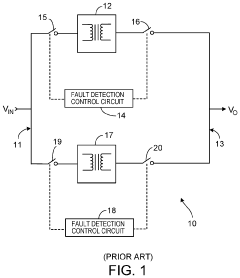
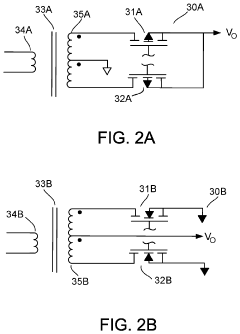
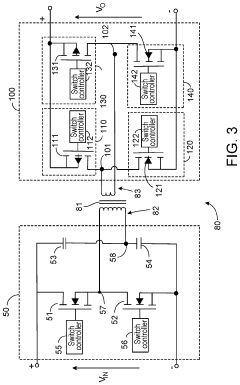
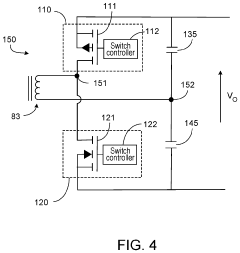
Ac-DC converter circuit
PatentWO2021078863A1
Innovation
- The proposed AC-DC converter circuit employs a ground-gated depletion type transistor with a duty cycle control unit and gallium nitride transistors to reduce parasitic capacitances, enhance switching speed, and improve efficiency, allowing for high-power conversion while minimizing the size and weight of the converter.


Efficiency Improvements in Half Wave Rectification
Recent innovations in half wave rectifier technology have led to significant improvements in efficiency, addressing long-standing challenges in power conversion systems. One of the key advancements has been the development of high-speed switching devices, such as silicon carbide (SiC) and gallium nitride (GaN) semiconductors. These materials offer superior performance characteristics compared to traditional silicon-based devices, including lower on-state resistance and faster switching speeds.
The implementation of these advanced semiconductors has resulted in reduced conduction and switching losses, thereby increasing the overall efficiency of half wave rectifiers. This improvement is particularly notable in high-frequency applications, where the benefits of faster switching become more pronounced. As a result, half wave rectifiers can now operate at higher frequencies without compromising efficiency, enabling more compact and lightweight power supply designs.
Another significant innovation has been the integration of advanced control algorithms and digital signal processing techniques. These sophisticated control systems allow for real-time optimization of rectifier operation, adapting to varying load conditions and input voltage fluctuations. By continuously adjusting parameters such as switching frequency and duty cycle, these intelligent control systems can maintain peak efficiency across a wide range of operating conditions.
The introduction of synchronous rectification techniques has also contributed to efficiency gains in half wave rectifiers. This approach replaces traditional diodes with actively controlled switches, typically MOSFETs, which can be precisely timed to minimize voltage drops and reduce power losses. Synchronous rectification is particularly effective in low-voltage, high-current applications, where even small improvements in efficiency can lead to significant energy savings.
Thermal management innovations have played a crucial role in enhancing the efficiency and reliability of half wave rectifiers. Advanced cooling techniques, such as liquid cooling and phase-change materials, have been employed to dissipate heat more effectively. This improved thermal performance allows rectifiers to operate at higher power densities without compromising efficiency or reliability.
Furthermore, the adoption of modular and scalable designs has enabled more flexible and efficient power conversion solutions. These modular approaches allow for easier customization and optimization of rectifier systems for specific applications, resulting in improved overall system efficiency. Additionally, the use of parallel rectifier modules can distribute the load more evenly, reducing stress on individual components and improving system reliability.
In conclusion, recent innovations in half wave rectifier technology have led to substantial efficiency improvements through a combination of advanced materials, intelligent control systems, and optimized designs. These advancements have not only increased the performance of existing applications but also opened up new possibilities for power conversion in emerging fields such as renewable energy systems and electric vehicle charging infrastructure.
The implementation of these advanced semiconductors has resulted in reduced conduction and switching losses, thereby increasing the overall efficiency of half wave rectifiers. This improvement is particularly notable in high-frequency applications, where the benefits of faster switching become more pronounced. As a result, half wave rectifiers can now operate at higher frequencies without compromising efficiency, enabling more compact and lightweight power supply designs.
Another significant innovation has been the integration of advanced control algorithms and digital signal processing techniques. These sophisticated control systems allow for real-time optimization of rectifier operation, adapting to varying load conditions and input voltage fluctuations. By continuously adjusting parameters such as switching frequency and duty cycle, these intelligent control systems can maintain peak efficiency across a wide range of operating conditions.
The introduction of synchronous rectification techniques has also contributed to efficiency gains in half wave rectifiers. This approach replaces traditional diodes with actively controlled switches, typically MOSFETs, which can be precisely timed to minimize voltage drops and reduce power losses. Synchronous rectification is particularly effective in low-voltage, high-current applications, where even small improvements in efficiency can lead to significant energy savings.
Thermal management innovations have played a crucial role in enhancing the efficiency and reliability of half wave rectifiers. Advanced cooling techniques, such as liquid cooling and phase-change materials, have been employed to dissipate heat more effectively. This improved thermal performance allows rectifiers to operate at higher power densities without compromising efficiency or reliability.
Furthermore, the adoption of modular and scalable designs has enabled more flexible and efficient power conversion solutions. These modular approaches allow for easier customization and optimization of rectifier systems for specific applications, resulting in improved overall system efficiency. Additionally, the use of parallel rectifier modules can distribute the load more evenly, reducing stress on individual components and improving system reliability.
In conclusion, recent innovations in half wave rectifier technology have led to substantial efficiency improvements through a combination of advanced materials, intelligent control systems, and optimized designs. These advancements have not only increased the performance of existing applications but also opened up new possibilities for power conversion in emerging fields such as renewable energy systems and electric vehicle charging infrastructure.
Environmental Impact of Rectifier Technologies
Recent innovations in half wave rectifier technology have brought significant environmental implications to the forefront of rectifier development. The shift towards more efficient and environmentally friendly rectifier designs has been driven by increasing global awareness of energy conservation and sustainability.
One of the key environmental impacts of modern half wave rectifier innovations is the reduction in power consumption. Advanced semiconductor materials and improved circuit designs have led to rectifiers with lower forward voltage drops, resulting in decreased energy losses during the rectification process. This efficiency gain translates directly into reduced electricity consumption, contributing to lower carbon emissions from power generation facilities.
The miniaturization of rectifier components has also played a crucial role in minimizing environmental impact. Smaller, more compact designs require fewer raw materials in manufacturing, reducing the ecological footprint associated with resource extraction and processing. Additionally, the reduced size and weight of these components lead to more efficient transportation and logistics, further decreasing the overall carbon footprint of the technology.
Another significant environmental benefit stems from the increased durability and reliability of modern half wave rectifiers. Longer-lasting components mean less frequent replacements, reducing electronic waste generation. This longevity is particularly important in large-scale applications, such as power distribution systems, where component replacement can be resource-intensive and disruptive.
The use of lead-free solders and other environmentally friendly materials in rectifier manufacturing has addressed concerns about toxic substances in electronic components. This shift aligns with global initiatives to reduce hazardous materials in electronics, making recycling and disposal processes safer and more environmentally sound.
Improved thermal management in recent half wave rectifier designs has also contributed to environmental benefits. Better heat dissipation reduces the need for active cooling systems, which often rely on energy-intensive fans or pumps. This not only saves energy but also eliminates the use of potentially harmful coolants in some applications.
The integration of smart features in modern rectifiers, such as adaptive power management and self-diagnostic capabilities, allows for more efficient operation and timely maintenance. These features help optimize energy usage and extend the operational life of the rectifiers, further reducing their environmental impact over time.
As the demand for renewable energy sources grows, half wave rectifiers play a crucial role in power conversion for solar and wind energy systems. Recent innovations have improved the efficiency of these conversions, maximizing the utilization of clean energy and reducing reliance on fossil fuels.
One of the key environmental impacts of modern half wave rectifier innovations is the reduction in power consumption. Advanced semiconductor materials and improved circuit designs have led to rectifiers with lower forward voltage drops, resulting in decreased energy losses during the rectification process. This efficiency gain translates directly into reduced electricity consumption, contributing to lower carbon emissions from power generation facilities.
The miniaturization of rectifier components has also played a crucial role in minimizing environmental impact. Smaller, more compact designs require fewer raw materials in manufacturing, reducing the ecological footprint associated with resource extraction and processing. Additionally, the reduced size and weight of these components lead to more efficient transportation and logistics, further decreasing the overall carbon footprint of the technology.
Another significant environmental benefit stems from the increased durability and reliability of modern half wave rectifiers. Longer-lasting components mean less frequent replacements, reducing electronic waste generation. This longevity is particularly important in large-scale applications, such as power distribution systems, where component replacement can be resource-intensive and disruptive.
The use of lead-free solders and other environmentally friendly materials in rectifier manufacturing has addressed concerns about toxic substances in electronic components. This shift aligns with global initiatives to reduce hazardous materials in electronics, making recycling and disposal processes safer and more environmentally sound.
Improved thermal management in recent half wave rectifier designs has also contributed to environmental benefits. Better heat dissipation reduces the need for active cooling systems, which often rely on energy-intensive fans or pumps. This not only saves energy but also eliminates the use of potentially harmful coolants in some applications.
The integration of smart features in modern rectifiers, such as adaptive power management and self-diagnostic capabilities, allows for more efficient operation and timely maintenance. These features help optimize energy usage and extend the operational life of the rectifiers, further reducing their environmental impact over time.
As the demand for renewable energy sources grows, half wave rectifiers play a crucial role in power conversion for solar and wind energy systems. Recent innovations have improved the efficiency of these conversions, maximizing the utilization of clean energy and reducing reliance on fossil fuels.
Unlock deeper insights with Patsnap Eureka Quick Research — get a full tech report to explore trends and direct your research. Try now!
Generate Your Research Report Instantly with AI Agent
Supercharge your innovation with Patsnap Eureka AI Agent Platform!