

Nanocellulose Composite Failure Modes And Improved Damage Tolerance
SEP 3, 202510 MIN READ
Generate Your Research Report Instantly with AI Agent
PatSnap Eureka helps you evaluate technical feasibility & market potential.
Nanocellulose Composite Evolution and Research Objectives
Nanocellulose composites represent a significant advancement in sustainable materials science, emerging from decades of research into natural fiber reinforcements. The evolution of these composites began in the early 2000s when researchers first isolated cellulose nanofibrils (CNFs) and cellulose nanocrystals (CNCs) at scale, recognizing their exceptional mechanical properties including high specific strength and modulus comparable to synthetic reinforcements like aramid fibers.
The developmental trajectory has been marked by progressive improvements in extraction methods, moving from energy-intensive mechanical processes to more efficient enzymatic and chemical approaches. This evolution has enabled the production of nanocellulose with increasingly controlled dimensions and surface chemistry, critical factors in determining composite performance and failure mechanisms.
A significant milestone occurred around 2010 when researchers demonstrated nanocellulose composites with tensile strengths exceeding 200 MPa and Young's moduli approaching 20 GPa, establishing their potential as alternatives to conventional petroleum-based composites. However, these early composites exhibited brittle failure modes and poor damage tolerance, limiting their practical applications.
The current research landscape focuses on understanding and mitigating these failure modes, particularly the interfacial debonding between nanocellulose and polymer matrices that often initiates catastrophic failure. Recent studies have identified several critical failure mechanisms: microfibril pull-out, matrix cracking, and stress concentration at nanocellulose agglomerations. These mechanisms are exacerbated by moisture absorption, a persistent challenge given cellulose's hydrophilic nature.
Our research objectives center on developing nanocellulose composites with enhanced damage tolerance through several complementary approaches. First, we aim to establish comprehensive models of failure propagation in nanocellulose composites under various loading conditions, incorporating multi-scale analysis from nano to macro levels. This will provide fundamental understanding of crack initiation and propagation pathways.
Second, we seek to engineer nanocellulose-matrix interfaces through chemical modifications that promote energy dissipation rather than catastrophic failure. This includes exploring grafting techniques, coupling agents, and nano-engineered interphases that can redirect crack propagation.
Third, we intend to develop hierarchical composite structures that mimic biological materials known for exceptional damage tolerance, such as nacre and bone. These bio-inspired designs incorporate sacrificial bonds and hidden length scales that enable progressive failure rather than sudden fracture.
The ultimate goal is to create nanocellulose composites that maintain their sustainable advantages while achieving damage tolerance comparable to conventional engineering composites, enabling their application in more demanding structural applications including automotive components, construction materials, and consumer products.
The developmental trajectory has been marked by progressive improvements in extraction methods, moving from energy-intensive mechanical processes to more efficient enzymatic and chemical approaches. This evolution has enabled the production of nanocellulose with increasingly controlled dimensions and surface chemistry, critical factors in determining composite performance and failure mechanisms.
A significant milestone occurred around 2010 when researchers demonstrated nanocellulose composites with tensile strengths exceeding 200 MPa and Young's moduli approaching 20 GPa, establishing their potential as alternatives to conventional petroleum-based composites. However, these early composites exhibited brittle failure modes and poor damage tolerance, limiting their practical applications.
The current research landscape focuses on understanding and mitigating these failure modes, particularly the interfacial debonding between nanocellulose and polymer matrices that often initiates catastrophic failure. Recent studies have identified several critical failure mechanisms: microfibril pull-out, matrix cracking, and stress concentration at nanocellulose agglomerations. These mechanisms are exacerbated by moisture absorption, a persistent challenge given cellulose's hydrophilic nature.
Our research objectives center on developing nanocellulose composites with enhanced damage tolerance through several complementary approaches. First, we aim to establish comprehensive models of failure propagation in nanocellulose composites under various loading conditions, incorporating multi-scale analysis from nano to macro levels. This will provide fundamental understanding of crack initiation and propagation pathways.
Second, we seek to engineer nanocellulose-matrix interfaces through chemical modifications that promote energy dissipation rather than catastrophic failure. This includes exploring grafting techniques, coupling agents, and nano-engineered interphases that can redirect crack propagation.
Third, we intend to develop hierarchical composite structures that mimic biological materials known for exceptional damage tolerance, such as nacre and bone. These bio-inspired designs incorporate sacrificial bonds and hidden length scales that enable progressive failure rather than sudden fracture.
The ultimate goal is to create nanocellulose composites that maintain their sustainable advantages while achieving damage tolerance comparable to conventional engineering composites, enabling their application in more demanding structural applications including automotive components, construction materials, and consumer products.
Market Applications and Demand Analysis for Damage-Resistant Nanocomposites
The global market for damage-resistant nanocellulose composites is experiencing significant growth driven by increasing demands across multiple industries seeking sustainable yet high-performance materials. The aerospace sector represents one of the most promising application areas, with projections indicating a compound annual growth rate of 12.3% through 2030 for lightweight, damage-tolerant composite materials. Aircraft manufacturers are actively seeking materials that can withstand impact damage while maintaining structural integrity, particularly for critical components like fuselage panels and wing structures.
The automotive industry constitutes another major market segment, with manufacturers increasingly incorporating nanocellulose composites into vehicle designs to meet stringent fuel efficiency and safety standards. Market research indicates that damage-resistant bio-based composites could capture up to 15% of the automotive materials market by 2028, representing a substantial opportunity for nanocellulose technologies with enhanced damage tolerance.
Construction and infrastructure sectors demonstrate growing interest in damage-resistant nanocellulose composites for applications in structural elements exposed to environmental stresses and potential impact damage. The ability to withstand seismic activity, extreme weather conditions, and everyday wear while maintaining structural performance positions these materials as valuable alternatives to traditional construction materials.
Consumer electronics manufacturers are exploring nanocellulose composites for device casings and internal components, driven by consumer demand for durable yet lightweight products. Market analysis reveals that damage-resistant electronic casings represent a rapidly expanding niche, with consumers willing to pay premium prices for devices with enhanced durability.
The packaging industry shows particular interest in nanocellulose composites with improved damage tolerance for high-value and sensitive product protection. The global sustainable packaging market is projected to reach $305 billion by 2027, with damage-resistant bio-based materials positioned to capture a significant share of this growth.
Healthcare applications represent an emerging market segment, with damage-resistant nanocellulose composites being evaluated for medical devices, implants, and protective equipment. The biocompatibility of nanocellulose, combined with enhanced damage tolerance, creates unique value propositions for applications requiring both durability and biological integration.
Market analysis indicates that customers across these sectors are willing to pay 20-30% premium prices for materials demonstrating superior damage resistance compared to conventional alternatives. However, cost-sensitivity varies significantly by application, with aerospace and medical industries demonstrating higher willingness to invest in premium materials than mass-market consumer goods manufacturers.
The automotive industry constitutes another major market segment, with manufacturers increasingly incorporating nanocellulose composites into vehicle designs to meet stringent fuel efficiency and safety standards. Market research indicates that damage-resistant bio-based composites could capture up to 15% of the automotive materials market by 2028, representing a substantial opportunity for nanocellulose technologies with enhanced damage tolerance.
Construction and infrastructure sectors demonstrate growing interest in damage-resistant nanocellulose composites for applications in structural elements exposed to environmental stresses and potential impact damage. The ability to withstand seismic activity, extreme weather conditions, and everyday wear while maintaining structural performance positions these materials as valuable alternatives to traditional construction materials.
Consumer electronics manufacturers are exploring nanocellulose composites for device casings and internal components, driven by consumer demand for durable yet lightweight products. Market analysis reveals that damage-resistant electronic casings represent a rapidly expanding niche, with consumers willing to pay premium prices for devices with enhanced durability.
The packaging industry shows particular interest in nanocellulose composites with improved damage tolerance for high-value and sensitive product protection. The global sustainable packaging market is projected to reach $305 billion by 2027, with damage-resistant bio-based materials positioned to capture a significant share of this growth.
Healthcare applications represent an emerging market segment, with damage-resistant nanocellulose composites being evaluated for medical devices, implants, and protective equipment. The biocompatibility of nanocellulose, combined with enhanced damage tolerance, creates unique value propositions for applications requiring both durability and biological integration.
Market analysis indicates that customers across these sectors are willing to pay 20-30% premium prices for materials demonstrating superior damage resistance compared to conventional alternatives. However, cost-sensitivity varies significantly by application, with aerospace and medical industries demonstrating higher willingness to invest in premium materials than mass-market consumer goods manufacturers.
Current Limitations and Failure Mechanisms in Nanocellulose Composites
Despite the promising properties of nanocellulose composites, these materials face significant limitations that hinder their widespread industrial adoption. The primary failure mechanisms in nanocellulose composites can be categorized into interfacial, structural, and environmental factors, each contributing to performance degradation under various conditions.
Interfacial failures represent one of the most critical challenges, manifesting as poor adhesion between the nanocellulose fibers and polymer matrices. This incompatibility stems from the hydrophilic nature of nanocellulose contrasting with the typically hydrophobic character of many polymer matrices. When subjected to mechanical stress, these weak interfaces become initiation points for cracks and delamination, ultimately leading to catastrophic failure of the composite structure.
Moisture sensitivity presents another substantial limitation. Nanocellulose inherently absorbs water due to its abundant hydroxyl groups, causing dimensional instability, reduced mechanical properties, and accelerated degradation in humid environments. Studies have shown that exposure to just 50% relative humidity can decrease tensile strength by up to 40% in certain nanocellulose composites, severely limiting their application in variable environmental conditions.
Structural homogeneity issues also plague current nanocellulose composites. The tendency of nanocellulose to agglomerate during processing creates localized stress concentration points within the material. These agglomerations disrupt the uniform distribution of mechanical loads, resulting in premature failure at lower than theoretical stress levels. Advanced microscopy has revealed that these agglomerations can range from micro to nanoscale, with larger clusters creating more severe mechanical discontinuities.
Thermal degradation represents another significant failure mode. Nanocellulose begins to degrade at temperatures above 200-300°C, limiting processing options and high-temperature applications. This thermal sensitivity restricts manufacturing techniques to those operating below these critical temperatures, eliminating many conventional composite processing methods that could otherwise enhance performance characteristics.
Fatigue behavior in nanocellulose composites remains poorly understood but increasingly recognized as problematic. Under cyclic loading, these materials often exhibit progressive damage accumulation through microcrack formation, fiber pullout, and interface degradation. Research indicates that nanocellulose composites typically demonstrate lower fatigue resistance compared to conventional fiber-reinforced composites, with failure occurring at significantly lower cycle counts.
Scaling challenges further compound these limitations. Laboratory-scale successes often fail to translate to industrial production due to processing inconsistencies, quality control difficulties, and the absence of standardized manufacturing protocols. This scaling gap creates significant barriers to commercial viability and widespread adoption across industries.
Interfacial failures represent one of the most critical challenges, manifesting as poor adhesion between the nanocellulose fibers and polymer matrices. This incompatibility stems from the hydrophilic nature of nanocellulose contrasting with the typically hydrophobic character of many polymer matrices. When subjected to mechanical stress, these weak interfaces become initiation points for cracks and delamination, ultimately leading to catastrophic failure of the composite structure.
Moisture sensitivity presents another substantial limitation. Nanocellulose inherently absorbs water due to its abundant hydroxyl groups, causing dimensional instability, reduced mechanical properties, and accelerated degradation in humid environments. Studies have shown that exposure to just 50% relative humidity can decrease tensile strength by up to 40% in certain nanocellulose composites, severely limiting their application in variable environmental conditions.
Structural homogeneity issues also plague current nanocellulose composites. The tendency of nanocellulose to agglomerate during processing creates localized stress concentration points within the material. These agglomerations disrupt the uniform distribution of mechanical loads, resulting in premature failure at lower than theoretical stress levels. Advanced microscopy has revealed that these agglomerations can range from micro to nanoscale, with larger clusters creating more severe mechanical discontinuities.
Thermal degradation represents another significant failure mode. Nanocellulose begins to degrade at temperatures above 200-300°C, limiting processing options and high-temperature applications. This thermal sensitivity restricts manufacturing techniques to those operating below these critical temperatures, eliminating many conventional composite processing methods that could otherwise enhance performance characteristics.
Fatigue behavior in nanocellulose composites remains poorly understood but increasingly recognized as problematic. Under cyclic loading, these materials often exhibit progressive damage accumulation through microcrack formation, fiber pullout, and interface degradation. Research indicates that nanocellulose composites typically demonstrate lower fatigue resistance compared to conventional fiber-reinforced composites, with failure occurring at significantly lower cycle counts.
Scaling challenges further compound these limitations. Laboratory-scale successes often fail to translate to industrial production due to processing inconsistencies, quality control difficulties, and the absence of standardized manufacturing protocols. This scaling gap creates significant barriers to commercial viability and widespread adoption across industries.
Existing Approaches to Enhance Nanocellulose Composite Damage Tolerance
01 Nanocellulose reinforcement for improved damage tolerance
Nanocellulose fibers can be incorporated into composite materials to enhance their damage tolerance properties. The high aspect ratio and strength of nanocellulose fibers create a reinforcement network within the composite matrix, improving resistance to crack propagation and increasing overall toughness. These reinforced composites demonstrate superior impact resistance and can withstand higher stress before failure compared to conventional composites.- Nanocellulose reinforcement for improved damage tolerance: Nanocellulose fibers can be incorporated into composite materials to enhance their damage tolerance properties. The high aspect ratio and strength of nanocellulose fibers create a reinforcement network within the composite matrix, improving resistance to crack propagation and impact damage. These reinforced composites demonstrate superior mechanical properties including higher tensile strength, improved fracture toughness, and better energy absorption capabilities during impact events.
- Surface modification of nanocellulose for enhanced composite interfaces: Chemical modification of nanocellulose surfaces improves compatibility with various polymer matrices, resulting in stronger interfacial bonding in composites. These modified interfaces prevent premature failure and enhance load transfer between the matrix and reinforcement phases. Surface treatments include silylation, acetylation, and grafting of functional groups that can form covalent bonds with the matrix, significantly improving the overall damage tolerance of the composite system.
- Nanocellulose-based composites for sensing and monitoring damage: Nanocellulose composites can be engineered with self-sensing capabilities to detect and monitor damage progression. By incorporating conductive elements or responsive materials alongside nanocellulose, these smart composites can provide real-time feedback on structural integrity. The electrical, optical, or mechanical properties change in response to damage, allowing for early detection of microcracks or deformation before catastrophic failure occurs.
- Hierarchical structures in nanocellulose composites for damage mitigation: Hierarchical structuring of nanocellulose composites at multiple length scales enhances damage tolerance through energy dissipation mechanisms. By designing composites with controlled organization from nano to macro scales, damage can be contained and redirected away from critical areas. These structures often mimic biological systems, incorporating features like sacrificial bonds, interlocking elements, and gradient properties that work together to prevent catastrophic failure under mechanical stress.
- Environmental factors affecting damage tolerance of nanocellulose composites: The damage tolerance of nanocellulose composites is significantly influenced by environmental conditions such as humidity, temperature, and UV exposure. Research has focused on developing moisture-resistant and thermally stable nanocellulose composites that maintain their damage tolerance properties under varying environmental conditions. Strategies include chemical crosslinking, hydrophobic coatings, and incorporation of stabilizing additives that preserve the mechanical integrity of the composite when exposed to harsh environments.
02 Surface modification of nanocellulose for composite integration
Chemical modification of nanocellulose surfaces improves compatibility with various polymer matrices, enhancing the interfacial bonding in composites. These modifications can include silylation, acetylation, or grafting of functional groups that promote better dispersion and stronger adhesion between the nanocellulose and the matrix. The improved interfacial strength results in composites with enhanced damage tolerance and resistance to delamination under mechanical stress.Expand Specific Solutions03 Nanocellulose-based composites for structural applications
Nanocellulose composites can be engineered for structural applications requiring high damage tolerance. By controlling the orientation and distribution of nanocellulose within the composite structure, materials with directional strength properties can be developed. These composites exhibit excellent energy absorption capabilities and maintain structural integrity even after initial damage, making them suitable for applications in automotive, aerospace, and construction industries where damage tolerance is critical.Expand Specific Solutions04 Hybrid nanocellulose composites with enhanced damage resistance
Combining nanocellulose with other nanomaterials such as carbon nanotubes, graphene, or inorganic nanoparticles creates hybrid composites with synergistic damage tolerance properties. These hybrid systems benefit from multiple reinforcement mechanisms operating at different length scales, resulting in improved crack deflection, stress distribution, and energy dissipation. The multifunctional nature of these composites allows for customization of damage tolerance properties for specific applications.Expand Specific Solutions05 Processing techniques for damage-tolerant nanocellulose composites
Advanced processing methods significantly impact the damage tolerance of nanocellulose composites. Techniques such as freeze-drying, hot-pressing, solvent casting, and 3D printing can be optimized to control porosity, alignment, and interfacial properties. These processing approaches enable the development of hierarchical structures that mimic natural damage-tolerant materials, with mechanisms for crack stopping and energy dissipation built into the composite architecture.Expand Specific Solutions
Leading Manufacturers and Research Institutions in Nanocellulose Technology
The nanocellulose composite market is currently in a growth phase, characterized by increasing research activities and commercial applications. The global market size for nanocellulose composites is expanding rapidly, driven by demand for sustainable materials with enhanced mechanical properties. From a technical maturity perspective, academic institutions like University of Tokyo, Zhejiang University, and Washington State University are leading fundamental research on failure modes, while companies such as LG Chem, Asahi Kasei, and FiberLean Technologies are advancing commercial applications. Research organizations like VTT and KRICT are bridging the gap between academic research and industrial implementation. The industry is progressing toward improved damage tolerance solutions, with significant innovations coming from collaborative efforts between academic and industrial players, though challenges in scalability and cost-effectiveness remain.
University of Tokyo
Technical Solution: The University of Tokyo has developed advanced multi-scale characterization techniques for nanocellulose composites that combine atomic force microscopy, X-ray diffraction, and in-situ mechanical testing to understand failure mechanisms at different structural levels. Their research focuses on the interface between cellulose nanofibrils (CNFs) and polymer matrices, where they've identified that hydrogen bonding networks significantly influence crack propagation pathways. They've engineered surface modifications using silane coupling agents and TEMPO-mediated oxidation to enhance interfacial adhesion, resulting in composites with up to 40% improvement in fracture toughness. Their recent work includes developing self-healing nanocellulose composites incorporating dynamic covalent bonds that can recover up to 85% of original mechanical properties after damage events.
Strengths: Exceptional characterization capabilities and fundamental understanding of failure mechanisms at the nanoscale. Their surface modification techniques effectively address the hydrophilicity challenge of nanocellulose. Weaknesses: Their approaches often require sophisticated equipment and complex chemical modifications that may limit industrial scalability and cost-effectiveness.
LG Chem Ltd.
Technical Solution: LG Chem has developed proprietary nanocellulose composite technologies focusing on damage tolerance for automotive and electronics applications. Their approach involves a hierarchical reinforcement strategy where cellulose nanocrystals (CNCs) are first surface-modified with phosphate esters to improve dispersion, then incorporated into polymer matrices using a patented melt-compounding process that preserves the nanostructure integrity. This results in composites with significantly improved impact resistance (up to 65% higher than conventional composites) while maintaining high stiffness. LG Chem's technology also incorporates strain-hardening mechanisms through carefully engineered CNC networks that activate under high strain rates, effectively dissipating energy during impact events. Their recent innovations include self-diagnosing nanocellulose composites with embedded optical indicators that change color in response to microdamage, allowing for early detection of potential failure points.
Strengths: Strong industrial focus with scalable manufacturing processes already implemented in production lines. Their composites achieve an excellent balance between stiffness and toughness, addressing a common trade-off in materials engineering. Weaknesses: Their solutions are primarily optimized for synthetic polymer matrices, with limited application in fully bio-based composite systems.
Critical Patents and Research on Nanocellulose Failure Mode Mitigation
Nanocellulose composite, and method for manufacturing same
PatentWO2018190645A1
Innovation
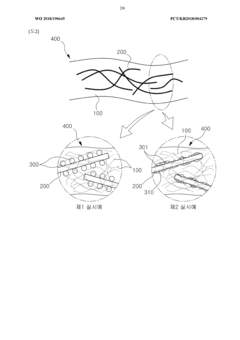
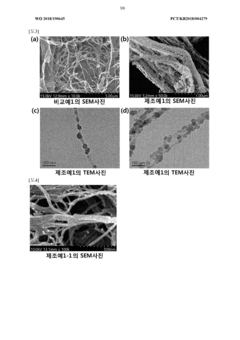
- A method involving the preparation of cellulose nanofibers with a silica coating or silica particles attached to their surface, which are then mixed with a polymer to form a composite, enhancing dispersibility and heat resistance through surface vitrification and uneven silica coating.


Sustainability Impact and Life Cycle Assessment
The sustainability impact of nanocellulose composites represents a critical dimension in evaluating their overall viability for industrial applications. These materials offer significant environmental advantages compared to conventional petroleum-based composites, primarily due to their biodegradable nature and renewable sourcing. When examining failure modes and damage tolerance improvements, sustainability considerations become particularly relevant as they influence material selection, processing methods, and end-of-life scenarios.
Life cycle assessment (LCA) studies of nanocellulose composites indicate reduced carbon footprints compared to traditional composites, with potential reductions of 30-50% in greenhouse gas emissions depending on processing techniques. However, the energy-intensive nature of nanocellulose extraction and processing—particularly in mechanical and chemical treatments—presents sustainability challenges that must be addressed when developing damage-tolerant formulations.
The relationship between failure modes and sustainability is multifaceted. Improving damage tolerance through cross-linking agents or chemical modifications may reduce material replacement frequency but potentially compromise biodegradability. Conversely, maintaining biodegradability while enhancing mechanical properties requires innovative approaches such as bio-based coupling agents and green chemistry principles, which have demonstrated promising results in recent research.
Water consumption represents another critical sustainability metric, with nanocellulose production typically requiring significant water resources. Advanced water recycling systems and low-water processing techniques have emerged as solutions, reducing water usage by up to 70% in optimized production facilities while maintaining the mechanical integrity necessary for damage-resistant applications.
End-of-life considerations reveal that nanocellulose composites with improved damage tolerance often face recycling challenges due to the complex matrix of additives and reinforcements. Biodegradation rates may be compromised by the very modifications that enhance mechanical performance. Recent innovations in designing for disassembly and selective biodegradation show promise for addressing this tension between performance and environmental impact.
The economic dimension of sustainability cannot be overlooked. While nanocellulose composites with enhanced damage tolerance may have higher initial production costs, their extended service life and reduced maintenance requirements often result in favorable life-cycle economics. Market analyses suggest a 15-25% reduction in total ownership costs compared to conventional materials when accounting for longevity and reduced replacement frequency.
Regulatory frameworks increasingly recognize the sustainability benefits of bio-based materials, creating incentives for industries to adopt nanocellulose composites. These policy developments, coupled with consumer demand for environmentally responsible products, are accelerating research into damage-tolerant formulations that maintain strong sustainability credentials throughout their life cycle.
Life cycle assessment (LCA) studies of nanocellulose composites indicate reduced carbon footprints compared to traditional composites, with potential reductions of 30-50% in greenhouse gas emissions depending on processing techniques. However, the energy-intensive nature of nanocellulose extraction and processing—particularly in mechanical and chemical treatments—presents sustainability challenges that must be addressed when developing damage-tolerant formulations.
The relationship between failure modes and sustainability is multifaceted. Improving damage tolerance through cross-linking agents or chemical modifications may reduce material replacement frequency but potentially compromise biodegradability. Conversely, maintaining biodegradability while enhancing mechanical properties requires innovative approaches such as bio-based coupling agents and green chemistry principles, which have demonstrated promising results in recent research.
Water consumption represents another critical sustainability metric, with nanocellulose production typically requiring significant water resources. Advanced water recycling systems and low-water processing techniques have emerged as solutions, reducing water usage by up to 70% in optimized production facilities while maintaining the mechanical integrity necessary for damage-resistant applications.
End-of-life considerations reveal that nanocellulose composites with improved damage tolerance often face recycling challenges due to the complex matrix of additives and reinforcements. Biodegradation rates may be compromised by the very modifications that enhance mechanical performance. Recent innovations in designing for disassembly and selective biodegradation show promise for addressing this tension between performance and environmental impact.
The economic dimension of sustainability cannot be overlooked. While nanocellulose composites with enhanced damage tolerance may have higher initial production costs, their extended service life and reduced maintenance requirements often result in favorable life-cycle economics. Market analyses suggest a 15-25% reduction in total ownership costs compared to conventional materials when accounting for longevity and reduced replacement frequency.
Regulatory frameworks increasingly recognize the sustainability benefits of bio-based materials, creating incentives for industries to adopt nanocellulose composites. These policy developments, coupled with consumer demand for environmentally responsible products, are accelerating research into damage-tolerant formulations that maintain strong sustainability credentials throughout their life cycle.
Testing Methodologies and Standards for Damage Tolerance Evaluation
The evaluation of damage tolerance in nanocellulose composites requires standardized testing methodologies to ensure consistent and comparable results across research institutions and industries. Currently, several established testing protocols have been adapted from traditional composite testing, while new methods specific to nanocellulose-based materials are emerging to address their unique properties.
ASTM D5528 and ISO 15024 standards for Mode I interlaminar fracture toughness testing have been widely applied to nanocellulose composites, providing valuable insights into crack initiation and propagation behaviors. These double cantilever beam (DCB) tests reveal how nanocellulose reinforcement affects the composite's resistance to delamination, a critical failure mode in layered structures.
For cyclic loading scenarios, ASTM D6115 fatigue delamination growth testing has been modified to accommodate the viscoelastic nature of nanocellulose composites. Researchers have observed that humidity conditioning significantly affects test results, necessitating strict environmental control during testing procedures.
Impact resistance evaluation follows ASTM D7136 for drop-weight impact testing, though modifications in impactor geometry are often required for thinner nanocellulose composite specimens. Post-impact damage assessment typically employs ultrasonic C-scan techniques to visualize internal damage distribution, revealing the unique damage suppression mechanisms of nanocellulose reinforcement.
Microscale damage characterization has advanced significantly with the development of in-situ SEM mechanical testing, allowing real-time observation of failure initiation at the nanocellulose-matrix interface. Digital image correlation (DIC) techniques have been particularly valuable in mapping strain distributions around nanocellulose-reinforced regions during progressive loading.
Standardization efforts specific to nanocellulose composites are being led by ISO/TC 229 (Nanotechnologies) and TAPPI's Nanotechnology Division, which recently published TAPPI WI 3021 for characterizing nanocellulose mechanical properties in composite applications. These emerging standards address the challenges of nanoscale reinforcement characterization and provide frameworks for damage tolerance assessment.
Multi-scale testing approaches are gaining prominence, combining macro-mechanical testing with nanoscale characterization to establish structure-property relationships. This integrated methodology helps identify the critical damage mechanisms at different hierarchical levels and guides the development of more damage-tolerant nanocellulose composite systems.
Round-robin testing initiatives across multiple laboratories have highlighted the need for standardized sample preparation protocols, as variations in nanocellulose dispersion quality significantly impact damage tolerance performance and test reproducibility. These collaborative efforts are essential for establishing reliable benchmarks for industrial implementation of nanocellulose composites in damage-critical applications.
ASTM D5528 and ISO 15024 standards for Mode I interlaminar fracture toughness testing have been widely applied to nanocellulose composites, providing valuable insights into crack initiation and propagation behaviors. These double cantilever beam (DCB) tests reveal how nanocellulose reinforcement affects the composite's resistance to delamination, a critical failure mode in layered structures.
For cyclic loading scenarios, ASTM D6115 fatigue delamination growth testing has been modified to accommodate the viscoelastic nature of nanocellulose composites. Researchers have observed that humidity conditioning significantly affects test results, necessitating strict environmental control during testing procedures.
Impact resistance evaluation follows ASTM D7136 for drop-weight impact testing, though modifications in impactor geometry are often required for thinner nanocellulose composite specimens. Post-impact damage assessment typically employs ultrasonic C-scan techniques to visualize internal damage distribution, revealing the unique damage suppression mechanisms of nanocellulose reinforcement.
Microscale damage characterization has advanced significantly with the development of in-situ SEM mechanical testing, allowing real-time observation of failure initiation at the nanocellulose-matrix interface. Digital image correlation (DIC) techniques have been particularly valuable in mapping strain distributions around nanocellulose-reinforced regions during progressive loading.
Standardization efforts specific to nanocellulose composites are being led by ISO/TC 229 (Nanotechnologies) and TAPPI's Nanotechnology Division, which recently published TAPPI WI 3021 for characterizing nanocellulose mechanical properties in composite applications. These emerging standards address the challenges of nanoscale reinforcement characterization and provide frameworks for damage tolerance assessment.
Multi-scale testing approaches are gaining prominence, combining macro-mechanical testing with nanoscale characterization to establish structure-property relationships. This integrated methodology helps identify the critical damage mechanisms at different hierarchical levels and guides the development of more damage-tolerant nanocellulose composite systems.
Round-robin testing initiatives across multiple laboratories have highlighted the need for standardized sample preparation protocols, as variations in nanocellulose dispersion quality significantly impact damage tolerance performance and test reproducibility. These collaborative efforts are essential for establishing reliable benchmarks for industrial implementation of nanocellulose composites in damage-critical applications.
Unlock deeper insights with PatSnap Eureka Quick Research — get a full tech report to explore trends and direct your research. Try now!
Generate Your Research Report Instantly with AI Agent
Supercharge your innovation with PatSnap Eureka AI Agent Platform!