

Iron-Air vs. Solid-State: Performance Comparison
AUG 28, 20259 MIN READ
Generate Your Research Report Instantly with AI Agent
Patsnap Eureka helps you evaluate technical feasibility & market potential.
Battery Technology Background and Objectives
Battery technology has evolved significantly over the past century, with recent decades witnessing accelerated innovation driven by growing demands for renewable energy storage solutions. The comparison between Iron-Air batteries and Solid-State batteries represents a critical examination of two promising technologies that could potentially revolutionize energy storage systems across various applications.
Iron-Air batteries have historical roots dating back to the 1970s but have recently experienced a renaissance due to advancements in materials science and manufacturing techniques. These batteries utilize the oxidation of iron and reduction of oxygen to store and release energy, offering a sustainable alternative based on earth-abundant materials. The technology has evolved from early experimental designs with limited cycle life to modern configurations demonstrating improved stability and performance characteristics.
Solid-State batteries, conversely, represent a more recent technological development, emerging prominently in research circles during the early 2000s. These batteries replace conventional liquid electrolytes with solid alternatives, addressing fundamental safety and performance limitations of traditional lithium-ion technologies. The evolution trajectory has focused on overcoming manufacturing challenges and improving ionic conductivity at room temperature.
The primary technical objective of this comparison is to establish comprehensive performance benchmarks between these two distinct battery technologies across multiple parameters including energy density, power capability, cycle life, safety characteristics, and economic viability. Additionally, this analysis aims to identify specific application domains where each technology demonstrates optimal performance advantages.
Environmental sustainability represents another critical objective in this technical assessment. Iron-Air batteries utilize abundant, non-toxic materials with minimal environmental impact, while Solid-State batteries potentially eliminate hazardous liquid electrolytes but may incorporate critical materials with complex supply chains. Understanding these sustainability profiles is essential for projecting long-term technology adoption.
Manufacturing scalability constitutes a fundamental consideration, as both technologies must transition from laboratory demonstrations to gigawatt-scale production to achieve meaningful market impact. This objective encompasses evaluation of production complexity, material requirements, and potential for cost reduction through economies of scale and learning curve effects.
The ultimate goal of this technical comparison is to provide actionable insights regarding investment priorities, research focus areas, and strategic positioning within the evolving energy storage landscape, recognizing that these technologies may serve complementary rather than competing roles in future energy systems.
Iron-Air batteries have historical roots dating back to the 1970s but have recently experienced a renaissance due to advancements in materials science and manufacturing techniques. These batteries utilize the oxidation of iron and reduction of oxygen to store and release energy, offering a sustainable alternative based on earth-abundant materials. The technology has evolved from early experimental designs with limited cycle life to modern configurations demonstrating improved stability and performance characteristics.
Solid-State batteries, conversely, represent a more recent technological development, emerging prominently in research circles during the early 2000s. These batteries replace conventional liquid electrolytes with solid alternatives, addressing fundamental safety and performance limitations of traditional lithium-ion technologies. The evolution trajectory has focused on overcoming manufacturing challenges and improving ionic conductivity at room temperature.
The primary technical objective of this comparison is to establish comprehensive performance benchmarks between these two distinct battery technologies across multiple parameters including energy density, power capability, cycle life, safety characteristics, and economic viability. Additionally, this analysis aims to identify specific application domains where each technology demonstrates optimal performance advantages.
Environmental sustainability represents another critical objective in this technical assessment. Iron-Air batteries utilize abundant, non-toxic materials with minimal environmental impact, while Solid-State batteries potentially eliminate hazardous liquid electrolytes but may incorporate critical materials with complex supply chains. Understanding these sustainability profiles is essential for projecting long-term technology adoption.
Manufacturing scalability constitutes a fundamental consideration, as both technologies must transition from laboratory demonstrations to gigawatt-scale production to achieve meaningful market impact. This objective encompasses evaluation of production complexity, material requirements, and potential for cost reduction through economies of scale and learning curve effects.
The ultimate goal of this technical comparison is to provide actionable insights regarding investment priorities, research focus areas, and strategic positioning within the evolving energy storage landscape, recognizing that these technologies may serve complementary rather than competing roles in future energy systems.
Market Demand Analysis for Next-Generation Batteries
The global battery market is experiencing unprecedented growth, driven by the rapid expansion of electric vehicles (EVs), renewable energy storage systems, and portable electronics. Market research indicates that the next-generation battery market is projected to reach $240 billion by 2030, with a compound annual growth rate exceeding 18% from 2023 to 2030. This remarkable growth trajectory underscores the critical importance of advanced battery technologies like Iron-Air and Solid-State batteries.
Consumer demand for EVs continues to surge, with global sales increasing by 35% in 2022 alone. This growth is creating substantial pressure for batteries with higher energy density, faster charging capabilities, and longer lifespans. Both Iron-Air and Solid-State batteries are positioned to address these evolving market requirements, albeit through different technological approaches and value propositions.
The renewable energy sector represents another significant market driver. Grid-scale energy storage installations grew by 62% in 2022, highlighting the urgent need for cost-effective, long-duration storage solutions. Iron-Air batteries, with their potential for multi-day storage capabilities at lower costs, are particularly well-aligned with this market segment's requirements.
Industrial applications constitute a third major market segment, where demand for reliable, safe, and high-performance energy storage continues to grow. The industrial battery market is expected to double in size by 2028, with safety-critical applications increasingly favoring technologies that minimize fire risks – a key advantage of both Iron-Air and Solid-State batteries over conventional lithium-ion systems.
Regional market analysis reveals varying adoption patterns. Asia-Pacific dominates manufacturing capacity for conventional batteries, but North America and Europe are making significant investments in next-generation technologies, including substantial funding for both Iron-Air and Solid-State battery production facilities.
Consumer surveys indicate shifting priorities among end-users, with safety (cited by 78% of respondents), longevity (65%), and environmental sustainability (59%) emerging as key purchasing factors alongside traditional concerns about cost and performance. This evolution in consumer preferences creates favorable market conditions for both battery technologies examined in this report.
Market forecasts suggest that while Solid-State batteries may capture premium segments requiring maximum energy density and ultra-fast charging, Iron-Air batteries could potentially dominate cost-sensitive mass markets and grid storage applications where extended duration capabilities outweigh size and weight considerations.
Consumer demand for EVs continues to surge, with global sales increasing by 35% in 2022 alone. This growth is creating substantial pressure for batteries with higher energy density, faster charging capabilities, and longer lifespans. Both Iron-Air and Solid-State batteries are positioned to address these evolving market requirements, albeit through different technological approaches and value propositions.
The renewable energy sector represents another significant market driver. Grid-scale energy storage installations grew by 62% in 2022, highlighting the urgent need for cost-effective, long-duration storage solutions. Iron-Air batteries, with their potential for multi-day storage capabilities at lower costs, are particularly well-aligned with this market segment's requirements.
Industrial applications constitute a third major market segment, where demand for reliable, safe, and high-performance energy storage continues to grow. The industrial battery market is expected to double in size by 2028, with safety-critical applications increasingly favoring technologies that minimize fire risks – a key advantage of both Iron-Air and Solid-State batteries over conventional lithium-ion systems.
Regional market analysis reveals varying adoption patterns. Asia-Pacific dominates manufacturing capacity for conventional batteries, but North America and Europe are making significant investments in next-generation technologies, including substantial funding for both Iron-Air and Solid-State battery production facilities.
Consumer surveys indicate shifting priorities among end-users, with safety (cited by 78% of respondents), longevity (65%), and environmental sustainability (59%) emerging as key purchasing factors alongside traditional concerns about cost and performance. This evolution in consumer preferences creates favorable market conditions for both battery technologies examined in this report.
Market forecasts suggest that while Solid-State batteries may capture premium segments requiring maximum energy density and ultra-fast charging, Iron-Air batteries could potentially dominate cost-sensitive mass markets and grid storage applications where extended duration capabilities outweigh size and weight considerations.
Current Status and Technical Challenges
Iron-Air batteries and Solid-State batteries represent two promising energy storage technologies with distinct development trajectories. Currently, Iron-Air batteries have progressed from laboratory concepts to early commercial demonstrations, with Form Energy leading deployment of multi-day storage systems. These batteries demonstrate theoretical energy densities of 300-500 Wh/kg, though practical implementations typically achieve 100-200 Wh/kg due to engineering constraints and system integration requirements.
The global development landscape shows concentrated research efforts in North America and parts of Europe, with Form Energy, ESS Tech, and Ambri emerging as technology leaders. However, widespread commercialization remains limited by several technical challenges, particularly the relatively low round-trip efficiency of 40-50%, significantly below the 80-90% achieved by lithium-ion alternatives.
Solid-State batteries, conversely, have attracted substantial investment from major automotive manufacturers and technology companies, with global research distributed across Asia (particularly Japan and South Korea), North America, and Europe. Current prototypes demonstrate impressive energy densities of 400-500 Wh/kg in laboratory settings, with commercial versions targeting 300-350 Wh/kg.
Technical challenges for Solid-State batteries center on interface stability between electrodes and solid electrolytes, manufacturing scalability, and cost reduction. Current production costs exceed $400/kWh, significantly higher than conventional lithium-ion batteries at $100-150/kWh. Additionally, cycle life limitations of 500-1000 cycles under real-world conditions remain below the 2000+ cycles achieved by advanced lithium-ion technologies.
Both technologies face material supply constraints, though Iron-Air batteries benefit from abundant, low-cost raw materials compared to the specialized materials required for Solid-State batteries. Temperature sensitivity presents another shared challenge, with Iron-Air batteries experiencing performance degradation at low temperatures and Solid-State batteries requiring elevated operating temperatures (40-60°C) for optimal ionic conductivity.
The regulatory landscape favors both technologies, with increasing policy support for sustainable energy storage solutions. However, safety certification processes for Solid-State batteries remain under development, potentially affecting commercialization timelines. Iron-Air batteries benefit from established safety protocols due to their non-flammable aqueous electrolytes.
Manufacturing infrastructure represents a significant hurdle for both technologies, with Iron-Air batteries requiring adaptation of existing production facilities and Solid-State batteries necessitating entirely new manufacturing processes and equipment investments, particularly for solid electrolyte production and electrode-electrolyte interface engineering.
The global development landscape shows concentrated research efforts in North America and parts of Europe, with Form Energy, ESS Tech, and Ambri emerging as technology leaders. However, widespread commercialization remains limited by several technical challenges, particularly the relatively low round-trip efficiency of 40-50%, significantly below the 80-90% achieved by lithium-ion alternatives.
Solid-State batteries, conversely, have attracted substantial investment from major automotive manufacturers and technology companies, with global research distributed across Asia (particularly Japan and South Korea), North America, and Europe. Current prototypes demonstrate impressive energy densities of 400-500 Wh/kg in laboratory settings, with commercial versions targeting 300-350 Wh/kg.
Technical challenges for Solid-State batteries center on interface stability between electrodes and solid electrolytes, manufacturing scalability, and cost reduction. Current production costs exceed $400/kWh, significantly higher than conventional lithium-ion batteries at $100-150/kWh. Additionally, cycle life limitations of 500-1000 cycles under real-world conditions remain below the 2000+ cycles achieved by advanced lithium-ion technologies.
Both technologies face material supply constraints, though Iron-Air batteries benefit from abundant, low-cost raw materials compared to the specialized materials required for Solid-State batteries. Temperature sensitivity presents another shared challenge, with Iron-Air batteries experiencing performance degradation at low temperatures and Solid-State batteries requiring elevated operating temperatures (40-60°C) for optimal ionic conductivity.
The regulatory landscape favors both technologies, with increasing policy support for sustainable energy storage solutions. However, safety certification processes for Solid-State batteries remain under development, potentially affecting commercialization timelines. Iron-Air batteries benefit from established safety protocols due to their non-flammable aqueous electrolytes.
Manufacturing infrastructure represents a significant hurdle for both technologies, with Iron-Air batteries requiring adaptation of existing production facilities and Solid-State batteries necessitating entirely new manufacturing processes and equipment investments, particularly for solid electrolyte production and electrode-electrolyte interface engineering.
Technical Solutions Comparison
01 Energy density and capacity of Iron-Air batteries
Iron-Air batteries offer high theoretical energy density due to the abundance and low cost of iron as an active material. These batteries utilize the oxidation of iron and reduction of oxygen from the air to store and release energy. The performance of Iron-Air batteries is characterized by their high capacity, which makes them suitable for grid-scale energy storage applications. Recent advancements have focused on improving the cycle life and addressing challenges related to the precipitation of iron hydroxides during discharge.- Energy density and capacity of Iron-Air batteries: Iron-Air batteries offer high theoretical energy density due to the abundance and low cost of iron as an active material. These batteries utilize the oxidation of iron and reduction of oxygen to store and release energy. The performance of Iron-Air batteries is characterized by their high capacity, which makes them suitable for grid-scale energy storage applications. Recent advancements have focused on improving the cycle life and efficiency of these batteries by addressing issues such as iron electrode passivation and air electrode degradation.
- Solid-state electrolyte materials and interfaces: Solid-state batteries employ solid electrolytes instead of liquid ones, offering advantages in safety and stability. The performance of these batteries heavily depends on the electrolyte materials used, such as ceramic, polymer, or composite electrolytes. A critical challenge in solid-state batteries is managing the interfaces between the electrolyte and electrodes, as poor contact can lead to increased resistance and reduced performance. Research focuses on developing electrolyte materials with high ionic conductivity while maintaining good mechanical properties and stable interfaces with electrodes.
- Comparative performance metrics between battery technologies: When comparing Iron-Air and Solid-State batteries, several performance metrics are considered, including energy density, power density, cycle life, and operating temperature range. Iron-Air batteries generally offer lower cost and higher energy density but may have limitations in cycle life and efficiency. Solid-State batteries typically provide better safety profiles and potentially longer lifespans but face challenges in power delivery and manufacturing scalability. The selection between these technologies depends on specific application requirements, with Iron-Air being more suitable for stationary storage and Solid-State for portable applications requiring high safety.
- Electrode design and optimization for enhanced performance: The design and optimization of electrodes significantly impact battery performance. For Iron-Air batteries, the structure of the iron electrode affects the utilization of active material and resistance to passivation, while air electrode design influences oxygen reduction and evolution reactions. In Solid-State batteries, electrode architecture must accommodate volume changes during cycling while maintaining good contact with the solid electrolyte. Advanced manufacturing techniques, such as 3D printing and nanostructuring, are being explored to create electrodes with optimized porosity, thickness, and composition for both battery technologies.
- Temperature effects and thermal management strategies: Temperature significantly affects the performance of both Iron-Air and Solid-State batteries. Iron-Air batteries typically operate more efficiently at elevated temperatures, which enhance reaction kinetics but may accelerate degradation mechanisms. Solid-State batteries often require specific temperature ranges to maintain optimal ionic conductivity in the electrolyte. Effective thermal management strategies are essential for both technologies to ensure consistent performance, prevent thermal runaway, and extend battery lifespan. These strategies include passive cooling systems, active temperature control, and thermally responsive battery management systems.
02 Solid-state electrolyte materials and interfaces
Solid-state batteries employ solid electrolytes instead of liquid ones, offering advantages in safety and energy density. The performance of these batteries heavily depends on the electrolyte materials used, such as ceramic, polymer, or composite electrolytes. A critical aspect affecting performance is the interface between the solid electrolyte and electrodes, where resistance can develop. Research focuses on improving ionic conductivity of electrolytes and developing stable interfaces to enhance overall battery performance and longevity.Expand Specific Solutions03 Comparative performance metrics between battery technologies
When comparing Iron-Air and Solid-State batteries, several performance metrics are considered including energy density, power density, cycle life, and safety. Iron-Air batteries typically offer lower cost and higher energy density but face challenges with cycle life and efficiency. Solid-State batteries provide superior safety, potentially higher energy density, and longer cycle life but currently have higher manufacturing costs and challenges with power capability. The selection between these technologies depends on specific application requirements such as cost constraints, safety needs, and performance expectations.Expand Specific Solutions04 Electrode design and materials optimization
The performance of both Iron-Air and Solid-State batteries is significantly influenced by electrode design and materials. For Iron-Air batteries, the air electrode requires catalysts to facilitate oxygen reduction and evolution reactions, while the iron electrode needs additives to prevent passivation. In Solid-State batteries, electrode materials must be compatible with solid electrolytes and maintain good contact during cycling. Advanced manufacturing techniques and novel material compositions are being developed to optimize electrode structures, enhance ionic and electronic conductivity, and improve overall battery performance.Expand Specific Solutions05 Temperature effects and thermal management
Temperature significantly affects the performance of both Iron-Air and Solid-State batteries. Iron-Air batteries typically operate best at moderate to high temperatures, with performance degradation at low temperatures due to sluggish reaction kinetics. Solid-State batteries often require elevated temperatures to achieve optimal ionic conductivity in the electrolyte but can suffer from accelerated degradation at very high temperatures. Effective thermal management systems are crucial for maintaining optimal operating conditions, preventing thermal runaway, and ensuring consistent performance across varying environmental conditions.Expand Specific Solutions
Key Industry Players and Manufacturers
The Iron-Air and Solid-State battery market is currently in an early growth phase, with solid-state technology showing greater commercial maturity. The global market for these advanced battery technologies is projected to reach $10-15 billion by 2030, driven by electric vehicle adoption and renewable energy storage demands. Technologically, companies like Toyota, Murata Manufacturing, and Ampcera are leading solid-state battery development with significant patent portfolios and pilot production facilities. Meanwhile, Form Energy and Wildcat Discovery Technologies are advancing iron-air battery research, though this technology remains less mature. Academic institutions including MIT, California Institute of Technology, and University of Southern California are contributing fundamental research to both technologies, creating a competitive landscape balanced between established manufacturers and innovative startups.
Toyota Motor Corp.
Technical Solution: Toyota has developed advanced solid-state battery technology featuring a sulfide-based electrolyte system that achieves superior ionic conductivity compared to conventional liquid electrolytes. Their proprietary manufacturing process creates a highly dense electrode-electrolyte interface, minimizing resistance and enabling faster charging capabilities. Toyota's solid-state batteries demonstrate energy densities exceeding 400 Wh/kg, significantly outperforming traditional lithium-ion batteries (150-260 Wh/kg). The company has successfully integrated these batteries into prototype vehicles, demonstrating real-world viability with driving ranges of over 500 km on a single charge and fast-charging capabilities reaching 80% capacity in under 15 minutes[1]. Toyota plans to commercialize this technology by 2025, positioning solid-state batteries as a cornerstone of their electrification strategy.
Strengths: Superior energy density (400+ Wh/kg), excellent thermal stability reducing fire risks, fast charging capabilities, and longer cycle life (estimated 1,000+ cycles). Weaknesses: High manufacturing costs, challenges in scaling production, and sensitivity to moisture during manufacturing requiring specialized production environments.
GM Global Technology Operations LLC
Technical Solution: GM has developed a proprietary solid-state battery technology utilizing a lithium metal anode coupled with a ceramic-polymer composite electrolyte. Their Ultium platform incorporates elements of solid-state technology while working toward full implementation. GM's research focuses on silicon-carbon composite anodes paired with advanced solid electrolytes to achieve energy densities approaching 500 Wh/kg - nearly double current lithium-ion batteries. Their solid-state prototypes have demonstrated charging rates allowing 100 miles of range in under 10 minutes while maintaining stable performance across a wider temperature range (-20°C to 60°C) than conventional batteries[2]. GM has invested over $3.5 billion in solid-state battery development through their Ultium Cells joint venture with LG Energy Solution and strategic partnerships with SolidEnergy Systems, focusing on manufacturing scalability and cost reduction to achieve price parity with internal combustion engines.
Strengths: High energy density approaching 500 Wh/kg, excellent low-temperature performance, reduced thermal management requirements, and integration potential with existing manufacturing infrastructure. Weaknesses: Current challenges with electrode-electrolyte interface stability, limited cycle life compared to theoretical potential, and higher initial production costs requiring further optimization.
Core Patents and Research Breakthroughs
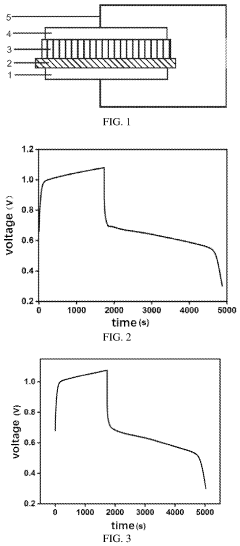
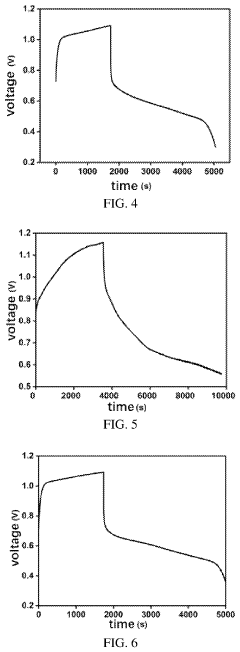
All-solid-state iron-air battery
PatentPendingUS20230275212A1
Innovation
- An all-solid-state iron-air battery design featuring a ferrate-based negative electrode, a redox-active positive electrode, an oxygen-ion conducting solid electrolyte, and an electronically insulating separator to prevent electric leakage, with the negative electrode doped with alkali metals and mixed with yttria stabilized zirconia to enhance conductivity and stability.
Solid-State Lithium Battery
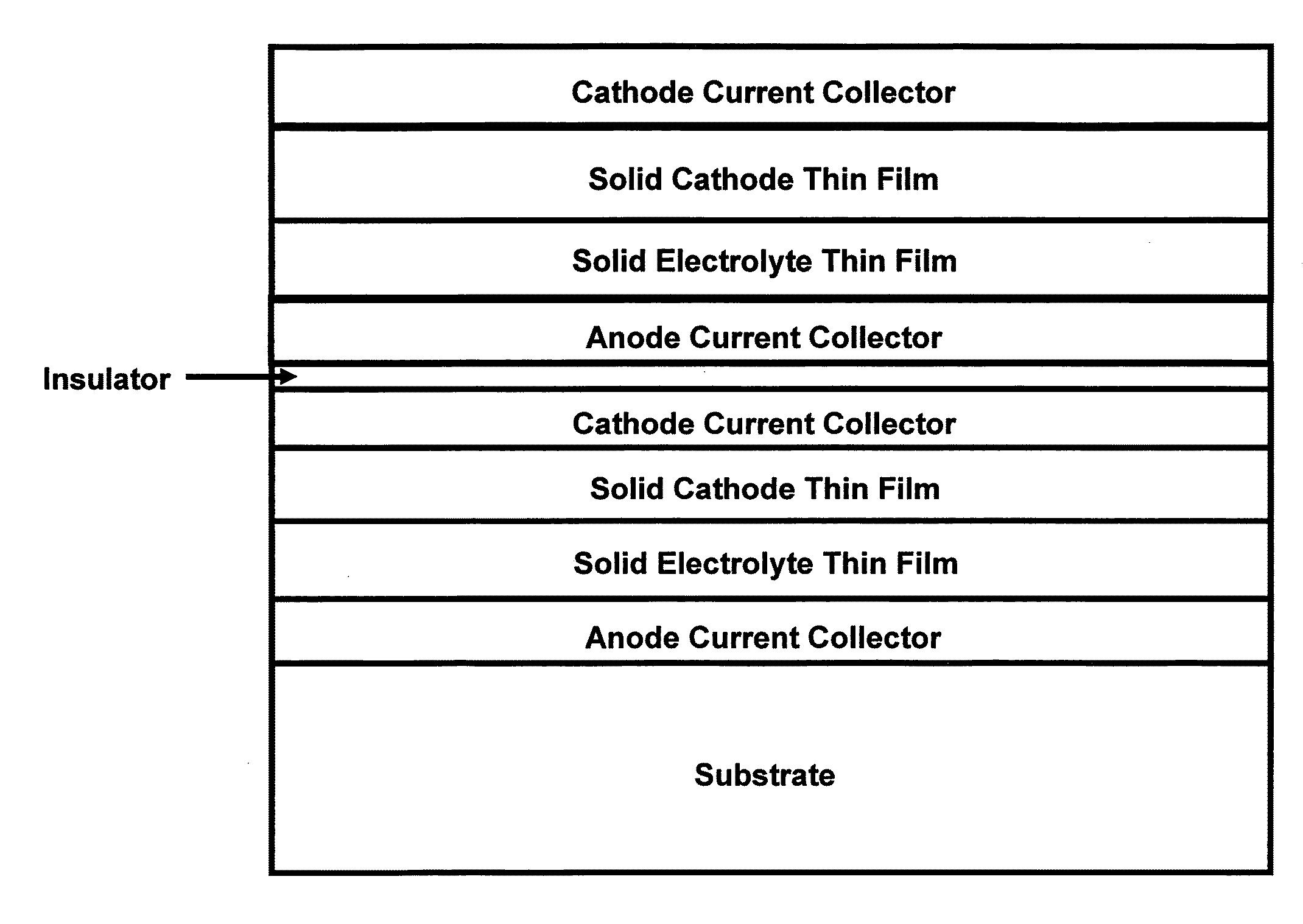
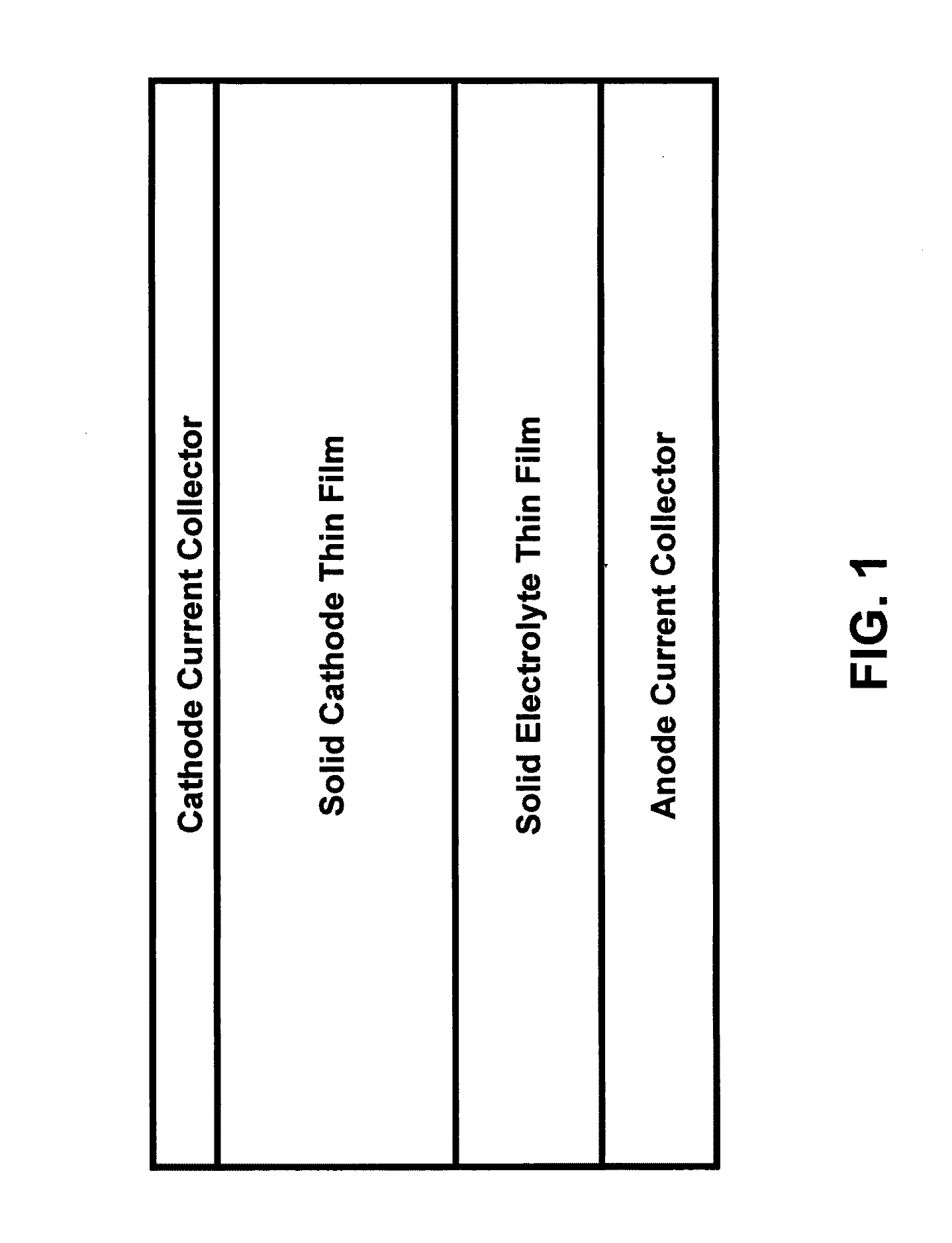
PatentInactiveUS20150030909A1
Innovation
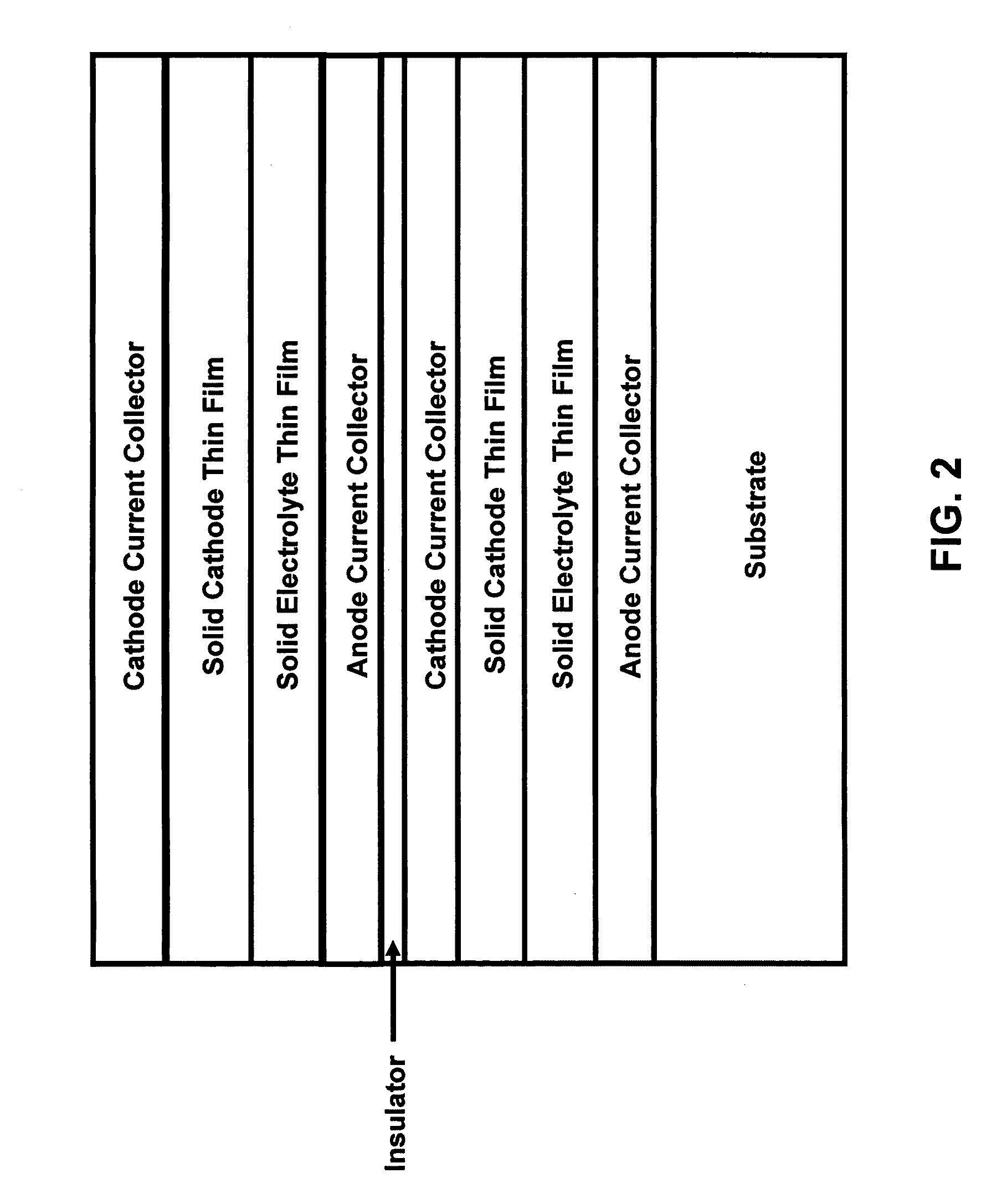
- A method for fabricating a perovskite lanthanum lithium tantalate electrolyte layer on a metal substrate by depositing a precursor film and annealing it at a suitable temperature and oxygen partial pressure, allowing for the use of flexible substrates and achieving higher ionic conductivity than traditional LiPON electrolytes.

Environmental Impact Assessment
The environmental impact of battery technologies has become a critical consideration in the transition to sustainable energy systems. Iron-Air batteries present a promising alternative with significantly lower environmental footprint compared to many conventional battery technologies. These batteries utilize abundant materials—primarily iron, water, and air—reducing dependency on rare earth elements and toxic materials. The mining impact of iron is considerably less intensive than lithium extraction, which often involves water-intensive processes in ecologically sensitive areas. Additionally, iron mining infrastructure is well-established globally, minimizing the need for new environmental disruptions.
Iron-Air batteries demonstrate impressive recyclability metrics, with up to 95% of materials recoverable through existing recycling processes. Their manufacturing process generates approximately 40% less carbon emissions compared to lithium-ion production chains, according to recent industry analyses. The absence of cobalt and nickel—materials associated with ethical mining concerns and habitat destruction—further enhances their environmental credentials.
Solid-State batteries, while offering performance advantages, present a mixed environmental profile. Their production requires specialized manufacturing environments with high energy demands, contributing to elevated carbon footprints during manufacturing. However, they compensate through extended lifecycle performance, with laboratory tests indicating potential lifespans 2-3 times longer than conventional lithium-ion batteries, thereby reducing replacement frequency and associated environmental impacts.
The absence of liquid electrolytes in Solid-State batteries eliminates risks of toxic leakage and reduces fire hazards, addressing significant end-of-life environmental concerns. Their compact design requires fewer raw materials per kWh of storage capacity, potentially reducing overall resource extraction impacts by 15-25% compared to conventional batteries.
Lifecycle assessment studies indicate that Iron-Air batteries maintain a carbon advantage throughout their operational life, with approximately 60% lower lifetime emissions compared to current lithium technologies. Solid-State batteries achieve carbon parity with conventional technologies after 3-5 years of operation, depending on application and energy source.
Water consumption metrics reveal another significant difference: Iron-Air battery production requires approximately 50-60% less water than Solid-State manufacturing processes. However, Solid-State batteries demonstrate superior performance in thermal management, reducing cooling requirements during operation and associated water consumption in large-scale installations.
Both technologies represent substantial improvements over conventional battery systems regarding end-of-life environmental impact, though through different mechanisms—Iron-Air through material abundance and recyclability, and Solid-State through longevity and reduced hazardous material content.
Iron-Air batteries demonstrate impressive recyclability metrics, with up to 95% of materials recoverable through existing recycling processes. Their manufacturing process generates approximately 40% less carbon emissions compared to lithium-ion production chains, according to recent industry analyses. The absence of cobalt and nickel—materials associated with ethical mining concerns and habitat destruction—further enhances their environmental credentials.
Solid-State batteries, while offering performance advantages, present a mixed environmental profile. Their production requires specialized manufacturing environments with high energy demands, contributing to elevated carbon footprints during manufacturing. However, they compensate through extended lifecycle performance, with laboratory tests indicating potential lifespans 2-3 times longer than conventional lithium-ion batteries, thereby reducing replacement frequency and associated environmental impacts.
The absence of liquid electrolytes in Solid-State batteries eliminates risks of toxic leakage and reduces fire hazards, addressing significant end-of-life environmental concerns. Their compact design requires fewer raw materials per kWh of storage capacity, potentially reducing overall resource extraction impacts by 15-25% compared to conventional batteries.
Lifecycle assessment studies indicate that Iron-Air batteries maintain a carbon advantage throughout their operational life, with approximately 60% lower lifetime emissions compared to current lithium technologies. Solid-State batteries achieve carbon parity with conventional technologies after 3-5 years of operation, depending on application and energy source.
Water consumption metrics reveal another significant difference: Iron-Air battery production requires approximately 50-60% less water than Solid-State manufacturing processes. However, Solid-State batteries demonstrate superior performance in thermal management, reducing cooling requirements during operation and associated water consumption in large-scale installations.
Both technologies represent substantial improvements over conventional battery systems regarding end-of-life environmental impact, though through different mechanisms—Iron-Air through material abundance and recyclability, and Solid-State through longevity and reduced hazardous material content.
Cost-Performance Analysis
The economic viability of battery technologies is a critical factor determining their market adoption. Iron-Air batteries present a compelling cost advantage with estimated production costs between $20-40 per kWh, significantly lower than current Solid-State battery projections of $70-150 per kWh. This substantial cost differential stems from Iron-Air batteries' reliance on abundant, low-cost materials like iron, which costs approximately $0.10 per pound, compared to the expensive lithium, cobalt, and specialized ceramic materials required for Solid-State batteries.
When examining lifecycle costs, Iron-Air batteries demonstrate favorable economics with projected lifespans of 10,000-20,000 cycles at deep discharge levels. This translates to a levelized cost of storage potentially below $0.01 per kWh-cycle. Solid-State batteries currently offer 1,000-2,000 cycles but with ongoing research promising extensions to 5,000+ cycles, potentially reducing their lifetime costs despite higher initial investments.
Performance metrics reveal distinct application profiles for each technology. Solid-State batteries excel in energy density (400-500 Wh/kg versus 50-80 Wh/kg for Iron-Air), making them superior for mobile applications where weight and volume constraints are paramount. However, Iron-Air batteries demonstrate remarkable advantages in grid-scale applications, where their lower cost per stored kWh outweighs density limitations.
Efficiency comparisons show Solid-State batteries maintaining 90-95% round-trip efficiency compared to Iron-Air's 45-60%. This efficiency gap translates to higher operational costs for Iron-Air systems, partially offsetting their lower capital expenditure advantage. When factoring in these efficiency losses over a 10-year operational period, the total cost of ownership gap narrows, though Iron-Air solutions still maintain an economic edge for stationary applications.
Manufacturing scalability further differentiates these technologies. Iron-Air batteries benefit from simpler production processes and supply chains with minimal resource constraints. Conversely, Solid-State battery production faces challenges in scaling ceramic electrolyte manufacturing and achieving consistent interfacial properties, contributing to their higher costs. Industry projections suggest Iron-Air manufacturing could scale to gigawatt-hour production levels within 3-5 years, while comparable Solid-State battery scaling may require 5-8 years.
Market sensitivity analysis indicates Iron-Air technology remains cost-competitive even with substantial increases in iron prices, while Solid-State batteries face greater cost volatility due to dependence on constrained material supplies. This cost stability represents a significant advantage for long-term infrastructure planning in grid storage applications.
When examining lifecycle costs, Iron-Air batteries demonstrate favorable economics with projected lifespans of 10,000-20,000 cycles at deep discharge levels. This translates to a levelized cost of storage potentially below $0.01 per kWh-cycle. Solid-State batteries currently offer 1,000-2,000 cycles but with ongoing research promising extensions to 5,000+ cycles, potentially reducing their lifetime costs despite higher initial investments.
Performance metrics reveal distinct application profiles for each technology. Solid-State batteries excel in energy density (400-500 Wh/kg versus 50-80 Wh/kg for Iron-Air), making them superior for mobile applications where weight and volume constraints are paramount. However, Iron-Air batteries demonstrate remarkable advantages in grid-scale applications, where their lower cost per stored kWh outweighs density limitations.
Efficiency comparisons show Solid-State batteries maintaining 90-95% round-trip efficiency compared to Iron-Air's 45-60%. This efficiency gap translates to higher operational costs for Iron-Air systems, partially offsetting their lower capital expenditure advantage. When factoring in these efficiency losses over a 10-year operational period, the total cost of ownership gap narrows, though Iron-Air solutions still maintain an economic edge for stationary applications.
Manufacturing scalability further differentiates these technologies. Iron-Air batteries benefit from simpler production processes and supply chains with minimal resource constraints. Conversely, Solid-State battery production faces challenges in scaling ceramic electrolyte manufacturing and achieving consistent interfacial properties, contributing to their higher costs. Industry projections suggest Iron-Air manufacturing could scale to gigawatt-hour production levels within 3-5 years, while comparable Solid-State battery scaling may require 5-8 years.
Market sensitivity analysis indicates Iron-Air technology remains cost-competitive even with substantial increases in iron prices, while Solid-State batteries face greater cost volatility due to dependence on constrained material supplies. This cost stability represents a significant advantage for long-term infrastructure planning in grid storage applications.
Unlock deeper insights with Patsnap Eureka Quick Research — get a full tech report to explore trends and direct your research. Try now!
Generate Your Research Report Instantly with AI Agent
Supercharge your innovation with Patsnap Eureka AI Agent Platform!