

Phased Array in Security Systems: Compare Effectiveness
SEP 22, 202510 MIN READ
Generate Your Research Report Instantly with AI Agent
PatSnap Eureka helps you evaluate technical feasibility & market potential.
Phased Array Security Technology Background and Objectives
Phased array technology has evolved significantly since its inception in radar systems during World War II. Initially developed for military applications, this technology has progressively transitioned into civilian security domains over the past three decades. The fundamental principle involves multiple antenna elements working in concert, with signals being electronically steered through phase manipulation rather than mechanical movement, enabling rapid and precise scanning capabilities.
The security sector has witnessed accelerated adoption of phased array systems since the early 2000s, driven by heightened global security concerns and technological advancements in signal processing. Contemporary phased array security systems operate across various frequency bands, typically ranging from 1 GHz to 77 GHz, with higher frequencies offering improved resolution but at increased implementation complexity and cost.
Recent technological trends indicate a shift toward more compact, energy-efficient phased array systems with enhanced detection capabilities. Miniaturization of components, integration of advanced semiconductor materials, and implementation of sophisticated algorithms have collectively contributed to this evolution. The integration of artificial intelligence and machine learning algorithms has further enhanced the discrimination capabilities of these systems, reducing false alarm rates significantly.
The primary objective of phased array technology in security applications is to provide reliable, high-resolution detection and tracking of potential threats while minimizing false positives. These systems aim to offer comprehensive surveillance coverage across diverse environmental conditions, maintaining consistent performance regardless of weather, lighting, or background noise variations.
Secondary objectives include achieving operational efficiency through reduced power consumption, minimizing maintenance requirements, and ensuring seamless integration with existing security infrastructure. The technology also strives to balance detection sensitivity with privacy considerations, particularly in civilian applications where continuous monitoring must comply with legal and ethical standards.
Current research focuses on enhancing the effectiveness of phased array security systems through improved signal processing techniques, advanced materials for antenna elements, and more sophisticated detection algorithms. The development of multi-functional systems capable of simultaneous detection, identification, and tracking represents a significant technological goal, potentially revolutionizing perimeter security, infrastructure protection, and public safety applications.
The convergence of phased array technology with other sensing modalities, such as optical and infrared systems, presents promising opportunities for creating more robust and versatile security solutions. This integration aims to overcome the inherent limitations of individual technologies, providing comprehensive threat detection capabilities across diverse operational scenarios and environmental conditions.
The security sector has witnessed accelerated adoption of phased array systems since the early 2000s, driven by heightened global security concerns and technological advancements in signal processing. Contemporary phased array security systems operate across various frequency bands, typically ranging from 1 GHz to 77 GHz, with higher frequencies offering improved resolution but at increased implementation complexity and cost.
Recent technological trends indicate a shift toward more compact, energy-efficient phased array systems with enhanced detection capabilities. Miniaturization of components, integration of advanced semiconductor materials, and implementation of sophisticated algorithms have collectively contributed to this evolution. The integration of artificial intelligence and machine learning algorithms has further enhanced the discrimination capabilities of these systems, reducing false alarm rates significantly.
The primary objective of phased array technology in security applications is to provide reliable, high-resolution detection and tracking of potential threats while minimizing false positives. These systems aim to offer comprehensive surveillance coverage across diverse environmental conditions, maintaining consistent performance regardless of weather, lighting, or background noise variations.
Secondary objectives include achieving operational efficiency through reduced power consumption, minimizing maintenance requirements, and ensuring seamless integration with existing security infrastructure. The technology also strives to balance detection sensitivity with privacy considerations, particularly in civilian applications where continuous monitoring must comply with legal and ethical standards.
Current research focuses on enhancing the effectiveness of phased array security systems through improved signal processing techniques, advanced materials for antenna elements, and more sophisticated detection algorithms. The development of multi-functional systems capable of simultaneous detection, identification, and tracking represents a significant technological goal, potentially revolutionizing perimeter security, infrastructure protection, and public safety applications.
The convergence of phased array technology with other sensing modalities, such as optical and infrared systems, presents promising opportunities for creating more robust and versatile security solutions. This integration aims to overcome the inherent limitations of individual technologies, providing comprehensive threat detection capabilities across diverse operational scenarios and environmental conditions.
Market Analysis for Phased Array Security Solutions
The global market for phased array security solutions has experienced significant growth over the past decade, driven by increasing security concerns across various sectors including critical infrastructure, transportation hubs, and commercial facilities. Currently valued at approximately 3.2 billion USD, this market segment is projected to reach 5.7 billion USD by 2028, representing a compound annual growth rate of 10.3% during the forecast period.
North America dominates the market with a 42% share, followed by Europe at 28% and Asia-Pacific at 21%. The remaining 9% is distributed across other regions. This regional distribution reflects the technological advancement and security investment priorities of developed economies, though emerging markets are showing accelerated adoption rates, particularly in the Middle East and parts of Asia.
The demand for phased array security systems is primarily driven by their superior detection capabilities, reduced false alarm rates, and ability to provide comprehensive surveillance coverage with fewer installation points. Government and defense sectors currently represent the largest customer segment, accounting for 47% of market revenue, followed by critical infrastructure protection at 23%, commercial security at 18%, and transportation security at 12%.
Key market trends include the integration of artificial intelligence and machine learning algorithms to enhance threat detection accuracy, miniaturization of phased array components enabling more discreet deployment options, and the development of multi-function systems that combine surveillance, communication, and counter-measure capabilities in single platforms.
Customer requirements are evolving toward solutions offering greater range, higher resolution, weather-resistance, and seamless integration with existing security ecosystems. Price sensitivity varies significantly by sector, with government and critical infrastructure customers prioritizing performance over cost, while commercial applications remain more cost-conscious.
The competitive landscape features both established defense contractors expanding into commercial markets and specialized security technology firms. Major players include Raytheon Technologies, Lockheed Martin, Thales Group, and L3Harris Technologies, collectively holding approximately 58% market share. Emerging competitors like Echodyne, RADA Electronic Industries, and Metawave are gaining traction through innovative approaches and specialized applications.
Market barriers include high initial deployment costs, technical complexity requiring specialized installation and maintenance, regulatory hurdles related to radio frequency emissions, and cybersecurity concerns as these systems become increasingly networked. Despite these challenges, the market outlook remains highly positive, with technological advancements continually expanding the application scope and improving the cost-effectiveness of phased array security solutions.
North America dominates the market with a 42% share, followed by Europe at 28% and Asia-Pacific at 21%. The remaining 9% is distributed across other regions. This regional distribution reflects the technological advancement and security investment priorities of developed economies, though emerging markets are showing accelerated adoption rates, particularly in the Middle East and parts of Asia.
The demand for phased array security systems is primarily driven by their superior detection capabilities, reduced false alarm rates, and ability to provide comprehensive surveillance coverage with fewer installation points. Government and defense sectors currently represent the largest customer segment, accounting for 47% of market revenue, followed by critical infrastructure protection at 23%, commercial security at 18%, and transportation security at 12%.
Key market trends include the integration of artificial intelligence and machine learning algorithms to enhance threat detection accuracy, miniaturization of phased array components enabling more discreet deployment options, and the development of multi-function systems that combine surveillance, communication, and counter-measure capabilities in single platforms.
Customer requirements are evolving toward solutions offering greater range, higher resolution, weather-resistance, and seamless integration with existing security ecosystems. Price sensitivity varies significantly by sector, with government and critical infrastructure customers prioritizing performance over cost, while commercial applications remain more cost-conscious.
The competitive landscape features both established defense contractors expanding into commercial markets and specialized security technology firms. Major players include Raytheon Technologies, Lockheed Martin, Thales Group, and L3Harris Technologies, collectively holding approximately 58% market share. Emerging competitors like Echodyne, RADA Electronic Industries, and Metawave are gaining traction through innovative approaches and specialized applications.
Market barriers include high initial deployment costs, technical complexity requiring specialized installation and maintenance, regulatory hurdles related to radio frequency emissions, and cybersecurity concerns as these systems become increasingly networked. Despite these challenges, the market outlook remains highly positive, with technological advancements continually expanding the application scope and improving the cost-effectiveness of phased array security solutions.
Current Phased Array Implementation Challenges
Despite the proven effectiveness of phased array technology in security systems, several significant implementation challenges persist that limit its widespread adoption. The primary obstacle remains the high cost associated with phased array systems. The complex electronic components, including numerous transmit/receive modules, phase shifters, and sophisticated signal processing hardware, contribute to substantial manufacturing expenses. This cost barrier particularly affects small to medium-sized security operations that cannot justify the investment despite the technology's superior detection capabilities.
Technical complexity presents another major challenge. Phased array systems require precise calibration and maintenance to function optimally. The intricate beamforming algorithms and signal processing techniques demand specialized expertise that many security organizations lack. This knowledge gap often results in suboptimal system performance or increased dependency on external technical support, further raising operational costs.
Power consumption remains a critical concern, especially for deployable or remote security applications. Current phased array systems require significant electrical power to operate multiple transmit/receive modules simultaneously. This power requirement limits the technology's applicability in scenarios where energy resources are constrained or where covert, low-signature operation is necessary.
Integration challenges with existing security infrastructure also impede implementation. Many organizations have invested heavily in conventional security technologies, and the transition to phased array systems often requires substantial modifications to supporting systems. The lack of standardized interfaces between phased array technology and legacy security equipment creates compatibility issues that complicate deployment.
Environmental factors further complicate implementation. Phased array performance can be affected by adverse weather conditions, electromagnetic interference, and physical obstructions. These environmental limitations necessitate careful site planning and sometimes redundant systems, adding to implementation complexity and cost.
Regulatory hurdles present additional challenges. The operation of phased array systems, particularly those using radar technology, is subject to strict frequency allocation regulations that vary by country. Navigating these regulatory frameworks requires significant resources and can delay implementation timelines.
Size and form factor constraints also limit deployment options. While miniaturization efforts have progressed, current phased array systems remain relatively bulky compared to conventional security sensors, restricting their use in space-limited applications or covert surveillance scenarios where discretion is paramount.
Technical complexity presents another major challenge. Phased array systems require precise calibration and maintenance to function optimally. The intricate beamforming algorithms and signal processing techniques demand specialized expertise that many security organizations lack. This knowledge gap often results in suboptimal system performance or increased dependency on external technical support, further raising operational costs.
Power consumption remains a critical concern, especially for deployable or remote security applications. Current phased array systems require significant electrical power to operate multiple transmit/receive modules simultaneously. This power requirement limits the technology's applicability in scenarios where energy resources are constrained or where covert, low-signature operation is necessary.
Integration challenges with existing security infrastructure also impede implementation. Many organizations have invested heavily in conventional security technologies, and the transition to phased array systems often requires substantial modifications to supporting systems. The lack of standardized interfaces between phased array technology and legacy security equipment creates compatibility issues that complicate deployment.
Environmental factors further complicate implementation. Phased array performance can be affected by adverse weather conditions, electromagnetic interference, and physical obstructions. These environmental limitations necessitate careful site planning and sometimes redundant systems, adding to implementation complexity and cost.
Regulatory hurdles present additional challenges. The operation of phased array systems, particularly those using radar technology, is subject to strict frequency allocation regulations that vary by country. Navigating these regulatory frameworks requires significant resources and can delay implementation timelines.
Size and form factor constraints also limit deployment options. While miniaturization efforts have progressed, current phased array systems remain relatively bulky compared to conventional security sensors, restricting their use in space-limited applications or covert surveillance scenarios where discretion is paramount.
Comparative Analysis of Existing Phased Array Solutions
01 Phased array antenna design optimization
Optimization techniques for phased array antennas focus on improving beam forming capabilities, signal quality, and directional control. These designs incorporate advanced element configurations and spacing methodologies to enhance radiation patterns and minimize interference. The optimized structures enable better signal focusing, increased gain, and improved overall effectiveness in various applications including radar systems and wireless communications.- Phased Array Antenna Design Optimization: Optimization techniques for phased array antennas focus on improving beam steering capabilities and signal quality. These designs incorporate advanced element configurations, spacing optimization, and phase control mechanisms to enhance directivity and gain. Various approaches include adaptive algorithms for beam forming, element pattern optimization, and integrated circuit designs that minimize interference while maximizing radiation efficiency.
- Signal Processing Techniques for Phased Arrays: Advanced signal processing methods significantly enhance phased array effectiveness through digital beamforming, adaptive filtering, and real-time calibration algorithms. These techniques enable precise beam steering, interference cancellation, and improved signal-to-noise ratios. Implementation of digital signal processors and field-programmable gate arrays allows for dynamic adjustment of array parameters to optimize performance in changing environmental conditions.
- Thermal Management and Environmental Resilience: Thermal management solutions are critical for maintaining phased array effectiveness, particularly in high-power applications. Innovative cooling systems, heat-resistant materials, and thermal distribution designs prevent performance degradation due to heat buildup. Environmental protection features shield array elements from moisture, dust, and temperature fluctuations, ensuring consistent operation across diverse deployment scenarios and extending operational lifespan.
- Miniaturization and Integration Technologies: Miniaturization technologies enable more compact and efficient phased array systems through advanced semiconductor processes, MEMS technology, and integrated circuit designs. These approaches reduce size and weight while maintaining or improving performance metrics. Integration of multiple functions on single chips decreases system complexity and power consumption while enhancing reliability through reduced interconnection points and simplified manufacturing processes.
- Multi-band and Wideband Operation Capabilities: Multi-band and wideband phased arrays provide enhanced operational flexibility across diverse frequency ranges. These systems incorporate specialized element designs, feed networks, and control architectures to maintain effectiveness across multiple frequency bands simultaneously. Advanced materials and novel geometrical configurations enable broader bandwidth operation without compromising gain or beam quality, making these arrays particularly valuable for applications requiring frequency agility.
02 Signal processing techniques for phased arrays
Advanced signal processing methods significantly enhance phased array performance through digital beamforming, adaptive filtering, and real-time calibration algorithms. These techniques enable dynamic beam steering, interference cancellation, and improved signal-to-noise ratios. By implementing sophisticated processing algorithms, phased array systems can achieve higher resolution, better target discrimination, and enhanced operational effectiveness across varying environmental conditions.Expand Specific Solutions03 Power management and efficiency improvements
Innovative power management solutions for phased array systems focus on reducing energy consumption while maintaining or improving performance. These approaches include efficient amplifier designs, intelligent power distribution networks, and thermal management techniques. By optimizing power usage across array elements and implementing advanced control systems, these innovations enhance operational longevity, reduce cooling requirements, and improve overall system reliability.Expand Specific Solutions04 Integration and miniaturization technologies
Miniaturization and integration technologies enable more compact and effective phased array systems through advanced packaging, semiconductor integration, and novel materials. These approaches allow for higher element density, reduced form factors, and improved thermal performance. The resulting integrated designs offer enhanced functionality in smaller packages, making phased arrays more practical for space-constrained applications while maintaining or improving performance metrics.Expand Specific Solutions05 Calibration and error correction methods
Sophisticated calibration and error correction techniques improve phased array accuracy and reliability by compensating for manufacturing variations, environmental effects, and component aging. These methods include automated phase and amplitude calibration, real-time error detection, and adaptive compensation algorithms. By continuously monitoring and adjusting array parameters, these systems maintain optimal performance over time and across varying operational conditions, significantly enhancing overall effectiveness.Expand Specific Solutions
Leading Phased Array Security System Manufacturers
Phased array technology in security systems is currently in a growth phase, with the market expanding due to increasing security concerns and technological advancements. The global market size for phased array security systems is projected to reach significant value in the coming years, driven by applications in perimeter security, threat detection, and surveillance. Leading players like Raytheon, Lockheed Martin, and Rafael Advanced Defense Systems demonstrate high technical maturity with established defense-oriented solutions, while companies such as Huawei, MediaTek, and NXP are advancing commercial applications. Academic institutions including MIT and Beihang University contribute to innovation through research partnerships. The technology is transitioning from primarily military applications to broader commercial security implementations, with varying degrees of maturity across different market segments.
Raytheon Co.
Technical Solution: Raytheon has developed advanced phased array radar systems for security applications that utilize Active Electronically Scanned Array (AESA) technology. Their systems employ digital beamforming techniques that allow for simultaneous tracking of multiple threats across wide coverage areas. Raytheon's phased array security systems incorporate adaptive algorithms that automatically adjust to changing environmental conditions and potential jamming attempts[1]. Their technology enables 360-degree surveillance with no mechanical moving parts, significantly reducing maintenance requirements while improving reliability. The systems feature scalable architectures that can be configured for various security applications, from critical infrastructure protection to border security, with detection ranges extending to several kilometers depending on configuration[3]. Raytheon's implementation includes advanced signal processing capabilities that filter out clutter and false alarms, providing high probability of detection while maintaining low false alarm rates even in complex urban environments.
Strengths: Superior detection range and accuracy in adverse weather conditions; highly resistant to jamming; exceptional multi-target tracking capabilities. Weaknesses: Higher initial acquisition costs compared to conventional systems; requires specialized technical expertise for maintenance and operation; power consumption can be significant for larger installations.
Rafael Advanced Defense Systems Ltd.
Technical Solution: Rafael has pioneered phased array technology in security systems through their integrated defense solutions. Their phased array systems utilize sophisticated digital signal processing algorithms that enable precise beam steering and formation without mechanical movement. Rafael's technology implements multi-function capabilities, allowing a single array to perform simultaneous detection, tracking, and electronic countermeasures. Their systems employ gallium nitride (GaN) based transmit/receive modules that provide higher power efficiency and reliability in harsh environments[2]. Rafael's phased arrays incorporate advanced MIMO (Multiple-Input Multiple-Output) techniques to enhance detection sensitivity and spatial resolution, particularly effective against small targets and low-observable threats. The company has developed specialized software that enables automatic threat classification and prioritization, reducing operator workload in high-stress security scenarios[4]. Their systems feature distributed architecture designs that provide redundancy and continued operation even if portions of the array are damaged or compromised.
Strengths: Exceptional electronic counter-countermeasures capabilities; highly modular design allowing for customization to specific security needs; proven reliability in combat situations. Weaknesses: Complex integration requirements with existing security infrastructure; higher procurement costs compared to conventional systems; requires specialized training for effective operation.
Key Patents and Innovations in Phased Array Security
Phased array system with distributed processing
PatentPendingEP4610687A1
Innovation
- Implementing a distributed processing architecture that distributes metric calculations across multiple subarray units, preprocesses metrics, and utilizes a distributed data link system to maintain balanced load distribution and scalability, while allowing for selective configuration of subarray units as control or processing units to handle failures.
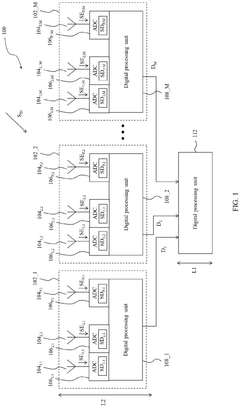
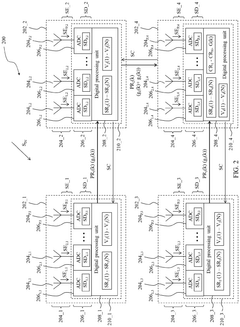
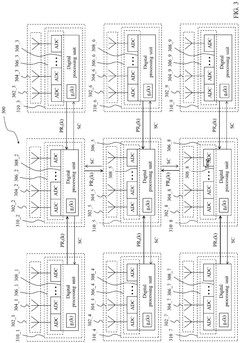
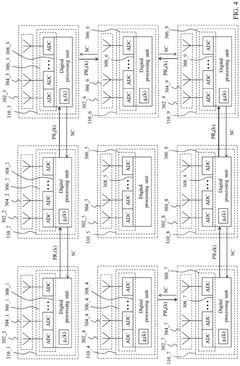
Phase shifting and combining architecture for phased arrays
PatentActiveUS7683833B2
Innovation
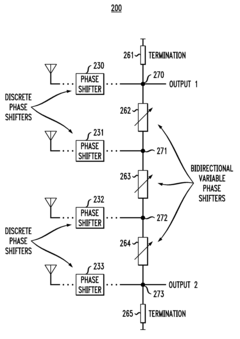
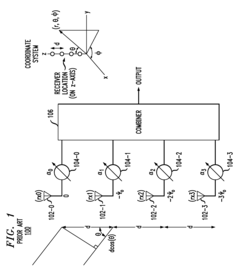
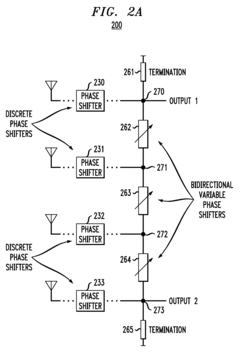
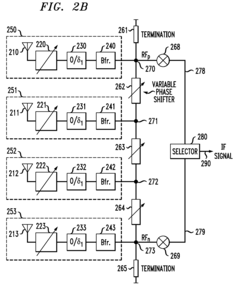
- The implementation of N discrete phase shifters and N-1 variable phase shifters, where the discrete phase shifters reduce the continuous phase shift range and eliminate the need for variable termination impedance, allowing for low insertion and return losses, and enabling single-chip integration with a widely adjustable phase shifter.
Integration with AI and Machine Learning Capabilities
The integration of AI and machine learning capabilities with phased array technology represents a significant advancement in security systems. These intelligent algorithms enhance the effectiveness of phased array radar systems by optimizing signal processing, target identification, and threat assessment capabilities.
Machine learning algorithms significantly improve signal processing in phased array systems by adaptively filtering noise and interference patterns. This dynamic filtering capability allows security systems to maintain optimal performance across varying environmental conditions, from dense urban settings to remote locations with minimal infrastructure. Neural networks trained on extensive datasets can distinguish between genuine security threats and benign objects, dramatically reducing false alarm rates that plague conventional systems.
Deep learning models enable phased array security systems to perform real-time classification of detected objects with remarkable accuracy. These systems can differentiate between humans, vehicles, animals, and other objects based on their radar signatures, movement patterns, and contextual information. The classification capabilities continue to improve over time as the system accumulates operational data, creating a self-improving security solution.
Predictive analytics represents another valuable integration point, allowing phased array systems to anticipate potential security breaches based on historical patterns and anomaly detection. By analyzing temporal and spatial data, these systems can identify suspicious behavior patterns before they manifest as security incidents. This proactive approach transforms phased array technology from a detection tool to a prevention mechanism.
Edge computing architectures have emerged as critical enablers for AI-enhanced phased array systems. By processing data locally at the sensor level, these systems minimize latency in threat response while reducing bandwidth requirements for data transmission. This distributed intelligence approach enables deployment in locations with limited connectivity while maintaining robust security capabilities.
Multi-sensor fusion algorithms combine data from phased arrays with inputs from complementary security technologies such as optical cameras, infrared sensors, and acoustic detectors. Machine learning models integrate these diverse data streams to create comprehensive situational awareness that exceeds the capabilities of any single sensing modality. This fusion approach addresses the inherent limitations of individual technologies, creating more resilient security systems.
The integration of AI with phased array technology also enables adaptive security postures that respond dynamically to changing threat levels. These systems can automatically adjust scanning patterns, detection thresholds, and alert protocols based on environmental conditions, time of day, or specific security protocols. This adaptability ensures optimal resource utilization while maintaining comprehensive security coverage.
Machine learning algorithms significantly improve signal processing in phased array systems by adaptively filtering noise and interference patterns. This dynamic filtering capability allows security systems to maintain optimal performance across varying environmental conditions, from dense urban settings to remote locations with minimal infrastructure. Neural networks trained on extensive datasets can distinguish between genuine security threats and benign objects, dramatically reducing false alarm rates that plague conventional systems.
Deep learning models enable phased array security systems to perform real-time classification of detected objects with remarkable accuracy. These systems can differentiate between humans, vehicles, animals, and other objects based on their radar signatures, movement patterns, and contextual information. The classification capabilities continue to improve over time as the system accumulates operational data, creating a self-improving security solution.
Predictive analytics represents another valuable integration point, allowing phased array systems to anticipate potential security breaches based on historical patterns and anomaly detection. By analyzing temporal and spatial data, these systems can identify suspicious behavior patterns before they manifest as security incidents. This proactive approach transforms phased array technology from a detection tool to a prevention mechanism.
Edge computing architectures have emerged as critical enablers for AI-enhanced phased array systems. By processing data locally at the sensor level, these systems minimize latency in threat response while reducing bandwidth requirements for data transmission. This distributed intelligence approach enables deployment in locations with limited connectivity while maintaining robust security capabilities.
Multi-sensor fusion algorithms combine data from phased arrays with inputs from complementary security technologies such as optical cameras, infrared sensors, and acoustic detectors. Machine learning models integrate these diverse data streams to create comprehensive situational awareness that exceeds the capabilities of any single sensing modality. This fusion approach addresses the inherent limitations of individual technologies, creating more resilient security systems.
The integration of AI with phased array technology also enables adaptive security postures that respond dynamically to changing threat levels. These systems can automatically adjust scanning patterns, detection thresholds, and alert protocols based on environmental conditions, time of day, or specific security protocols. This adaptability ensures optimal resource utilization while maintaining comprehensive security coverage.
Regulatory Compliance and Standards for Security Systems
The implementation of phased array technology in security systems is subject to a complex framework of regulatory requirements and industry standards that vary significantly across regions and applications. In the United States, the Federal Communications Commission (FCC) regulates radio frequency emissions under Part 15 rules, which directly impact phased array radar systems used in security applications. These regulations establish specific frequency bands, power limitations, and interference mitigation requirements that manufacturers must adhere to during system design and deployment.
The European Union enforces similar but distinct regulations through the Radio Equipment Directive (RED) and the Electromagnetic Compatibility Directive (EMCD), which impose additional constraints on phased array security systems marketed within EU member states. These directives emphasize harmonized standards for electromagnetic compatibility and efficient spectrum usage, critical factors in phased array performance evaluation.
International standards organizations play a pivotal role in establishing performance benchmarks for security systems incorporating phased array technology. The International Electrotechnical Commission (IEC) has developed standards specifically addressing electromagnetic compatibility and safety requirements, while the International Organization for Standardization (ISO) provides frameworks for security management systems that incorporate advanced detection technologies.
Industry-specific standards further refine requirements for phased array implementation in security contexts. ANSI/SIA CP-01 standards for control panels and UL 2900 for software cybersecurity have direct implications for the digital components of phased array systems, particularly as these systems increasingly integrate with networked security infrastructure. The National Fire Protection Association (NFPA) codes also influence installation parameters when phased arrays are incorporated into comprehensive building security solutions.
Privacy regulations represent an emerging compliance challenge for phased array security systems, especially those with enhanced imaging capabilities. The General Data Protection Regulation (GDPR) in Europe and similar frameworks worldwide impose strict requirements on systems that might capture personally identifiable information, necessitating careful system design and operational protocols to ensure compliance.
Military and critical infrastructure applications face additional regulatory hurdles, with standards such as MIL-STD-461 for electromagnetic interference and MIL-STD-810 for environmental conditions establishing rigorous performance requirements. These standards significantly influence the comparative effectiveness evaluation of different phased array implementations in high-security environments.
Compliance certification processes vary by jurisdiction but typically involve laboratory testing, documentation review, and sometimes field verification. Manufacturers must navigate these processes carefully, as non-compliance can result in market access restrictions, liability issues, and reputational damage that directly impact product viability and competitive positioning.
The European Union enforces similar but distinct regulations through the Radio Equipment Directive (RED) and the Electromagnetic Compatibility Directive (EMCD), which impose additional constraints on phased array security systems marketed within EU member states. These directives emphasize harmonized standards for electromagnetic compatibility and efficient spectrum usage, critical factors in phased array performance evaluation.
International standards organizations play a pivotal role in establishing performance benchmarks for security systems incorporating phased array technology. The International Electrotechnical Commission (IEC) has developed standards specifically addressing electromagnetic compatibility and safety requirements, while the International Organization for Standardization (ISO) provides frameworks for security management systems that incorporate advanced detection technologies.
Industry-specific standards further refine requirements for phased array implementation in security contexts. ANSI/SIA CP-01 standards for control panels and UL 2900 for software cybersecurity have direct implications for the digital components of phased array systems, particularly as these systems increasingly integrate with networked security infrastructure. The National Fire Protection Association (NFPA) codes also influence installation parameters when phased arrays are incorporated into comprehensive building security solutions.
Privacy regulations represent an emerging compliance challenge for phased array security systems, especially those with enhanced imaging capabilities. The General Data Protection Regulation (GDPR) in Europe and similar frameworks worldwide impose strict requirements on systems that might capture personally identifiable information, necessitating careful system design and operational protocols to ensure compliance.
Military and critical infrastructure applications face additional regulatory hurdles, with standards such as MIL-STD-461 for electromagnetic interference and MIL-STD-810 for environmental conditions establishing rigorous performance requirements. These standards significantly influence the comparative effectiveness evaluation of different phased array implementations in high-security environments.
Compliance certification processes vary by jurisdiction but typically involve laboratory testing, documentation review, and sometimes field verification. Manufacturers must navigate these processes carefully, as non-compliance can result in market access restrictions, liability issues, and reputational damage that directly impact product viability and competitive positioning.
Unlock deeper insights with PatSnap Eureka Quick Research — get a full tech report to explore trends and direct your research. Try now!
Generate Your Research Report Instantly with AI Agent
Supercharge your innovation with PatSnap Eureka AI Agent Platform!