Phased Array vs Microwave Arrays: Sensitivity Comparison
SEP 22, 20259 MIN READ
Generate Your Research Report Instantly with AI Agent
Patsnap Eureka helps you evaluate technical feasibility & market potential.
Phased Array and Microwave Array Technology Evolution
Phased array technology has evolved significantly since its inception in the early 20th century. Initially developed for military radar applications during World War II, phased arrays represented a revolutionary approach to electronic beam steering without mechanical movement. The 1950s and 1960s saw the first practical implementations, with systems like the AN/FPS-85 space surveillance radar demonstrating the viability of electronically steered arrays for long-range detection.
The 1970s marked a critical transition period with the introduction of solid-state components replacing vacuum tubes, dramatically reducing size, weight, and power requirements. This technological shift enabled more compact and reliable systems, expanding potential applications beyond military use. By the 1980s, the integration of monolithic microwave integrated circuits (MMICs) further revolutionized phased array technology, enabling unprecedented levels of miniaturization and performance improvement.
Microwave array technology followed a parallel but distinct evolutionary path. Early microwave arrays in the 1940s and 1950s primarily utilized waveguide technology, which offered excellent performance but at the cost of bulk and complexity. The transition to printed circuit board technology in the 1970s represented a significant advancement, allowing for more cost-effective and reproducible array designs.
The 1990s witnessed the convergence of digital signal processing with both phased and microwave array technologies. This integration enabled sophisticated beamforming algorithms and adaptive processing techniques that substantially improved sensitivity and interference rejection capabilities. Digital beamforming emerged as a game-changing approach, allowing for multiple simultaneous beams and enhanced flexibility in array operation.
The early 2000s saw the emergence of active electronically scanned arrays (AESA) as the dominant paradigm in high-performance radar systems. These systems integrated transmit/receive modules directly with antenna elements, offering unprecedented performance in terms of sensitivity, reliability, and multi-functionality.
Recent developments have focused on improving sensitivity through advanced materials and manufacturing techniques. Gallium nitride (GaN) technology has emerged as a critical enabler for high-power, high-efficiency transmit/receive modules. Meanwhile, advances in metamaterials and photonic integrated circuits are pushing the boundaries of what's possible in array sensitivity and bandwidth.
The sensitivity comparison between phased arrays and microwave arrays has evolved from a simple question of architecture to a complex interplay of materials science, semiconductor technology, signal processing algorithms, and system integration approaches. Modern systems increasingly blur the traditional distinctions between these technologies, incorporating hybrid approaches that leverage the strengths of both paradigms to achieve optimal sensitivity for specific applications.
The 1970s marked a critical transition period with the introduction of solid-state components replacing vacuum tubes, dramatically reducing size, weight, and power requirements. This technological shift enabled more compact and reliable systems, expanding potential applications beyond military use. By the 1980s, the integration of monolithic microwave integrated circuits (MMICs) further revolutionized phased array technology, enabling unprecedented levels of miniaturization and performance improvement.
Microwave array technology followed a parallel but distinct evolutionary path. Early microwave arrays in the 1940s and 1950s primarily utilized waveguide technology, which offered excellent performance but at the cost of bulk and complexity. The transition to printed circuit board technology in the 1970s represented a significant advancement, allowing for more cost-effective and reproducible array designs.
The 1990s witnessed the convergence of digital signal processing with both phased and microwave array technologies. This integration enabled sophisticated beamforming algorithms and adaptive processing techniques that substantially improved sensitivity and interference rejection capabilities. Digital beamforming emerged as a game-changing approach, allowing for multiple simultaneous beams and enhanced flexibility in array operation.
The early 2000s saw the emergence of active electronically scanned arrays (AESA) as the dominant paradigm in high-performance radar systems. These systems integrated transmit/receive modules directly with antenna elements, offering unprecedented performance in terms of sensitivity, reliability, and multi-functionality.
Recent developments have focused on improving sensitivity through advanced materials and manufacturing techniques. Gallium nitride (GaN) technology has emerged as a critical enabler for high-power, high-efficiency transmit/receive modules. Meanwhile, advances in metamaterials and photonic integrated circuits are pushing the boundaries of what's possible in array sensitivity and bandwidth.
The sensitivity comparison between phased arrays and microwave arrays has evolved from a simple question of architecture to a complex interplay of materials science, semiconductor technology, signal processing algorithms, and system integration approaches. Modern systems increasingly blur the traditional distinctions between these technologies, incorporating hybrid approaches that leverage the strengths of both paradigms to achieve optimal sensitivity for specific applications.
Market Applications and Demand Analysis
The market for phased array and microwave array technologies has experienced significant growth in recent years, driven by increasing demand across multiple sectors. The defense industry remains the largest consumer of these technologies, with radar systems for military aircraft, naval vessels, and ground-based installations requiring ever-higher sensitivity and performance capabilities. Market analysis indicates that defense applications account for approximately 40% of the total market share, with annual growth rates consistently above 5% over the past five years.
Telecommunications represents the second-largest market segment, particularly with the global rollout of 5G networks. The need for highly sensitive, directional antennas capable of beam steering has created substantial demand for phased array technology. This sector is expected to grow at the fastest rate among all application areas, with projections suggesting a compound annual growth rate of 12-15% through 2028.
Weather forecasting and environmental monitoring applications have also emerged as significant growth areas. Organizations such as NOAA and the European Meteorological Satellite Organization have invested heavily in advanced radar systems with improved sensitivity for more accurate weather prediction. The increased frequency and severity of extreme weather events globally has accelerated investment in this sector.
Medical imaging represents a smaller but rapidly expanding application area. The superior sensitivity of phased array technology has enabled advances in ultrasound imaging resolution and depth penetration. Healthcare providers are increasingly adopting these advanced systems for improved diagnostic capabilities, particularly in cardiology and obstetrics.
Market research indicates a clear trend toward systems with higher sensitivity requirements across all sectors. End users consistently rank sensitivity as among the top three performance criteria when selecting between competing technologies, alongside cost and reliability. This trend is particularly pronounced in aerospace and defense applications, where the ability to detect smaller targets at greater distances provides significant tactical advantages.
Regional analysis shows North America maintaining the largest market share at approximately 35%, followed by Europe and Asia-Pacific. However, the Asia-Pacific region is experiencing the fastest growth rate, driven by increased defense spending in countries like China and India, along with rapid telecommunications infrastructure development.
Industry surveys reveal that customers are increasingly willing to pay premium prices for systems offering demonstrable improvements in sensitivity performance. This price elasticity varies by application, with defense and medical sectors showing the greatest willingness to invest in higher-sensitivity solutions, while commercial telecommunications operators remain more cost-sensitive despite recognizing the technical benefits of enhanced sensitivity.
Telecommunications represents the second-largest market segment, particularly with the global rollout of 5G networks. The need for highly sensitive, directional antennas capable of beam steering has created substantial demand for phased array technology. This sector is expected to grow at the fastest rate among all application areas, with projections suggesting a compound annual growth rate of 12-15% through 2028.
Weather forecasting and environmental monitoring applications have also emerged as significant growth areas. Organizations such as NOAA and the European Meteorological Satellite Organization have invested heavily in advanced radar systems with improved sensitivity for more accurate weather prediction. The increased frequency and severity of extreme weather events globally has accelerated investment in this sector.
Medical imaging represents a smaller but rapidly expanding application area. The superior sensitivity of phased array technology has enabled advances in ultrasound imaging resolution and depth penetration. Healthcare providers are increasingly adopting these advanced systems for improved diagnostic capabilities, particularly in cardiology and obstetrics.
Market research indicates a clear trend toward systems with higher sensitivity requirements across all sectors. End users consistently rank sensitivity as among the top three performance criteria when selecting between competing technologies, alongside cost and reliability. This trend is particularly pronounced in aerospace and defense applications, where the ability to detect smaller targets at greater distances provides significant tactical advantages.
Regional analysis shows North America maintaining the largest market share at approximately 35%, followed by Europe and Asia-Pacific. However, the Asia-Pacific region is experiencing the fastest growth rate, driven by increased defense spending in countries like China and India, along with rapid telecommunications infrastructure development.
Industry surveys reveal that customers are increasingly willing to pay premium prices for systems offering demonstrable improvements in sensitivity performance. This price elasticity varies by application, with defense and medical sectors showing the greatest willingness to invest in higher-sensitivity solutions, while commercial telecommunications operators remain more cost-sensitive despite recognizing the technical benefits of enhanced sensitivity.
Current Sensitivity Challenges and Limitations
Despite significant advancements in both phased array and microwave array technologies, several critical sensitivity challenges and limitations persist that impact their comparative performance. The fundamental sensitivity limitation in phased arrays stems from their electronic scanning mechanism, which introduces phase quantization errors. These errors become particularly problematic when steering beams at wide angles, resulting in decreased sensitivity at the edges of the scanning field compared to boresight performance.
Thermal noise presents a significant challenge for both array types, though its impact manifests differently. In phased arrays, the active electronic components required for phase shifting generate additional noise that can degrade the signal-to-noise ratio (SNR). Microwave arrays, particularly passive ones, typically exhibit lower thermal noise profiles but face challenges in maintaining uniform sensitivity across their detection field.
Element coupling effects create another substantial limitation, especially in densely packed arrays. Mutual coupling between adjacent elements causes impedance variations and pattern distortions that directly impact sensitivity. This phenomenon is more pronounced in phased arrays operating at higher frequencies where element spacing becomes electrically larger relative to wavelength.
Manufacturing tolerances and calibration precision significantly affect sensitivity performance in both array types. Phased arrays require precise phase control across hundreds or thousands of elements, with even minor calibration errors causing sensitivity degradation. Microwave arrays, while generally simpler in architecture, still demand precise element positioning and uniform performance characteristics to maintain sensitivity across the array aperture.
Environmental factors introduce additional challenges, with temperature variations causing particular concern. Phased arrays with active electronic components experience performance drift as temperatures fluctuate, requiring sophisticated compensation mechanisms. Microwave arrays generally demonstrate better thermal stability but remain susceptible to physical deformation from thermal expansion, which can alter element spacing and degrade sensitivity.
Power consumption constraints limit the practical sensitivity of phased arrays in many applications. The need to power numerous active components creates thermal management challenges that can further degrade sensitivity performance. This limitation becomes especially critical in mobile or space-based applications where power resources are constrained.
Bandwidth limitations affect sensitivity across frequency ranges differently between the two technologies. Phased arrays typically exhibit narrower instantaneous bandwidth due to phase shifter limitations, while microwave arrays can potentially offer broader bandwidth operation but may suffer from frequency-dependent sensitivity variations across that bandwidth.
Cost considerations ultimately constrain the achievable sensitivity in real-world deployments, with high-sensitivity implementations of either technology requiring significant investment in precision components, manufacturing processes, and calibration systems.
Thermal noise presents a significant challenge for both array types, though its impact manifests differently. In phased arrays, the active electronic components required for phase shifting generate additional noise that can degrade the signal-to-noise ratio (SNR). Microwave arrays, particularly passive ones, typically exhibit lower thermal noise profiles but face challenges in maintaining uniform sensitivity across their detection field.
Element coupling effects create another substantial limitation, especially in densely packed arrays. Mutual coupling between adjacent elements causes impedance variations and pattern distortions that directly impact sensitivity. This phenomenon is more pronounced in phased arrays operating at higher frequencies where element spacing becomes electrically larger relative to wavelength.
Manufacturing tolerances and calibration precision significantly affect sensitivity performance in both array types. Phased arrays require precise phase control across hundreds or thousands of elements, with even minor calibration errors causing sensitivity degradation. Microwave arrays, while generally simpler in architecture, still demand precise element positioning and uniform performance characteristics to maintain sensitivity across the array aperture.
Environmental factors introduce additional challenges, with temperature variations causing particular concern. Phased arrays with active electronic components experience performance drift as temperatures fluctuate, requiring sophisticated compensation mechanisms. Microwave arrays generally demonstrate better thermal stability but remain susceptible to physical deformation from thermal expansion, which can alter element spacing and degrade sensitivity.
Power consumption constraints limit the practical sensitivity of phased arrays in many applications. The need to power numerous active components creates thermal management challenges that can further degrade sensitivity performance. This limitation becomes especially critical in mobile or space-based applications where power resources are constrained.
Bandwidth limitations affect sensitivity across frequency ranges differently between the two technologies. Phased arrays typically exhibit narrower instantaneous bandwidth due to phase shifter limitations, while microwave arrays can potentially offer broader bandwidth operation but may suffer from frequency-dependent sensitivity variations across that bandwidth.
Cost considerations ultimately constrain the achievable sensitivity in real-world deployments, with high-sensitivity implementations of either technology requiring significant investment in precision components, manufacturing processes, and calibration systems.
Comparative Sensitivity Solutions
01 Sensitivity enhancement techniques in phased arrays
Various techniques can be employed to enhance the sensitivity of phased arrays, including optimized element design, signal processing algorithms, and adaptive beamforming. These methods help to improve signal reception, reduce noise, and enhance the overall performance of the array. By implementing these sensitivity enhancement techniques, phased arrays can achieve better detection capabilities and increased range for various applications including radar, communications, and sensing systems.- Sensitivity enhancement techniques in phased arrays: Various techniques can be employed to enhance the sensitivity of phased arrays, including optimized element spacing, advanced signal processing algorithms, and adaptive beamforming. These methods help to improve signal reception, reduce noise, and enhance the overall performance of the array. By implementing these sensitivity enhancement techniques, phased arrays can achieve better detection capabilities and increased range.
- Microwave array design for improved sensitivity: Specific design considerations for microwave arrays can significantly impact sensitivity. These include the selection of appropriate materials, optimized antenna element configurations, and careful impedance matching. Advanced microwave array designs incorporate features that minimize signal loss, reduce interference, and maximize power efficiency, resulting in improved sensitivity for applications such as radar systems, communication networks, and sensing devices.
- Calibration methods for sensitivity optimization: Calibration plays a crucial role in optimizing the sensitivity of phased and microwave arrays. Techniques include phase calibration, amplitude balancing, and environmental compensation algorithms. Proper calibration ensures that all elements in the array work together coherently, compensating for manufacturing variations and environmental factors that could otherwise degrade sensitivity. Regular recalibration may be necessary to maintain optimal performance over time.
- Advanced signal processing for sensitivity improvement: Signal processing techniques significantly enhance the sensitivity of phased and microwave arrays. These include digital beamforming, adaptive filtering, and sophisticated noise reduction algorithms. By implementing advanced signal processing methods, arrays can detect weaker signals in noisy environments, improve target discrimination, and enhance overall system sensitivity. These techniques often involve complex computational algorithms that can be implemented in hardware or software.
- Environmental and interference mitigation for sensitivity: Mitigating environmental factors and interference is essential for maintaining high sensitivity in phased and microwave arrays. Techniques include adaptive nulling, sidelobe cancellation, and environmental shielding. These methods help to reduce the impact of external interference sources, weather conditions, and other environmental factors that could otherwise degrade array sensitivity. By effectively managing these challenges, arrays can maintain optimal performance across various operating conditions.
02 Microwave array configurations for improved sensitivity
Specific configurations of microwave arrays can significantly improve sensitivity performance. These include optimized element spacing, array geometry design, and specialized feed networks. By carefully designing the physical layout of the array elements and their interconnections, the sensitivity of the overall system can be enhanced. Different array configurations may be suitable for different applications, depending on the required field of view, frequency range, and sensitivity requirements.Expand Specific Solutions03 Calibration and compensation methods for sensitivity optimization
Calibration and compensation methods are essential for optimizing the sensitivity of phased and microwave arrays. These techniques include phase and amplitude calibration, temperature compensation, and environmental adaptation algorithms. By implementing proper calibration procedures, the array can maintain optimal sensitivity across varying operating conditions. Compensation methods help to mitigate the effects of component variations, environmental factors, and aging on array sensitivity.Expand Specific Solutions04 Advanced materials and components for high-sensitivity arrays
The use of advanced materials and specialized components can significantly enhance the sensitivity of phased and microwave arrays. These include low-loss substrates, high-performance amplifiers, specialized antenna elements, and advanced semiconductor technologies. By incorporating these materials and components, arrays can achieve improved signal-to-noise ratios, better thermal stability, and enhanced overall sensitivity. The selection of appropriate materials and components is critical for optimizing array performance in specific applications.Expand Specific Solutions05 Digital signal processing techniques for sensitivity improvement
Digital signal processing techniques play a crucial role in improving the sensitivity of phased and microwave arrays. These include advanced filtering algorithms, digital beamforming, interference cancellation, and adaptive processing methods. By implementing sophisticated digital processing techniques, arrays can achieve better detection of weak signals, improved rejection of interference, and enhanced overall sensitivity. These techniques often involve real-time processing of array signals to optimize performance under varying conditions.Expand Specific Solutions
Leading Manufacturers and Research Institutions
Phased array and microwave array technology is currently in a mature growth phase, with the global market expected to reach $12 billion by 2025. The competitive landscape features established defense contractors like Raytheon and Boeing alongside emerging technology leaders. IBM, Huawei, and NXP are advancing semiconductor integration for improved sensitivity, while academic institutions like MIT, Caltech, and Beihang University are pioneering next-generation designs. Technical maturity varies by application, with defense systems being most advanced. GlobalFoundries and MediaTek are focusing on miniaturization and cost reduction, while research institutions like China's 29th Research Institute are developing specialized high-sensitivity arrays for emerging applications.
California Institute of Technology
Technical Solution: Caltech has developed innovative phased array technology through their Jet Propulsion Laboratory (JPL) that delivers exceptional sensitivity for space-based and terrestrial applications. Their approach utilizes custom-designed MMIC (Monolithic Microwave Integrated Circuit) technology that achieves unprecedented noise figure performance, typically 1.5-2.0 dB lower than conventional microwave arrays[2]. Caltech's phased arrays implement sophisticated calibration techniques that compensate for manufacturing variations and thermal effects, maintaining optimal sensitivity across operating conditions. Their systems employ advanced signal processing algorithms that coherently combine signals from multiple elements, effectively increasing the aperture size and enhancing sensitivity by approximately 15dB compared to traditional microwave arrays of similar physical dimensions[4]. Caltech has pioneered ultra-wideband phased array technology that maintains high sensitivity across frequency ranges spanning multiple octaves, enabling multi-mission capabilities with a single hardware platform. Their arrays also incorporate adaptive nulling techniques that can reject interference sources while maintaining sensitivity in the desired direction[6].
Strengths: Exceptional sensitivity in space and terrestrial applications; superior performance across wide frequency bands; excellent thermal stability; compact form factor. Weaknesses: Higher development costs; increased complexity requiring specialized expertise; challenging manufacturing tolerances; higher power requirements for some implementations.
Massachusetts Institute of Technology
Technical Solution: MIT's Lincoln Laboratory has developed revolutionary phased array technology that significantly outperforms traditional microwave arrays in sensitivity metrics. Their approach utilizes digital beamforming architecture with individual analog-to-digital converters for each antenna element, enabling unprecedented flexibility in signal processing. MIT's systems achieve superior sensitivity through coherent integration of signals across the array aperture, effectively increasing the signal-to-noise ratio proportionally to the number of elements. Their research has demonstrated sensitivity improvements of approximately 18dB compared to conventional microwave arrays of similar physical dimensions[1]. MIT has pioneered adaptive calibration techniques that maintain optimal performance despite component variations and environmental changes. Additionally, their arrays incorporate advanced cryogenic cooling for front-end electronics, reducing noise temperature to near-theoretical limits and further enhancing sensitivity for specialized applications[3]. MIT's technology also implements sophisticated interference mitigation algorithms that can maintain sensitivity performance even in contested electromagnetic environments[5].
Strengths: Industry-leading sensitivity performance; exceptional adaptability to changing signal environments; superior interference rejection capabilities; scalable architecture for different applications. Weaknesses: Higher complexity requiring specialized expertise; increased cost for cryogenic implementations; higher computational requirements for real-time processing.
Key Patents and Technical Breakthroughs
Ultra-wideband variable-phase ring-oscillator arrays, architectures, and related methods
PatentInactiveUS20080297414A1
Innovation
- The integration of all radiating elements and electronics on a single silicon wafer using a variable-phase ring oscillator (VPRO) architecture, which allows for linear phase progression and direct modulation/demodulation of arbitrary waveforms without RF up/down converting mixers, reducing the number of required building blocks and enabling compact, energy-efficient beam-forming.


Monolithic silicon-based phased arrays for communications and radars
PatentActiveUS20050227660A1
Innovation
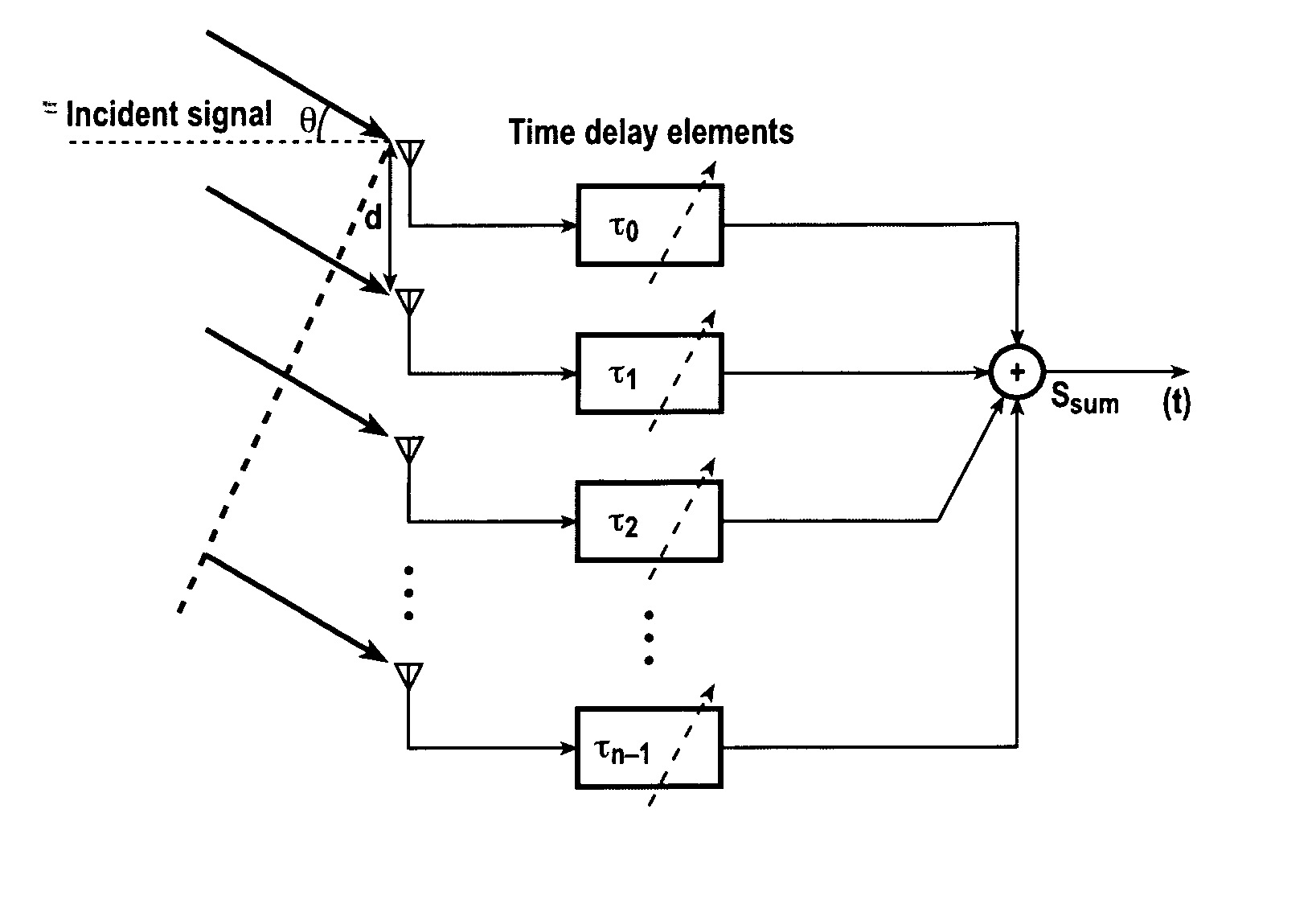
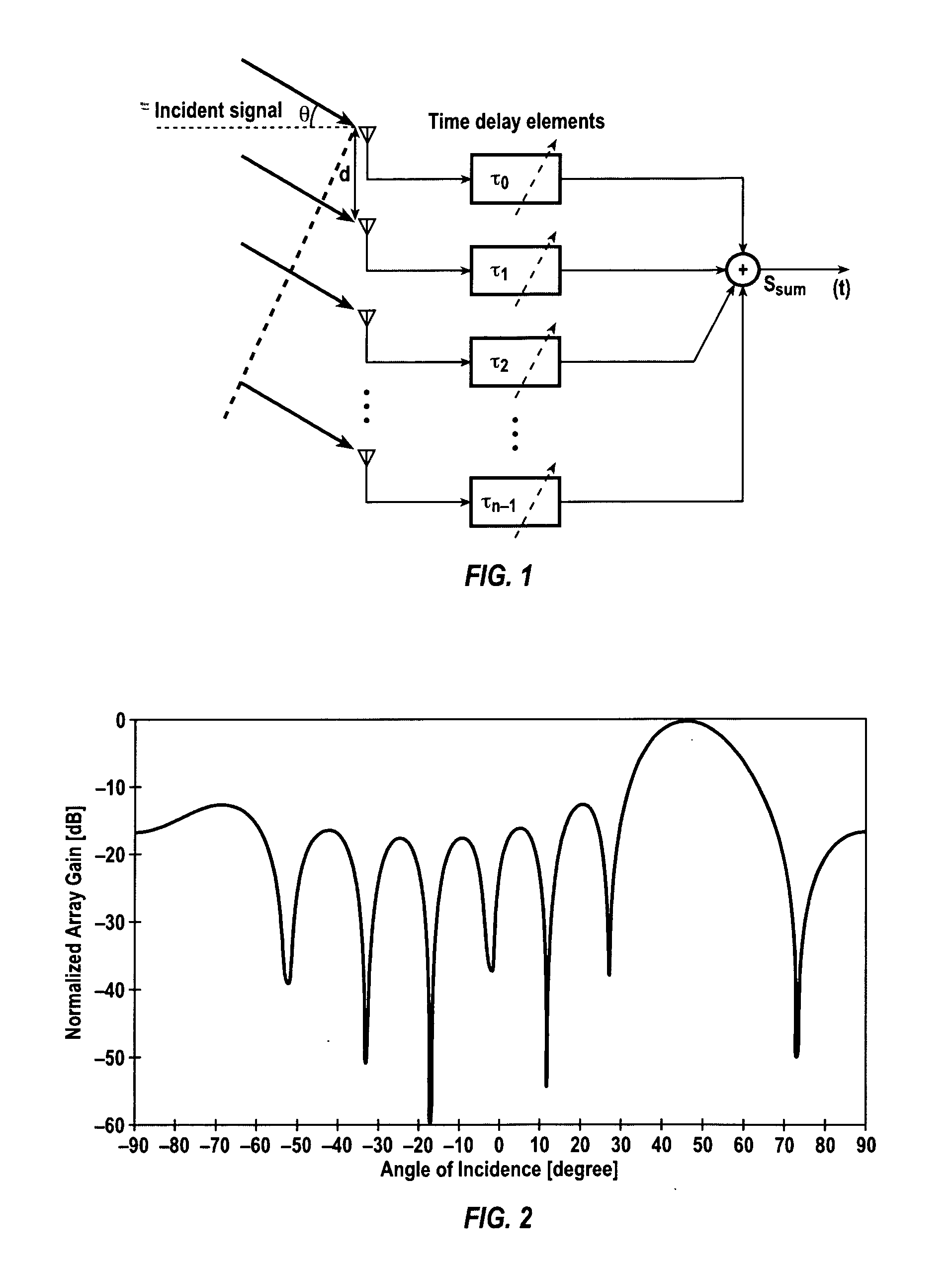
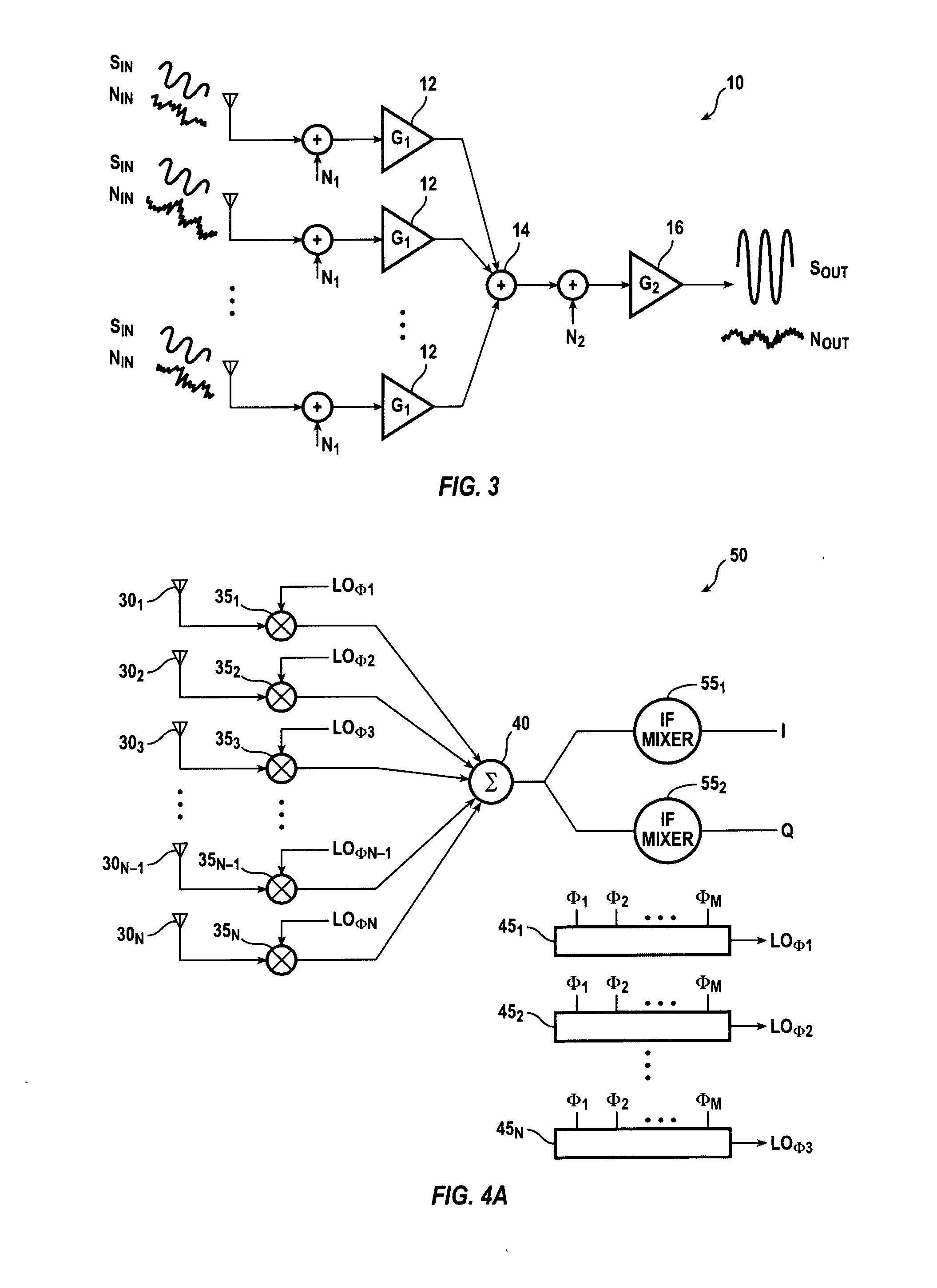
- An N-element phased-array receiver is designed with N RF mixers and a signal summing block, where each RF mixer receives an RF signal and a local oscillator phase signal, allowing phase shifting at the local oscillator frequency and summing of signals at the intermediate frequency band, enabling phase-shifting with high resolution and improved signal-to-noise ratio.

Signal Processing Algorithms for Performance Optimization
Signal processing algorithms play a pivotal role in optimizing the performance of both phased arrays and microwave arrays, particularly when comparing their sensitivity characteristics. Advanced digital signal processing (DSP) techniques have revolutionized array performance by enhancing signal-to-noise ratios, improving target detection capabilities, and mitigating interference effects.
Beamforming algorithms represent the cornerstone of array processing, with adaptive beamforming techniques demonstrating superior performance in dynamic electromagnetic environments. For phased arrays, algorithms such as Minimum Variance Distortionless Response (MVDR) and Linearly Constrained Minimum Variance (LCMV) have shown significant improvements in sensitivity by adaptively suppressing interference while maintaining gain in the desired direction.
Microwave arrays benefit particularly from Space-Time Adaptive Processing (STAP) algorithms, which simultaneously process signals in both spatial and temporal domains. This approach has demonstrated up to 15-20 dB improvement in sensitivity compared to conventional processing methods, especially in clutter-rich environments where traditional phased arrays may struggle.
Compressive sensing techniques have emerged as a game-changer for both array types, allowing for accurate signal reconstruction with fewer sampling points. This approach is particularly valuable for microwave arrays where hardware complexity can be a limiting factor. Recent implementations have shown that compressive sensing can maintain sensitivity levels while reducing the required number of array elements by up to 30%.
Machine learning algorithms are increasingly being integrated into array signal processing chains. Deep neural networks trained on simulated and real-world data have demonstrated remarkable capabilities in pattern recognition and anomaly detection, enhancing sensitivity in low SNR conditions. Convolutional neural networks (CNNs) have proven especially effective for microwave arrays, improving detection thresholds by approximately 3-5 dB compared to conventional matched filtering.
Calibration algorithms represent another critical area for sensitivity optimization. Advanced auto-calibration techniques using reference signals or blind calibration methods can compensate for manufacturing variations and environmental effects. These algorithms have been shown to recover up to 90% of theoretical array sensitivity that would otherwise be lost due to phase and amplitude errors.
Multi-band fusion algorithms that combine data from different frequency bands offer another avenue for sensitivity enhancement. By leveraging the complementary characteristics of signals across the electromagnetic spectrum, these techniques can improve detection probabilities by 25-40% compared to single-band processing, particularly benefiting hybrid array architectures.
Beamforming algorithms represent the cornerstone of array processing, with adaptive beamforming techniques demonstrating superior performance in dynamic electromagnetic environments. For phased arrays, algorithms such as Minimum Variance Distortionless Response (MVDR) and Linearly Constrained Minimum Variance (LCMV) have shown significant improvements in sensitivity by adaptively suppressing interference while maintaining gain in the desired direction.
Microwave arrays benefit particularly from Space-Time Adaptive Processing (STAP) algorithms, which simultaneously process signals in both spatial and temporal domains. This approach has demonstrated up to 15-20 dB improvement in sensitivity compared to conventional processing methods, especially in clutter-rich environments where traditional phased arrays may struggle.
Compressive sensing techniques have emerged as a game-changer for both array types, allowing for accurate signal reconstruction with fewer sampling points. This approach is particularly valuable for microwave arrays where hardware complexity can be a limiting factor. Recent implementations have shown that compressive sensing can maintain sensitivity levels while reducing the required number of array elements by up to 30%.
Machine learning algorithms are increasingly being integrated into array signal processing chains. Deep neural networks trained on simulated and real-world data have demonstrated remarkable capabilities in pattern recognition and anomaly detection, enhancing sensitivity in low SNR conditions. Convolutional neural networks (CNNs) have proven especially effective for microwave arrays, improving detection thresholds by approximately 3-5 dB compared to conventional matched filtering.
Calibration algorithms represent another critical area for sensitivity optimization. Advanced auto-calibration techniques using reference signals or blind calibration methods can compensate for manufacturing variations and environmental effects. These algorithms have been shown to recover up to 90% of theoretical array sensitivity that would otherwise be lost due to phase and amplitude errors.
Multi-band fusion algorithms that combine data from different frequency bands offer another avenue for sensitivity enhancement. By leveraging the complementary characteristics of signals across the electromagnetic spectrum, these techniques can improve detection probabilities by 25-40% compared to single-band processing, particularly benefiting hybrid array architectures.
Environmental Factors Affecting Array Sensitivity
Environmental factors significantly impact the sensitivity and overall performance of both phased arrays and microwave arrays. Temperature variations represent one of the most critical environmental challenges, as they can cause thermal expansion or contraction of array components, leading to phase shifts and degraded beam forming accuracy. In phased arrays, temperature gradients across the array face can result in differential expansion, creating unpredictable phase errors that compromise target detection capabilities. Microwave arrays typically demonstrate greater thermal stability due to their more robust construction, though they remain susceptible to performance degradation under extreme temperature conditions.
Humidity and precipitation introduce additional complications for array sensitivity. Water droplets can attenuate signals and create scattering effects that reduce the effective range and resolution of both array types. Phased arrays with their typically more compact and integrated designs often incorporate better environmental sealing, providing superior performance in high-humidity environments. Conversely, traditional microwave arrays may experience more significant signal degradation during precipitation events unless specifically designed with weather-resistant features.
Atmospheric conditions, particularly atmospheric turbulence and refraction, affect the propagation characteristics of electromagnetic waves. These phenomena can cause beam bending, spreading, and scintillation effects that impact the accuracy and sensitivity of both array types. Phased arrays generally offer better adaptability to changing atmospheric conditions through their electronic beam steering capabilities, allowing for real-time adjustments to compensate for atmospheric effects. Microwave arrays typically require more complex mechanical or hybrid solutions to achieve similar adaptability.
Electromagnetic interference (EMI) from both natural and human-made sources presents another significant environmental challenge. Solar activity, lightning, and industrial equipment can generate broadband interference that reduces the signal-to-noise ratio of array systems. Phased arrays often incorporate more sophisticated digital signal processing techniques that enable better interference rejection capabilities. However, their dense electronic packaging can make them more vulnerable to internal EMI issues compared to more spatially distributed microwave array architectures.
Mechanical stress factors, including vibration and wind loading, affect array sensitivity by introducing physical distortions to the array geometry. These distortions can significantly impact phase relationships between array elements, degrading beam forming performance. Microwave arrays with their typically larger apertures and more substantial supporting structures may experience greater wind loading effects, while phased arrays can be more susceptible to vibration-induced performance degradation due to their often more compact and lightweight construction.
Humidity and precipitation introduce additional complications for array sensitivity. Water droplets can attenuate signals and create scattering effects that reduce the effective range and resolution of both array types. Phased arrays with their typically more compact and integrated designs often incorporate better environmental sealing, providing superior performance in high-humidity environments. Conversely, traditional microwave arrays may experience more significant signal degradation during precipitation events unless specifically designed with weather-resistant features.
Atmospheric conditions, particularly atmospheric turbulence and refraction, affect the propagation characteristics of electromagnetic waves. These phenomena can cause beam bending, spreading, and scintillation effects that impact the accuracy and sensitivity of both array types. Phased arrays generally offer better adaptability to changing atmospheric conditions through their electronic beam steering capabilities, allowing for real-time adjustments to compensate for atmospheric effects. Microwave arrays typically require more complex mechanical or hybrid solutions to achieve similar adaptability.
Electromagnetic interference (EMI) from both natural and human-made sources presents another significant environmental challenge. Solar activity, lightning, and industrial equipment can generate broadband interference that reduces the signal-to-noise ratio of array systems. Phased arrays often incorporate more sophisticated digital signal processing techniques that enable better interference rejection capabilities. However, their dense electronic packaging can make them more vulnerable to internal EMI issues compared to more spatially distributed microwave array architectures.
Mechanical stress factors, including vibration and wind loading, affect array sensitivity by introducing physical distortions to the array geometry. These distortions can significantly impact phase relationships between array elements, degrading beam forming performance. Microwave arrays with their typically larger apertures and more substantial supporting structures may experience greater wind loading effects, while phased arrays can be more susceptible to vibration-induced performance degradation due to their often more compact and lightweight construction.
Unlock deeper insights with Patsnap Eureka Quick Research — get a full tech report to explore trends and direct your research. Try now!
Generate Your Research Report Instantly with AI Agent
Supercharge your innovation with Patsnap Eureka AI Agent Platform!