

QLED Tech Trends: The Path to Future Visualization
QLED Evolution and Objectives
Quantum Dot Light-Emitting Diode (QLED) technology has emerged as a revolutionary advancement in display technology, promising superior color reproduction, brightness, and energy efficiency. The evolution of QLED technology can be traced back to the early 2000s when researchers first began exploring the potential of quantum dots in display applications. Since then, QLED has undergone significant improvements, driven by the increasing demand for high-quality visual experiences in various sectors, including consumer electronics, automotive displays, and professional imaging.
The primary objective of QLED technology is to overcome the limitations of traditional LED and OLED displays while offering enhanced performance characteristics. QLED aims to provide wider color gamut, higher peak brightness, improved energy efficiency, and longer lifespan compared to existing display technologies. As the technology continues to evolve, researchers and manufacturers are focusing on refining quantum dot synthesis methods, optimizing device structures, and developing novel materials to further enhance QLED performance.
One of the key trends in QLED evolution is the pursuit of improved color purity and accuracy. This involves developing quantum dots with narrower emission spectra and more precise size control, allowing for more accurate color reproduction and a wider color gamut. Another significant trend is the enhancement of quantum dot stability and longevity, which is crucial for ensuring consistent performance over extended periods of use.
The development of QLED technology is also closely tied to advancements in manufacturing processes. Researchers are exploring new deposition techniques, such as inkjet printing and photolithography, to enable more efficient and cost-effective production of QLED displays. These advancements aim to make QLED technology more accessible and competitive in the consumer market.
Looking ahead, the objectives for QLED technology include achieving higher quantum efficiency, reducing power consumption, and improving color stability under various operating conditions. There is also a growing focus on developing flexible and transparent QLED displays, opening up new possibilities for innovative product designs and applications.
As QLED technology continues to mature, it is expected to play a significant role in shaping the future of visualization across various industries. The ongoing research and development efforts are aimed at not only enhancing the visual experience but also addressing environmental concerns by improving energy efficiency and reducing the use of harmful materials in display production.
QLED Market Demand Analysis
The QLED (Quantum Dot Light Emitting Diode) technology has been gaining significant traction in the display market, driven by increasing consumer demand for superior visual experiences. Market analysis indicates a robust growth trajectory for QLED displays, with the global market expected to expand substantially over the next decade.
Consumer preferences are shifting towards larger screen sizes and higher resolution displays, particularly in the premium segment. QLED technology addresses these demands by offering enhanced color accuracy, brightness, and energy efficiency compared to traditional LED and OLED displays. This has led to a surge in adoption across various applications, including high-end televisions, monitors, and digital signage.
The home entertainment sector has been a primary driver of QLED market growth. With the rise of streaming services and the increasing availability of 4K and 8K content, consumers are seeking displays that can fully showcase these high-resolution visuals. QLED's ability to deliver vibrant colors and deep blacks makes it an attractive option for cinephiles and gamers alike.
In the commercial sector, QLED displays are finding applications in digital advertising, control rooms, and large-scale visualization systems. The technology's high brightness and wide color gamut make it particularly suitable for environments with varying lighting conditions, such as retail spaces and outdoor digital signage.
The automotive industry is emerging as a promising market for QLED technology. As vehicles become more connected and autonomous, there is a growing need for advanced in-vehicle displays. QLED's high contrast ratios and wide viewing angles make it well-suited for automotive infotainment systems and digital cockpits.
Market research suggests that the Asia-Pacific region, particularly China and South Korea, is leading in QLED adoption and production. However, North America and Europe are also showing strong growth potential, driven by technological advancements and increasing consumer awareness.
Despite the positive outlook, the QLED market faces competition from other display technologies, notably OLED. Manufacturers are investing heavily in research and development to improve QLED performance and reduce production costs. This ongoing innovation is expected to further expand the market potential and applications of QLED technology in the coming years.
QLED Tech Challenges
QLED technology, while promising, faces several significant challenges that need to be addressed for its widespread adoption and continued advancement. One of the primary hurdles is the issue of blue light emission. The blue quantum dots used in QLED displays tend to have lower efficiency and shorter lifespans compared to their red and green counterparts. This discrepancy leads to color imbalance and potential degradation of display quality over time.
Another critical challenge lies in the manufacturing process of quantum dots. Achieving consistent size and uniformity of quantum dots at scale remains a complex task. Even minor variations in size can result in significant shifts in color output, affecting the overall display performance. Additionally, the production of quantum dots often involves the use of toxic materials, raising concerns about environmental impact and safety in manufacturing.
The encapsulation of quantum dots presents another technical hurdle. Quantum dots are highly sensitive to oxygen and moisture, which can rapidly degrade their performance. Developing effective and long-lasting encapsulation methods to protect quantum dots from environmental factors is crucial for ensuring the longevity and reliability of QLED displays.
Power efficiency is an ongoing concern in QLED technology. While QLEDs offer improvements over traditional LED-LCD displays, there is still room for enhancement in energy consumption, particularly for large-format displays and mobile devices where battery life is critical.
The cost of production remains a significant barrier to widespread QLED adoption. The materials and processes involved in manufacturing high-quality quantum dots are expensive, making QLED displays less competitive in price compared to other display technologies. Reducing production costs while maintaining or improving quality is a key challenge for the industry.
Lastly, the integration of quantum dots with other emerging display technologies, such as micro-LED or OLED, presents both opportunities and challenges. Combining these technologies could potentially lead to superior display solutions, but it requires overcoming complex technical and manufacturing hurdles.
Addressing these challenges will be crucial for the future development and market penetration of QLED technology. Ongoing research and innovation in materials science, manufacturing processes, and display engineering will be essential to overcome these obstacles and fully realize the potential of QLED displays in the visualization industry.
Current QLED Solutions
01 QLED display structure and manufacturing
This category focuses on the structural design and manufacturing processes of QLED displays. It includes innovations in quantum dot layers, light-emitting layers, and electrode configurations. The manufacturing techniques aim to improve display quality, efficiency, and durability.- QLED display structure and fabrication: This category focuses on the structural design and manufacturing processes of QLED displays. It includes innovations in quantum dot layer formation, electrode configurations, and overall device architecture to enhance display performance and efficiency.
- Color conversion and light emission techniques: This area covers methods for improving color conversion and light emission in QLED technology. It involves techniques for optimizing quantum dot properties, enhancing color gamut, and increasing the efficiency of light emission for better visual quality.
- QLED integration with other technologies: This category explores the integration of QLED technology with other display or electronic technologies. It includes hybrid systems, combination with traditional LED or OLED technologies, and incorporation into various electronic devices for enhanced functionality.
- QLED visualization software and algorithms: This point focuses on software solutions and algorithms specifically designed for QLED technology visualization. It includes image processing techniques, color management systems, and rendering algorithms optimized for QLED displays to improve visual output.
- QLED application in specific industries: This category covers the application of QLED technology in various industries and specific use cases. It includes implementations in areas such as automotive displays, medical imaging, augmented reality, and other specialized fields where high-quality visualization is crucial.
02 Color conversion and enhancement in QLED
This area covers techniques for improving color reproduction and enhancing visual quality in QLED displays. It includes methods for color conversion using quantum dots, color gamut expansion, and optimization of color filters to achieve more vibrant and accurate colors.Expand Specific Solutions03 QLED backlighting and illumination systems
This category encompasses innovations in QLED backlighting technologies for displays. It includes designs for efficient light distribution, uniform illumination, and integration of quantum dots in backlight units to enhance brightness and energy efficiency.Expand Specific Solutions04 QLED integration with other display technologies
This area focuses on the integration of QLED technology with other display technologies such as OLED or micro-LED. It includes hybrid display designs, composite structures, and methods for combining different display technologies to leverage their respective advantages.Expand Specific Solutions05 QLED visualization software and user interfaces
This category covers software solutions and user interface designs specifically tailored for QLED displays. It includes visualization algorithms, image processing techniques, and interactive display features that enhance the user experience and take advantage of QLED's unique capabilities.Expand Specific Solutions
QLED Industry Leaders
The QLED technology market is in a growth phase, with increasing adoption in high-end displays and TVs. The global market size is expanding rapidly, driven by demand for superior image quality and energy efficiency. Technologically, QLED is maturing, with major players like BOE Technology Group, TCL China Star Optoelectronics, and Sharp Corp. making significant advancements. These companies, along with others like AUO Corp. and Lumileds LLC, are investing heavily in R&D to improve color accuracy, brightness, and longevity of QLED displays. The competitive landscape is intensifying as more firms enter the market, pushing innovation and driving down costs, which is likely to accelerate market growth and technological refinement in the coming years.
BOE Technology Group Co., Ltd.
TCL China Star Optoelectronics Technology Co., Ltd.
QLED Core Innovations
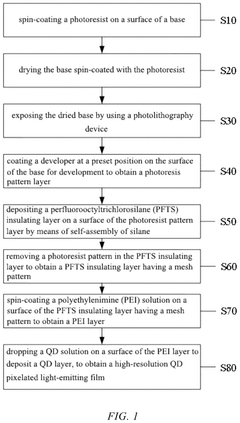
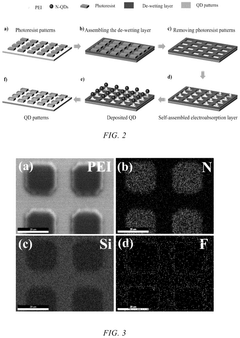
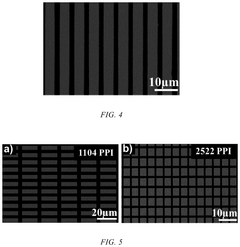
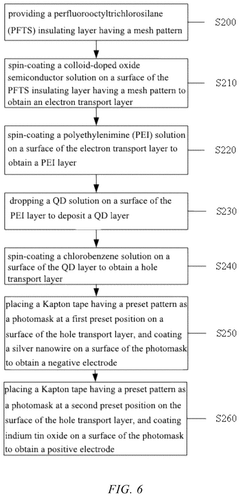
- A method involving spin-coating a photoresist, exposing, and developing to create a pattern, followed by depositing a perfluorooctyltrichlorosilane (PFTS) insulating layer, then a polyethylenimine (PEI) layer, and finally a QD layer, using self-assembly and electrostatic interactions to avoid direct photolithography on the QD layer, thereby preventing damage and improving film quality.
- Using a mask with a modified surface and a solution method, the quantum dot material ink can accurately enter the sub-pixel area of the substrate through the hollow part. The modified surface and pixel isolation structure are used to prevent the ink from dispersing. Combined with the ultrasonic spraying process, the equipment cost is reduced.


QLED Manufacturing Process
The QLED manufacturing process is a complex and highly sophisticated procedure that involves several key stages. At its core, the process begins with the creation of quantum dots, which are nanoscale semiconductor particles that emit light when excited. These quantum dots are typically made from materials such as cadmium selenide or indium phosphide, carefully engineered to produce specific colors of light.
The next crucial step in QLED manufacturing is the deposition of quantum dots onto a substrate. This is often achieved through a technique called photolithography, where patterns are created on the substrate using light-sensitive materials. The quantum dots are then precisely placed within these patterns, forming the basis of the display's pixel structure.
Following the quantum dot deposition, several layers of materials are added to complete the QLED structure. These layers include electron transport layers, hole transport layers, and emissive layers, each serving a specific function in the overall display performance. The exact composition and arrangement of these layers can vary depending on the manufacturer and the specific QLED technology being employed.
One of the most critical aspects of QLED manufacturing is the encapsulation process. This step involves sealing the quantum dot layer to protect it from environmental factors such as moisture and oxygen, which can degrade the performance and lifespan of the display. Advanced encapsulation techniques, such as thin-film encapsulation, are often used to ensure long-term stability and reliability of QLED devices.
The final stages of QLED manufacturing involve the integration of the quantum dot layer with other display components, such as the backlight unit, color filters, and polarizers. This integration process requires precise alignment and bonding techniques to ensure optimal display performance and uniformity across the entire screen.
Throughout the manufacturing process, stringent quality control measures are implemented to maintain consistency and performance. This includes rigorous testing of color accuracy, brightness uniformity, and overall display quality. Advanced imaging and spectroscopic techniques are often employed to detect any defects or inconsistencies in the quantum dot layer or other display components.
As QLED technology continues to evolve, manufacturers are constantly refining and optimizing their production processes. This includes exploring new materials for quantum dots, developing more efficient deposition techniques, and improving encapsulation methods to enhance display performance and longevity. The ongoing advancements in QLED manufacturing are driving the technology towards higher efficiency, better color accuracy, and increased durability, paving the way for the next generation of display technologies.
QLED Environmental Impact
The environmental impact of QLED (Quantum Dot Light Emitting Diode) technology is a crucial consideration as this visualization technology continues to advance. QLED displays offer significant improvements in energy efficiency compared to traditional LED and LCD screens, contributing to reduced power consumption and lower carbon emissions over their lifecycle.
One of the key environmental benefits of QLED technology lies in its use of quantum dots, which are highly efficient at converting electrical energy into light. This efficiency translates to less energy waste and lower heat generation during operation, potentially extending the lifespan of devices and reducing the frequency of replacements. The improved color accuracy and brightness of QLED displays also mean that they can achieve the same visual quality at lower power settings, further enhancing their energy-saving potential.
However, the production of quantum dots raises some environmental concerns. The synthesis of these nanoparticles often involves the use of heavy metals and toxic chemicals, which require careful handling and disposal to prevent environmental contamination. Manufacturers are increasingly focusing on developing more environmentally friendly quantum dot materials, such as cadmium-free alternatives, to address these issues.
The durability and longevity of QLED displays also contribute to their environmental profile. With proper care, these screens can maintain their performance for extended periods, reducing the need for frequent replacements and thereby minimizing electronic waste. Additionally, the materials used in QLED displays are generally more recyclable than those in older display technologies, although the recycling infrastructure for these advanced components is still developing.
As QLED technology evolves, researchers and manufacturers are exploring ways to further reduce its environmental footprint. This includes investigating bio-based quantum dots, improving manufacturing processes to minimize waste and energy consumption, and developing more efficient recycling methods for end-of-life products. The industry is also working on enhancing the overall sustainability of QLED displays by optimizing their design for easier disassembly and material recovery.
The adoption of QLED technology in various applications, from consumer electronics to large-scale digital signage, has the potential to drive significant energy savings across multiple sectors. As the technology matures and becomes more widespread, its positive environmental impact is expected to grow, contributing to global efforts to reduce energy consumption and combat climate change.