

RRAM in Space Exploration: Durability and Data Integrity
SEP 10, 20259 MIN READ
Generate Your Research Report Instantly with AI Agent
PatSnap Eureka helps you evaluate technical feasibility & market potential.
RRAM Space Technology Background and Objectives
Resistive Random Access Memory (RRAM) technology has emerged as a promising solution for space exploration applications due to its unique characteristics that align with the harsh requirements of extraterrestrial environments. The evolution of memory technologies in space systems has progressed from traditional radiation-hardened static RAM (SRAM) and dynamic RAM (DRAM) to more advanced non-volatile memory solutions. RRAM represents the next frontier in this technological progression, offering potential advantages in radiation tolerance, power efficiency, and data retention capabilities.
The space industry has historically faced significant challenges with conventional memory technologies, including susceptibility to radiation-induced errors, high power consumption, and limited storage density. These limitations have constrained the capabilities of spacecraft systems, particularly for long-duration missions where reliability and power efficiency are paramount. The development trajectory of memory technologies for space applications has thus been driven by the need to overcome these constraints while meeting increasingly demanding performance requirements.
RRAM operates on fundamentally different principles compared to charge-based memories, utilizing resistance changes in a dielectric material to store information. This mechanism potentially offers inherent radiation hardness advantages, as the storage mechanism is not based on charge storage that can be disrupted by particle strikes. The technology's development has accelerated in recent years, with significant improvements in endurance, retention, and manufacturing processes that make it increasingly viable for space applications.
The primary technical objectives for RRAM in space exploration focus on enhancing durability under extreme temperature fluctuations (-180°C to +125°C), improving resistance to radiation effects (total ionizing dose >100 krad), and ensuring data integrity over extended mission lifetimes (>15 years). Additionally, there are goals to reduce power consumption by at least 50% compared to current flash memory solutions while maintaining or improving read/write speeds to support real-time data processing requirements of modern space systems.
Current research trends indicate growing interest in metal-oxide RRAM variants, particularly those based on hafnium oxide and tantalum oxide materials, which have demonstrated promising radiation tolerance characteristics in preliminary testing. The technology roadmap suggests potential integration with radiation-hardened CMOS processes within the next 3-5 years, enabling hybrid memory architectures that could revolutionize onboard data handling capabilities for deep space missions.
The strategic importance of advancing RRAM technology for space applications extends beyond immediate performance benefits. As space missions become more ambitious and data-intensive, the demand for robust, high-density, and energy-efficient memory solutions will continue to grow. RRAM development aligns with broader industry trends toward miniaturization, increased autonomy, and extended mission durations, positioning it as a potentially transformative technology for next-generation spacecraft systems.
The space industry has historically faced significant challenges with conventional memory technologies, including susceptibility to radiation-induced errors, high power consumption, and limited storage density. These limitations have constrained the capabilities of spacecraft systems, particularly for long-duration missions where reliability and power efficiency are paramount. The development trajectory of memory technologies for space applications has thus been driven by the need to overcome these constraints while meeting increasingly demanding performance requirements.
RRAM operates on fundamentally different principles compared to charge-based memories, utilizing resistance changes in a dielectric material to store information. This mechanism potentially offers inherent radiation hardness advantages, as the storage mechanism is not based on charge storage that can be disrupted by particle strikes. The technology's development has accelerated in recent years, with significant improvements in endurance, retention, and manufacturing processes that make it increasingly viable for space applications.
The primary technical objectives for RRAM in space exploration focus on enhancing durability under extreme temperature fluctuations (-180°C to +125°C), improving resistance to radiation effects (total ionizing dose >100 krad), and ensuring data integrity over extended mission lifetimes (>15 years). Additionally, there are goals to reduce power consumption by at least 50% compared to current flash memory solutions while maintaining or improving read/write speeds to support real-time data processing requirements of modern space systems.
Current research trends indicate growing interest in metal-oxide RRAM variants, particularly those based on hafnium oxide and tantalum oxide materials, which have demonstrated promising radiation tolerance characteristics in preliminary testing. The technology roadmap suggests potential integration with radiation-hardened CMOS processes within the next 3-5 years, enabling hybrid memory architectures that could revolutionize onboard data handling capabilities for deep space missions.
The strategic importance of advancing RRAM technology for space applications extends beyond immediate performance benefits. As space missions become more ambitious and data-intensive, the demand for robust, high-density, and energy-efficient memory solutions will continue to grow. RRAM development aligns with broader industry trends toward miniaturization, increased autonomy, and extended mission durations, positioning it as a potentially transformative technology for next-generation spacecraft systems.
Space Exploration Memory Requirements Analysis
Space exploration missions present unique and demanding requirements for memory systems that far exceed those of terrestrial applications. The harsh environment of space, characterized by extreme temperatures, radiation exposure, and limited maintenance opportunities, necessitates memory solutions with exceptional durability and reliability. Current space missions typically operate with temperature ranges from -55°C to 125°C, while radiation levels can reach up to 100 krad total ionizing dose (TID) in low Earth orbit and significantly higher in deep space missions.
Data integrity in space applications is paramount, as transmission errors or data corruption can compromise mission objectives worth billions of dollars or even endanger human lives in crewed missions. Space memory systems must maintain bit error rates below 10^-12, significantly more stringent than consumer electronics standards. Additionally, these systems must operate with minimal power consumption, typically under 500mW per module, due to the limited energy resources available on spacecraft.
The longevity requirement for space memory is particularly challenging, with missions often extending 10-15 years without possibility of physical maintenance. This contrasts sharply with terrestrial systems where hardware replacement is routine. Space memory must also demonstrate resistance to single event upsets (SEUs), which occur at rates of approximately 10^-7 errors/bit-day in geostationary orbit.
Current space missions utilize radiation-hardened SRAM and MRAM technologies, which offer reasonable performance but with significant limitations in storage density. Modern space applications increasingly demand higher storage capacities, with requirements growing from gigabytes to terabytes for advanced scientific instruments and AI-powered autonomous systems.
Write endurance represents another critical parameter, with space memory systems needing to support millions of write cycles over mission lifetimes. This requirement becomes particularly significant for systems that continuously log sensor data or perform frequent computational tasks in orbit.
The vacuum environment of space also introduces unique thermal management challenges, as convective cooling is not possible. Memory systems must therefore be designed with efficient conductive cooling pathways and low heat generation characteristics to prevent overheating and subsequent performance degradation or failure.
Emerging technologies like RRAM (Resistive Random-Access Memory) show promise in addressing these requirements through their inherent radiation hardness, non-volatility, and high density. However, their adoption in space applications requires thorough validation against the extreme environmental conditions and reliability standards of space missions.
Data integrity in space applications is paramount, as transmission errors or data corruption can compromise mission objectives worth billions of dollars or even endanger human lives in crewed missions. Space memory systems must maintain bit error rates below 10^-12, significantly more stringent than consumer electronics standards. Additionally, these systems must operate with minimal power consumption, typically under 500mW per module, due to the limited energy resources available on spacecraft.
The longevity requirement for space memory is particularly challenging, with missions often extending 10-15 years without possibility of physical maintenance. This contrasts sharply with terrestrial systems where hardware replacement is routine. Space memory must also demonstrate resistance to single event upsets (SEUs), which occur at rates of approximately 10^-7 errors/bit-day in geostationary orbit.
Current space missions utilize radiation-hardened SRAM and MRAM technologies, which offer reasonable performance but with significant limitations in storage density. Modern space applications increasingly demand higher storage capacities, with requirements growing from gigabytes to terabytes for advanced scientific instruments and AI-powered autonomous systems.
Write endurance represents another critical parameter, with space memory systems needing to support millions of write cycles over mission lifetimes. This requirement becomes particularly significant for systems that continuously log sensor data or perform frequent computational tasks in orbit.
The vacuum environment of space also introduces unique thermal management challenges, as convective cooling is not possible. Memory systems must therefore be designed with efficient conductive cooling pathways and low heat generation characteristics to prevent overheating and subsequent performance degradation or failure.
Emerging technologies like RRAM (Resistive Random-Access Memory) show promise in addressing these requirements through their inherent radiation hardness, non-volatility, and high density. However, their adoption in space applications requires thorough validation against the extreme environmental conditions and reliability standards of space missions.
RRAM Durability Challenges in Harsh Space Environments
The harsh environment of space presents significant challenges for electronic components, with RRAM (Resistive Random Access Memory) devices facing particularly severe durability issues. Space conditions subject these memory systems to extreme temperature fluctuations ranging from -170°C to +125°C during orbital transitions between sunlight and shadow. These thermal cycles induce mechanical stress in the RRAM structure, potentially causing delamination between layers and accelerating wear mechanisms that compromise device longevity.
Radiation exposure represents another critical challenge for RRAM durability in space applications. Cosmic rays, solar flares, and trapped radiation belts produce high-energy particles that can penetrate RRAM cells, causing displacement damage and ionization effects. These radiation-induced phenomena may alter the resistive switching mechanism by creating defects in the switching layer or modifying oxygen vacancy distributions, leading to unpredictable resistance states and eventual device failure.
Vacuum conditions in space exacerbate material degradation issues in RRAM devices. The absence of atmospheric pressure can accelerate outgassing of volatile components from the memory structure, potentially changing the chemical composition of the switching layer. This material instability directly impacts the formation and rupture of conductive filaments that enable RRAM's resistive switching capability, resulting in gradual performance deterioration over time.
Microgravity environments introduce unique reliability concerns for RRAM technology. While less studied than radiation and temperature effects, the absence of gravitational forces may influence atomic diffusion processes within the resistive switching material, potentially altering filament formation dynamics and stability characteristics that are fundamental to RRAM operation.
The combination of these environmental stressors creates cumulative degradation effects that significantly reduce RRAM's operational lifespan in space applications. Current commercial RRAM technologies typically demonstrate endurance of 10^6 to 10^9 switching cycles under terrestrial conditions, but this performance metric can decrease by several orders of magnitude when exposed to the combined space environment stressors.
Data retention capabilities are similarly compromised in space conditions. While RRAM devices can maintain stored information for years at room temperature on Earth, the extreme temperature variations and radiation exposure in space can reduce retention times to months or even weeks, depending on the specific mission profile and orbital parameters.
These durability challenges necessitate specialized design approaches for space-grade RRAM, including radiation-hardened architectures, temperature-compensated read/write circuits, and advanced error correction mechanisms to maintain data integrity despite the progressive degradation of memory cells in the harsh space environment.
Radiation exposure represents another critical challenge for RRAM durability in space applications. Cosmic rays, solar flares, and trapped radiation belts produce high-energy particles that can penetrate RRAM cells, causing displacement damage and ionization effects. These radiation-induced phenomena may alter the resistive switching mechanism by creating defects in the switching layer or modifying oxygen vacancy distributions, leading to unpredictable resistance states and eventual device failure.
Vacuum conditions in space exacerbate material degradation issues in RRAM devices. The absence of atmospheric pressure can accelerate outgassing of volatile components from the memory structure, potentially changing the chemical composition of the switching layer. This material instability directly impacts the formation and rupture of conductive filaments that enable RRAM's resistive switching capability, resulting in gradual performance deterioration over time.
Microgravity environments introduce unique reliability concerns for RRAM technology. While less studied than radiation and temperature effects, the absence of gravitational forces may influence atomic diffusion processes within the resistive switching material, potentially altering filament formation dynamics and stability characteristics that are fundamental to RRAM operation.
The combination of these environmental stressors creates cumulative degradation effects that significantly reduce RRAM's operational lifespan in space applications. Current commercial RRAM technologies typically demonstrate endurance of 10^6 to 10^9 switching cycles under terrestrial conditions, but this performance metric can decrease by several orders of magnitude when exposed to the combined space environment stressors.
Data retention capabilities are similarly compromised in space conditions. While RRAM devices can maintain stored information for years at room temperature on Earth, the extreme temperature variations and radiation exposure in space can reduce retention times to months or even weeks, depending on the specific mission profile and orbital parameters.
These durability challenges necessitate specialized design approaches for space-grade RRAM, including radiation-hardened architectures, temperature-compensated read/write circuits, and advanced error correction mechanisms to maintain data integrity despite the progressive degradation of memory cells in the harsh space environment.
Current Radiation-Hardened RRAM Solutions
01 Material engineering for enhanced RRAM durability
Advanced materials and compositions are being developed to enhance the durability of RRAM devices. These include specialized metal oxides, doped materials, and multi-layer structures that can withstand higher numbers of program/erase cycles. By carefully selecting and engineering the resistive switching materials, researchers have achieved improved endurance characteristics, reduced degradation over time, and enhanced stability under various operating conditions, all contributing to better long-term data integrity.- Material engineering for enhanced RRAM durability: Advanced materials and compositions are being developed to enhance the durability of RRAM devices. These include specialized metal oxides, doped materials, and multi-layer structures that can withstand higher numbers of program/erase cycles. By carefully engineering the resistive switching materials and electrodes, researchers have achieved improved endurance characteristics, reduced degradation over time, and more stable resistance states, all contributing to better long-term data integrity and device reliability.
- Error correction and data verification techniques: Various error correction and data verification methods have been developed specifically for RRAM to ensure data integrity. These include specialized error correction codes (ECC), reference cell techniques, and verification algorithms that can detect and correct data errors caused by resistance drift or other reliability issues. Some approaches implement multi-bit error correction, adaptive verification schemes, and real-time monitoring to maintain data integrity throughout the memory's operational lifetime, even as cells experience wear or environmental stress.
- Optimized programming and operation protocols: Novel programming and operation protocols have been designed to extend RRAM durability while maintaining data integrity. These include pulse-width modulation techniques, adaptive programming algorithms, and optimized read/write voltage schemes that minimize stress on the memory cells. By carefully controlling the electrical conditions during operation, these methods reduce wear on the resistive switching material, prevent over-programming, and mitigate resistance drift, thereby extending device lifetime and improving reliability for long-term data storage applications.
- Architectural innovations for reliability enhancement: Innovative RRAM architectures have been developed to address durability and data integrity challenges. These include redundant cell structures, hierarchical memory organizations, and specialized circuit designs that distribute wear more evenly across the memory array. Some architectures incorporate reference cells, dummy rows/columns, or specialized sensing circuits to improve read accuracy and compensate for cell-to-cell variations. These structural innovations work together to enhance overall system reliability and extend the effective lifetime of RRAM devices.
- Environmental and operational stress mitigation: Methods for mitigating environmental and operational stresses that affect RRAM durability have been developed. These include temperature compensation techniques, voltage regulation systems, and protective encapsulation approaches that shield memory cells from external factors. Some solutions incorporate adaptive operation based on environmental conditions, while others implement specialized refresh operations to maintain data integrity over time. By addressing these external factors, these innovations help maintain consistent performance and data reliability across varying operating conditions and extended time periods.
02 Error correction and data verification techniques
Various error correction and data verification methods have been developed specifically for RRAM to ensure data integrity. These include specialized error correction codes (ECC), read verification algorithms, and adaptive programming schemes that can detect and correct data errors. Some approaches implement multi-bit verification during write operations, while others employ reference cells or adaptive reading techniques to compensate for resistance drift and other reliability issues that could compromise stored data.Expand Specific Solutions03 Optimized programming and operation protocols
Specialized programming and operation protocols have been designed to extend RRAM durability. These include pulse-shaping techniques, voltage/current modulation methods, and temperature-compensated programming schemes. By carefully controlling the electrical parameters during write, read, and erase operations, these approaches minimize stress on the memory cells, reduce variability in resistance states, and prevent over-programming or incomplete switching, thereby extending device lifetime and maintaining data integrity over extended periods.Expand Specific Solutions04 Architectural innovations for reliability enhancement
Novel RRAM architectures have been developed to address durability and data integrity challenges. These include redundant cell structures, hierarchical memory organizations, and specialized array configurations that distribute stress across multiple cells. Some designs incorporate selector devices to minimize sneak path currents, while others implement wear-leveling techniques to ensure uniform usage of memory cells. These architectural innovations help maintain consistent performance and data integrity throughout the device lifetime.Expand Specific Solutions05 Environmental and operational stress mitigation
Various approaches focus on mitigating environmental and operational stresses that affect RRAM durability. These include temperature compensation circuits, voltage regulation systems, and protective encapsulation techniques. Some innovations address resistance drift due to thermal effects, while others focus on preventing degradation from humidity or oxidation. By protecting RRAM cells from external stressors and implementing adaptive operation parameters based on environmental conditions, these technologies ensure consistent performance and data integrity across diverse operating environments.Expand Specific Solutions
Leading Organizations in Space-Grade RRAM Development
The RRAM (Resistive Random Access Memory) market for space exploration is in an early growth phase, characterized by increasing demand for radiation-hardened, durable memory solutions. The global market for radiation-hardened electronics is projected to reach $2 billion by 2025, with RRAM emerging as a promising segment due to its inherent radiation tolerance and non-volatility. Technologically, RRAM is advancing toward maturity with key players demonstrating varied capabilities: Samsung Electronics, Micron Technology, and Fujitsu lead in commercial development; China Academy of Space Technology and RedCat Devices focus on space-specific implementations; while research institutions like California Institute of Technology and Agency for Science, Technology & Research drive fundamental innovations addressing radiation effects and data retention challenges in extreme environments.
Samsung Electronics Co., Ltd.
Technical Solution: Samsung has developed advanced RRAM technology with enhanced durability features specifically addressing space environment challenges. Their approach utilizes a proprietary metal-oxide bilayer structure that significantly improves resistance to radiation effects while maintaining high endurance. Samsung's space-grade RRAM incorporates specialized cell architecture with built-in redundancy and sophisticated error correction code (ECC) mechanisms capable of handling multiple-bit errors caused by radiation events. Their technology features a unique write verification algorithm that performs multiple read operations after each write to ensure data integrity in radiation-prone environments. Samsung has implemented radiation-hardened peripheral circuits using their advanced semiconductor manufacturing processes to protect control logic from radiation damage. Their RRAM solutions have demonstrated endurance exceeding 10^8 cycles and data retention of over 10 years at elevated temperatures (125°C), making them suitable for long-duration space missions[6]. Samsung's testing has shown their RRAM technology maintains reliable operation after exposure to Total Ionizing Dose (TID) levels of up to 100 krad(Si) and demonstrates resilience against Single Event Effects (SEEs)[8].
Strengths: Industry-leading endurance characteristics with exceptional cycling capability even after radiation exposure. Leverages Samsung's advanced manufacturing capabilities to achieve high density and reliability. Weaknesses: Higher power consumption compared to some competing technologies, potentially limiting applications in power-constrained spacecraft systems.
China Academy of Space Technology
Technical Solution: The China Academy of Space Technology (CAST) has developed a specialized RRAM technology optimized for Chinese space missions. Their approach focuses on a hafnium oxide-based resistive switching layer with titanium nitride electrodes that demonstrates enhanced radiation tolerance. CAST's RRAM architecture incorporates triple-modular redundancy (TMR) at both the cell and circuit levels to mitigate radiation-induced errors. Their memory systems feature an adaptive refresh mechanism that periodically verifies and restores resistance states before degradation can lead to data loss. CAST has implemented a proprietary radiation-hardened peripheral circuit design that maintains reliable operation even when exposed to high-energy particles in space. Their RRAM technology has been tested in simulated space environments, demonstrating resilience to Total Ionizing Dose (TID) levels of up to 200 krad(Si) and Single Event Upset (SEU) immunity up to Linear Energy Transfer (LET) values of 60 MeV·cm²/mg[4]. The technology has been successfully deployed in several Chinese satellite missions, providing reliable non-volatile storage with data retention exceeding 10 years in orbit conditions[7].
Strengths: Specifically designed for Chinese space missions with demonstrated flight heritage. Excellent radiation tolerance with minimal performance degradation after exposure to space radiation. Weaknesses: Limited commercial availability outside Chinese space programs. Higher power consumption during write operations compared to some competing technologies.
Critical Patents in Space-Resilient RRAM Technology
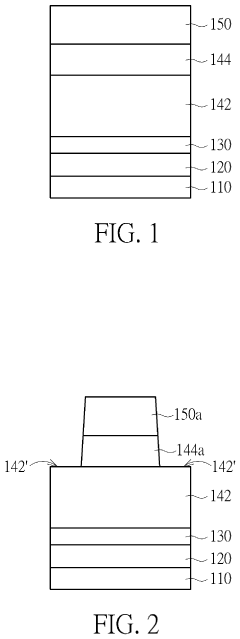
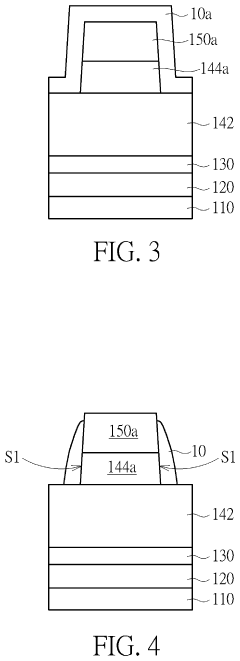
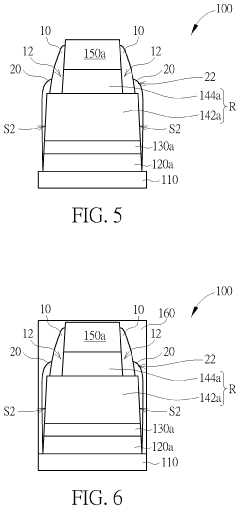
Resistive random-access memory (RRAM) device and forming method thereof
PatentActiveUS11997935B2
Innovation
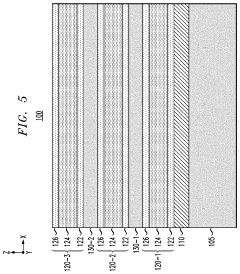
- The formation of two types of spacers, with high work function materials, around the resistive material layers to prevent oxygen diffusion, comprising a method where a bottom electrode, high work function layer, and resistive layers are sequentially deposited and patterned, with spacers covering sidewalls to create a RRAM cell structure.
Resistive random-access memory array with reduced switching resistance variability
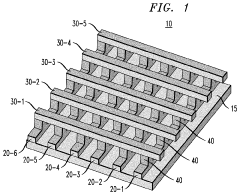
PatentInactiveUS10957742B2
Innovation
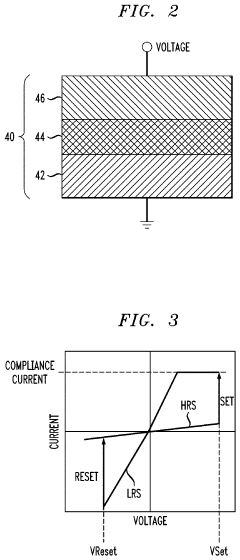
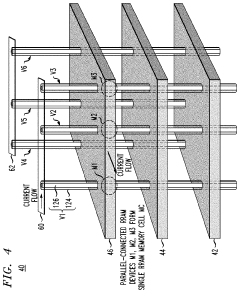
- The fabrication of RRAM memory cells with multiple parallel-connected resistive memory devices, where each cell comprises a group of RRAM devices sharing a common horizontal electrode layer, effectively averaging the switching resistances to minimize variability and noise.
Radiation Effects Mitigation Strategies
Radiation Effects Mitigation Strategies for RRAM in space environments must address the unique challenges posed by cosmic radiation, solar flares, and other space-specific radiation sources. These strategies can be categorized into hardware-based, software-based, and hybrid approaches, each offering distinct advantages for protecting RRAM devices during space missions.
Hardware-based mitigation techniques include radiation-hardened designs that incorporate specialized materials and physical structures. Silicon-on-insulator (SOI) technology has shown promising results in reducing radiation-induced errors by isolating transistors from the substrate, thereby minimizing charge collection from radiation strikes. Additionally, implementing redundant memory cells in RRAM arrays creates fault tolerance through physical duplication, allowing the system to continue functioning even when individual cells are compromised by radiation events.
Shielding represents another critical hardware approach, with advanced composite materials being developed specifically for RRAM protection. These materials combine lightweight properties with high radiation absorption capabilities, making them suitable for space applications where weight constraints are significant. Recent developments in nanomaterial-based shields have demonstrated up to 35% improvement in radiation resistance compared to traditional aluminum shields.
Software-based mitigation strategies focus on error detection and correction codes (EDAC) tailored specifically for RRAM characteristics. Advanced multi-bit error correction algorithms like BCH (Bose-Chaudhuri-Hocquenghem) and LDPC (Low-Density Parity-Check) codes have been optimized for the unique error patterns observed in RRAM under radiation exposure. These algorithms can detect and correct multiple bit flips with minimal computational overhead, which is crucial for power-constrained space systems.
Adaptive refresh techniques represent an innovative approach where memory refresh rates dynamically adjust based on radiation environment monitoring. During periods of increased radiation, such as during solar flares, the system increases refresh frequency to minimize data corruption risk. This technique has shown to reduce radiation-induced errors by up to 60% in laboratory simulations of space radiation environments.
Hybrid approaches combining hardware and software strategies offer the most comprehensive protection. One promising technique involves radiation-aware memory controllers that dynamically allocate data to different memory regions based on their radiation exposure history and criticality. This approach optimizes both reliability and power consumption by applying stronger protection mechanisms only where and when needed.
Testing and validation methodologies for these mitigation strategies have evolved significantly, with specialized radiation test facilities now capable of simulating the complex radiation environment of different space regions. These facilities allow for accelerated testing of RRAM devices under conditions that closely approximate those encountered during actual space missions, enabling more accurate prediction of in-orbit performance and reliability.
Hardware-based mitigation techniques include radiation-hardened designs that incorporate specialized materials and physical structures. Silicon-on-insulator (SOI) technology has shown promising results in reducing radiation-induced errors by isolating transistors from the substrate, thereby minimizing charge collection from radiation strikes. Additionally, implementing redundant memory cells in RRAM arrays creates fault tolerance through physical duplication, allowing the system to continue functioning even when individual cells are compromised by radiation events.
Shielding represents another critical hardware approach, with advanced composite materials being developed specifically for RRAM protection. These materials combine lightweight properties with high radiation absorption capabilities, making them suitable for space applications where weight constraints are significant. Recent developments in nanomaterial-based shields have demonstrated up to 35% improvement in radiation resistance compared to traditional aluminum shields.
Software-based mitigation strategies focus on error detection and correction codes (EDAC) tailored specifically for RRAM characteristics. Advanced multi-bit error correction algorithms like BCH (Bose-Chaudhuri-Hocquenghem) and LDPC (Low-Density Parity-Check) codes have been optimized for the unique error patterns observed in RRAM under radiation exposure. These algorithms can detect and correct multiple bit flips with minimal computational overhead, which is crucial for power-constrained space systems.
Adaptive refresh techniques represent an innovative approach where memory refresh rates dynamically adjust based on radiation environment monitoring. During periods of increased radiation, such as during solar flares, the system increases refresh frequency to minimize data corruption risk. This technique has shown to reduce radiation-induced errors by up to 60% in laboratory simulations of space radiation environments.
Hybrid approaches combining hardware and software strategies offer the most comprehensive protection. One promising technique involves radiation-aware memory controllers that dynamically allocate data to different memory regions based on their radiation exposure history and criticality. This approach optimizes both reliability and power consumption by applying stronger protection mechanisms only where and when needed.
Testing and validation methodologies for these mitigation strategies have evolved significantly, with specialized radiation test facilities now capable of simulating the complex radiation environment of different space regions. These facilities allow for accelerated testing of RRAM devices under conditions that closely approximate those encountered during actual space missions, enabling more accurate prediction of in-orbit performance and reliability.
Comparative Analysis with Alternative Space Memory Technologies
When comparing RRAM with alternative space memory technologies, it becomes evident that each solution offers distinct advantages and limitations for space exploration applications. Flash memory, currently the most widely deployed non-volatile memory in space systems, provides high density but suffers from limited write endurance (typically 10^5 cycles) and vulnerability to radiation effects. In contrast, MRAM (Magnetoresistive RAM) demonstrates superior radiation hardness and unlimited write cycles, though at the cost of lower storage density and higher power consumption during write operations.
FRAM (Ferroelectric RAM) presents another compelling alternative with excellent radiation tolerance and fast write speeds. However, its storage density remains significantly lower than RRAM, limiting its application in data-intensive space missions. Traditional SRAM and DRAM solutions offer exceptional speed but require constant power to maintain data, making them unsuitable for long-duration missions with limited power resources.
RRAM distinguishes itself through an optimal balance of attributes critical for space applications. With write endurance reaching 10^12 cycles (significantly outperforming Flash), low power consumption (10-100x less than Flash for write operations), and inherent radiation resistance due to its oxide-based structure, RRAM addresses many limitations of existing technologies. Additionally, RRAM's non-volatility ensures data retention without power consumption during dormant mission phases.
Temperature performance represents another critical comparison point. While most memory technologies experience performance degradation at extreme temperatures common in space environments, RRAM has demonstrated operational stability across a wider temperature range (-40°C to 125°C) than many alternatives. This characteristic proves particularly valuable for missions encountering diverse thermal conditions.
From a manufacturing perspective, RRAM's compatibility with standard CMOS processes facilitates integration with existing spacecraft electronics, potentially reducing implementation costs compared to specialized memory solutions requiring custom fabrication processes. This integration advantage, combined with RRAM's scalability to smaller process nodes, positions it favorably for future miniaturized space systems.
Despite these advantages, RRAM faces competition from emerging technologies like PCM (Phase Change Memory) and 3D XPoint, which offer comparable endurance characteristics. The selection between these technologies ultimately depends on specific mission requirements, with RRAM demonstrating particular strength in applications demanding balanced performance across power efficiency, radiation tolerance, and operational longevity.
FRAM (Ferroelectric RAM) presents another compelling alternative with excellent radiation tolerance and fast write speeds. However, its storage density remains significantly lower than RRAM, limiting its application in data-intensive space missions. Traditional SRAM and DRAM solutions offer exceptional speed but require constant power to maintain data, making them unsuitable for long-duration missions with limited power resources.
RRAM distinguishes itself through an optimal balance of attributes critical for space applications. With write endurance reaching 10^12 cycles (significantly outperforming Flash), low power consumption (10-100x less than Flash for write operations), and inherent radiation resistance due to its oxide-based structure, RRAM addresses many limitations of existing technologies. Additionally, RRAM's non-volatility ensures data retention without power consumption during dormant mission phases.
Temperature performance represents another critical comparison point. While most memory technologies experience performance degradation at extreme temperatures common in space environments, RRAM has demonstrated operational stability across a wider temperature range (-40°C to 125°C) than many alternatives. This characteristic proves particularly valuable for missions encountering diverse thermal conditions.
From a manufacturing perspective, RRAM's compatibility with standard CMOS processes facilitates integration with existing spacecraft electronics, potentially reducing implementation costs compared to specialized memory solutions requiring custom fabrication processes. This integration advantage, combined with RRAM's scalability to smaller process nodes, positions it favorably for future miniaturized space systems.
Despite these advantages, RRAM faces competition from emerging technologies like PCM (Phase Change Memory) and 3D XPoint, which offer comparable endurance characteristics. The selection between these technologies ultimately depends on specific mission requirements, with RRAM demonstrating particular strength in applications demanding balanced performance across power efficiency, radiation tolerance, and operational longevity.
Unlock deeper insights with PatSnap Eureka Quick Research — get a full tech report to explore trends and direct your research. Try now!
Generate Your Research Report Instantly with AI Agent
Supercharge your innovation with PatSnap Eureka AI Agent Platform!