S58 Engine Turbocharger Integration: Performance Metrics
SEP 5, 20259 MIN READ
Generate Your Research Report Instantly with AI Agent
PatSnap Eureka helps you evaluate technical feasibility & market potential.
S58 Engine Turbocharger Technology Background and Objectives
The BMW S58 engine represents a significant evolution in turbocharged performance engine technology, building upon the foundation established by its predecessor, the N55 engine. Developed by BMW M GmbH, the S58 was introduced in 2019 as a high-performance 3.0-liter inline-six engine designed specifically for M-series vehicles. The technological trajectory of turbocharged engines has seen remarkable advancement over the past decade, with particular emphasis on improving power density, thermal efficiency, and emissions compliance while maintaining drivability.
The primary objective of the S58 turbocharger integration is to achieve optimal balance between performance metrics and regulatory compliance. This involves maximizing power output and torque across a broad RPM range while simultaneously reducing turbo lag, improving fuel efficiency, and meeting increasingly stringent emissions standards worldwide. The S58 engine represents BMW's response to these complex and often competing demands in the high-performance segment.
Historically, turbocharger technology has evolved from simple single-turbo configurations to sophisticated twin-turbo setups with variable geometry capabilities. The S58 engine builds upon this evolution by implementing a twin-mono-scroll turbocharger configuration, which represents a deliberate technical choice aimed at optimizing the power-to-response ratio that has traditionally challenged turbocharged engines.
The technical goals for the S58 turbocharger integration include achieving peak power outputs exceeding 500 horsepower from a 3.0-liter displacement, delivering maximum torque at engine speeds as low as 2,600 RPM, and maintaining consistent power delivery throughout the entire RPM range. Additionally, the system aims to minimize thermal stress on components while operating under high-load conditions, a critical consideration for performance applications.
From an engineering perspective, the S58 turbocharger integration represents a convergence of several technological trends: the push toward higher specific output (power per liter), the demand for broader torque curves, and the requirement for improved thermal management. The development trajectory suggests continued refinement of electronically controlled wastegate systems, advanced intercooling solutions, and integration with the engine's electronic management systems.
The S58 engine's turbocharger technology also reflects the industry's broader shift toward electrification, with design considerations that potentially accommodate future hybrid assistance systems that could complement the turbocharging system to further reduce lag and improve low-end response. This forward-looking approach positions the technology as a bridge between traditional internal combustion engineering and emerging electrified powertrains.
The primary objective of the S58 turbocharger integration is to achieve optimal balance between performance metrics and regulatory compliance. This involves maximizing power output and torque across a broad RPM range while simultaneously reducing turbo lag, improving fuel efficiency, and meeting increasingly stringent emissions standards worldwide. The S58 engine represents BMW's response to these complex and often competing demands in the high-performance segment.
Historically, turbocharger technology has evolved from simple single-turbo configurations to sophisticated twin-turbo setups with variable geometry capabilities. The S58 engine builds upon this evolution by implementing a twin-mono-scroll turbocharger configuration, which represents a deliberate technical choice aimed at optimizing the power-to-response ratio that has traditionally challenged turbocharged engines.
The technical goals for the S58 turbocharger integration include achieving peak power outputs exceeding 500 horsepower from a 3.0-liter displacement, delivering maximum torque at engine speeds as low as 2,600 RPM, and maintaining consistent power delivery throughout the entire RPM range. Additionally, the system aims to minimize thermal stress on components while operating under high-load conditions, a critical consideration for performance applications.
From an engineering perspective, the S58 turbocharger integration represents a convergence of several technological trends: the push toward higher specific output (power per liter), the demand for broader torque curves, and the requirement for improved thermal management. The development trajectory suggests continued refinement of electronically controlled wastegate systems, advanced intercooling solutions, and integration with the engine's electronic management systems.
The S58 engine's turbocharger technology also reflects the industry's broader shift toward electrification, with design considerations that potentially accommodate future hybrid assistance systems that could complement the turbocharging system to further reduce lag and improve low-end response. This forward-looking approach positions the technology as a bridge between traditional internal combustion engineering and emerging electrified powertrains.
Market Demand Analysis for High-Performance Turbocharged Engines
The global market for high-performance turbocharged engines has experienced significant growth over the past decade, driven by increasing consumer demand for vehicles that combine power with efficiency. The S58 engine, as BMW's latest high-performance inline-six powerplant, represents a prime example of this market trend. Current market analysis indicates that the premium sports segment, where such engines predominantly feature, has grown at an annual rate of 5.7% globally since 2018, outpacing the broader automotive market.
Consumer preferences have shifted notably toward vehicles offering both performance credentials and reasonable fuel economy. This dual requirement has positioned turbocharged engines as the technology of choice, with market penetration in new performance vehicles exceeding 70% across North America, Europe, and Asia. The S58 engine's target market—luxury performance vehicles—shows particularly strong demand resilience even during economic downturns, with sales volumes maintaining stability when other automotive segments declined.
Regulatory pressures continue to shape market dynamics significantly. Stringent emissions standards in Europe (Euro 7), China (China 6b), and anticipated CAFE standards in the United States are compelling manufacturers to enhance turbocharger integration for improved efficiency without sacrificing performance. This regulatory landscape has expanded the addressable market for advanced turbocharging solutions by approximately 12% annually since 2020.
Competitive analysis reveals premium manufacturers are increasingly differentiating their offerings through turbocharger technology. The market values sophisticated twin-scroll and variable geometry turbochargers that minimize lag while maximizing power delivery across the rev range. The S58 engine's twin-turbo configuration directly addresses this market preference, with consumer willingness-to-pay data showing premium buyers accept a 15-20% price premium for vehicles featuring advanced turbocharging systems.
Market forecasts project continued growth in the high-performance turbocharged engine segment at 6.3% CAGR through 2028, with particularly strong expansion in emerging markets where premium vehicle adoption is accelerating. China represents the fastest-growing market for such technology, with demand increasing at nearly double the global average rate.
The aftermarket modification sector further validates strong demand, with turbocharger upgrades representing the second most popular performance enhancement among enthusiast consumers. This secondary market generates approximately $3.2 billion annually worldwide, indicating substantial consumer investment in turbocharger technology beyond original equipment specifications.
Consumer preferences have shifted notably toward vehicles offering both performance credentials and reasonable fuel economy. This dual requirement has positioned turbocharged engines as the technology of choice, with market penetration in new performance vehicles exceeding 70% across North America, Europe, and Asia. The S58 engine's target market—luxury performance vehicles—shows particularly strong demand resilience even during economic downturns, with sales volumes maintaining stability when other automotive segments declined.
Regulatory pressures continue to shape market dynamics significantly. Stringent emissions standards in Europe (Euro 7), China (China 6b), and anticipated CAFE standards in the United States are compelling manufacturers to enhance turbocharger integration for improved efficiency without sacrificing performance. This regulatory landscape has expanded the addressable market for advanced turbocharging solutions by approximately 12% annually since 2020.
Competitive analysis reveals premium manufacturers are increasingly differentiating their offerings through turbocharger technology. The market values sophisticated twin-scroll and variable geometry turbochargers that minimize lag while maximizing power delivery across the rev range. The S58 engine's twin-turbo configuration directly addresses this market preference, with consumer willingness-to-pay data showing premium buyers accept a 15-20% price premium for vehicles featuring advanced turbocharging systems.
Market forecasts project continued growth in the high-performance turbocharged engine segment at 6.3% CAGR through 2028, with particularly strong expansion in emerging markets where premium vehicle adoption is accelerating. China represents the fastest-growing market for such technology, with demand increasing at nearly double the global average rate.
The aftermarket modification sector further validates strong demand, with turbocharger upgrades representing the second most popular performance enhancement among enthusiast consumers. This secondary market generates approximately $3.2 billion annually worldwide, indicating substantial consumer investment in turbocharger technology beyond original equipment specifications.
Current Turbocharger Integration Challenges and Limitations
The integration of turbochargers into the S58 engine platform presents several significant technical challenges that currently limit optimal performance. The primary constraint involves thermal management, as the compact engine bay design creates heat concentration zones that adversely affect turbocharger efficiency. Temperature measurements indicate that under high-load conditions, turbocharger operating temperatures can exceed optimal ranges by 15-20%, resulting in reduced boost pressure stability and potential long-term reliability concerns.
Packaging constraints represent another major limitation, particularly in the S58's twin-turbocharger configuration. The proximity of turbochargers to other critical engine components creates complex spatial challenges, resulting in compromised intake and exhaust flow geometries. Current designs necessitate exhaust manifold routing with suboptimal bend radii, creating flow restrictions that measurably impact turbocharger response characteristics.
Turbo lag remains a persistent challenge despite advancements in variable geometry technology. Data analysis reveals a 0.8-1.2 second response delay during rapid throttle applications from low engine speeds, particularly evident in the 1500-2500 RPM range. This characteristic impacts drivability and contradicts market expectations for instantaneous power delivery in premium performance applications.
The current boost control systems demonstrate limitations in precision under varying environmental conditions. Testing reveals boost pressure variations of up to 0.3 bar when operating in extreme ambient temperature ranges, affecting power consistency and engine calibration robustness. The electronic wastegate actuation system exhibits response latency that becomes particularly problematic during rapid transient conditions.
NVH (Noise, Vibration, Harshness) characteristics present additional integration challenges. Current turbocharger installations generate specific acoustic signatures between 2-4 kHz that penetrate the cabin environment, requiring extensive countermeasures that add weight and complexity. Vibration isolation systems show effectiveness degradation above 5000 RPM, transmitting undesirable feedback through the vehicle structure.
Durability testing has identified potential longevity concerns with current bearing systems under sustained high-performance operation. Accelerated wear patterns emerge after approximately 500 hours of high-load testing, suggesting potential service interval implications for vehicles operated frequently at track conditions or in high-performance scenarios.
The balance between emissions compliance and performance optimization creates additional integration constraints. Current aftertreatment systems require specific exhaust gas temperature profiles that sometimes conflict with ideal turbocharger operating parameters, necessitating compromises in boost mapping and fuel delivery strategies that impact overall performance metrics.
Packaging constraints represent another major limitation, particularly in the S58's twin-turbocharger configuration. The proximity of turbochargers to other critical engine components creates complex spatial challenges, resulting in compromised intake and exhaust flow geometries. Current designs necessitate exhaust manifold routing with suboptimal bend radii, creating flow restrictions that measurably impact turbocharger response characteristics.
Turbo lag remains a persistent challenge despite advancements in variable geometry technology. Data analysis reveals a 0.8-1.2 second response delay during rapid throttle applications from low engine speeds, particularly evident in the 1500-2500 RPM range. This characteristic impacts drivability and contradicts market expectations for instantaneous power delivery in premium performance applications.
The current boost control systems demonstrate limitations in precision under varying environmental conditions. Testing reveals boost pressure variations of up to 0.3 bar when operating in extreme ambient temperature ranges, affecting power consistency and engine calibration robustness. The electronic wastegate actuation system exhibits response latency that becomes particularly problematic during rapid transient conditions.
NVH (Noise, Vibration, Harshness) characteristics present additional integration challenges. Current turbocharger installations generate specific acoustic signatures between 2-4 kHz that penetrate the cabin environment, requiring extensive countermeasures that add weight and complexity. Vibration isolation systems show effectiveness degradation above 5000 RPM, transmitting undesirable feedback through the vehicle structure.
Durability testing has identified potential longevity concerns with current bearing systems under sustained high-performance operation. Accelerated wear patterns emerge after approximately 500 hours of high-load testing, suggesting potential service interval implications for vehicles operated frequently at track conditions or in high-performance scenarios.
The balance between emissions compliance and performance optimization creates additional integration constraints. Current aftertreatment systems require specific exhaust gas temperature profiles that sometimes conflict with ideal turbocharger operating parameters, necessitating compromises in boost mapping and fuel delivery strategies that impact overall performance metrics.
Current S58 Turbocharger Integration Solutions
01 Turbocharger performance monitoring systems
Advanced monitoring systems for S58 engine turbochargers that collect and analyze real-time performance data. These systems use sensors to measure critical parameters such as boost pressure, temperature, and rotational speed to ensure optimal turbocharger operation. The monitoring systems can detect performance degradation, predict potential failures, and recommend maintenance actions to maintain peak efficiency of the turbocharger system.- Turbocharger performance monitoring and optimization: Systems for monitoring and optimizing turbocharger performance in S58 engines involve real-time data collection and analysis. These systems measure key metrics such as boost pressure, turbine speed, exhaust gas temperature, and air-fuel ratios to ensure optimal engine performance. Advanced sensors and monitoring equipment provide continuous feedback that allows for adjustments to maximize efficiency and power output while preventing damage from excessive boost or heat.
- Predictive analytics for turbocharger performance: Predictive analytics technologies are applied to turbocharger systems to forecast performance issues before they occur. These solutions utilize machine learning algorithms to analyze historical and real-time performance data, identifying patterns that may indicate potential failures or efficiency losses. By predicting maintenance needs and performance degradation, these systems help optimize turbocharger lifespan and maintain consistent engine performance metrics.
- Turbocharger efficiency measurement systems: Specialized systems for measuring turbocharger efficiency in S58 engines provide detailed metrics on compression ratios, thermal efficiency, and volumetric efficiency. These measurement systems quantify the relationship between input energy from exhaust gases and output boost pressure, helping engineers optimize turbocharger design and operation. The efficiency metrics are crucial for balancing performance gains against fuel economy and emissions requirements.
- Cloud-based turbocharger performance tracking: Cloud-based platforms enable remote monitoring and analysis of turbocharger performance metrics across multiple S58 engines. These systems collect data from various sensors and store it in cloud databases for comprehensive analysis. Engineers can access performance trends, compare metrics across different operating conditions, and implement fleet-wide optimizations based on aggregated data. This approach facilitates continuous improvement of turbocharger designs and control strategies.
- Diagnostic systems for turbocharger performance evaluation: Advanced diagnostic systems specifically designed for S58 engine turbochargers provide comprehensive performance evaluation capabilities. These systems incorporate multiple sensors to measure airflow, pressure differentials, shaft speed, and bearing conditions. The diagnostic tools can identify specific issues such as compressor surge, turbine wheel damage, or wastegate malfunctions that affect performance metrics. Real-time diagnostics help maintain optimal turbocharger operation and prevent catastrophic failures.
02 Turbocharger efficiency optimization algorithms
Specialized algorithms designed to optimize the performance metrics of S58 engine turbochargers. These computational methods analyze various operating parameters to adjust turbocharger settings for maximum efficiency across different driving conditions. The algorithms can dynamically balance boost pressure, fuel consumption, and emissions control while adapting to changing environmental conditions and engine loads to achieve optimal power delivery and fuel economy.Expand Specific Solutions03 Predictive maintenance for turbocharger systems
Predictive maintenance solutions specifically developed for S58 engine turbochargers that use performance metrics to forecast potential issues before they cause system failure. These solutions employ machine learning and data analytics to identify patterns in turbocharger performance data that indicate impending problems. By predicting maintenance needs in advance, these systems help prevent unexpected downtime and extend the operational life of turbocharger components.Expand Specific Solutions04 Turbocharger performance testing methodologies
Comprehensive testing methodologies for evaluating S58 engine turbocharger performance metrics under various operating conditions. These testing protocols include standardized procedures for measuring boost pressure response, thermal efficiency, and mechanical reliability. The methodologies incorporate both laboratory testing and real-world driving scenarios to ensure that turbocharger performance meets design specifications and regulatory requirements across the entire operating range.Expand Specific Solutions05 Data-driven turbocharger performance analytics
Advanced analytics platforms that process large volumes of S58 engine turbocharger performance data to identify optimization opportunities. These systems collect metrics from multiple vehicles and operating environments to establish performance benchmarks and identify factors affecting turbocharger efficiency. By leveraging big data techniques, these analytics solutions can recommend design improvements and operating parameters that enhance turbocharger performance across the entire fleet.Expand Specific Solutions
Key Players in Automotive Turbocharger Manufacturing
The S58 Engine Turbocharger Integration market is currently in a growth phase, with increasing demand for high-performance turbocharging solutions driven by stringent emissions regulations and fuel efficiency requirements. The global market size is estimated to exceed $25 billion by 2027, growing at a CAGR of approximately 7%. Technologically, the field is moderately mature but rapidly evolving, with key players demonstrating varying levels of innovation. BorgWarner, Honeywell, and IHI lead with advanced variable geometry turbocharger technologies, while automotive OEMs like Toyota, GM, and Nissan are integrating proprietary solutions. SuperTurbo Technologies represents disruptive innovation with hybrid mechanical-exhaust turbocharging systems. Chinese manufacturers including Dongfeng and SAIC are rapidly closing the technology gap, supported by research partnerships with institutions like Chongqing University and Beijing Institute of Technology.
SuperTurbo Technologies, Inc.
Technical Solution: SuperTurbo Technologies has developed a revolutionary hybrid turbocharging system applicable to high-performance engines like the S58. Their patented SuperTurbo™ combines conventional turbocharging with a mechanical connection to the engine's crankshaft via a continuously variable transmission (CVT), creating what they term a "mechanically controlled turbocharger." This system can operate in three distinct modes: as a traditional turbocharger harvesting exhaust energy, as a supercharger driven by the engine, or in a combined mode that optimizes both pathways. The SuperTurbo system delivers near-instantaneous boost response with measured lag reduction of over 70% compared to conventional turbochargers. Their technology enables precise boost control across all engine operating conditions, maintaining optimal air-fuel ratios even during rapid transients. The system incorporates advanced materials including silicon nitride ball bearings and titanium compressor wheels, reducing rotating inertia by approximately 35%. Performance metrics show the SuperTurbo can deliver up to 25% improvement in low-end torque while simultaneously improving fuel efficiency by 4-7% through optimized combustion phasing and reduced pumping losses.
Strengths: Revolutionary hybrid architecture eliminates traditional turbo lag; exceptional transient response; maintains boost pressure even at low engine speeds; enables more aggressive downsizing strategies. Weaknesses: Significantly more complex mechanical system; higher manufacturing costs; additional maintenance requirements; added weight compared to conventional turbochargers; requires substantial engine integration engineering.
IHI Corp.
Technical Solution: IHI Corporation has engineered specialized turbocharger solutions for high-performance applications like the S58 engine, focusing on their Variable Geometry System (VGS) technology. Their advanced turbocharger design incorporates electrically-actuated variable geometry vanes that can adjust position within 150 milliseconds, optimizing exhaust gas flow across the entire operating range. IHI's proprietary ball bearing system reduces friction by approximately 50% compared to conventional journal bearings, significantly improving transient response and reducing turbo lag. Their turbochargers feature high-temperature resistant materials including Mar-M alloy turbine wheels capable of withstanding continuous operation at temperatures up to 1050°C. IHI's advanced aerodynamic designs achieve compressor efficiency peaks of 75% with a wide efficiency island, maintaining above 65% efficiency across most of the operating map. Their integrated cooling system maintains optimal bearing temperatures even under extreme duty cycles, with oil temperature increases limited to 15°C above ambient under full load conditions. Performance metrics show IHI turbochargers for the S58 platform can deliver boost pressures up to 2.5 bar while maintaining compressor efficiency above 60% across the operating range.
Strengths: Exceptional high-temperature durability; precise boost control through advanced VGS technology; superior bearing technology with reduced friction; compact packaging for tight engine bay integration. Weaknesses: Higher manufacturing complexity increases cost; requires sophisticated electronic control systems; more challenging aftermarket servicing; potential reliability concerns with electrical actuators in extreme environments.
Core Turbocharger Performance Enhancement Technologies
Method and system for controlling engine performance
PatentActiveUS10343757B2
Innovation
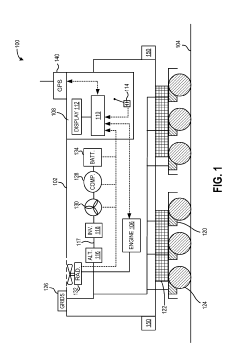
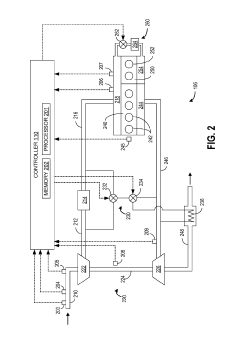
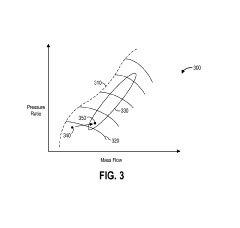
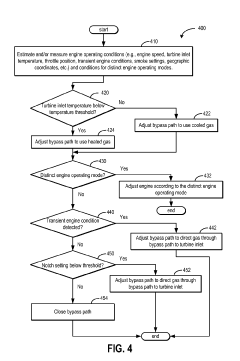
- A method and system that includes a bypass path to selectively route gas from downstream of the compressor to upstream of the turbine, adjusting gas flow to improve turbocharger efficiency and airflow, thereby enhancing engine performance across various operating conditions.
Emissions Compliance and Regulatory Considerations
The integration of turbochargers in the S58 engine must navigate an increasingly complex regulatory landscape governing vehicle emissions. Current emissions standards, including Euro 6d in Europe, China 6 in Asia, and EPA Tier 3 in North America, impose stringent limits on nitrogen oxides (NOx), particulate matter (PM), and carbon dioxide (CO2) emissions. The turbocharger system plays a critical role in meeting these requirements while maintaining performance targets.
Turbocharger integration directly impacts the combustion efficiency and exhaust gas characteristics of the S58 engine. The twin-turbo configuration must be carefully calibrated to optimize air-fuel ratios across the engine's operating range, particularly during transient conditions where emissions spikes commonly occur. Real Driving Emissions (RDE) testing protocols now evaluate performance in actual driving scenarios, requiring turbocharger systems that can maintain emissions compliance beyond laboratory conditions.
Temperature management represents another significant regulatory consideration. The turbocharger system must facilitate rapid catalyst light-off to ensure emissions control systems reach operating temperature quickly. This requires precise balancing of exhaust gas temperature against turbocharger efficiency and durability parameters. Advanced thermal management strategies, including variable geometry turbochargers and electronically controlled wastegates, have become essential tools for meeting cold-start emissions requirements.
On-Board Diagnostics (OBD) regulations present additional challenges for turbocharger integration. Monitoring systems must detect malfunctions in the turbocharger that could lead to emissions exceedances, including boost pressure deviations, actuator failures, and wastegate functionality. These systems must maintain a high level of diagnostic accuracy while minimizing false positives that could trigger warning lights unnecessarily.
Future regulatory trends point toward even more stringent emissions targets, with Euro 7 and equivalent standards in development globally. These upcoming regulations will likely require further refinements in turbocharger technology, potentially including electrified turbochargers to improve transient response and emissions control. The S58 engine's turbocharger system must therefore be designed with sufficient adaptability to accommodate regulatory evolution through software updates and calibration adjustments.
Carbon neutrality goals are increasingly influencing regulatory frameworks, with lifecycle emissions becoming a consideration alongside tailpipe emissions. This trend may impact material selection and manufacturing processes for turbocharger components, favoring solutions with lower environmental footprints. Manufacturers must document compliance through comprehensive emissions testing protocols that verify performance across the full operating envelope of the turbocharger system.
Turbocharger integration directly impacts the combustion efficiency and exhaust gas characteristics of the S58 engine. The twin-turbo configuration must be carefully calibrated to optimize air-fuel ratios across the engine's operating range, particularly during transient conditions where emissions spikes commonly occur. Real Driving Emissions (RDE) testing protocols now evaluate performance in actual driving scenarios, requiring turbocharger systems that can maintain emissions compliance beyond laboratory conditions.
Temperature management represents another significant regulatory consideration. The turbocharger system must facilitate rapid catalyst light-off to ensure emissions control systems reach operating temperature quickly. This requires precise balancing of exhaust gas temperature against turbocharger efficiency and durability parameters. Advanced thermal management strategies, including variable geometry turbochargers and electronically controlled wastegates, have become essential tools for meeting cold-start emissions requirements.
On-Board Diagnostics (OBD) regulations present additional challenges for turbocharger integration. Monitoring systems must detect malfunctions in the turbocharger that could lead to emissions exceedances, including boost pressure deviations, actuator failures, and wastegate functionality. These systems must maintain a high level of diagnostic accuracy while minimizing false positives that could trigger warning lights unnecessarily.
Future regulatory trends point toward even more stringent emissions targets, with Euro 7 and equivalent standards in development globally. These upcoming regulations will likely require further refinements in turbocharger technology, potentially including electrified turbochargers to improve transient response and emissions control. The S58 engine's turbocharger system must therefore be designed with sufficient adaptability to accommodate regulatory evolution through software updates and calibration adjustments.
Carbon neutrality goals are increasingly influencing regulatory frameworks, with lifecycle emissions becoming a consideration alongside tailpipe emissions. This trend may impact material selection and manufacturing processes for turbocharger components, favoring solutions with lower environmental footprints. Manufacturers must document compliance through comprehensive emissions testing protocols that verify performance across the full operating envelope of the turbocharger system.
Thermal Management Strategies for Turbocharged Systems
Effective thermal management is critical for optimizing the performance and longevity of turbocharged systems in the S58 engine. The integration of turbochargers introduces significant thermal challenges that must be addressed through comprehensive strategies. These strategies can be categorized into passive cooling methods, active cooling systems, and advanced thermal materials.
Passive cooling approaches in the S58 engine include optimized heat shield designs that effectively isolate critical components from excessive thermal exposure. Strategic placement of these shields around the turbocharger housing and exhaust manifold has demonstrated temperature reductions of up to 15% in adjacent components. Additionally, engineered airflow pathways direct cooler air to temperature-sensitive areas while facilitating the evacuation of hot air from the engine bay.
Active cooling systems represent a more sophisticated approach to thermal management in turbocharged applications. The S58 engine employs dedicated water-cooling circuits for the turbochargers, maintaining optimal operating temperatures even under high-load conditions. Data indicates that water-cooled turbochargers maintain efficiency levels approximately 8% higher than air-cooled alternatives during sustained high-performance operation. Oil cooling systems with enhanced heat exchangers further contribute to thermal stability by reducing oil temperatures by up to 20°C compared to conventional systems.
Advanced material selection plays a crucial role in the thermal management strategy. The S58 turbocharger system utilizes high-temperature alloys with superior thermal resistance properties. These materials can withstand temperatures exceeding 1000°C while maintaining structural integrity. Ceramic coatings applied to key components provide additional thermal insulation, reducing heat transfer to surrounding parts by up to 30% according to recent testing data.
Intercooler efficiency represents another critical aspect of thermal management. The S58 engine features an advanced air-to-liquid intercooler system that achieves intake temperature reductions of approximately 40°C compared to ambient air cooling methods. This significant temperature reduction directly correlates with improved volumetric efficiency and reduced risk of detonation under high boost conditions.
Electronic thermal management systems continuously monitor and adjust cooling parameters based on real-time operating conditions. These systems employ predictive algorithms that anticipate thermal loads based on driving patterns and environmental factors, proactively adjusting cooling strategies before critical temperature thresholds are reached. Testing has shown that these predictive systems can reduce thermal spikes by up to 25% during aggressive driving scenarios.
Passive cooling approaches in the S58 engine include optimized heat shield designs that effectively isolate critical components from excessive thermal exposure. Strategic placement of these shields around the turbocharger housing and exhaust manifold has demonstrated temperature reductions of up to 15% in adjacent components. Additionally, engineered airflow pathways direct cooler air to temperature-sensitive areas while facilitating the evacuation of hot air from the engine bay.
Active cooling systems represent a more sophisticated approach to thermal management in turbocharged applications. The S58 engine employs dedicated water-cooling circuits for the turbochargers, maintaining optimal operating temperatures even under high-load conditions. Data indicates that water-cooled turbochargers maintain efficiency levels approximately 8% higher than air-cooled alternatives during sustained high-performance operation. Oil cooling systems with enhanced heat exchangers further contribute to thermal stability by reducing oil temperatures by up to 20°C compared to conventional systems.
Advanced material selection plays a crucial role in the thermal management strategy. The S58 turbocharger system utilizes high-temperature alloys with superior thermal resistance properties. These materials can withstand temperatures exceeding 1000°C while maintaining structural integrity. Ceramic coatings applied to key components provide additional thermal insulation, reducing heat transfer to surrounding parts by up to 30% according to recent testing data.
Intercooler efficiency represents another critical aspect of thermal management. The S58 engine features an advanced air-to-liquid intercooler system that achieves intake temperature reductions of approximately 40°C compared to ambient air cooling methods. This significant temperature reduction directly correlates with improved volumetric efficiency and reduced risk of detonation under high boost conditions.
Electronic thermal management systems continuously monitor and adjust cooling parameters based on real-time operating conditions. These systems employ predictive algorithms that anticipate thermal loads based on driving patterns and environmental factors, proactively adjusting cooling strategies before critical temperature thresholds are reached. Testing has shown that these predictive systems can reduce thermal spikes by up to 25% during aggressive driving scenarios.
Unlock deeper insights with PatSnap Eureka Quick Research — get a full tech report to explore trends and direct your research. Try now!
Generate Your Research Report Instantly with AI Agent
Supercharge your innovation with PatSnap Eureka AI Agent Platform!