

Understanding Power Loss in Half Wave Rectifiers
JUL 15, 202510 MIN READ
Generate Your Research Report Instantly with AI Agent
PatSnap Eureka helps you evaluate technical feasibility & market potential.
Half Wave Rectifier Background and Objectives
Half wave rectifiers have been a fundamental component in power electronics since the early days of electrical engineering. These devices play a crucial role in converting alternating current (AC) to pulsating direct current (DC), serving as the building blocks for various power supply systems. The evolution of half wave rectifiers can be traced back to the invention of vacuum tube diodes in the early 20th century, which paved the way for more efficient and compact semiconductor-based rectifiers.
The primary objective of understanding power loss in half wave rectifiers is to optimize their performance and efficiency in modern electronic applications. As energy conservation becomes increasingly important, minimizing power losses in rectification processes has become a key focus for engineers and researchers. This goal aligns with the broader trend of improving overall power system efficiency and reducing energy waste across various industries.
Half wave rectifiers, while simple in design, face several challenges related to power loss. These losses primarily stem from the inherent characteristics of diodes, including forward voltage drop and reverse recovery time. Additionally, the pulsating nature of the output current in half wave rectification leads to higher ripple content, which can contribute to increased power dissipation in subsequent filtering stages.
The technological progression in this field has been marked by significant improvements in diode materials and designs. From early selenium rectifiers to modern silicon and Schottky diodes, each advancement has aimed at reducing power losses and improving overall efficiency. The introduction of fast recovery diodes and synchronous rectification techniques has further pushed the boundaries of what's possible in terms of minimizing power loss in rectification circuits.
Understanding power loss in half wave rectifiers is not just about improving the rectifier itself, but also about its impact on the entire power conversion system. This includes considering factors such as electromagnetic interference (EMI), thermal management, and the interaction with other circuit components. As electronic devices become more compact and power-hungry, the need for efficient rectification becomes even more critical.
The pursuit of understanding and mitigating power loss in half wave rectifiers aligns with broader technological trends, such as the push for higher power density in electronic devices, the growing adoption of renewable energy sources, and the increasing electrification of various sectors. By addressing these power loss issues, engineers can contribute to the development of more energy-efficient and sustainable electronic systems across a wide range of applications, from consumer electronics to industrial power supplies and renewable energy systems.
The primary objective of understanding power loss in half wave rectifiers is to optimize their performance and efficiency in modern electronic applications. As energy conservation becomes increasingly important, minimizing power losses in rectification processes has become a key focus for engineers and researchers. This goal aligns with the broader trend of improving overall power system efficiency and reducing energy waste across various industries.
Half wave rectifiers, while simple in design, face several challenges related to power loss. These losses primarily stem from the inherent characteristics of diodes, including forward voltage drop and reverse recovery time. Additionally, the pulsating nature of the output current in half wave rectification leads to higher ripple content, which can contribute to increased power dissipation in subsequent filtering stages.
The technological progression in this field has been marked by significant improvements in diode materials and designs. From early selenium rectifiers to modern silicon and Schottky diodes, each advancement has aimed at reducing power losses and improving overall efficiency. The introduction of fast recovery diodes and synchronous rectification techniques has further pushed the boundaries of what's possible in terms of minimizing power loss in rectification circuits.
Understanding power loss in half wave rectifiers is not just about improving the rectifier itself, but also about its impact on the entire power conversion system. This includes considering factors such as electromagnetic interference (EMI), thermal management, and the interaction with other circuit components. As electronic devices become more compact and power-hungry, the need for efficient rectification becomes even more critical.
The pursuit of understanding and mitigating power loss in half wave rectifiers aligns with broader technological trends, such as the push for higher power density in electronic devices, the growing adoption of renewable energy sources, and the increasing electrification of various sectors. By addressing these power loss issues, engineers can contribute to the development of more energy-efficient and sustainable electronic systems across a wide range of applications, from consumer electronics to industrial power supplies and renewable energy systems.
Market Demand Analysis for Efficient Rectifiers
The market demand for efficient rectifiers, particularly those addressing power loss in half-wave rectifiers, has been steadily growing across various industries. This demand is primarily driven by the increasing focus on energy efficiency, miniaturization of electronic devices, and the rapid expansion of renewable energy systems.
In the consumer electronics sector, there is a significant push for more efficient power conversion in smartphones, laptops, and other portable devices. As these devices become more powerful and feature-rich, the need for efficient rectifiers that can minimize power loss and extend battery life has become crucial. This trend is expected to continue as consumers demand longer-lasting devices with faster charging capabilities.
The automotive industry is another major driver of demand for efficient rectifiers. With the rise of electric and hybrid vehicles, there is a growing need for high-performance power conversion systems. Efficient rectifiers play a vital role in managing power flow between batteries, motors, and other vehicle systems, contributing to improved range and overall performance.
In the renewable energy sector, particularly in solar and wind power systems, efficient rectifiers are essential for converting and managing the variable DC output from solar panels or AC output from wind turbines. As the adoption of renewable energy sources continues to accelerate globally, the demand for advanced rectifier technologies is expected to surge.
The industrial automation sector is also contributing to the market demand for efficient rectifiers. As factories and manufacturing processes become increasingly electrified and digitized, there is a growing need for reliable and efficient power conversion solutions. This includes applications in robotics, motor drives, and various control systems where minimizing power loss is critical for operational efficiency and cost reduction.
Telecommunications infrastructure represents another significant market for efficient rectifiers. With the ongoing rollout of 5G networks and the expansion of data centers, there is a heightened focus on energy-efficient power conversion solutions. Efficient rectifiers are crucial in these applications to reduce operational costs and improve the overall energy efficiency of network equipment.
Market analysts project that the global market for efficient rectifiers, including those addressing half-wave rectifier power loss, will experience substantial growth in the coming years. This growth is expected to be driven by advancements in semiconductor technologies, such as wide-bandgap materials like silicon carbide (SiC) and gallium nitride (GaN), which enable the development of more efficient and compact rectifier designs.
The increasing emphasis on sustainability and energy conservation across industries is likely to further boost the demand for efficient rectifiers. As governments worldwide implement stricter energy efficiency regulations and standards, manufacturers are compelled to adopt more advanced power conversion technologies, creating additional market opportunities for innovative rectifier solutions.
In the consumer electronics sector, there is a significant push for more efficient power conversion in smartphones, laptops, and other portable devices. As these devices become more powerful and feature-rich, the need for efficient rectifiers that can minimize power loss and extend battery life has become crucial. This trend is expected to continue as consumers demand longer-lasting devices with faster charging capabilities.
The automotive industry is another major driver of demand for efficient rectifiers. With the rise of electric and hybrid vehicles, there is a growing need for high-performance power conversion systems. Efficient rectifiers play a vital role in managing power flow between batteries, motors, and other vehicle systems, contributing to improved range and overall performance.
In the renewable energy sector, particularly in solar and wind power systems, efficient rectifiers are essential for converting and managing the variable DC output from solar panels or AC output from wind turbines. As the adoption of renewable energy sources continues to accelerate globally, the demand for advanced rectifier technologies is expected to surge.
The industrial automation sector is also contributing to the market demand for efficient rectifiers. As factories and manufacturing processes become increasingly electrified and digitized, there is a growing need for reliable and efficient power conversion solutions. This includes applications in robotics, motor drives, and various control systems where minimizing power loss is critical for operational efficiency and cost reduction.
Telecommunications infrastructure represents another significant market for efficient rectifiers. With the ongoing rollout of 5G networks and the expansion of data centers, there is a heightened focus on energy-efficient power conversion solutions. Efficient rectifiers are crucial in these applications to reduce operational costs and improve the overall energy efficiency of network equipment.
Market analysts project that the global market for efficient rectifiers, including those addressing half-wave rectifier power loss, will experience substantial growth in the coming years. This growth is expected to be driven by advancements in semiconductor technologies, such as wide-bandgap materials like silicon carbide (SiC) and gallium nitride (GaN), which enable the development of more efficient and compact rectifier designs.
The increasing emphasis on sustainability and energy conservation across industries is likely to further boost the demand for efficient rectifiers. As governments worldwide implement stricter energy efficiency regulations and standards, manufacturers are compelled to adopt more advanced power conversion technologies, creating additional market opportunities for innovative rectifier solutions.
Current Challenges in Half Wave Rectification
Half wave rectifiers, while simple and cost-effective, face several significant challenges that limit their efficiency and applicability in modern power electronics. One of the primary issues is the substantial power loss inherent in their operation. This loss occurs due to the rectifier's inability to utilize the full AC waveform, effectively wasting half of the input power during each cycle.
The inefficient use of the input waveform leads to a low power factor, typically around 0.5, which is far from ideal for most applications. This poor power factor results in increased current draw from the source, leading to higher transmission losses and potentially increased costs for power distribution systems. Additionally, the low efficiency of half wave rectifiers often necessitates larger transformers and other components to achieve the desired output power, increasing overall system size and cost.
Another challenge is the high ripple content in the output voltage. The pulsating nature of the half wave rectified output requires substantial filtering to produce a smooth DC voltage. This filtering often involves large capacitors or inductors, which can add significant cost and bulk to the circuit. The ripple also introduces harmonics into the system, potentially causing electromagnetic interference (EMI) and affecting the performance of nearby electronic equipment.
The unidirectional current flow in half wave rectifiers can lead to DC saturation in transformers, particularly in applications with high power requirements. This saturation can cause core losses, reduce transformer efficiency, and potentially lead to overheating and premature failure of the transformer. To mitigate this issue, transformers used with half wave rectifiers often need to be oversized, further increasing system cost and size.
Voltage regulation is another area of concern for half wave rectifiers. The output voltage can vary significantly with changes in load or input voltage, making it challenging to maintain a stable DC output without additional regulation circuitry. This poor voltage regulation can be particularly problematic in applications requiring precise and stable power supplies.
Furthermore, the non-linear nature of half wave rectifiers introduces harmonic distortion into the power system. These harmonics can propagate back into the power grid, potentially affecting other equipment and violating power quality standards. As power quality regulations become increasingly stringent, the use of half wave rectifiers in many applications is becoming less viable without additional harmonic mitigation measures.
In summary, while half wave rectifiers offer simplicity and low component count, they face numerous challenges in modern applications. These include significant power loss, poor power factor, high ripple content, potential for transformer saturation, poor voltage regulation, and harmonic distortion. Addressing these issues often requires additional components and circuitry, which can negate the initial advantages of simplicity and low cost. As a result, many designers are turning to more advanced rectification techniques to meet the demands of modern power electronics applications.
The inefficient use of the input waveform leads to a low power factor, typically around 0.5, which is far from ideal for most applications. This poor power factor results in increased current draw from the source, leading to higher transmission losses and potentially increased costs for power distribution systems. Additionally, the low efficiency of half wave rectifiers often necessitates larger transformers and other components to achieve the desired output power, increasing overall system size and cost.
Another challenge is the high ripple content in the output voltage. The pulsating nature of the half wave rectified output requires substantial filtering to produce a smooth DC voltage. This filtering often involves large capacitors or inductors, which can add significant cost and bulk to the circuit. The ripple also introduces harmonics into the system, potentially causing electromagnetic interference (EMI) and affecting the performance of nearby electronic equipment.
The unidirectional current flow in half wave rectifiers can lead to DC saturation in transformers, particularly in applications with high power requirements. This saturation can cause core losses, reduce transformer efficiency, and potentially lead to overheating and premature failure of the transformer. To mitigate this issue, transformers used with half wave rectifiers often need to be oversized, further increasing system cost and size.
Voltage regulation is another area of concern for half wave rectifiers. The output voltage can vary significantly with changes in load or input voltage, making it challenging to maintain a stable DC output without additional regulation circuitry. This poor voltage regulation can be particularly problematic in applications requiring precise and stable power supplies.
Furthermore, the non-linear nature of half wave rectifiers introduces harmonic distortion into the power system. These harmonics can propagate back into the power grid, potentially affecting other equipment and violating power quality standards. As power quality regulations become increasingly stringent, the use of half wave rectifiers in many applications is becoming less viable without additional harmonic mitigation measures.
In summary, while half wave rectifiers offer simplicity and low component count, they face numerous challenges in modern applications. These include significant power loss, poor power factor, high ripple content, potential for transformer saturation, poor voltage regulation, and harmonic distortion. Addressing these issues often requires additional components and circuitry, which can negate the initial advantages of simplicity and low cost. As a result, many designers are turning to more advanced rectification techniques to meet the demands of modern power electronics applications.
Existing Power Loss Mitigation Techniques
01 Circuit design for reducing power loss
Various circuit designs can be implemented to reduce power loss in half-wave rectifiers. These designs may include the use of specific components or configurations to minimize energy dissipation during the rectification process. Improved circuit designs can lead to higher efficiency and better overall performance of the rectifier.- Circuit design for reducing power loss: Various circuit designs can be implemented to reduce power loss in half-wave rectifiers. These designs may include the use of specific components or configurations to minimize energy dissipation during the rectification process. Improved circuit layouts and component selection can significantly enhance the efficiency of half-wave rectifiers.
- Semiconductor device optimization: Optimizing semiconductor devices used in half-wave rectifiers can lead to reduced power loss. This may involve using advanced materials, improving device structures, or implementing novel fabrication techniques to enhance the performance and efficiency of the rectifying elements.
- Thermal management techniques: Implementing effective thermal management techniques can help minimize power loss in half-wave rectifiers. This may include using heat sinks, improved cooling systems, or thermal design considerations to dissipate heat generated during the rectification process, thereby reducing overall power loss.
- Control and regulation strategies: Employing advanced control and regulation strategies can help optimize the operation of half-wave rectifiers and reduce power loss. This may involve implementing feedback mechanisms, adaptive control systems, or intelligent power management techniques to improve efficiency and minimize energy dissipation.
- Integration with power factor correction: Integrating half-wave rectifiers with power factor correction techniques can lead to improved overall system efficiency and reduced power loss. This approach helps minimize harmonic distortion and optimize power transfer, resulting in lower energy dissipation and improved performance of the rectification system.
02 Use of advanced semiconductor materials
Incorporating advanced semiconductor materials in half-wave rectifiers can significantly reduce power loss. These materials may have lower resistance or improved thermal properties, allowing for more efficient current flow and heat dissipation. The use of such materials can enhance the overall efficiency of the rectification process.Expand Specific Solutions03 Thermal management techniques
Implementing effective thermal management techniques can help minimize power loss in half-wave rectifiers. This may include the use of heat sinks, improved cooling systems, or thermal design considerations to dissipate heat more efficiently. Proper thermal management can prevent performance degradation and extend the lifespan of the rectifier components.Expand Specific Solutions04 Optimization of component selection
Careful selection and optimization of components used in half-wave rectifiers can contribute to reduced power loss. This may involve choosing diodes with lower forward voltage drop, using capacitors with lower equivalent series resistance, or selecting inductors with higher quality factors. Optimized component selection can improve the overall efficiency of the rectification process.Expand Specific Solutions05 Control and monitoring systems
Implementing advanced control and monitoring systems can help minimize power loss in half-wave rectifiers. These systems may include feedback loops, adaptive control algorithms, or real-time monitoring of operating parameters. By optimizing the rectifier's performance based on current conditions, power loss can be reduced and overall efficiency improved.Expand Specific Solutions
Key Players in Power Electronics Industry
The market for understanding power loss in half wave rectifiers is in a mature stage, with established technologies and well-defined applications. The global power electronics market, which includes rectifiers, is projected to reach $40 billion by 2027. Major players like Robert Bosch, Siemens, and ABB Group dominate the industry, leveraging their extensive R&D capabilities and global presence. Emerging companies such as Energous Corp. and Transphorm Technology are focusing on innovative solutions to improve efficiency and reduce power loss. Academic institutions like Shanghai Jiao Tong University and research organizations like CNRS are contributing to advancements in this field, pushing the boundaries of rectifier technology and exploring new materials and designs to minimize power loss.
Robert Bosch GmbH
Technical Solution: Bosch has developed advanced half-wave rectifier designs that focus on minimizing power loss through innovative circuit topologies and component selection. Their approach includes the use of fast-recovery diodes with low forward voltage drop and reverse recovery time, reducing conduction and switching losses [1]. They have also implemented synchronous rectification techniques, replacing traditional diodes with MOSFETs controlled by intelligent gate drivers, which can significantly reduce the forward voltage drop and associated power losses [2]. Additionally, Bosch has integrated thermal management solutions to dissipate heat more effectively, further improving overall efficiency [3].
Strengths: High efficiency, reduced heat generation, and improved power quality. Weaknesses: Increased complexity and potentially higher component costs.
Siemens Corp.
Technical Solution: Siemens has developed a comprehensive approach to understanding and mitigating power loss in half-wave rectifiers. Their solution incorporates advanced semiconductor materials, such as silicon carbide (SiC) diodes, which offer lower forward voltage drops and faster switching speeds compared to traditional silicon diodes [1]. Siemens has also implemented sophisticated control algorithms that optimize the rectification process, reducing ripple and improving overall power quality [2]. Furthermore, they have integrated passive component optimization techniques, including the use of low-ESR capacitors and high-frequency transformers, to minimize losses in the surrounding circuit [3].
Strengths: High efficiency, improved power quality, and adaptability to various applications. Weaknesses: Potentially higher initial costs and complexity in implementation.
Core Innovations in Rectifier Efficiency
Fault tolerant power converter
PatentActiveUS11990848B1
Innovation
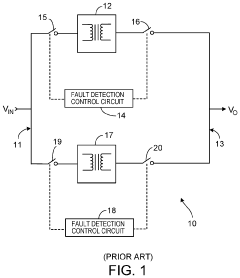
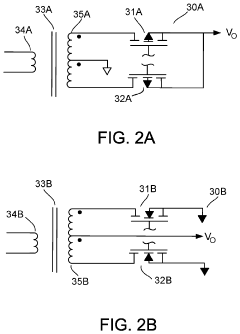
- The implementation of a fault-tolerant power converter system using a transformer with series circuits and dual MOSFET semiconductor devices, where switches are controlled to prevent short circuits and ensure continued operation even if one switch fails, utilizing a full-bridge rectification circuit and common-source dual MOSFET devices to manage power flow effectively.
Common zero volt reference ac / DC power supply with positive and negative rectification and method of operation thereof
PatentActiveUS20160181941A1
Innovation
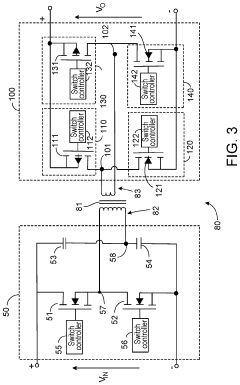
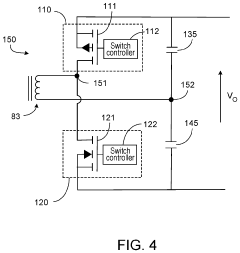
- A common zero volt reference AC/DC power supply with positive and negative rectification, utilizing a first rectifier for half-wave rectification of the positive half cycle and a second rectifier for the negative half cycle, along with a DC/DC power converter to ensure energy recovery and a common zero volt reference between AC input and DC output.


Thermal Management Strategies
Thermal management is a critical aspect of half wave rectifier design, particularly when dealing with power loss. As these devices convert AC to DC, they generate heat that must be effectively dissipated to maintain optimal performance and prevent component failure. Several strategies can be employed to manage thermal issues in half wave rectifiers.
One primary approach is the use of heat sinks. These passive cooling devices increase the surface area available for heat dissipation, allowing for more efficient transfer of thermal energy to the surrounding air. Heat sinks are typically made of materials with high thermal conductivity, such as aluminum or copper, and can be designed with various fin structures to maximize heat transfer. The selection of an appropriate heat sink depends on factors such as the power rating of the rectifier, ambient temperature, and available space.
Active cooling methods can also be implemented for more demanding applications. Forced-air cooling, using fans or blowers, can significantly enhance heat dissipation by increasing air flow over the rectifier components. This method is particularly effective when combined with heat sinks, as it improves the convective heat transfer. For high-power applications, liquid cooling systems may be employed, offering superior thermal management capabilities but at the cost of increased complexity and maintenance requirements.
Thermal interface materials (TIMs) play a crucial role in improving heat transfer between the rectifier components and cooling solutions. These materials, such as thermal greases, pads, or phase-change materials, fill microscopic air gaps between surfaces, enhancing thermal conductivity. Proper selection and application of TIMs can significantly reduce thermal resistance and improve overall cooling efficiency.
Component layout and PCB design also contribute to effective thermal management. Strategically placing heat-generating components to optimize heat distribution and utilizing thermal vias to conduct heat through PCB layers can help mitigate hotspots. Additionally, employing thicker copper traces or planes can improve heat spreading across the board.
Advanced packaging technologies, such as direct bonded copper (DBC) substrates or insulated metal substrates (IMS), offer improved thermal performance for high-power rectifier designs. These substrates provide better heat dissipation paths and can significantly reduce thermal resistance compared to traditional FR4 PCBs.
Implementing thermal monitoring and protection circuits can safeguard the rectifier against overheating. Temperature sensors and thermal shutdown mechanisms can be integrated to detect excessive temperatures and take appropriate action, such as reducing power output or shutting down the system to prevent damage.
By employing a combination of these thermal management strategies, designers can effectively mitigate power loss-related heat issues in half wave rectifiers, ensuring reliable operation and extended component lifespan. The specific approach chosen will depend on the application requirements, power levels, and environmental conditions.
One primary approach is the use of heat sinks. These passive cooling devices increase the surface area available for heat dissipation, allowing for more efficient transfer of thermal energy to the surrounding air. Heat sinks are typically made of materials with high thermal conductivity, such as aluminum or copper, and can be designed with various fin structures to maximize heat transfer. The selection of an appropriate heat sink depends on factors such as the power rating of the rectifier, ambient temperature, and available space.
Active cooling methods can also be implemented for more demanding applications. Forced-air cooling, using fans or blowers, can significantly enhance heat dissipation by increasing air flow over the rectifier components. This method is particularly effective when combined with heat sinks, as it improves the convective heat transfer. For high-power applications, liquid cooling systems may be employed, offering superior thermal management capabilities but at the cost of increased complexity and maintenance requirements.
Thermal interface materials (TIMs) play a crucial role in improving heat transfer between the rectifier components and cooling solutions. These materials, such as thermal greases, pads, or phase-change materials, fill microscopic air gaps between surfaces, enhancing thermal conductivity. Proper selection and application of TIMs can significantly reduce thermal resistance and improve overall cooling efficiency.
Component layout and PCB design also contribute to effective thermal management. Strategically placing heat-generating components to optimize heat distribution and utilizing thermal vias to conduct heat through PCB layers can help mitigate hotspots. Additionally, employing thicker copper traces or planes can improve heat spreading across the board.
Advanced packaging technologies, such as direct bonded copper (DBC) substrates or insulated metal substrates (IMS), offer improved thermal performance for high-power rectifier designs. These substrates provide better heat dissipation paths and can significantly reduce thermal resistance compared to traditional FR4 PCBs.
Implementing thermal monitoring and protection circuits can safeguard the rectifier against overheating. Temperature sensors and thermal shutdown mechanisms can be integrated to detect excessive temperatures and take appropriate action, such as reducing power output or shutting down the system to prevent damage.
By employing a combination of these thermal management strategies, designers can effectively mitigate power loss-related heat issues in half wave rectifiers, ensuring reliable operation and extended component lifespan. The specific approach chosen will depend on the application requirements, power levels, and environmental conditions.
Environmental Impact of Rectifier Efficiency
The environmental impact of rectifier efficiency, particularly in half-wave rectifiers, is a critical consideration in the context of power electronics and energy conservation. Half-wave rectifiers, while simple in design, are inherently less efficient than their full-wave counterparts, leading to increased power losses and subsequent environmental consequences.
The primary environmental concern stems from the wasted energy in the form of heat dissipation. When a half-wave rectifier operates, it only utilizes one half of the AC cycle, effectively discarding the other half. This inefficiency translates to higher power consumption from the grid to achieve the same output, resulting in increased greenhouse gas emissions from power generation facilities.
Furthermore, the heat generated by inefficient rectifiers contributes to the urban heat island effect, particularly in densely populated areas with high concentrations of electronic devices. This localized temperature increase can lead to higher cooling demands, creating a feedback loop of energy consumption and environmental impact.
The manufacturing of additional components to compensate for inefficiencies also has environmental implications. More robust heat sinks and cooling systems are often required, leading to increased resource extraction, processing, and eventual disposal of these materials. This lifecycle impact extends beyond the operational phase of the rectifier itself.
In industrial applications, where large-scale rectification is common, the cumulative effect of using less efficient half-wave rectifiers can be substantial. The increased power demand can strain electrical grids, potentially leading to the need for additional power generation capacity, which often relies on fossil fuels in many regions.
From a sustainability perspective, improving rectifier efficiency is crucial. Transitioning to more efficient full-wave rectifiers or implementing advanced control strategies can significantly reduce power losses. This shift not only decreases direct energy consumption but also minimizes the need for auxiliary cooling systems, further reducing the overall environmental footprint.
Regulatory bodies and environmental agencies are increasingly focusing on the efficiency of power electronic devices. Stricter standards and energy efficiency requirements are being implemented globally, pushing manufacturers to innovate and improve rectifier designs. This regulatory pressure serves as a catalyst for technological advancements that can mitigate the environmental impact of power conversion processes.
In conclusion, the environmental impact of rectifier efficiency, especially in half-wave rectifiers, extends beyond immediate power losses. It encompasses broader issues of energy consumption, resource utilization, and long-term sustainability. Addressing these inefficiencies through improved designs and technologies is essential for reducing the environmental footprint of electronic systems and contributing to global energy conservation efforts.
The primary environmental concern stems from the wasted energy in the form of heat dissipation. When a half-wave rectifier operates, it only utilizes one half of the AC cycle, effectively discarding the other half. This inefficiency translates to higher power consumption from the grid to achieve the same output, resulting in increased greenhouse gas emissions from power generation facilities.
Furthermore, the heat generated by inefficient rectifiers contributes to the urban heat island effect, particularly in densely populated areas with high concentrations of electronic devices. This localized temperature increase can lead to higher cooling demands, creating a feedback loop of energy consumption and environmental impact.
The manufacturing of additional components to compensate for inefficiencies also has environmental implications. More robust heat sinks and cooling systems are often required, leading to increased resource extraction, processing, and eventual disposal of these materials. This lifecycle impact extends beyond the operational phase of the rectifier itself.
In industrial applications, where large-scale rectification is common, the cumulative effect of using less efficient half-wave rectifiers can be substantial. The increased power demand can strain electrical grids, potentially leading to the need for additional power generation capacity, which often relies on fossil fuels in many regions.
From a sustainability perspective, improving rectifier efficiency is crucial. Transitioning to more efficient full-wave rectifiers or implementing advanced control strategies can significantly reduce power losses. This shift not only decreases direct energy consumption but also minimizes the need for auxiliary cooling systems, further reducing the overall environmental footprint.
Regulatory bodies and environmental agencies are increasingly focusing on the efficiency of power electronic devices. Stricter standards and energy efficiency requirements are being implemented globally, pushing manufacturers to innovate and improve rectifier designs. This regulatory pressure serves as a catalyst for technological advancements that can mitigate the environmental impact of power conversion processes.
In conclusion, the environmental impact of rectifier efficiency, especially in half-wave rectifiers, extends beyond immediate power losses. It encompasses broader issues of energy consumption, resource utilization, and long-term sustainability. Addressing these inefficiencies through improved designs and technologies is essential for reducing the environmental footprint of electronic systems and contributing to global energy conservation efforts.
Unlock deeper insights with PatSnap Eureka Quick Research — get a full tech report to explore trends and direct your research. Try now!
Generate Your Research Report Instantly with AI Agent
Supercharge your innovation with PatSnap Eureka AI Agent Platform!