

V6 Engine vs Diesel Engine: Efficiency Comparison
SEP 3, 20259 MIN READ
Generate Your Research Report Instantly with AI Agent
PatSnap Eureka helps you evaluate technical feasibility & market potential.
V6 and Diesel Engine Development History and Objectives
The evolution of internal combustion engines has been marked by continuous innovation since their inception in the late 19th century. The V6 engine, characterized by its V-shaped cylinder arrangement, emerged in the early 20th century as manufacturers sought more compact and powerful alternatives to inline configurations. The first production V6 engine was developed by Lancia in 1950 with the Aurelia model, setting a precedent for this configuration's adoption in passenger vehicles.
Throughout the 1960s and 1970s, V6 engines gained popularity in North America and Europe as automakers faced increasing pressure to improve fuel efficiency while maintaining performance. The oil crises of the 1970s accelerated this trend, pushing manufacturers to refine V6 designs with technologies like fuel injection and variable valve timing to optimize combustion efficiency.
Diesel engines, conversely, trace their origins to Rudolf Diesel's 1892 patent and his first working prototype in 1897. Initially developed for industrial applications due to their superior efficiency and durability, diesel engines began penetrating the automotive market in the 1930s. Mercedes-Benz introduced the 260D in 1936, widely considered the first mass-produced diesel passenger car.
The technological trajectories of both engine types have been significantly influenced by increasingly stringent emissions regulations and efficiency demands. Since the 1990s, V6 gasoline engines have incorporated direct injection, turbocharging, and cylinder deactivation technologies to reduce fuel consumption while maintaining performance characteristics valued by consumers.
Diesel engine development has focused on overcoming inherent challenges related to emissions, particularly nitrogen oxides (NOx) and particulate matter. Advanced technologies such as common rail direct injection, introduced commercially in the late 1990s, variable geometry turbochargers, and sophisticated exhaust after-treatment systems have transformed modern diesel engines into significantly cleaner power plants.
The primary objective in comparing V6 and diesel engine efficiency is to establish comprehensive metrics that account for thermal efficiency, fuel economy under various operating conditions, power-to-weight ratios, and emissions profiles. This analysis must consider that diesel engines typically achieve 30-35% thermal efficiency compared to 25-30% for gasoline V6 engines, but with different performance characteristics and emissions challenges.
Current technological development aims to narrow this efficiency gap through innovations like homogeneous charge compression ignition (HCCI) for gasoline engines and low-temperature combustion techniques for diesel engines. The ultimate goal is to provide stakeholders with actionable insights regarding which engine technology offers optimal efficiency for specific applications, considering factors such as duty cycle, environmental conditions, and regulatory requirements.
Throughout the 1960s and 1970s, V6 engines gained popularity in North America and Europe as automakers faced increasing pressure to improve fuel efficiency while maintaining performance. The oil crises of the 1970s accelerated this trend, pushing manufacturers to refine V6 designs with technologies like fuel injection and variable valve timing to optimize combustion efficiency.
Diesel engines, conversely, trace their origins to Rudolf Diesel's 1892 patent and his first working prototype in 1897. Initially developed for industrial applications due to their superior efficiency and durability, diesel engines began penetrating the automotive market in the 1930s. Mercedes-Benz introduced the 260D in 1936, widely considered the first mass-produced diesel passenger car.
The technological trajectories of both engine types have been significantly influenced by increasingly stringent emissions regulations and efficiency demands. Since the 1990s, V6 gasoline engines have incorporated direct injection, turbocharging, and cylinder deactivation technologies to reduce fuel consumption while maintaining performance characteristics valued by consumers.
Diesel engine development has focused on overcoming inherent challenges related to emissions, particularly nitrogen oxides (NOx) and particulate matter. Advanced technologies such as common rail direct injection, introduced commercially in the late 1990s, variable geometry turbochargers, and sophisticated exhaust after-treatment systems have transformed modern diesel engines into significantly cleaner power plants.
The primary objective in comparing V6 and diesel engine efficiency is to establish comprehensive metrics that account for thermal efficiency, fuel economy under various operating conditions, power-to-weight ratios, and emissions profiles. This analysis must consider that diesel engines typically achieve 30-35% thermal efficiency compared to 25-30% for gasoline V6 engines, but with different performance characteristics and emissions challenges.
Current technological development aims to narrow this efficiency gap through innovations like homogeneous charge compression ignition (HCCI) for gasoline engines and low-temperature combustion techniques for diesel engines. The ultimate goal is to provide stakeholders with actionable insights regarding which engine technology offers optimal efficiency for specific applications, considering factors such as duty cycle, environmental conditions, and regulatory requirements.
Market Demand Analysis for Engine Efficiency
The global automotive industry is experiencing a significant shift in market demands regarding engine efficiency, driven primarily by stringent emission regulations, rising fuel costs, and increasing environmental consciousness among consumers. This market transformation has placed engine efficiency at the forefront of automotive development priorities, creating a competitive landscape where manufacturers must balance performance with fuel economy.
Consumer research indicates that fuel efficiency has become the second most important purchasing factor after price, with approximately 68% of new vehicle buyers citing it as a critical consideration. This trend is particularly pronounced in European and Asian markets, where fuel prices remain consistently high. The efficiency comparison between V6 and diesel engines has therefore become increasingly relevant to manufacturers' product planning and marketing strategies.
The commercial vehicle sector demonstrates particularly strong demand for efficient diesel engines, with the global market for diesel engines projected to maintain steady growth despite challenges from alternative powertrains. Fleet operators consistently prioritize total cost of ownership calculations where diesel's superior efficiency often provides compelling long-term value propositions despite higher initial acquisition costs.
Regulatory frameworks worldwide continue to shape market demand significantly. Euro 7 standards in Europe, Corporate Average Fuel Economy (CAFE) regulations in the United States, and similar policies in China and Japan have established progressively stringent efficiency targets that directly influence engine development priorities. These regulations have created market conditions where diesel engines' inherent efficiency advantages must be balanced against their higher emissions control requirements.
Market segmentation analysis reveals interesting patterns in efficiency demand. Premium vehicle segments show continued preference for V6 gasoline engines where performance characteristics remain paramount, while mid-market segments demonstrate increasing receptiveness to efficient diesel options. The SUV and light truck segments represent particularly contested battlegrounds where the torque advantages of diesel engines compete directly with the refinement of modern V6 gasoline powerplants.
Regional variations in market demand are pronounced, with North American consumers traditionally favoring gasoline V6 engines while European markets maintain stronger diesel penetration. However, these regional preferences are evolving as technological improvements narrow the efficiency gap between engine types and as hybrid and electrification technologies increasingly supplement both engine architectures.
The aftermarket and retrofit sectors also demonstrate significant demand for efficiency improvements, with substantial growth in efficiency-enhancing modifications and maintenance services for both engine types. This indicates a broader market recognition of efficiency's importance beyond new vehicle purchases, extending throughout the vehicle lifecycle.
Consumer research indicates that fuel efficiency has become the second most important purchasing factor after price, with approximately 68% of new vehicle buyers citing it as a critical consideration. This trend is particularly pronounced in European and Asian markets, where fuel prices remain consistently high. The efficiency comparison between V6 and diesel engines has therefore become increasingly relevant to manufacturers' product planning and marketing strategies.
The commercial vehicle sector demonstrates particularly strong demand for efficient diesel engines, with the global market for diesel engines projected to maintain steady growth despite challenges from alternative powertrains. Fleet operators consistently prioritize total cost of ownership calculations where diesel's superior efficiency often provides compelling long-term value propositions despite higher initial acquisition costs.
Regulatory frameworks worldwide continue to shape market demand significantly. Euro 7 standards in Europe, Corporate Average Fuel Economy (CAFE) regulations in the United States, and similar policies in China and Japan have established progressively stringent efficiency targets that directly influence engine development priorities. These regulations have created market conditions where diesel engines' inherent efficiency advantages must be balanced against their higher emissions control requirements.
Market segmentation analysis reveals interesting patterns in efficiency demand. Premium vehicle segments show continued preference for V6 gasoline engines where performance characteristics remain paramount, while mid-market segments demonstrate increasing receptiveness to efficient diesel options. The SUV and light truck segments represent particularly contested battlegrounds where the torque advantages of diesel engines compete directly with the refinement of modern V6 gasoline powerplants.
Regional variations in market demand are pronounced, with North American consumers traditionally favoring gasoline V6 engines while European markets maintain stronger diesel penetration. However, these regional preferences are evolving as technological improvements narrow the efficiency gap between engine types and as hybrid and electrification technologies increasingly supplement both engine architectures.
The aftermarket and retrofit sectors also demonstrate significant demand for efficiency improvements, with substantial growth in efficiency-enhancing modifications and maintenance services for both engine types. This indicates a broader market recognition of efficiency's importance beyond new vehicle purchases, extending throughout the vehicle lifecycle.
Current Technical Status and Challenges in Engine Design
The global engine design landscape is witnessing significant transformations driven by stringent emission regulations, fuel economy demands, and shifting consumer preferences. V6 engines and diesel engines represent two distinct approaches to powertrain design, each with unique efficiency characteristics. Currently, modern V6 gasoline engines typically achieve thermal efficiency rates of 25-30%, while advanced diesel engines can reach 40-45% thermal efficiency, representing one of the fundamental differences between these technologies.
In the automotive industry, V6 engines have evolved considerably with the integration of direct injection, variable valve timing, and turbocharging technologies. These advancements have narrowed the efficiency gap with diesel engines, particularly in partial load conditions. However, diesel engines maintain superiority in full-load efficiency scenarios due to their higher compression ratios (typically 14:1 to 23:1 compared to 8:1 to 12:1 in gasoline V6 engines) and lean combustion characteristics.
A significant technical challenge facing both engine types is the trade-off between efficiency and emissions control. Diesel engines, while more thermally efficient, require more complex and costly after-treatment systems to manage NOx and particulate emissions. V6 gasoline engines face challenges in reducing CO2 emissions while maintaining performance characteristics that consumers expect, particularly in larger vehicles and SUVs where these engines are commonly deployed.
Material science limitations present another critical challenge. Both engine types are pushing the boundaries of material capabilities, with higher combustion temperatures and pressures demanding advanced alloys and manufacturing techniques. Cylinder deactivation technology in V6 engines, which improves efficiency by shutting down cylinders during light-load conditions, introduces additional mechanical complexity and potential reliability concerns.
Geographically, diesel engine technology development remains concentrated in Europe, where regulatory frameworks have historically favored diesel adoption. V6 gasoline engine development is more globally distributed, with significant innovation centers in North America, Japan, and increasingly, China. This geographical distribution influences the pace and direction of technological advancement in each engine type.
The integration of hybrid systems represents both an opportunity and challenge for both engine types. V6 engines have shown promising efficiency improvements when paired with electric motors in hybrid configurations, while diesel-hybrid systems remain less common due to cost and complexity factors. The challenge lies in optimizing the interaction between conventional engine operation and electric assistance to maximize overall system efficiency.
Weight reduction efforts continue to be a critical focus area, with manufacturers exploring aluminum, magnesium alloys, and composite materials to reduce engine mass while maintaining structural integrity. This is particularly important for V6 engines, which typically carry a weight penalty compared to inline-four alternatives.
AI-driven combustion control systems are emerging as a frontier technology that could significantly impact the efficiency comparison between these engine types, potentially enabling more precise combustion management and further narrowing performance gaps.
In the automotive industry, V6 engines have evolved considerably with the integration of direct injection, variable valve timing, and turbocharging technologies. These advancements have narrowed the efficiency gap with diesel engines, particularly in partial load conditions. However, diesel engines maintain superiority in full-load efficiency scenarios due to their higher compression ratios (typically 14:1 to 23:1 compared to 8:1 to 12:1 in gasoline V6 engines) and lean combustion characteristics.
A significant technical challenge facing both engine types is the trade-off between efficiency and emissions control. Diesel engines, while more thermally efficient, require more complex and costly after-treatment systems to manage NOx and particulate emissions. V6 gasoline engines face challenges in reducing CO2 emissions while maintaining performance characteristics that consumers expect, particularly in larger vehicles and SUVs where these engines are commonly deployed.
Material science limitations present another critical challenge. Both engine types are pushing the boundaries of material capabilities, with higher combustion temperatures and pressures demanding advanced alloys and manufacturing techniques. Cylinder deactivation technology in V6 engines, which improves efficiency by shutting down cylinders during light-load conditions, introduces additional mechanical complexity and potential reliability concerns.
Geographically, diesel engine technology development remains concentrated in Europe, where regulatory frameworks have historically favored diesel adoption. V6 gasoline engine development is more globally distributed, with significant innovation centers in North America, Japan, and increasingly, China. This geographical distribution influences the pace and direction of technological advancement in each engine type.
The integration of hybrid systems represents both an opportunity and challenge for both engine types. V6 engines have shown promising efficiency improvements when paired with electric motors in hybrid configurations, while diesel-hybrid systems remain less common due to cost and complexity factors. The challenge lies in optimizing the interaction between conventional engine operation and electric assistance to maximize overall system efficiency.
Weight reduction efforts continue to be a critical focus area, with manufacturers exploring aluminum, magnesium alloys, and composite materials to reduce engine mass while maintaining structural integrity. This is particularly important for V6 engines, which typically carry a weight penalty compared to inline-four alternatives.
AI-driven combustion control systems are emerging as a frontier technology that could significantly impact the efficiency comparison between these engine types, potentially enabling more precise combustion management and further narrowing performance gaps.
Current Technical Solutions for Efficiency Optimization
01 V6 Engine Design Improvements for Enhanced Efficiency
Various design improvements in V6 engines have been developed to enhance their efficiency. These include optimized cylinder configurations, improved combustion chamber designs, and advanced valve timing systems. These modifications help to reduce fuel consumption, improve power output, and decrease emissions. The optimized designs also contribute to better thermal management and reduced mechanical losses in V6 engines.- V6 Engine Design Improvements for Enhanced Efficiency: Various design improvements in V6 engines have been developed to enhance fuel efficiency. These include optimized cylinder configurations, improved combustion chamber designs, and advanced valve timing systems. These modifications help to reduce fuel consumption while maintaining or improving engine performance. The design improvements also focus on reducing friction losses and improving thermal efficiency in V6 engines.
- Diesel Engine Combustion Optimization: Innovations in diesel engine combustion processes have significantly improved efficiency. These include advanced fuel injection systems, optimized combustion chamber geometries, and improved air-fuel mixing techniques. By enhancing the combustion process, these technologies reduce fuel consumption and emissions while increasing power output. The optimization techniques also focus on reducing heat losses and improving the overall thermal efficiency of diesel engines.
- Hybrid and Alternative Fuel Systems for V6 and Diesel Engines: Integration of hybrid systems and alternative fuel technologies with V6 and diesel engines has shown significant efficiency improvements. These systems combine conventional engine technology with electric motors or allow engines to run on multiple fuel types. The hybrid systems often include regenerative braking and start-stop technology to further enhance fuel economy. Alternative fuels such as biodiesel, natural gas, or hydrogen can also be used to improve efficiency and reduce environmental impact.
- Advanced Engine Control Systems and Electronics: Modern electronic control systems have revolutionized engine efficiency in both V6 and diesel engines. These include sophisticated engine management systems, variable valve timing controls, and precision fuel delivery systems. By optimizing operating parameters in real-time based on driving conditions, these control systems maximize efficiency across various operating conditions. Advanced sensors and algorithms continuously monitor and adjust engine performance to maintain optimal efficiency.
- Thermal Management and Heat Recovery Systems: Innovative thermal management and waste heat recovery systems have been developed to improve the efficiency of both V6 and diesel engines. These systems capture and utilize waste heat that would otherwise be lost through the exhaust or cooling system. By recycling this thermal energy, overall engine efficiency is improved. Technologies include exhaust gas recirculation systems, thermoelectric generators, and advanced cooling systems that maintain optimal operating temperatures under various conditions.
02 Diesel Engine Combustion Optimization
Innovations in diesel engine combustion processes have significantly improved their efficiency. These include advanced fuel injection systems, improved air-fuel mixing techniques, and optimized combustion chamber designs. By enhancing the combustion process, these technologies enable more complete fuel burning, reduced emissions, and increased power output while maintaining or reducing fuel consumption.Expand Specific Solutions03 Hybrid and Alternative Fuel Systems for V6 and Diesel Engines
Integration of hybrid systems and alternative fuel technologies with V6 and diesel engines has led to significant efficiency improvements. These systems combine conventional engine technology with electric motors or allow engines to run on alternative fuels. Such combinations help to optimize power delivery, reduce fuel consumption during various driving conditions, and lower overall emissions while maintaining performance characteristics.Expand Specific Solutions04 Thermal Management and Heat Recovery Systems
Advanced thermal management and heat recovery systems have been developed to improve the efficiency of both V6 and diesel engines. These systems help to optimize operating temperatures, recover waste heat, and reduce energy losses. By effectively managing heat distribution and recovery, these technologies contribute to improved fuel efficiency, reduced emissions, and enhanced overall engine performance.Expand Specific Solutions05 Electronic Control and Monitoring Systems for Engine Efficiency
Sophisticated electronic control and monitoring systems have been implemented to optimize the efficiency of V6 and diesel engines. These systems include advanced engine control units, real-time performance monitoring, and adaptive control algorithms. By precisely controlling fuel injection, ignition timing, and other parameters based on operating conditions, these technologies maximize efficiency while minimizing emissions and maintaining optimal performance across various operating conditions.Expand Specific Solutions
Major Manufacturers and Competitive Landscape
The V6 vs Diesel engine efficiency comparison market is in a mature development stage with established technologies, though evolving toward greater sustainability. The global market size for these engine types exceeds $200 billion, with diesel engines dominating commercial applications while V6 engines remain prevalent in passenger vehicles. Leading players demonstrate varying technological maturity: traditional manufacturers like GM, Cummins, and Volvo Lastvagnar possess advanced capabilities in both engine types, while Yuchai Machinery and Yanmar focus on diesel innovation. Research institutions such as Southwest Research Institute and universities (Tianjin, Dalian) are advancing efficiency improvements. Companies like Hyundai and Mitsubishi are transitioning toward hybrid solutions that leverage strengths of both technologies while addressing environmental concerns.
GM Global Technology Operations LLC
Technical Solution: GM has developed advanced V6 engine technologies including their EcoTec3 V6 platform which incorporates direct injection, variable valve timing, and Active Fuel Management (cylinder deactivation). Their V6 engines achieve efficiency through reduced friction, optimized combustion chambers, and integrated exhaust manifolds. For diesel comparison, GM has implemented their Duramax diesel technology with high-pressure common rail fuel systems operating at 30,000+ PSI, allowing precise fuel delivery and improved atomization. Their diesel engines feature variable-geometry turbochargers and cooled exhaust gas recirculation (EGR) systems to balance power, efficiency, and emissions. GM's comparative testing shows their diesel offerings typically deliver 25-30% better fuel economy than comparable V6 gasoline engines, though with higher initial cost and maintenance requirements.
Strengths: Extensive R&D capabilities across both engine types; proprietary Active Fuel Management technology for V6; strong diesel expertise through Duramax platform. Weaknesses: Higher manufacturing costs for advanced technologies; diesel engines face increasingly stringent emissions regulations requiring complex aftertreatment systems.
Cummins, Inc.
Technical Solution: Cummins has pioneered advanced diesel engine technology with their X15 and B-Series platforms that incorporate sophisticated electronic control modules, variable geometry turbochargers, and high-pressure common rail fuel injection systems operating at pressures up to 2,500 bar. Their diesel engines utilize advanced combustion design with optimized bowl geometry and multiple injection events per cycle to maximize fuel efficiency while reducing emissions. Cummins' comparative analysis between diesel and V6 gasoline engines demonstrates diesel efficiency advantages of 20-35% in heavy-duty applications, with their latest generation achieving thermal efficiencies exceeding 50% compared to typical V6 gasoline engines at 35-38%. Their proprietary XPI fuel system enables precise fuel delivery timing and quantity control across all operating conditions. Cummins has also developed hybrid-compatible diesel architectures that can be integrated with electrification systems for further efficiency gains, particularly in transient operations where traditional diesels may suffer efficiency losses.
Strengths: Industry-leading diesel combustion expertise; proprietary high-pressure fuel injection systems; extensive testing facilities for comparative analysis; global service network. Weaknesses: Limited expertise in V6 gasoline technology; higher initial cost compared to gasoline alternatives; increasing complexity of emissions aftertreatment systems.
Key Innovations in Engine Efficiency Technologies
Low emission diesel particulate filter (DPF) regeneration
PatentInactiveUS20050241299A1
Innovation
- A diesel engine system that allows simultaneous DPF regeneration and EGR operation by using a flow control valve to re-circulate exhaust from one exhaust segment while injecting fuel into another for combustion in the catalyst, maintaining optimal ignition timing and preventing fuel re-circulation into the engine.


Two-stage process for producing oil from microalgae
PatentInactiveUS20240110210A1
Innovation
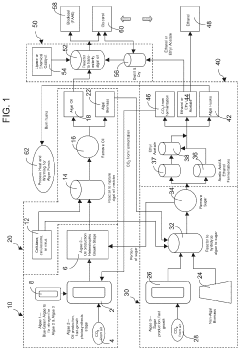
- Cultivating oil-producing algae through sequential photoautotrophic and heterotrophic growth, using sugar feeds to increase oil production, and converting algal oil into biodiesel, which can be extracted and processed using biological agents or mechanical methods, reducing the need for land and water resources and minimizing external inputs.
Environmental Impact and Emissions Regulations
The environmental impact of internal combustion engines represents a critical factor in the V6 versus diesel efficiency comparison, particularly as global emissions regulations become increasingly stringent. V6 gasoline engines typically produce higher levels of carbon dioxide (CO2) emissions per mile driven compared to diesel counterparts, primarily due to their lower thermal efficiency. However, diesel engines generate significantly more nitrogen oxides (NOx) and particulate matter (PM), which pose serious health and environmental concerns.
Regulatory frameworks worldwide have evolved dramatically over the past two decades, with the European Union's Euro standards, the United States' EPA Tier regulations, and China's National standards progressively tightening emission limits. The 2015 Volkswagen emissions scandal ("Dieselgate") marked a turning point in diesel regulation enforcement, leading to enhanced real-world driving emissions (RDE) testing protocols and greater scrutiny of diesel technology.
Modern V6 engines have responded to these challenges through technologies like direct injection, variable valve timing, and advanced catalytic converters. These innovations have substantially reduced hydrocarbon and carbon monoxide emissions while improving fuel economy. Meanwhile, diesel engines have incorporated selective catalytic reduction (SCR) systems, diesel particulate filters (DPF), and exhaust gas recirculation (EGR) to address their NOx and particulate emissions challenges.
The cost of emissions compliance has risen dramatically for both engine types, with diesel engines facing particularly steep increases due to their complex aftertreatment systems. This has narrowed diesel's traditional total cost of ownership advantage in many markets. Additionally, many urban centers have implemented or announced future restrictions on diesel vehicles, creating market uncertainty and accelerating the shift toward alternative powertrains.
Looking forward, the regulatory landscape continues to evolve toward zero-emission targets in many regions. The Euro 7 standards and equivalent regulations in other markets will further challenge both engine types, with particular pressure on diesel technology. This regulatory pressure is accelerating research into hybrid powertrains that combine V6 or diesel engines with electric propulsion to meet both efficiency and emissions targets.
The environmental calculus between these engine types ultimately depends on specific use cases, with diesel maintaining advantages in high-load, long-distance applications where its efficiency benefits outweigh emissions challenges, while V6 engines may offer better environmental performance in light-load urban scenarios where catalytic converters can operate at optimal temperatures.
Regulatory frameworks worldwide have evolved dramatically over the past two decades, with the European Union's Euro standards, the United States' EPA Tier regulations, and China's National standards progressively tightening emission limits. The 2015 Volkswagen emissions scandal ("Dieselgate") marked a turning point in diesel regulation enforcement, leading to enhanced real-world driving emissions (RDE) testing protocols and greater scrutiny of diesel technology.
Modern V6 engines have responded to these challenges through technologies like direct injection, variable valve timing, and advanced catalytic converters. These innovations have substantially reduced hydrocarbon and carbon monoxide emissions while improving fuel economy. Meanwhile, diesel engines have incorporated selective catalytic reduction (SCR) systems, diesel particulate filters (DPF), and exhaust gas recirculation (EGR) to address their NOx and particulate emissions challenges.
The cost of emissions compliance has risen dramatically for both engine types, with diesel engines facing particularly steep increases due to their complex aftertreatment systems. This has narrowed diesel's traditional total cost of ownership advantage in many markets. Additionally, many urban centers have implemented or announced future restrictions on diesel vehicles, creating market uncertainty and accelerating the shift toward alternative powertrains.
Looking forward, the regulatory landscape continues to evolve toward zero-emission targets in many regions. The Euro 7 standards and equivalent regulations in other markets will further challenge both engine types, with particular pressure on diesel technology. This regulatory pressure is accelerating research into hybrid powertrains that combine V6 or diesel engines with electric propulsion to meet both efficiency and emissions targets.
The environmental calculus between these engine types ultimately depends on specific use cases, with diesel maintaining advantages in high-load, long-distance applications where its efficiency benefits outweigh emissions challenges, while V6 engines may offer better environmental performance in light-load urban scenarios where catalytic converters can operate at optimal temperatures.
Total Cost of Ownership Analysis
When comparing V6 and diesel engines, total cost of ownership (TCO) analysis provides a comprehensive financial perspective beyond initial purchase price. The acquisition cost typically favors V6 gasoline engines, which are generally 15-20% less expensive than comparable diesel powerplants due to simpler emission control systems and manufacturing processes. However, this initial advantage diminishes when examining long-term operational expenses.
Fuel economy represents the most significant operational cost differential. Diesel engines demonstrate 20-30% better fuel efficiency than comparable V6 gasoline engines, translating to substantial savings over vehicle lifetime. Based on average annual driving distances of 15,000 miles, diesel owners may save $500-800 annually on fuel costs, depending on regional fuel price differentials.
Maintenance costs present a mixed picture in the TCO equation. Diesel engines typically require less frequent but more expensive service intervals. Oil changes for diesel engines cost approximately 30-50% more but can be performed at longer intervals. Diesel engines generally demonstrate superior longevity, often exceeding 250,000 miles before major overhaul, compared to 150,000-200,000 miles for typical V6 gasoline engines.
Depreciation patterns also differ significantly between these engine types. Diesel-powered vehicles typically retain 5-10% higher residual value after five years of ownership, particularly in certain market segments like trucks and large SUVs. This improved value retention partially offsets the higher initial acquisition cost.
Insurance costs generally favor V6 gasoline engines, with diesel vehicles commanding 5-15% premium increases due to higher replacement costs and specialized repair requirements. Additionally, diesel vehicles face potentially higher taxation in certain regions where fuel or emissions-based vehicle taxes are implemented.
When calculating comprehensive TCO over a 5-year ownership period with annual mileage of 15,000, diesel engines typically break even with V6 gasoline counterparts between years 3-4 of ownership. For high-mileage operators exceeding 20,000 miles annually, the diesel advantage accelerates, with break-even points occurring as early as 24-30 months into ownership.
The TCO advantage becomes most pronounced in heavy-duty applications where engine durability and torque characteristics directly impact productivity and operational efficiency. Commercial operators typically experience 15-20% lower lifetime ownership costs with diesel powerplants when factoring all operational variables including resale value.
Fuel economy represents the most significant operational cost differential. Diesel engines demonstrate 20-30% better fuel efficiency than comparable V6 gasoline engines, translating to substantial savings over vehicle lifetime. Based on average annual driving distances of 15,000 miles, diesel owners may save $500-800 annually on fuel costs, depending on regional fuel price differentials.
Maintenance costs present a mixed picture in the TCO equation. Diesel engines typically require less frequent but more expensive service intervals. Oil changes for diesel engines cost approximately 30-50% more but can be performed at longer intervals. Diesel engines generally demonstrate superior longevity, often exceeding 250,000 miles before major overhaul, compared to 150,000-200,000 miles for typical V6 gasoline engines.
Depreciation patterns also differ significantly between these engine types. Diesel-powered vehicles typically retain 5-10% higher residual value after five years of ownership, particularly in certain market segments like trucks and large SUVs. This improved value retention partially offsets the higher initial acquisition cost.
Insurance costs generally favor V6 gasoline engines, with diesel vehicles commanding 5-15% premium increases due to higher replacement costs and specialized repair requirements. Additionally, diesel vehicles face potentially higher taxation in certain regions where fuel or emissions-based vehicle taxes are implemented.
When calculating comprehensive TCO over a 5-year ownership period with annual mileage of 15,000, diesel engines typically break even with V6 gasoline counterparts between years 3-4 of ownership. For high-mileage operators exceeding 20,000 miles annually, the diesel advantage accelerates, with break-even points occurring as early as 24-30 months into ownership.
The TCO advantage becomes most pronounced in heavy-duty applications where engine durability and torque characteristics directly impact productivity and operational efficiency. Commercial operators typically experience 15-20% lower lifetime ownership costs with diesel powerplants when factoring all operational variables including resale value.
Unlock deeper insights with PatSnap Eureka Quick Research — get a full tech report to explore trends and direct your research. Try now!
Generate Your Research Report Instantly with AI Agent
Supercharge your innovation with PatSnap Eureka AI Agent Platform!