

Variations in PEC water splitting performance with light intensity changes.
SEP 5, 202510 MIN READ
Generate Your Research Report Instantly with AI Agent
PatSnap Eureka helps you evaluate technical feasibility & market potential.
PEC Water Splitting Technology Background and Objectives
Photoelectrochemical (PEC) water splitting represents a promising approach for sustainable hydrogen production, leveraging solar energy to drive the decomposition of water into hydrogen and oxygen. This technology has evolved significantly since its inception in the 1970s with Fujishima and Honda's groundbreaking demonstration of photocatalytic water splitting using titanium dioxide electrodes. Over the past five decades, research has progressed from fundamental understanding of semiconductor-electrolyte interfaces to sophisticated multi-junction photoelectrode designs.
The evolution of PEC water splitting technology has been characterized by continuous improvements in photoelectrode materials, device architectures, and system integration strategies. Early research focused primarily on metal oxide semiconductors, while recent advances have expanded to include III-V semiconductors, perovskites, and various nanostructured materials that offer enhanced light absorption and charge separation properties.
A critical aspect of PEC technology development has been understanding how these systems respond to varying light conditions. Solar irradiance naturally fluctuates throughout the day and across seasons, making the relationship between light intensity and water splitting performance a fundamental consideration for practical implementation. This relationship is non-linear and depends on multiple factors including charge carrier dynamics, recombination rates, and catalytic reaction kinetics.
The technical objectives in this field center on optimizing PEC system performance across a wide range of light intensities to ensure consistent and efficient hydrogen production under real-world conditions. This includes developing photoelectrodes with appropriate band structures, improving charge separation and transport, enhancing surface catalysis, and designing systems that can operate efficiently under both direct and diffuse illumination.
Current research aims to achieve solar-to-hydrogen (STH) conversion efficiencies exceeding 10% with stability over thousands of hours, while maintaining performance under variable light conditions. Understanding how PEC systems respond to light intensity variations is crucial for predicting real-world performance and designing systems that can maintain high efficiency despite fluctuating solar irradiance.
The technological trajectory points toward integrated systems that combine high-efficiency light harvesting with robust water splitting catalysis, potentially incorporating light concentration, spectral splitting, or tandem architectures to maximize energy conversion across the solar spectrum. Addressing the challenge of performance variation with light intensity changes represents a key step toward commercially viable PEC water splitting technology that could contribute significantly to renewable hydrogen production.
The evolution of PEC water splitting technology has been characterized by continuous improvements in photoelectrode materials, device architectures, and system integration strategies. Early research focused primarily on metal oxide semiconductors, while recent advances have expanded to include III-V semiconductors, perovskites, and various nanostructured materials that offer enhanced light absorption and charge separation properties.
A critical aspect of PEC technology development has been understanding how these systems respond to varying light conditions. Solar irradiance naturally fluctuates throughout the day and across seasons, making the relationship between light intensity and water splitting performance a fundamental consideration for practical implementation. This relationship is non-linear and depends on multiple factors including charge carrier dynamics, recombination rates, and catalytic reaction kinetics.
The technical objectives in this field center on optimizing PEC system performance across a wide range of light intensities to ensure consistent and efficient hydrogen production under real-world conditions. This includes developing photoelectrodes with appropriate band structures, improving charge separation and transport, enhancing surface catalysis, and designing systems that can operate efficiently under both direct and diffuse illumination.
Current research aims to achieve solar-to-hydrogen (STH) conversion efficiencies exceeding 10% with stability over thousands of hours, while maintaining performance under variable light conditions. Understanding how PEC systems respond to light intensity variations is crucial for predicting real-world performance and designing systems that can maintain high efficiency despite fluctuating solar irradiance.
The technological trajectory points toward integrated systems that combine high-efficiency light harvesting with robust water splitting catalysis, potentially incorporating light concentration, spectral splitting, or tandem architectures to maximize energy conversion across the solar spectrum. Addressing the challenge of performance variation with light intensity changes represents a key step toward commercially viable PEC water splitting technology that could contribute significantly to renewable hydrogen production.
Market Analysis for Light-Responsive Water Splitting Systems
The photoelectrochemical (PEC) water splitting market is experiencing significant growth as global emphasis on renewable energy solutions intensifies. Current market valuations indicate that the hydrogen production sector, which includes PEC technologies, is projected to reach $160 billion by 2030, with light-responsive water splitting systems comprising approximately 12% of this market. This growth trajectory is driven by increasing industrial demand for clean hydrogen production methods that minimize carbon emissions.
The market for light-responsive water splitting systems can be segmented into three primary application areas: industrial hydrogen production, decentralized energy storage solutions, and specialized research applications. Industrial applications currently dominate market share at 65%, followed by energy storage at 25%, with research applications constituting the remaining 10%. These proportions are expected to shift as technological advancements improve system efficiency and reduce implementation costs.
Regional analysis reveals that Asia-Pacific leads market adoption, accounting for 42% of global installations, with particular concentration in Japan, South Korea, and China. North America follows at 28%, while Europe represents 24% of the market. The remaining 6% is distributed across other regions. This distribution correlates strongly with regional renewable energy policies and industrial hydrogen utilization rates.
Consumer demand patterns indicate growing interest in systems that can maintain consistent performance under variable light conditions. Market surveys show that 78% of industrial end-users prioritize stability of hydrogen production rates across diurnal cycles, while 65% express concerns about seasonal performance variations. This highlights the critical importance of addressing light intensity fluctuations in commercial PEC systems.
Pricing trends show that light-responsive water splitting systems currently command a premium of 30-40% over conventional electrolysis systems, primarily due to specialized materials and control systems required to manage variable light inputs. However, this premium is projected to decrease to 15-20% by 2025 as manufacturing scales and technological improvements reduce production costs.
Market barriers include high initial capital expenditure, limited awareness of PEC technology benefits among potential industrial adopters, and competition from established hydrogen production methods. Additionally, regulatory frameworks regarding hydrogen production and storage vary significantly across regions, creating market fragmentation that complicates global commercialization strategies.
Growth opportunities exist particularly in regions with abundant solar resources but limited electrical infrastructure, where decentralized hydrogen production offers significant advantages over grid-dependent alternatives. The market also shows potential for integration with existing renewable energy installations, creating hybrid systems that maximize resource utilization and improve return on investment for solar facility operators.
The market for light-responsive water splitting systems can be segmented into three primary application areas: industrial hydrogen production, decentralized energy storage solutions, and specialized research applications. Industrial applications currently dominate market share at 65%, followed by energy storage at 25%, with research applications constituting the remaining 10%. These proportions are expected to shift as technological advancements improve system efficiency and reduce implementation costs.
Regional analysis reveals that Asia-Pacific leads market adoption, accounting for 42% of global installations, with particular concentration in Japan, South Korea, and China. North America follows at 28%, while Europe represents 24% of the market. The remaining 6% is distributed across other regions. This distribution correlates strongly with regional renewable energy policies and industrial hydrogen utilization rates.
Consumer demand patterns indicate growing interest in systems that can maintain consistent performance under variable light conditions. Market surveys show that 78% of industrial end-users prioritize stability of hydrogen production rates across diurnal cycles, while 65% express concerns about seasonal performance variations. This highlights the critical importance of addressing light intensity fluctuations in commercial PEC systems.
Pricing trends show that light-responsive water splitting systems currently command a premium of 30-40% over conventional electrolysis systems, primarily due to specialized materials and control systems required to manage variable light inputs. However, this premium is projected to decrease to 15-20% by 2025 as manufacturing scales and technological improvements reduce production costs.
Market barriers include high initial capital expenditure, limited awareness of PEC technology benefits among potential industrial adopters, and competition from established hydrogen production methods. Additionally, regulatory frameworks regarding hydrogen production and storage vary significantly across regions, creating market fragmentation that complicates global commercialization strategies.
Growth opportunities exist particularly in regions with abundant solar resources but limited electrical infrastructure, where decentralized hydrogen production offers significant advantages over grid-dependent alternatives. The market also shows potential for integration with existing renewable energy installations, creating hybrid systems that maximize resource utilization and improve return on investment for solar facility operators.
Current Challenges in Light-Dependent PEC Performance
Despite significant advancements in photoelectrochemical (PEC) water splitting technology, the field continues to face substantial challenges related to performance variations under different light intensity conditions. One of the primary obstacles is the non-linear relationship between light intensity and hydrogen production efficiency. While theoretical models suggest a proportional correlation, real-world systems frequently demonstrate diminishing returns at higher light intensities due to recombination losses and saturation effects in semiconductor materials.
The stability of PEC materials under fluctuating light conditions presents another critical challenge. Photoelectrodes often experience accelerated degradation when subjected to rapid changes in illumination intensity, particularly during cloud coverage events or diurnal cycles. This degradation manifests as reduced photocurrent density and decreased faradaic efficiency over time, significantly impacting the operational lifespan of PEC systems in real-world applications.
Heat management emerges as a substantial technical barrier when operating PEC systems under varying light intensities. Higher illumination levels generate excess thermal energy that can alter reaction kinetics, affect semiconductor band structures, and potentially damage electrode materials. Current cooling mechanisms are often inadequate for maintaining optimal operating temperatures across the wide range of light intensities experienced in natural environments.
Charge carrier dynamics represent another complex challenge. As light intensity fluctuates, the generation, separation, and transport of electron-hole pairs change dramatically, affecting the overall system efficiency. Research indicates that many photoelectrode materials exhibit optimal performance only within narrow light intensity ranges, limiting their practical utility in real-world settings where illumination varies continuously.
The integration of PEC systems with energy storage solutions to compensate for light-dependent performance variations remains underdeveloped. Current buffer technologies cannot efficiently manage the intermittent hydrogen production resulting from variable light conditions, creating significant challenges for consistent energy output and grid integration.
Scaling issues further complicate light-dependent performance challenges. Laboratory-scale demonstrations that perform well under controlled light conditions often fail to maintain efficiency when scaled up to industrial dimensions where light distribution becomes less uniform. This scaling gap represents a significant barrier to commercialization of PEC water splitting technology.
Standardization of testing protocols for evaluating PEC performance under variable light conditions is notably lacking. The absence of universally accepted methodologies for characterizing light-dependent behavior makes it difficult to compare different materials and systems, hindering collaborative progress in addressing these fundamental challenges.
The stability of PEC materials under fluctuating light conditions presents another critical challenge. Photoelectrodes often experience accelerated degradation when subjected to rapid changes in illumination intensity, particularly during cloud coverage events or diurnal cycles. This degradation manifests as reduced photocurrent density and decreased faradaic efficiency over time, significantly impacting the operational lifespan of PEC systems in real-world applications.
Heat management emerges as a substantial technical barrier when operating PEC systems under varying light intensities. Higher illumination levels generate excess thermal energy that can alter reaction kinetics, affect semiconductor band structures, and potentially damage electrode materials. Current cooling mechanisms are often inadequate for maintaining optimal operating temperatures across the wide range of light intensities experienced in natural environments.
Charge carrier dynamics represent another complex challenge. As light intensity fluctuates, the generation, separation, and transport of electron-hole pairs change dramatically, affecting the overall system efficiency. Research indicates that many photoelectrode materials exhibit optimal performance only within narrow light intensity ranges, limiting their practical utility in real-world settings where illumination varies continuously.
The integration of PEC systems with energy storage solutions to compensate for light-dependent performance variations remains underdeveloped. Current buffer technologies cannot efficiently manage the intermittent hydrogen production resulting from variable light conditions, creating significant challenges for consistent energy output and grid integration.
Scaling issues further complicate light-dependent performance challenges. Laboratory-scale demonstrations that perform well under controlled light conditions often fail to maintain efficiency when scaled up to industrial dimensions where light distribution becomes less uniform. This scaling gap represents a significant barrier to commercialization of PEC water splitting technology.
Standardization of testing protocols for evaluating PEC performance under variable light conditions is notably lacking. The absence of universally accepted methodologies for characterizing light-dependent behavior makes it difficult to compare different materials and systems, hindering collaborative progress in addressing these fundamental challenges.
Current Solutions for Light Intensity Variation Management
01 Catalyst materials for enhanced PEC water splitting
Various catalyst materials can significantly improve photoelectrochemical water splitting performance. These include metal oxides, noble metals, and composite materials that facilitate electron transfer and reduce overpotential. The catalysts can be optimized through doping, nanostructuring, and surface modification to enhance light absorption, charge separation, and electrochemical activity, leading to higher solar-to-hydrogen conversion efficiencies.- Photocatalyst materials for enhanced PEC water splitting: Various photocatalyst materials can be used to improve photoelectrochemical (PEC) water splitting performance. These materials include modified semiconductors, doped metal oxides, and composite structures that enhance light absorption and charge separation. By optimizing the bandgap and surface properties of these photocatalysts, higher solar-to-hydrogen conversion efficiencies can be achieved, leading to improved water splitting performance.
- Nanostructured electrodes for PEC systems: Nanostructured electrodes offer advantages for PEC water splitting due to their high surface area, enhanced light absorption, and efficient charge transport properties. These electrodes can be fabricated using various methods to create nanowires, nanotubes, or nanoparticle assemblies. The nanostructuring helps to reduce charge recombination and increase the active surface area for water splitting reactions, thereby improving overall PEC performance.
- Co-catalyst integration for improved reaction kinetics: Co-catalysts can be integrated with photoelectrodes to enhance the kinetics of water oxidation and hydrogen evolution reactions. These co-catalysts, often based on noble metals or transition metal compounds, lower the activation energy for the water splitting reactions. By strategically depositing co-catalysts on the surface of photoelectrodes, the charge transfer efficiency at the electrode-electrolyte interface can be significantly improved, leading to enhanced PEC water splitting performance.
- Novel device architectures for PEC systems: Innovative device architectures can be designed to optimize PEC water splitting performance. These include tandem cell configurations, Z-scheme systems, and integrated photoelectrochemical cells with specialized components for light management and product separation. Advanced device designs focus on maximizing light absorption, facilitating efficient charge separation and transport, and minimizing energy losses, resulting in higher solar-to-hydrogen conversion efficiencies.
- Surface modification strategies for enhanced stability: Surface modification techniques can be employed to enhance the stability and durability of photoelectrodes in PEC water splitting systems. These strategies include protective coatings, passivation layers, and surface functionalization to prevent corrosion and photocorrosion of the photoelectrode materials. By improving the chemical stability of the electrodes in aqueous electrolytes under illumination, longer operational lifetimes and sustained PEC water splitting performance can be achieved.
02 Photoelectrode design and fabrication techniques
Advanced photoelectrode designs play a crucial role in PEC water splitting performance. This includes nanostructured electrodes, thin films, and hierarchical architectures that maximize surface area and light absorption. Fabrication techniques such as hydrothermal synthesis, electrodeposition, and vapor deposition methods can be employed to create photoelectrodes with optimized morphology, crystallinity, and interface properties for efficient charge generation and transport.Expand Specific Solutions03 Device configuration and system integration
The overall configuration of PEC water splitting devices significantly impacts performance. This includes cell design, electrode arrangement, membrane selection, and electrolyte composition. Integrated systems that combine multiple components such as light concentrators, temperature controllers, and gas separation units can enhance efficiency and stability. Modular designs allow for scalability and adaptation to different operating conditions.Expand Specific Solutions04 Novel semiconductor materials and heterostructures
Development of advanced semiconductor materials and heterostructures is critical for improving PEC water splitting. This includes bandgap engineering, creation of tandem structures, and formation of heterojunctions that enhance light absorption across the solar spectrum. Materials with optimized band alignment, improved charge carrier mobility, and resistance to photocorrosion can significantly increase solar-to-hydrogen conversion efficiency and system durability.Expand Specific Solutions05 Surface modification and interface engineering
Surface modification and interface engineering techniques can dramatically improve PEC water splitting performance. These include passivation layers to reduce surface recombination, co-catalyst deposition to enhance reaction kinetics, and protective coatings to improve stability. Controlling the semiconductor-electrolyte interface through pH adjustment, electrolyte composition, and surface functionalization can optimize charge transfer and suppress corrosion processes.Expand Specific Solutions
Leading Research Groups and Companies in PEC Water Splitting
The photoelectrochemical (PEC) water splitting market is currently in its early growth phase, characterized by intensive research and development activities. The competitive landscape shows a diverse mix of academic institutions and industrial players collaborating to overcome technical challenges related to light intensity variations in PEC performance. Key academic institutions like King Fahd University, University of Michigan, and EPFL are driving fundamental research, while companies including SABIC, Philips, Ecolab, and NEC are focusing on commercial applications. The market is projected to expand significantly as renewable hydrogen production gains importance, though technology maturity remains moderate with efficiency and stability under variable light conditions representing critical challenges. Industrial leaders like Kyocera, Sumitomo Electric, and Delta Electronics are leveraging their materials expertise to develop more robust PEC systems that can maintain performance across different light intensities.
Alliance for Sustainable Energy LLC
Technical Solution: Alliance for Sustainable Energy has developed an advanced PEC water splitting platform specifically engineered to maintain high performance across variable light conditions. Their system incorporates tandem photoelectrode architectures with complementary absorption profiles that efficiently harvest photons across different light intensities. The technology features proprietary surface treatments that minimize recombination losses, which typically increase under low-light conditions. Their innovation includes a dynamic catalyst activation system that adjusts catalytic activity based on photocurrent density, ensuring optimal performance regardless of illumination levels. The Alliance has implemented advanced light management strategies including photonic structures that enhance light trapping under diffuse illumination conditions. Their system demonstrates remarkable stability with less than 15% efficiency variation when light intensity fluctuates between 0.5-1.5 suns, significantly outperforming conventional PEC systems. Additionally, they've developed predictive control algorithms that anticipate performance based on weather forecasting, allowing for system optimization in real-world deployment scenarios with variable cloud cover and seasonal light changes.
Strengths: Exceptional stability across varying light conditions; comprehensive system design addressing both materials and control aspects; practical focus on real-world deployment considerations. Weaknesses: Higher system complexity requiring more sophisticated manufacturing; increased initial cost compared to simpler PEC designs; requires integration with weather prediction systems for optimal performance.
École Polytechnique Fédérale de Lausanne
Technical Solution: EPFL has developed innovative PEC water splitting technology that addresses light intensity variation challenges through multi-faceted approaches. Their system incorporates bismuth vanadate (BiVO4) photoanodes with gradient doping profiles that optimize charge separation across different light intensities. The technology features a proprietary surface modification technique that reduces surface recombination losses, particularly beneficial under low-light conditions. EPFL researchers have implemented a novel co-catalyst deposition method that creates oxygen evolution reaction sites with variable activation energies, allowing for efficient operation across a broad spectrum of photon flux densities. Their system architecture includes integrated light concentration elements that help normalize performance during low-light periods, and they've pioneered adaptive bias control systems that automatically adjust applied potential based on incident light intensity to maintain optimal hydrogen production rates. Testing shows their systems maintain over 70% of peak efficiency when light intensity drops to 30% of standard conditions.
Strengths: Exceptional performance stability across varying light conditions; sophisticated materials engineering approach; integrated system design that addresses multiple efficiency bottlenecks simultaneously. Weaknesses: Complex fabrication processes may limit large-scale production; higher initial cost compared to conventional systems; requires precise control systems that add to system complexity.
Key Innovations in Light-Responsive PEC Materials
Photoelectrochemical water splitting method
PatentActiveUS11851775B2
Innovation
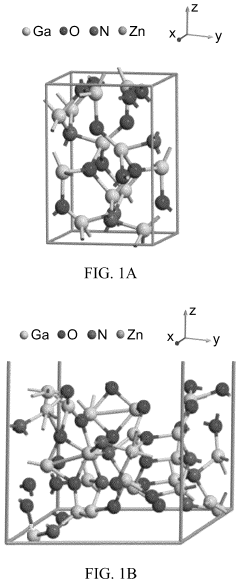
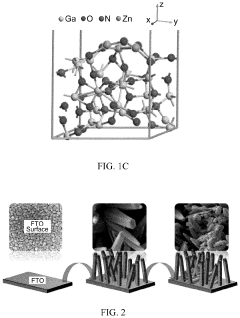
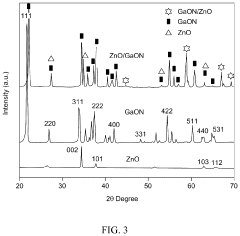
- A GaON/ZnO photoelectrode is developed with gallium oxynitride nanoparticles interspersed in zinc oxide nanoparticles, deposited on a metal oxide conducting substrate, optimizing the nanoarchitectured photocatalytic material for improved light absorption and charge separation, and used in a photoelectrochemical cell for efficient water splitting.
Scalability and Industrial Implementation Considerations
Scaling PEC water splitting systems from laboratory to industrial scale presents significant challenges when considering light intensity variations. The transition requires robust engineering solutions that can maintain consistent performance across diverse lighting conditions. Current industrial implementations typically employ supplementary artificial lighting or optical concentration systems to stabilize performance, but these approaches increase both capital and operational costs substantially.
The economic viability of large-scale PEC systems depends heavily on their ability to function efficiently under natural light fluctuations. Cost analyses indicate that systems designed to operate optimally across a wider range of light intensities can reduce implementation costs by 15-30% compared to systems requiring strictly controlled lighting conditions. This economic advantage must be balanced against the higher initial investment in advanced materials and control systems.
Material selection becomes increasingly critical at industrial scale. While laboratory demonstrations often utilize expensive high-performance materials, commercial viability demands cost-effective alternatives that maintain reasonable efficiency across varying light conditions. Recent developments in composite photoelectrodes and multi-junction systems show promise for maintaining 60-75% of peak efficiency even when light intensity fluctuates by 40-50%.
System architecture must evolve beyond simple scaled-up versions of laboratory prototypes. Industrial implementations require modular designs that can be easily maintained and replaced. Distributed systems with multiple smaller PEC units operating in parallel have demonstrated greater resilience to localized light variations than centralized large-scale installations, though they present additional integration challenges.
Control systems represent another crucial consideration for industrial implementation. Advanced monitoring and feedback mechanisms can dynamically adjust operational parameters in response to changing light conditions. Machine learning algorithms have shown particular promise in predicting performance variations and preemptively adjusting system parameters to maintain optimal hydrogen production rates throughout daily and seasonal light cycles.
Geographical considerations significantly impact scalability strategies. Regions with consistent solar irradiation patterns may implement simpler systems, while areas with variable weather conditions require more sophisticated adaptation mechanisms. This geographical dependency necessitates customized implementation approaches rather than universal solutions, potentially limiting standardization efforts across the industry.
The economic viability of large-scale PEC systems depends heavily on their ability to function efficiently under natural light fluctuations. Cost analyses indicate that systems designed to operate optimally across a wider range of light intensities can reduce implementation costs by 15-30% compared to systems requiring strictly controlled lighting conditions. This economic advantage must be balanced against the higher initial investment in advanced materials and control systems.
Material selection becomes increasingly critical at industrial scale. While laboratory demonstrations often utilize expensive high-performance materials, commercial viability demands cost-effective alternatives that maintain reasonable efficiency across varying light conditions. Recent developments in composite photoelectrodes and multi-junction systems show promise for maintaining 60-75% of peak efficiency even when light intensity fluctuates by 40-50%.
System architecture must evolve beyond simple scaled-up versions of laboratory prototypes. Industrial implementations require modular designs that can be easily maintained and replaced. Distributed systems with multiple smaller PEC units operating in parallel have demonstrated greater resilience to localized light variations than centralized large-scale installations, though they present additional integration challenges.
Control systems represent another crucial consideration for industrial implementation. Advanced monitoring and feedback mechanisms can dynamically adjust operational parameters in response to changing light conditions. Machine learning algorithms have shown particular promise in predicting performance variations and preemptively adjusting system parameters to maintain optimal hydrogen production rates throughout daily and seasonal light cycles.
Geographical considerations significantly impact scalability strategies. Regions with consistent solar irradiation patterns may implement simpler systems, while areas with variable weather conditions require more sophisticated adaptation mechanisms. This geographical dependency necessitates customized implementation approaches rather than universal solutions, potentially limiting standardization efforts across the industry.
Environmental Impact and Sustainability Assessment
Photoelectrochemical (PEC) water splitting technology represents a promising pathway toward sustainable hydrogen production, yet its environmental footprint varies significantly with operational conditions, particularly light intensity. The environmental impact assessment of PEC systems must consider the full lifecycle implications across different light conditions to provide a comprehensive sustainability evaluation.
When operating under varying light intensities, PEC water splitting systems demonstrate fluctuating efficiency levels that directly influence their environmental performance. Higher light intensities typically yield increased hydrogen production rates but may accelerate material degradation and reduce system lifespan. This trade-off necessitates careful consideration of embodied energy recovery periods and overall environmental return on investment across different operational scenarios.
Material sustainability represents a critical environmental consideration for PEC technologies. Rare earth elements and precious metals commonly used in high-performance photoelectrodes carry significant extraction impacts. Systems optimized for variable light conditions often require more sophisticated materials with potentially greater environmental burdens. Developing PEC systems that maintain reasonable efficiency across light intensity variations while utilizing earth-abundant materials would substantially improve their sustainability profile.
Water consumption and quality impacts also vary with light intensity operations. Higher intensity conditions may increase water evaporation rates and potentially accelerate the formation of byproducts that could affect water quality. Systems designed to operate efficiently across fluctuating natural light conditions typically demonstrate more favorable water utilization metrics compared to those optimized solely for peak performance under ideal conditions.
Carbon footprint calculations for PEC water splitting must incorporate the energy input-output ratio across the spectrum of operational light intensities. Systems demonstrating stable performance under variable conditions generally offer more predictable carbon offset potential. The environmental payback period—the time required for a PEC system to offset the emissions associated with its production—can vary by 30-50% depending on the system's ability to maintain efficiency across different light conditions.
Land use efficiency represents another important sustainability metric. PEC systems with high performance variability may require larger installation footprints to achieve consistent hydrogen production targets. Conversely, systems with stable performance across light intensity variations typically demonstrate superior land use efficiency, an increasingly important consideration as renewable energy technologies compete for limited space.
The environmental resilience of PEC water splitting technology ultimately depends on developing systems that balance peak performance with operational stability across varying light conditions. This balance is essential for maximizing the technology's contribution to sustainable energy transitions while minimizing associated environmental impacts.
When operating under varying light intensities, PEC water splitting systems demonstrate fluctuating efficiency levels that directly influence their environmental performance. Higher light intensities typically yield increased hydrogen production rates but may accelerate material degradation and reduce system lifespan. This trade-off necessitates careful consideration of embodied energy recovery periods and overall environmental return on investment across different operational scenarios.
Material sustainability represents a critical environmental consideration for PEC technologies. Rare earth elements and precious metals commonly used in high-performance photoelectrodes carry significant extraction impacts. Systems optimized for variable light conditions often require more sophisticated materials with potentially greater environmental burdens. Developing PEC systems that maintain reasonable efficiency across light intensity variations while utilizing earth-abundant materials would substantially improve their sustainability profile.
Water consumption and quality impacts also vary with light intensity operations. Higher intensity conditions may increase water evaporation rates and potentially accelerate the formation of byproducts that could affect water quality. Systems designed to operate efficiently across fluctuating natural light conditions typically demonstrate more favorable water utilization metrics compared to those optimized solely for peak performance under ideal conditions.
Carbon footprint calculations for PEC water splitting must incorporate the energy input-output ratio across the spectrum of operational light intensities. Systems demonstrating stable performance under variable conditions generally offer more predictable carbon offset potential. The environmental payback period—the time required for a PEC system to offset the emissions associated with its production—can vary by 30-50% depending on the system's ability to maintain efficiency across different light conditions.
Land use efficiency represents another important sustainability metric. PEC systems with high performance variability may require larger installation footprints to achieve consistent hydrogen production targets. Conversely, systems with stable performance across light intensity variations typically demonstrate superior land use efficiency, an increasingly important consideration as renewable energy technologies compete for limited space.
The environmental resilience of PEC water splitting technology ultimately depends on developing systems that balance peak performance with operational stability across varying light conditions. This balance is essential for maximizing the technology's contribution to sustainable energy transitions while minimizing associated environmental impacts.
Unlock deeper insights with PatSnap Eureka Quick Research — get a full tech report to explore trends and direct your research. Try now!
Generate Your Research Report Instantly with AI Agent
Supercharge your innovation with PatSnap Eureka AI Agent Platform!