
Near-infrared response carbon quantum dots/Bi2MoO6 photocatalyst and preparing method thereof
A carbon quantum dot and near-infrared technology, applied in the field of materials science, can solve the problems of easy recombination of photogenerated carriers, narrow spectral response range, inability to use near-infrared light and infrared light, etc., to increase the spectral response range, photocatalytic Effects of performance enhancement, high carrier separation efficiency, and photocatalytic activity
Patent Information
- Authority / Receiving Office
- CN · China
- Patent Type
- Applications(China)
- Current Assignee / Owner
- Publication Date
- 2016-07-20
- Estimated Expiration
- Not applicable · inactive patent
Smart Images
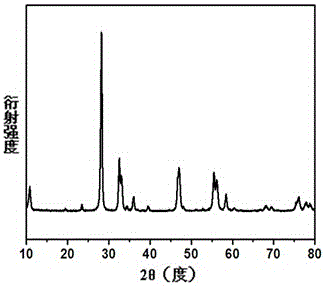
Figure 1 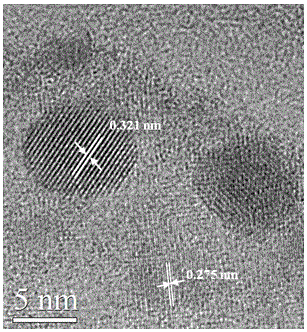
Figure 2 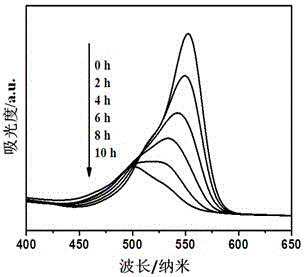
Figure 3
Abstract
Description
technical field
[0001] The invention belongs to the field of materials science, and relates to a photocatalytic material, specifically a near-infrared response carbon quantum dot / Bi 2 MoO 6 Photocatalyst and preparation method. Background technique
[0002] Due to the increasing environmental pollution and energy crisis in the world, the research and application of semiconductor photocatalysis have attracted widespread attention. The core issue of photocatalytic technology is the design, development and development of suitable photocatalysts, especially the research on high-performance photocatalytic materials with wide spectral response has become a top priority. However, most of the currently developed photocatalytic materials can only absorb ultraviolet light or visible light, but cannot utilize near-infrared light and infrared light, which account for 53% of the solar spectrum. In recent years, researchers have discovered that carbon quantum dots (CQDs) have upconvers...
Examples
Embodiment 1
[0029] A CQDs / Bi 2 MoO 6 Composite photocatalyst consisting of 50-100nm nanosheet Bi 2 MoO 6 and 5-10nm carbon quantum dots, and the CQDs nanoparticles are distributed in the nanometer-sized sheet-like Bi 2 MoO 6 Above, calculated by mass percentage, CQDs of nanoparticles: nanometer-sized sheet-like Bi 2 MoO 6 3.2%: 96.8%.
[0030] One of the above CQDs / Bi 2 MoO 6 Composite photocatalyst preparation method specifically comprises the following steps:
[0031] (1), the Bi(NO 3 ) 3 ·5H 2 O is dissolved in nitric acid to obtain Bi(NO 3 ) 3 solution;
[0032] Na 2 MoO4 2H 2 O was dissolved in deionized water to obtain Na at a concentration of 0.05 mol / L 2 MoO 4 solution;
[0033] Then calculated by molar ratio, that is, Bi(NO 3 ) 3 Bi in solution 3+ : Na 2 MoO 4 MoO in solution 4 2- For a ratio of 2:1, the Bi(NO 3 ) 3 solution and Na 2 MoO 4 The solution was mixed evenly to obtain a light yellow suspension;
[0034] (2) Add the CQDs aqueous solution t...
Embodiment 2
[0042] The difference between this embodiment and embodiment 1 is only: CQDs and Bi 2 MoO 6 The mass ratio is 1%: 99%, and all the other contents are identical with those described in Example 1. Known through detection and analysis: the CQDs / Bi obtained by the present embodiment 2 MoO 6 The degradation rate of rhodamine B of the composite photocatalytic material under the same conditions as the composite material obtained in Example 1 was 80.7%.
Embodiment 3
[0044] The difference between this embodiment and embodiment 1 is only: CQDs and Bi 2 MoO 6 The mass ratio is 6%: 94%, and all the other contents are identical with those described in Example 1. Known through detection and analysis: the CQDs / Bi obtained by the present embodiment 2 MoO 6 The degradation rate of rhodamine B of the composite photocatalytic material under the same conditions as the composite material obtained in Example 1 was 76.8%.