Method for predicting pore pressure of carbonate rock stratum

A technology of formation pore pressure and carbonate rock, applied in the field of geological exploration, can solve the problems of irregular longitudinal changes in carbonate rock formation, difficulty in establishing logging seismic response parameters, etc., and solve the difficulty of pore pressure prediction Effect

CN109323954AActive Publication Date: 2019-02-12CHINA UNIV OF GEOSCIENCES (WUHAN)
2 Cites 4 Cited by

Patent Information

Authority / Receiving Office
CN · China
Patent Type
Applications(China)
Current Assignee / Owner
Publication Date
2019-02-12

Smart Images

  • Figure 1
    Figure 1
  • Figure 2
    Figure 2
  • Figure 3
    Figure 3
Patent Text Reader

Abstract

The invention provides a method for predicting pore pressure of a carbonate rock stratum. The method comprises the following steps of firstly, carrying out a rock physical simulation experiment on a rock sample; then utilizing a Voigt-Reuss-Hill average modulus model for calculating the volume modulus of a rock matrix; calculating the volume modulus of a pore fluid by utilizing a Wood model and aPatch model; and calculating the volume modulus of a rock framework according to a rock physical simulation experiment fitting relational expression, and further calculating the pore pressure of the carbonate rock stratum. The beneficial effects of the invention are that: the technical scheme provided by the invention is based on a fluid-containing rock porous elastic mechanical theory and a generalized fenugreek law; starting from analysis of the carbonate rock stratum stress-strain pore pressure constitutive relation, a porous elastic mechanical pore pressure prediction theoretical model forrepresenting the quantitative relation between the pore pressure and the rock elastic parameter is established, so that the problem that the pore pressure is difficult to predict due to the fact thatthe carbonate rock is compact in lithology and extremely uneven is solved, and the method has industrial application value.
Need to check novelty before this filing date? Find Prior Art

Description

technical field

[0001] The invention relates to the field of geological exploration, in particular to a method for predicting pore pressure in carbonate formations. Background technique

[0002] Prediction of pore pressure in carbonate rock formation is an unresolved research problem at home and abroad. In the past, the widely used and effective empirical methods for the prediction of abnormally high pressure in clastic rock formations include: the equivalent depth method using porosity and acoustic logging data, the Eaton( 1972) formula method, using the Fillippone (1979) formula method of seismic layer velocity, the Eberhart-Phillips model (1989) and Bowers model (1989) and Bowers model ( 1995) etc. These methods are based on Terzaghi's effective stress theory, and realize the quantitative evaluation of clastic rock formation pore pressure by establishing the empirical relationship between pore pressure and different response parameters. However, these methods are not s...

Examples

Embodiment Construction

[0033] In order to have a clearer understanding of the technical features, purposes and effects of the present invention, the specific implementation manners of the present invention will now be described in detail with reference to the accompanying drawings.

[0034] Embodiments of the present invention provide a method, device and storage device for predicting pore pressure in a carbonate rock formation.

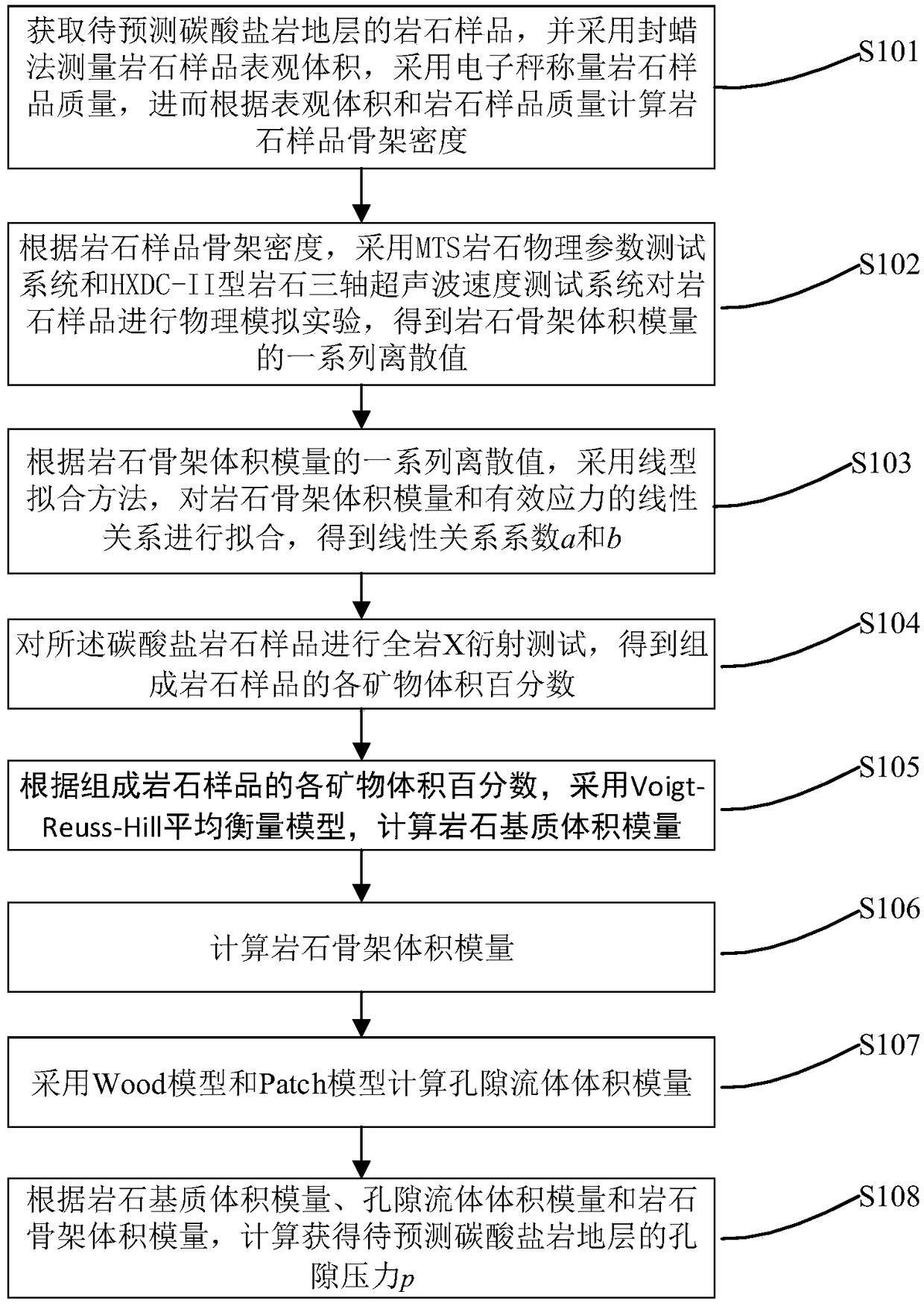
[0035] Please refer to figure 1 , figure 1 It is a flow chart of a method for predicting pore pressure in carbonate formations in an embodiment of the present invention, specifically comprising the following steps:

[0036] S101: Obtain a rock sample of the carbonate formation to be predicted, and calculate the skeleton density of the rock sample;

[0037] S102: According to the skeleton density of the rock sample, use the MTS rock physical parameter testing system and the HXDC-II rock triaxial ultrasonic velocity testing system to conduct a physical simulation experimen...