
Method, device and system for automated synchronization between terminals
- Summary
- Abstract
- Description
- Claims
- Application Information
AI Technical Summary
Benefits of technology
Problems solved by technology
Method used
Image

Examples
example 2
Switching Off
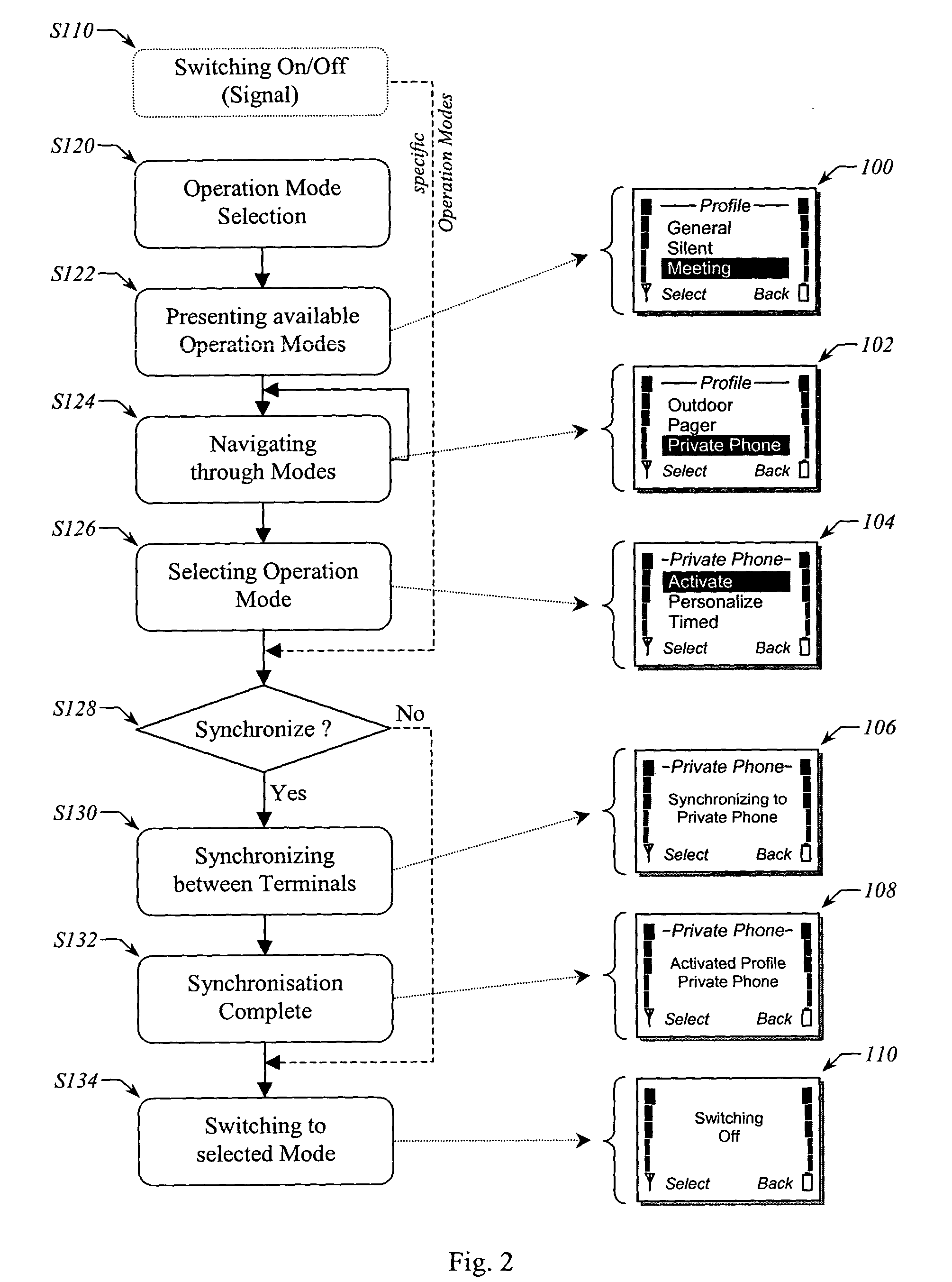
[0078] The present situation is that the user currently operates the business phone and wishes to change use to the private phone. With respect to an embodiment of the invention the switching off mode comprises a command to trigger synchronizing of the above mentioned application related data. In order to initiate the synchronizing operation the user operates the power-on / off key to enter a respective signal instructing the business phone to initiate the shut down process including the operation in accordance with the switching off mode.
[0079] In accordance with the aforementioned operation S110, the operational sequence is continued directly with operation S128 without the presentation of profiles to be selected as described in operations S122 to S126 illustrated by screen content illustrations 100 to 104. Possible status information of the synchronization process can bee seen in screen content illustrations 106 to 110.
[0080] In example 2 the synchronization between th...
example 3
Switching On
[0081] The present situation is that the user currently operates the business phone and wishes to switch in use to the private phone. With respect to an embodiment of the invention the switching on mode comprises a command to trigger synchronizing of the above mentioned application related data. In order to initiate the synchronizing operation the user operates the power-on / off key to enter a respective signal instructing the private phone to initiate the power on process including the operation in accordance with the switching on mode.
[0082] In accordance with the aforementioned operation S110, the operational sequence is continued directly with operation S128 without the presentation of profiles to be selected as described in operations S122 to S126 illustrated by screen content illustrations 100 to 104. Possible status information of the synchronization process are analogously to those depicted in the screen content illustrations 106 and 108.
[0083] After completing of...
PUM
 Login to View More
 Abstract
Description
Claims
Application Information
 Login to View More