
Fluorine-containing acrylate monomer and preparation method and application thereof
A technology of acrylate and monomer, applied in the field of fluorine-containing acrylate monomer and its preparation and application, to achieve the effects of avoiding high persistence and accumulation, convenient operation and simple intermediate process
Patent Information
- Authority / Receiving Office
- CN · China
- Patent Type
- Patents(China)
- Current Assignee / Owner
- Publication Date
- 2012-12-12
Smart Images
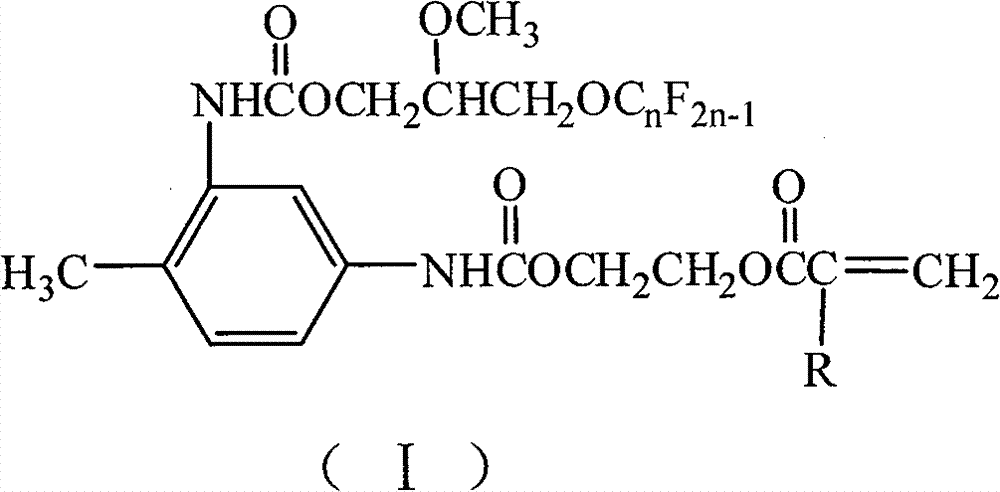
Figure 1 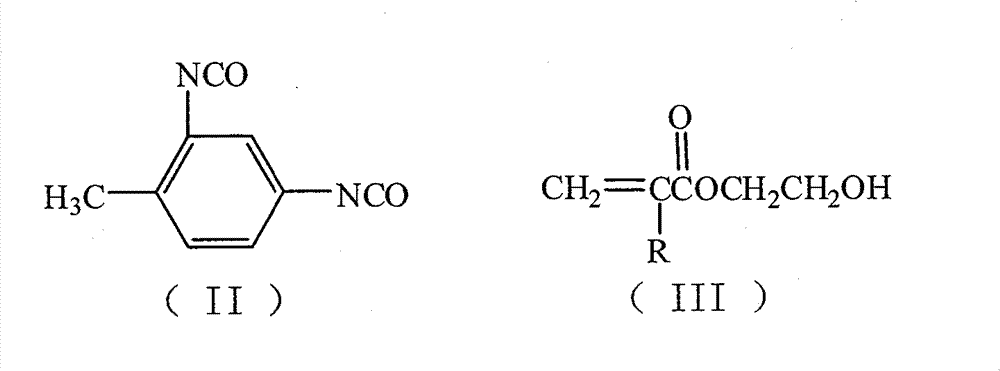
Figure 2 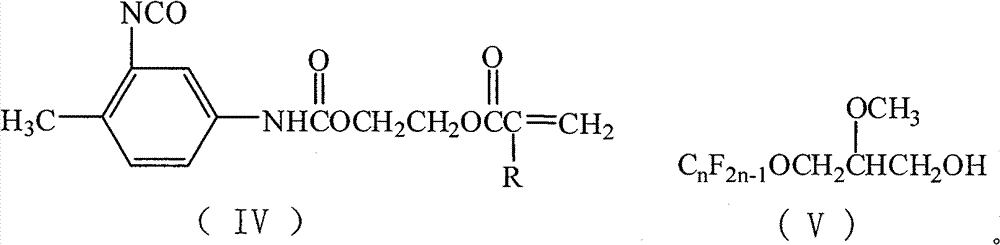
Figure 3
Abstract
Description
(1) Technical field
[0001] The invention relates to a fluorine-containing acrylate monomer, a preparation method and application thereof. (2) Background technology
[0002] Polymer surfactants usually refer to substances with a relative molecular mass of more than several thousand and significant surface activity. They have a long history of application, and some natural polymers have been used as polymer surfactants [Leather Science and Engineering, 2004, 14(6):24-30]. Compared with low-molecular-weight surfactants, polymer surfactants have the advantages of poor permeability, good film-forming properties, low or no toxicity, environmental friendliness, good dispersion, emulsification, and stability [Chemical Progress, 2005, 17(1 ): 151-156]. The introduction of fluorine atoms into polymer surfactants produces polymer fluorine-containing surfactants. Polymer fluorine-containing surfactants not only have the excellent performance of polymer surfactants, but also have the "...
Examples
Embodiment 1
[0024] Add 50 mL of 1,2-dichloroethane, 17.4 g (0.1 mol) of 2,4-TDI, 1.9 g (0.008 mol) of tetraethyltin, and 0.5 g of hydroquinone into a 250 mL four-necked flask as a polymerization inhibitor. Stir, heat up to 75°C, add 13.0 g (0.1 mol) of hydroxyethyl methacrylate dropwise, after the dropwise addition, TLC detection, follow the reaction progress, keep the temperature and stir for 4 hours. 53.6 g (0.1 mol) of 2-methoxy-3-perfluorononenyloxypropanol was added dropwise. After the dropwise addition was completed, TLC detection was carried out to track the reaction progress, and the reaction was carried out while maintaining the temperature and stirring for 5 h. The reaction is completed, distillation and desolvation, silica gel column chromatography separation (V 环己烷 :V 乙酸乙酯 = 7: 3), the yellow paste I was obtained after removing the solvent 1 (n=9, R is CH 3 ), yield 66.0%, purity 99.8%.
[0025] FT-IR (cm -1): 3324, 2957, 2927, 1709, 1601, 1530, 1276, 1196, 1159, 1080, 80...
Embodiment 2
[0029] React according to the method of Example 1, but 2-methoxyl-3-perfluorononenyloxypropanol is changed to 2-methoxyl-3-perfluorohexenyloxypropanol 38.6g (0.1mol), Other conditions are identical with embodiment 1, obtain pale yellow paste I 2 (n=6, R is CH 3 ), yield 70.1%, purity 99.7%.
[0030] 19 F NMRδ(CDCl 3 ): -129.4(t, 3F), -127.4(s, 3F), -121.6(m, 2F), -83.3(s, 2F), -78.1(t, 1F).
Embodiment 3
[0032] Carry out reaction according to embodiment 1 method, but hydroxyethyl methacrylate is changed into hydroxyethyl acrylate 11.6g (0.1mol), other conditions are identical with embodiment 1, obtain yellow paste I 3 (n=9, R is H), the yield is 69.9%, and the purity is 99.4%.
[0033] 1 H NMRδ(CDCl 3 ): 7.82(s, 1H), 7.21(s, 1H), 7.11(d, 1H), 6.80(s, 1H), 6.50(s, 1H), 6.25(s, 1H), 6.10(s, 1H) , 5.60(s, 1H), 5.08(m, 1H), 4.40(m, 4H), 4.19(m, 2H), 3.60(m, 2H), 3.40(s, 3H), 2.10(s, 3H).