
Synthesis method of chiral cis-bromo.ammine.bis(ethylenediamine) cobalt bromide
A synthesis method, ethylenediamine technology, applied in organic chemistry methods, chemical instruments and methods, asymmetric synthesis, etc., can solve problems such as chiral symmetry breaking, and achieve easy storage, good safety, and easy control Effect
Patent Information
- Authority / Receiving Office
- CN · China
- Current Assignee / Owner
- Publication Date
- 2011-02-09
- Estimated Expiration
- Not applicable · inactive patent
Smart Images
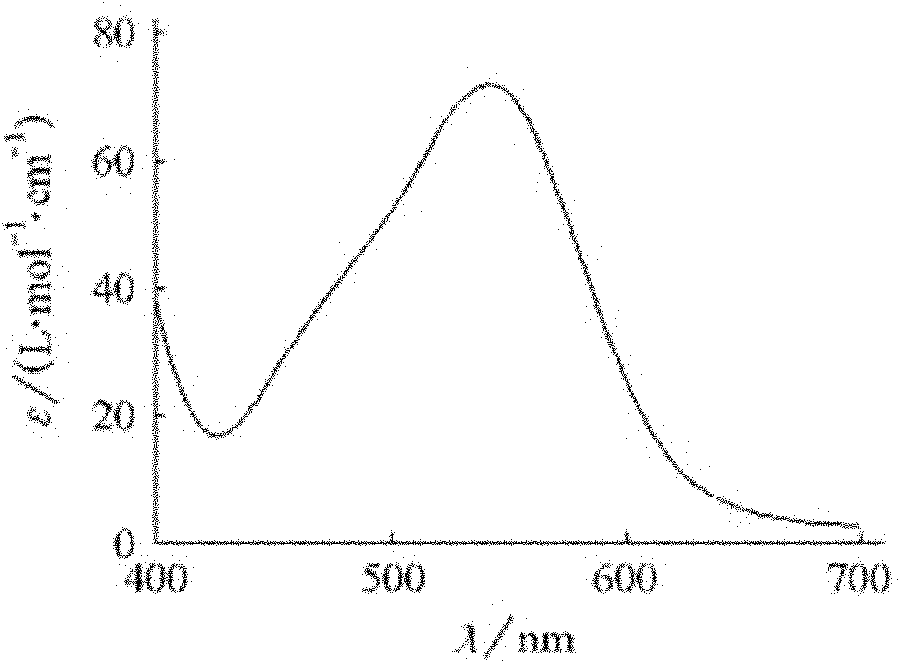
Figure 1 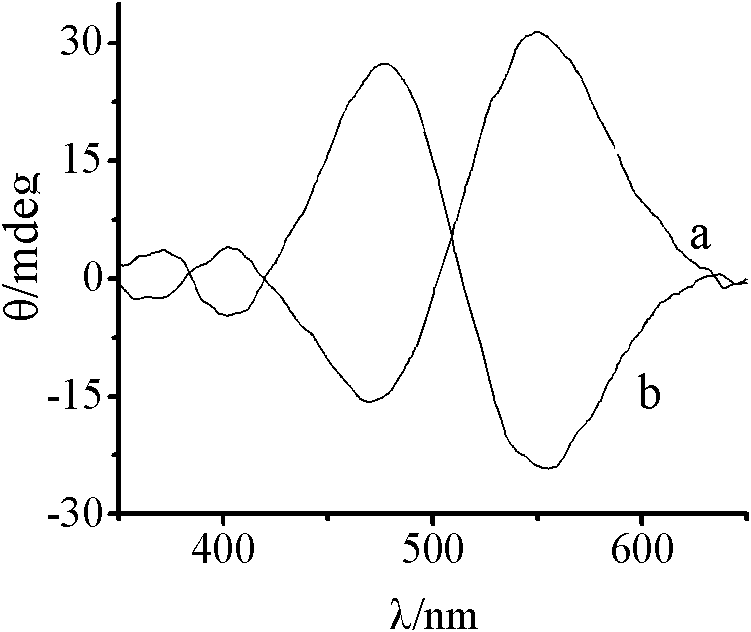
Figure 2 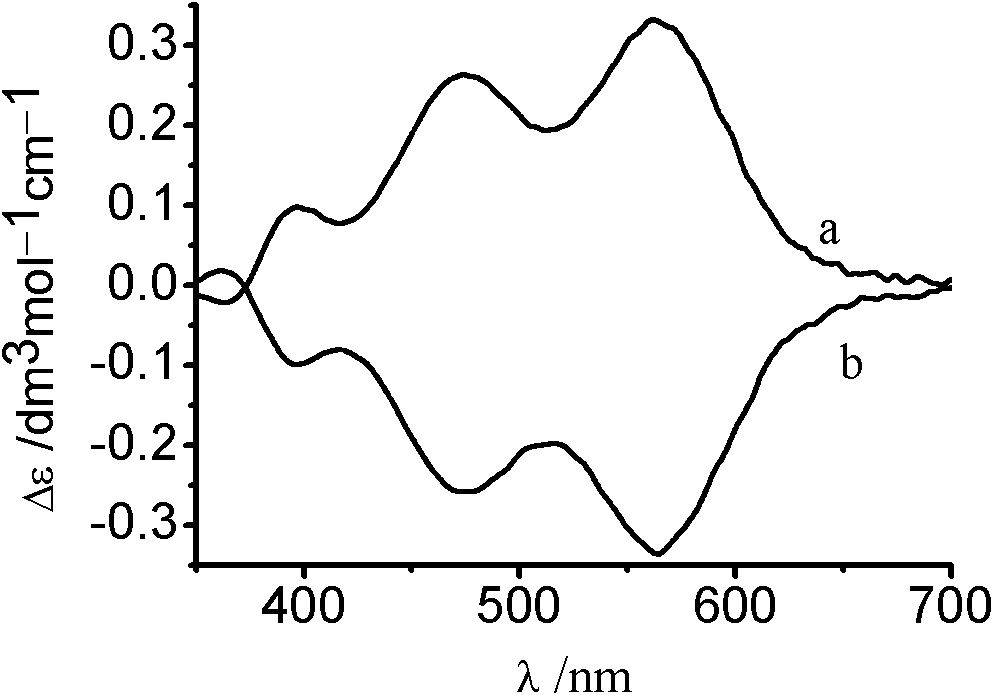
Figure 3
Abstract
Description
technical field
[0001] The invention relates to a synthesis method of chiral brominated cis-bromo·ammonia·bis(ethylene di)cobalt with high enantiopurity. Background technique
[0002] Absolutely asymmetric synthesis is a phenomenon of spontaneous symmetry breaking (Zhang Hui, Wang Xianying, Chen Leiqi, Fang Xueming, Gao Jingxing, Xu Zhigu. Acta Physicochemical Sinica, 2006, 22(5): 609-616), it refers to the In an achiral environment, the process of converting an achiral raw material into a chiral product. However, the result of this spontaneous symmetry breaking is difficult to predict, because the small enantiomeric excess (ee value) randomly generated in the system may achieve nonlinear amplification through a certain mechanism (Kondepudi, D.K.; Asakura, K.Acc .Chem.Res., 2001, 34(12):946-954), finally forming a product with a single chiral configuration. In 1990, Asakura et al. (K.Asakura, K.Kobayashi, Y.Mizusawa, et al.Physica.D., 1995, 84, 72-74) accidentally discover...
Examples
Embodiment 1
[0019] Will [Co(H 2 O) 2 {(μ-OH) 2 Co(en) 2} 2 ](SO 4 ) 2 ·7H 2 O (0.72g), NH 4 Br (2g) and 2g of water were mixed and stirred magnetically for 1min to form a suspension, and 0.0036gΛ-cis-[CoBr(NH 3 )(en) 2 ]Br 2 variety, then heated in a 50°C water bath and stirred for 5 minutes, and kept in a refrigerator (4°C) for more than 20 hours after cooling to obtain more crystals. The precipitated red-purple crystalline solid was filtered and washed successively with ethanol and ether to remove ammonium bromide and other by-products until no turbid liquid was washed out. The crude product was recrystallized with a minimum amount of 5% hydrobromic acid solution, and the saturated solution was left to crystallize at room temperature to obtain the compound Λ-cis-[CoBr(NH 3 )(en) 2 ]Br 2 . Yield 61.8%, Δε=0.354.
Embodiment 2
[0021] Will [Co(H 2 O) 2 {(μ-OH) 2 Co(en) 2} 2 ](SO 4 ) 2 ·7H 2 O (0.72g), NH 4 Br (2g) and 2g of water were mixed and stirred magnetically for 1min to form a suspension, and 0.0036g of Δ-cis-[CoBr(NH 3 )(en) 2 ]Br 2 variety, then heated in a 50°C water bath and stirred for 5 minutes, and kept in a refrigerator (4°C) for more than 20 hours after cooling to obtain more crystals. The precipitated red-purple crystalline solid was filtered and washed successively with ethanol and ether to remove ammonium bromide and other by-products until no turbid liquid was washed out. The crude product was recrystallized with a minimum amount of 5% hydrobromic acid solution, and the saturated solution was left to crystallize at room temperature to obtain a compound Δ-cis-[CoBr(NH 3 )(en) 2 ]Br 2. Yield 60.4%, Δε=-0.347.
Embodiment 3
[0023] Will [Co(H 2 O) 2 {(μ-OH) 2 Co(en) 2} 2 ](SO 4 ) 2 ·7H 2 O (2.14g), NH 4 Br (6.86g) and 6.8g of water were mixed and stirred magnetically for 1min to form a suspension, and 0.0107g of Δ-cis-[CoBr(NH 3 )(en) 2 ]Br 2 variety, then heated in a 50°C water bath and stirred for 5 minutes, and kept in a refrigerator (4°C) for more than 20 hours after cooling to obtain more crystals. The precipitated red-purple crystalline solid was filtered and washed successively with ethanol and ether to remove ammonium bromide and other by-products until no turbid liquid was washed out. The crude product was recrystallized with a minimum amount of 5% hydrobromic acid solution, and the saturated solution was left to crystallize at room temperature to obtain a compound Δ-cis-[CoBr(NH 3 )(en) 2 ]Br 2 . Yield 50.6%, Δε=-0.327.