
Outer surface damage repair technology for shaft parts
A technology for shaft parts and damage repair, applied in the field of surface damage repair, can solve problems such as insufficient bonding force, delamination, and inability to plate iron, etc., to achieve the effects of solving insufficient bonding force, reducing costs, and increasing thickness
Patent Information
- Authority / Receiving Office
- CN · China
- Current Assignee / Owner
- Publication Date
- 2013-02-20
- Estimated Expiration
- Not applicable · inactive patent
Smart Images
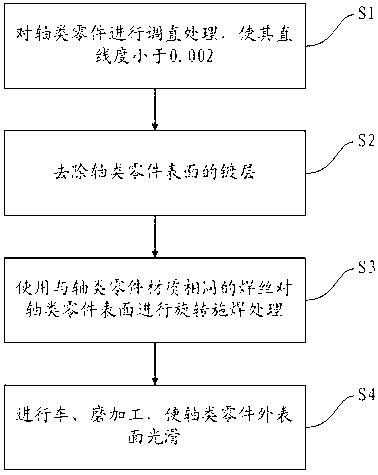
Figure 1 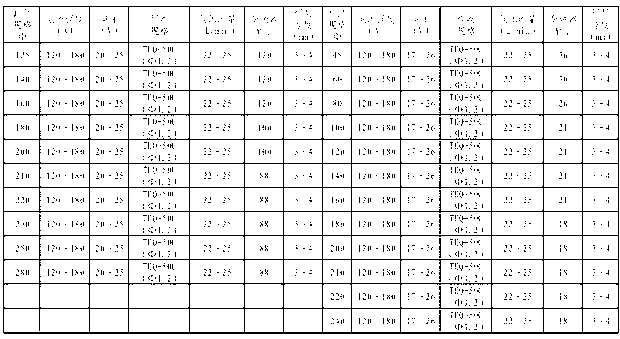
Figure 2
Abstract
Description
technical field
[0001] The invention relates to a technology for repairing surface damage, in particular to a technology for repairing damage on the outer surface of shaft parts. Background technique
[0002] Damage to the outer surface of the piston rod or shaft cylinder mainly includes scratches, wear, and rust. When the damage condition does not meet the requirements of use, it needs to be repaired on the surface. At present, the measures adopted are: the repair of the outer surface by iron plating process, but this iron plating repair process has a certain requirement for the thickness of the coating, and the thickness exceeds 1mm. It cannot be plated with iron. Generally speaking, the defects of the iron plating process are: 1. The coating is deposited on the surface of the substrate, the bonding force is insufficient, and it is easy to produce peeling, delamination, etc., and the thicker the coating is, the more obvious the defects are; 2. The material of the iron pla...
Examples
Embodiment Construction
[0016] The present invention will be described in further detail below in conjunction with the accompanying drawings and specific embodiments.
[0017] refer to figure 1 As shown, the present invention provides a process for repairing damage to the outer surface of shaft parts, which includes the following steps:
[0018] S1. Use a press or other straightening equipment to straighten the shaft parts so that the straightness is less than 0.002;
[0019] S2. Use turning and grinding to remove the coating on the surface of shaft parts;
[0020] S3. Use the welding wire with the same material as the shaft parts, and use carbon dioxide gas shielded welding to perform rotary welding on the surface of the shaft parts, so that the thickness of the welding layer is about 3 to 4 mm;
[0021] S4. Perform turning and grinding processing to make the outer surface of the shaft parts smooth.
[0022] The following table 1 is a preferred fusion welding technical parameter table obtained fr...