
Organic-inorganic hybridization transition-rare earth dissimilar metal substituted germanium tungstate crystal hydrogen storage material and preparation method thereof
A technology of germanium tungstate and hydrogen storage materials, which is applied in chemical instruments and methods, other chemical processes, hydrogen production, etc., can solve problems that have not been reported, and achieve a clear structure, improved stability, and simple preparation methods Effect
Patent Information
- Authority / Receiving Office
- CN · China
- Patent Type
- Patents(China)
- Current Assignee / Owner
- Publication Date
- 2014-04-16
- Estimated Expiration
- Not applicable · inactive patent
Smart Images
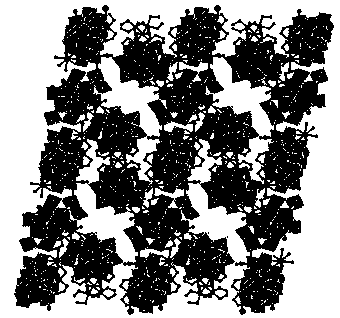
Figure 1 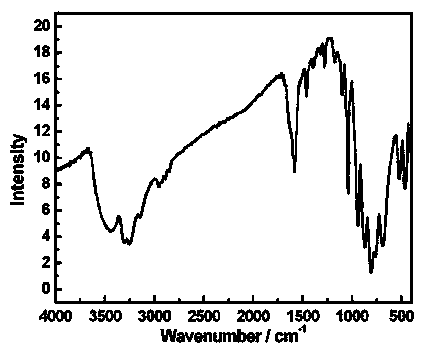
Figure 2 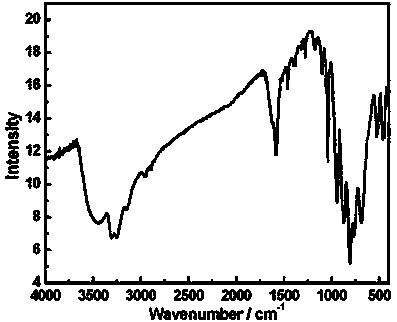
Figure 3
Abstract
Description
technical field
[0001] The invention belongs to the technical field of preparation of new chemical materials, and specifically relates to an organic-inorganic hybrid transition-rare earth heterometallic substituted germanium tungstate crystalline hydrogen storage material and a preparation method thereof. The material utilizes rare earth ions, transition metal ions, organic The ligand is prepared by reacting with vacant Keggin germanium tungstate under hydrothermal conditions. Background technique
[0002] Polyoxometalates are a class of compounds with remarkable structural characteristics formed by the connection of early transition metal ions through oxygen atoms. In terms of composition, the framework elements of polyoxometalates are usually some high-valence pre-transition metal ions, such as Mo(VI), W(VI), V(V), Nb(V) and Ta(V). Structurally speaking, the basic unit of polyoxometalates is mainly MO 6 Octahedral (M generally represents metal ion) and XO 4 Tetrahedra (...
Examples
Embodiment 1
[0035] Example 1: Na 3 h 7 [Cu(en) 2 ] 5 [Cu(en) 2 (H 2 O)] 2 [(α-GeW 11 o 39 Gd) 2 (α-GeW 11 o 39 Gd(H 2 O))
[0036] (α-GeW 11 o 39 Gd (H 2 O) 2 ) (WO 4 ) 2 ]·13H 2 Preparation of O crystalline hydrogen storage materials:
[0037] 1) Synthesize the required triple-deficient germanium tungstate precursor K according to the literature method 8 Na 2 [A-α-GeW 9 o 34 ]·25H 2 O, see L. H. Bi, U. Kortz, S. Nellutla, A. C. Stowe, J. van Tol, N. S. Dalal, B. Keita, L. Nadjo, Inorg. Chem. 2005, 44, 896);
[0038] 2) 3.62 g (0.01 mol) rare earth oxide Gd 2 o 3 Dissolve in 6.70 mL, 12 mol L under heating –1 Concentrated hydrochloric acid (0.08mol), and then heated and evaporated to dryness at 80°C (about 40 min) to obtain anhydrous GdCl 3 , cooled and sealed for storage;
[0039] 3) Under stirring conditions, 330mg (0.107mmol) K 8 Na 2 [A-α-GeW 9 o 34 ]·25H 2 O, 68 mg (0.399 mmol) CuCl 2 2H 2 O, 68 mg (0.258 mmol) GdCl 3 and 0.1mL (1.480mmol) of e...
Embodiment 2
[0040] Example 2: Na 3 h 7 [Cu(en) 2 ] 5 [Cu(en) 2 (H 2 O)] 2 [(α-GeW 11 o 39 Gd) 2 (α-GeW 11 o 39 Gd(H 2 O))
[0041] (α-GeW 11 o 39 Gd (H 2 O) 2 ) (WO 4 ) 2 ]·13H 2 Preparation of O crystalline hydrogen storage materials:
[0042] 1) Synthesize the required triple-deficient germanium tungstate precursor K according to the literature method 8 Na 2 [A-α-GeW 9 o 34 ]·25H 2 O, see L. H. Bi, U. Kortz, S. Nellutla, A. C. Stowe, J. van Tol, N. S. Dalal, B. Keita, L. Nadjo, Inorg. Chem. 2005, 44, 896);
[0043] 2) 3.62 g (0.01 mol) rare earth oxide Gd 2 o 3 Dissolve in 6.70 mL, 12 mol L under heating –1 Concentrated hydrochloric acid (0.08mol), then heated and evaporated to dryness at 90°C to obtain anhydrous GdCl 3 , cooled and sealed for storage;
[0044] 3) Under stirring conditions, 330mg (0.107mmol) K 8 Na 2 [A-α-GeW 9 o 34 ]·25H 2 O, 68 mg (0.399 mmol) CuCl 2 2H 2 O, 68 mg (0.258 mmol) GdCl 3 and 0.05mL (0.740mmol) of ethylenediamine wer...
Embodiment 3
[0045] Example 3: Na 3 h 7 [Cu(en) 2 ] 5 [Cu(en) 2 (H2 O)] 2 [(α-GeW 11 o 39 Y) 2 (α-GeW 11 o 39 Y(H 2 O))(α-GeW 11 o 39 Y (H 2 O) 2 ) (WO 4 ) 2 ]·13H 2 Preparation of O crystalline hydrogen storage materials:
[0046] 1) Synthesize the required triple-deficient germanium tungstate precursor K according to the literature method 8 Na 2 [A-α-GeW 9 o 34 ]·25H 2 O, see L. H. Bi, U. Kortz, S. Nellutla, A. C. Stowe, J. van Tol, N. S. Dalal, B. Keita, L. Nadjo, Inorg. Chem. 2005, 44, 896);
[0047] 2) 2.26 g (0.01 mol) rare earth oxide Y 2 o 3 Dissolve in 6.70 mL, 12 mol L under heating –1 Concentrated hydrochloric acid (0.08mol), and then heated and evaporated to dryness at 80°C (about 30min) to obtain anhydrous YCl 3 , cooled and sealed for storage;
[0048] 3) Under stirring conditions, 431mg (0.140mmol) K 8 Na 2 [A-α-GeW 9 o 34 ]·25H 2 O, 63 mg (0.370 mmol) CuCl 2 2H 2 O, 98mg (0.502mmol) YCl 3 and 0.1mL (1.480mmol) of ethylenediamine were ad...