
Cement paste microcosmic digital model generating algorithm
A technology of cement paste and microscopic model, applied in the direction of electrical digital data processing, calculation, special data processing applications, etc., can solve the problems of ignoring the internal relationship of concrete, and achieve the effect of improving recognition efficiency and improving recognition efficiency
Patent Information
- Authority / Receiving Office
- CN · China
- Current Assignee / Owner
- Publication Date
- 2013-12-04
Smart Images
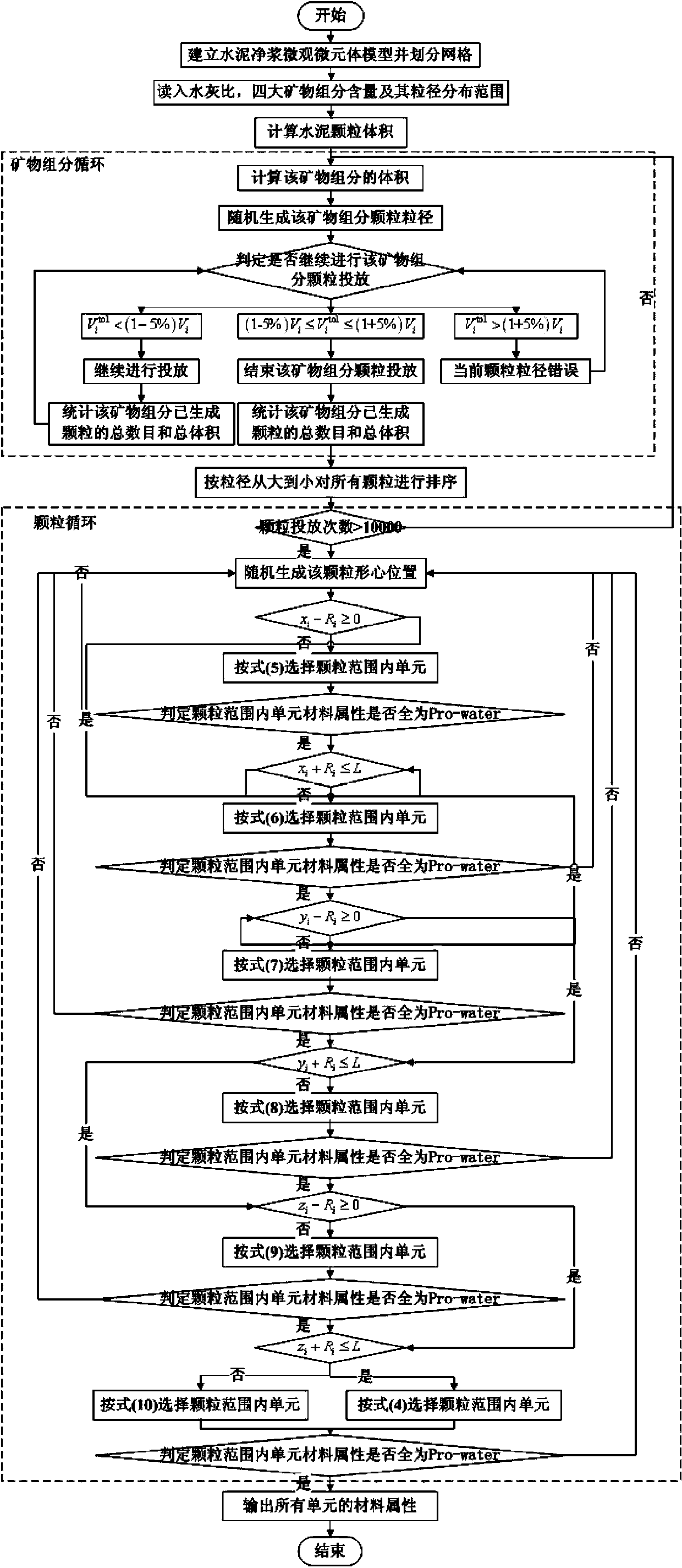
Figure 1 
Figure 2 
Figure 3
Abstract
Description
technical field
[0001] The invention belongs to the technical field of concrete microscopic digital test pretreatment, and specifically relates to a concrete microscopic model generation algorithm based on a cyclic boundary and area-occupied elimination method, and the generated model can be used for numerical simulation of the concrete hydration process. Background technique
[0002] Concrete is a heterogeneous material with multiple phases and scales. It is composed of cement particles as small as microns and coarse aggregates of several centimeters and tens of centimeters. The internal structure is very complex. During the hydration process, nanoscale calcium silicate hydrate gels and pores between colloidal particles will be generated inside the concrete, and the above three phases of solid, liquid and gas coexist in the cement-based material and are distributed in a disordered state. Traditional research idealizes concrete as a homogeneous continuum, ignoring the intrin...
Examples
Embodiment Construction
[0057] The present invention will be further described below in combination with specific embodiments.
[0058] The main step flow chart of the present invention is as figure 1 Shown, the specific implementation method of the present invention is illustrated below in conjunction with the accompanying drawings:
[0059] Step 1, the establishment of a side length of L μm cement slurry microscopic cube model, the unit grid size is equal to 1 μm;
[0060] Step 2, read in the water-cement ratio of the simulated cement slurry, the content of the four major mineral components and their particle size distribution;
[0061] Step 3, calculate cement particle volume by formula (1);
[0062] Step 4, cycle through the four types of mineral components, and calculate the volume V of the mineral components i , and generate the particle size of each particle of the mineral component in turn according to its particle size distribution requirements (unit μm, rounded):
[0063] Step 5, determ...