
Coal tar and residuum hydrocracking-delayed coking combination processing method
A delayed coking and hydrocracking technology, which is applied in the fields of hydrotreating process, hydrocarbon oil treatment, petroleum industry, etc., can solve the problems of high yield of light oil, low yield of light oil, low conversion rate, etc., and achieve Improve the conversion rate, increase the yield of light oil, and reduce the effect of coking
Patent Information
- Authority / Receiving Office
- CN · China
- Patent Type
- Applications(China)
- Current Assignee / Owner
- Publication Date
- 2014-05-07
Smart Images
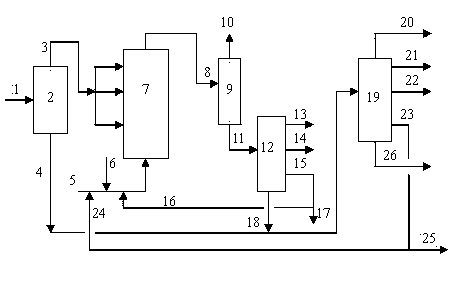
Figure 1
Abstract
Description
technical field
[0001] The invention relates to a coal tar and residual oil combined treatment process, in particular to a coal tar and residual oil hydrocracking-delayed coking combined treatment process. Background technique
[0002] With the rapid development of the global economy, the demand for clean fuel oil is increasing. But at present, most of the main oil fields in the world's major oil-producing countries have entered the middle and late stages of development. The quality of crude oil is getting worse and worse, and the quality of corresponding residual oil is also getting worse. How to effectively use these residual oils, especially low-quality residual oils, to realize It is currently an important issue to produce as much light oil as possible to meet the growing demand.
[0003] On the other hand, as the proportion of conventional resources such as light crude oil decreases, the proportion of unconventional resources such as coal tar begins to increase. Coal t...
Examples
Embodiment 1
[0035] The dry point of light coal tar in the raw materials used in the test is 485°C, and the ratio of residual oil to light coal tar is 5:1. The test process is as follows figure 1 shown. Ebullated bed reactor hydrocracking catalyst A tungsten-nickel catalyst supported by alumina, wherein the catalyst contains 6wt% nickel (calculated as NiO) and 12wt% tungsten (calculated as WO 3 calculate). Catalyst particle diameter is 0.5mm, bulk density is 0.79g / cm 3 , the specific surface area is 260m 2 / g. The reaction conditions, product distribution and product properties are shown in Table 2-Table 5. Vacuum gas oil and coking gas oil are partly recycled back to the ebullating bed reactor with a circulation ratio of 0.1.
Embodiment 2
[0037] The ratio of residual oil and light coal tar in the raw material properties used in the test is 1:1, and the test process is as follows: figure 1 shown. Ebullated bed reactor hydrocracking catalyst A tungsten-nickel catalyst supported by alumina, wherein the catalyst contains 6wt% nickel (calculated as NiO) and 12wt% tungsten (calculated as WO 3 calculate). Catalyst particle diameter is 0.5mm, bulk density is 0.79g / cm 3 , the specific surface area is 260m 2 / g. The reaction conditions, product distribution and product properties are shown in Table 2-Table 5. Vacuum gas oil and coking gas oil are partly recycled back to the ebullating bed reactor with a circulation ratio of 0.15.