
Efficient particle filter based track before detect (EPF-TBD) method based on object existence probability slope
An EPF-TBD and target technology, applied in the field of tracking before detection based on particle filter, can solve the problems of missed detection and false alarm, achieve better detection performance and alleviate the problems of missed detection and false alarm
Patent Information
- Authority / Receiving Office
- CN · China
- Current Assignee / Owner
- Publication Date
- 2015-11-18
- Estimated Expiration
- Not applicable · inactive patent
Smart Images
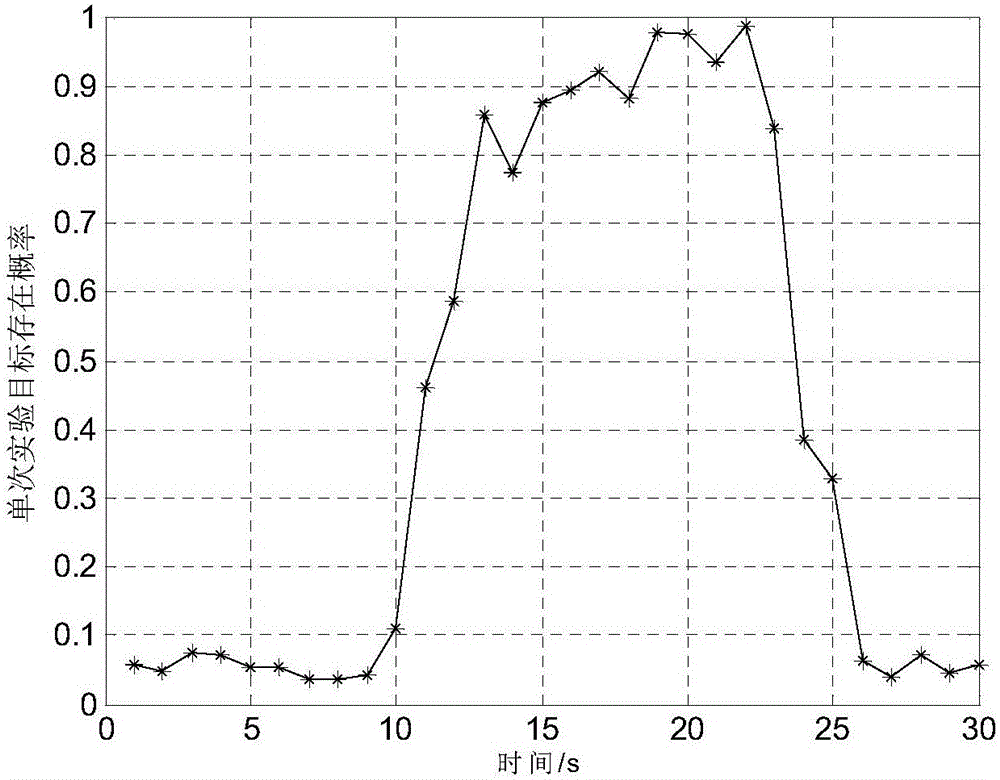
Figure 1 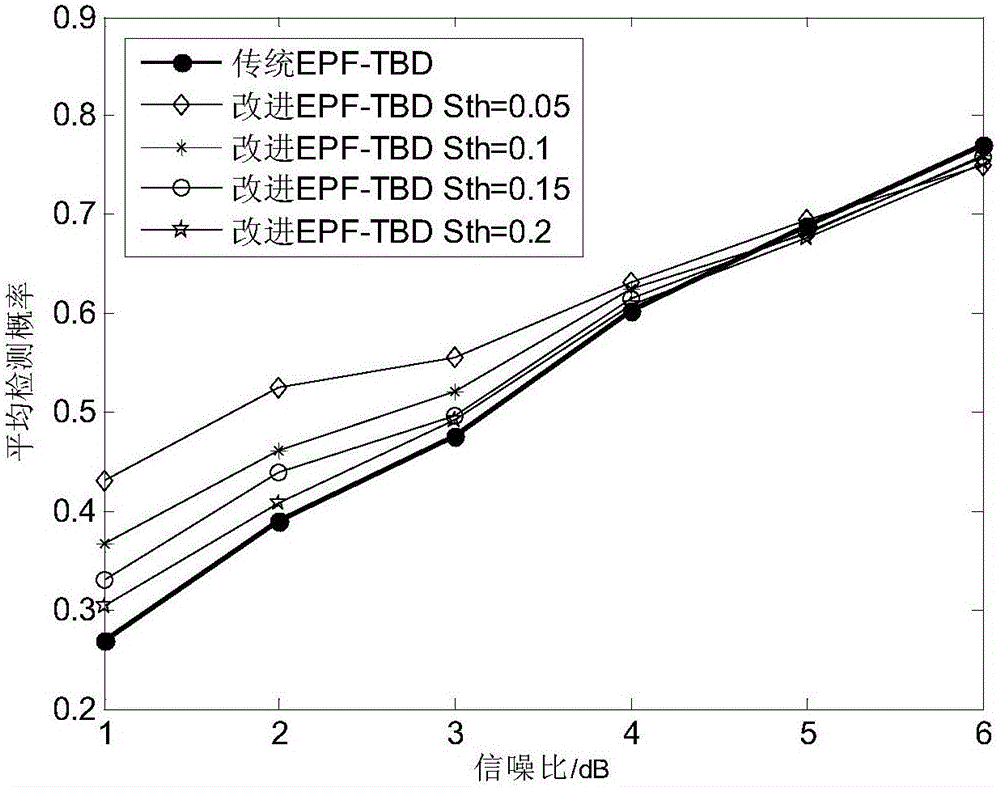
Figure 2 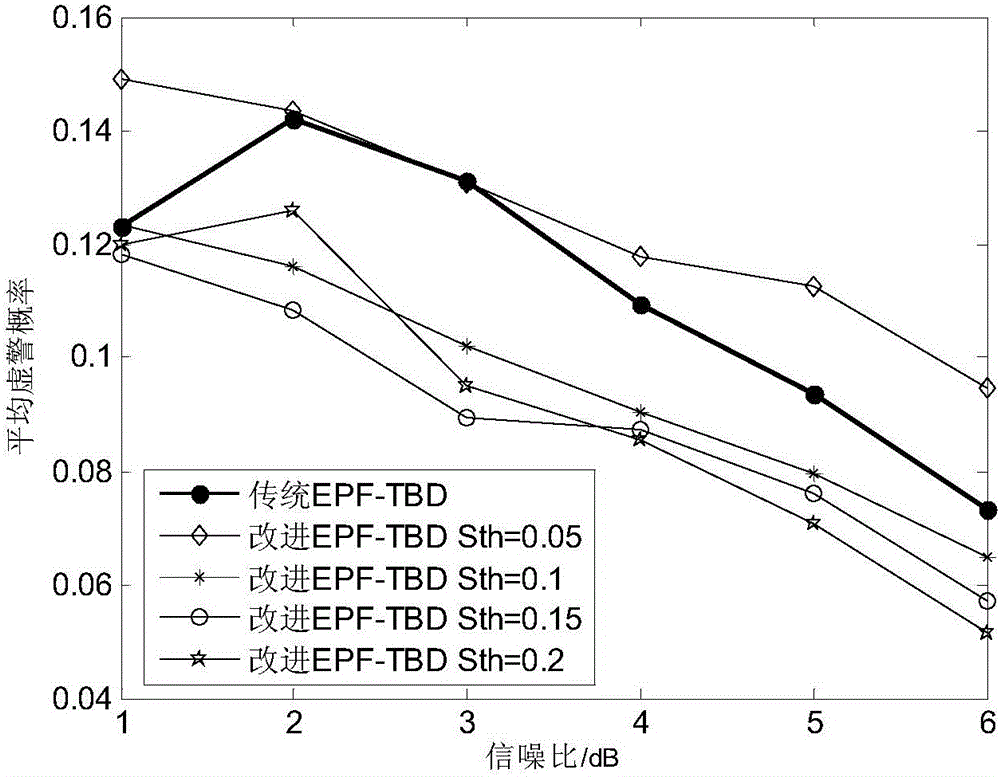
Figure 3
Abstract
Description
technical field
[0001] The invention belongs to the technical field of communication radar, in particular to a particle filter-based tracking-before-detection technology in tracking-before-detection under low signal-to-noise ratio. Background technique
[0002] In modern warfare, in order to detect enemy targets as early as possible and gain reaction time for the rear command and defense systems, radars are required to monitor targets at long distances, such as sky-wave over-the-horizon radar, long-distance infrared search and tracking systems, etc. In this application scenario, noise and clutter are often quite complex due to special radar echo characteristics, making the signal-to-noise ratio of the surveillance target very low. The Track before detect (TBD) algorithm accumulates multiple frames of data and then performs detection and judgment according to certain rules. When the target is detected, the tracking result can be given at the same time, which can well solve th...
Examples
Embodiment
[0064] Here, the infrared sensor is used for observation, assuming that the sampling period of the infrared sensor is T=1s, and the target motion track is set as: the real initial state of the target is x 0 =(4.2,0.45,7.2,0.25,20), the target appears in the 7th second, moves in a straight line at a uniform speed until the 23rd second, and then disappears. The target appears for a total of 16s, and the sensor continues to observe for 30s.
[0065] The sensor generates a frame at each moment containing n x ×m y Two-dimensional image of the entire observation area of resolution units (pixels) [38] . Among them, each resolution unit (i,j), i=1,...,n x , j=1,...,m y corresponding to a △ x ×△ y rectangular area. Therefore, the sensor observation at time k can obtain n x ×m y Intensity observation data, the observation sequence is:
[0066] z k = { z k ( ...