
Self-healing polyurethane resin containing disulfide bond and preparation method thereof
The technology of polyurethane resin and disulfide bond is applied in the field of self-healing polyurethane resin and its preparation, which can solve the problems of long healing time, high temperature and long time required for healing, and achieves fast healing speed, easy acquisition and low cost. Effect
Patent Information
- Authority / Receiving Office
- CN · China
- Patent Type
- Applications(China)
- Current Assignee / Owner
- Publication Date
- 2016-04-13
- Estimated Expiration
- Not applicable · inactive patent
Smart Images
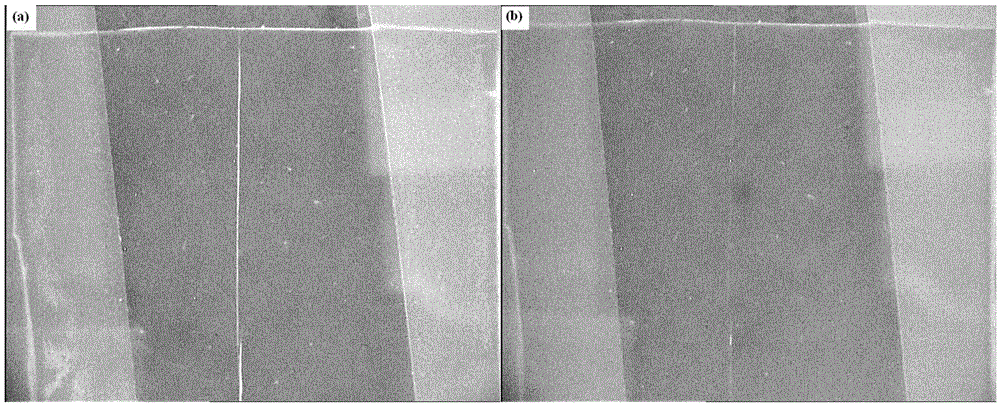
Figure 1 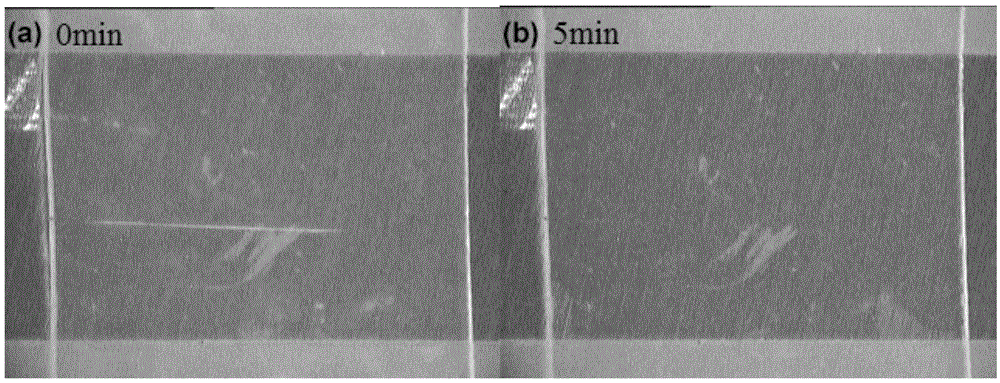
Figure 2
Abstract
Description
technical field
[0001] The invention belongs to the field of polyurethane resin and its preparation, in particular to a self-healing polyurethane resin containing disulfide bonds and its preparation method. Background technique
[0002] Like most polymer materials, polyurethane materials are inevitably vulnerable to external mechanical damage during use, which shortens their service life and greatly increases the maintenance and replacement costs of materials. To solve this problem, making polyurethane materials have self-healing ability is a very effective solution.
[0003] At present, there have been reports on self-healing polyurethane materials (Liu Xuanxuan. Research on self-healing linear polyurethane based on thermoreversible Diels-Alder reaction [D]. Shanghai: Shanghai Jiaotong University, 2013; JunLing, MinZhiRong, MingQiuZhang, Photo- stimulatedself-healingpolyurethanecontainingdihydroxylcoumarinderivatives[J].Polymer,2012,53,2691-2698;BiswajitGhosh,MarekW.Urban,...
Examples
Embodiment 1
[0029]Preparation of self-healing polyurethane resin: In parts by weight, add 23.4 parts of polytetrahydrofuran diol (Mn~1810) into a three-necked flask, stir and heat to 110°C, vacuumize and keep the vacuum of the reaction system at 0.08MPa Above, dehydrate for 2 hours, then lower the temperature to 70°C, add 4.6 parts of hexamethylene diisocyanate and 0.2 parts of dibutyltin dilaurate, continue to stir and react at 70°C under nitrogen protection for 2 hours, then cool down to 25°C , dropwise add a mixed solution of 2 parts of 2-hydroxyethyl disulfide and 70 parts of dimethylacetamide, continue to react for 2 hours under the protection of nitrogen, vacuum defoaming after completion, to obtain a mass fraction of 30% Polyurethane resin solution.
[0030] Preparation of self-healing polyurethane film: coating the obtained polyurethane resin solution on a glass plate, and heating in vacuum at 50° C. for 12 hours to obtain a polyurethane film with self-healing function.
[0031] ...
Embodiment 2
[0038] Preparation of self-healing polyurethane resin: In parts by weight, add 20.5 parts of polytetrahydrofuran diol (Mn~1810) into a three-necked flask, stir and heat to 110°C, vacuumize and keep the vacuum of the reaction system at 0.08MPa Above, dehydrate for 2 hours, then lower the temperature to 70°C, add 5.9 parts of hexamethylene diisocyanate and 0.2 parts of dibutyltin dilaurate, continue to stir and react at 70°C under nitrogen protection for 2 hours, then cool down to 25°C , dropwise add a mixed solution of 3.5 parts of 2-hydroxyethyl disulfide and 70 parts of dimethylacetamide, continue to react for 2 hours under the protection of nitrogen, vacuum defoaming after completion, to obtain a mass fraction of 30% Polyurethane resin solution.
[0039] Preparation of self-healing polyurethane film: coating the obtained polyurethane resin solution on a glass plate, and heating in vacuum at 50° C. for 12 hours to obtain a polyurethane film with self-healing function.
[004...
Embodiment 3
[0045] Preparation of self-healing polyurethane resin: In parts by weight, add 18.3 parts of polytetrahydrofuran diol (Mn~1810) into a three-necked flask, stir and heat to 110°C, vacuumize and keep the vacuum of the reaction system at 0.08MPa Above, dehydrate for 2 hours, then lower the temperature to 70°C, add 7 parts of hexamethylene diisocyanate and 0.2 parts of dibutyltin dilaurate, continue to stir and react for 2 hours at a temperature of 70°C under nitrogen protection, and then cool down to 25°C , dropwise add a mixed solution of 4.7 parts of 2-hydroxyethyl disulfide and 70 parts of dimethylacetamide, continue to react for 2 hours under the protection of nitrogen, vacuum defoaming after completion, to obtain a mass fraction of 30% Polyurethane resin solution.
[0046] Preparation of self-healing polyurethane film: coating the obtained polyurethane resin solution on a glass plate, and heating in vacuum at 50° C. for 12 hours to obtain a polyurethane film with self-healin...