
Preparation method of composite gypsum cementing material
A technology for composite cementitious materials and gypsum, which is applied in the field of preparation of gypsum composite cementitious materials, can solve problems such as difficult application, poor gel strength, easy cracking, etc., achieves low cost and carbon emission, and improves water softening performance. Effect
Patent Information
- Authority / Receiving Office
- CN · China
- Current Assignee / Owner
- Publication Date
- 2016-05-11
Smart Images
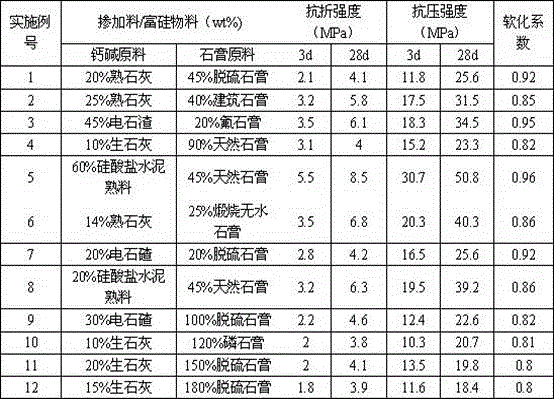
Figure 1
Abstract
Description
technical field
[0001] The invention belongs to the fields of solid waste treatment, ecological gelling materials and applications thereof, and in particular relates to a preparation method of gypsum composite gelling materials. Background technique
[0002] Industrial gypsum, also called chemical gypsum, refers to by-products or waste residues produced by chemical reactions in industrial production with calcium sulfate as the main component, mainly including phosphogypsum, desulfurization gypsum, fluorine gypsum, citrate gypsum, titanium gypsum and salt gypsum. Due to environmental protection, the research on the treatment and utilization of industrial gypsum has been continuously strengthened in recent years, among which the treatment and utilization of desulfurized gypsum has made great progress, and the production lines for preparing gypsum board, construction gypsum and cement retarder using it as raw materials have been put into operation one after another. The utiliza...
Examples
Embodiment Construction
[0017] The present invention will be further described in detail below in conjunction with specific examples, but the present invention is not limited thereto.
[0018] A total of 7 kinds of natural and artificial silicon-aluminum raw materials were used in the embodiment to prepare silicon-rich materials, and their chemical compositions are shown in Table 1. All silicon-aluminum raw materials are crushed, then added with alkali, mixed and ground evenly to a fineness of less than 10% on a 200-mesh sieve. The ground powder is calcined in the temperature range of 500-1000°C to obtain the silicon-rich material. See Table 2 for the processing parameters of silicon-rich materials in each embodiment. Add calcium-alkaline material and gypsum in an appropriate proportion to the silicon-rich material, and re-grind to a fineness of less than 10% on a 200-mesh sieve. According to the GB / T17671-1999 cement mortar strength test method, the strength performance of 3 days and 28 days was t...