
Femtosecond seed pulse generation device with large energy cycle level and ultra-high signal-to-noise ratio
A technology for generating devices and signal-to-noise ratios, applied to phonon exciters, laser components, electrical components, etc., to achieve the effects of avoiding complexity, realizing integration, and convenient adjustment
Patent Information
- Authority / Receiving Office
- CN · China
- Patent Type
- Patents(China)
- Current Assignee / Owner
- Publication Date
- 2018-10-02
Smart Images
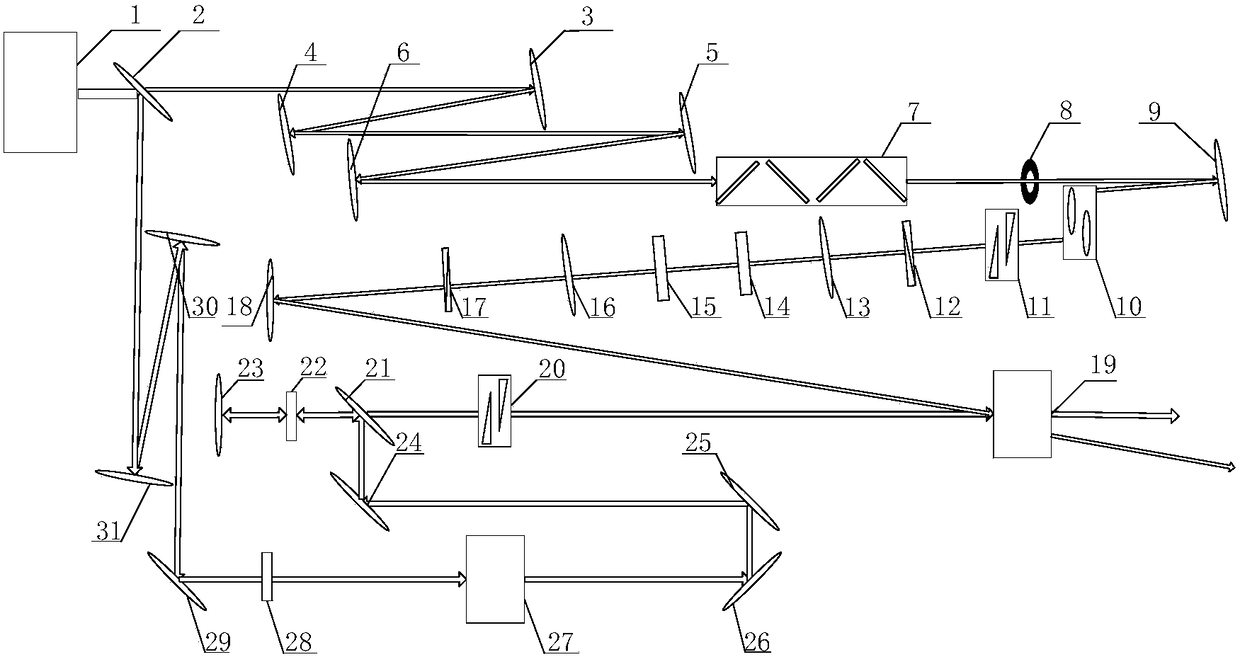
Figure 1
Abstract
Description
technical field
[0001] The invention relates to the field of ultra-short laser pulses, in particular to a period-level ultra-high signal-to-noise ratio seed source. By combining all-solid-state spectral broadening, cross-polarized wave generation, second harmonic generation, and type I near-degenerate optical parametric amplification process, a femtosecond seed pulse generation device with large energy period and ultra-high signal-to-noise ratio is proposed. Background technique
[0002] for the structure of matter in attoseconds (10 -18 s) order of time resolution and nanometer (10 -9 m) The huge demand for observation and manipulation on the spatial scale makes people urgently need attosecond coherent light sources. The use of solid-state high-order harmonics driven by ultra-intense and ultra-short lasers is one of the most promising ways to realize low-cost, desktop, and continuously tunable attosecond coherent light sources. The laser pulse with high peak power, ultra...
Examples
Embodiment Construction
[0021] The present invention will be further described below in conjunction with the accompanying drawings.
[0022] ① Split the P-polarized light output by the 800nm kilohertz laser with a beam splitter. One of the laser beams first passes through the beam reduction system composed of the first concave mirror and the first convex mirror, then is focused by the second concave mirror, reflected by the first total reflection mirror, passes through the fused silica window group, and the transmitted light passes through a small After the beam is limited by the aperture diaphragm, it is reflected by the third concave mirror, and the dispersion compensation is performed through the chirped mirror pair and the fused silica wedge pair in turn. The light after dispersion compensation is polarized by the first Glan prism, and then focused by the first convex lens and sequentially enters the first BaF 2 Crystal, second BaF 2 The crystal outputs laser light in the S polarization state...