
Laser remote wireless charging device based on visible indication light protection
A wireless charging, long-distance technology, applied in circuit devices, battery circuit devices, current collectors, etc., can solve the problem of no laser transmitter and solar panel specific design, no mutual matching to obtain the best photoelectric conversion efficiency, can not provide high Power and energy and other issues, to overcome the defects of electromagnetic wave principle, fast charging speed and light weight
Patent Information
- Authority / Receiving Office
- CN · China
- Current Assignee / Owner
- Publication Date
- 2017-03-29
- Estimated Expiration
- Not applicable · inactive patent
Smart Images
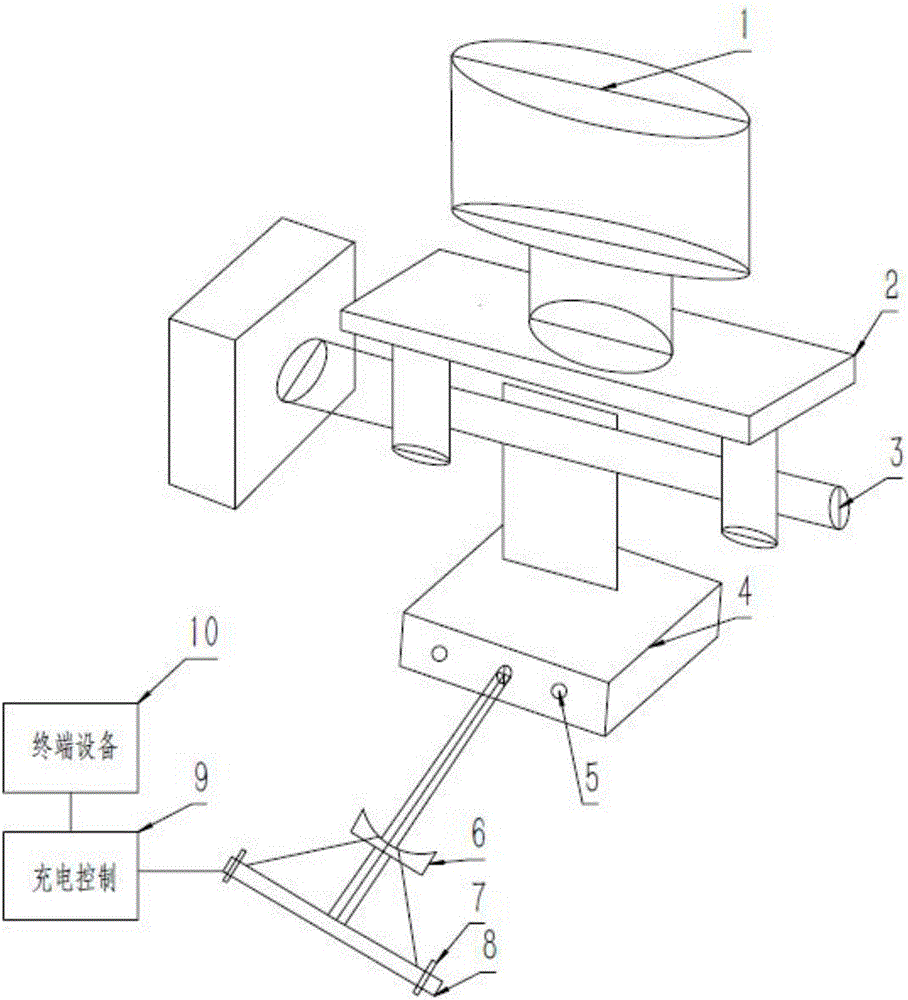
Figure 1
Abstract
Description
technical field
[0001] The invention relates to the technical field of wireless charging, in particular to a laser long-distance wireless charging device based on visible indicator light protection. Background technique
[0002] There are many forms of power transmission. At present, the most common is wired transmission. There must be a wire connection between the charger and the electronic device; it can also be carried by a battery, charging in one place and discharging in another; the other is wireless charging. Several wireless charging methods mainly include solar energy, microwave, electromagnetic induction and magnetic resonance.
[0003] The solar charging method is affected by weather, season, and angle, and it is difficult to provide a large current output in a small volume, and it is difficult to meet the requirements of fast charging. The microwave divergence is strong, which makes the size of the receiving antenna of the system too large. Electromagnetic indu...
Examples
Embodiment
[0034] Such as figure 1 As shown, this embodiment discloses a laser long-distance wireless charging device based on visible indicator light protection. The device uses laser as a carrier, that is, the transmitting end converts electrical energy into laser energy and transmits it to the receiving end, and the receiving end converts the laser for electrical energy. It overcomes the requirements that the microwave transmitting and receiving devices are bulky and not suitable for portable use; and avoids the oscillation frequency matching problem caused by the individual deviation of the inductance and capacitance components and temperature drift in the electromagnetic induction type. The invisible wave band light wave is used as the form of energy transfer, which will not cause light pollution and interference to communication signals. It can not only achieve wireless transmission, but also effectively overcome the defects of the principle of electromagnetic waves, and realize l...