
A high-precision direction-of-arrival estimation method for coprime arrays based on compressive sensing
A technology of direction of arrival estimation and compressed sensing, applied in the field of signal processing, to achieve the effect of reducing computational complexity
Patent Information
- Authority / Receiving Office
- CN · China
- Patent Type
- Patents(China)
- Current Assignee / Owner
- Publication Date
- 2019-10-18
Smart Images
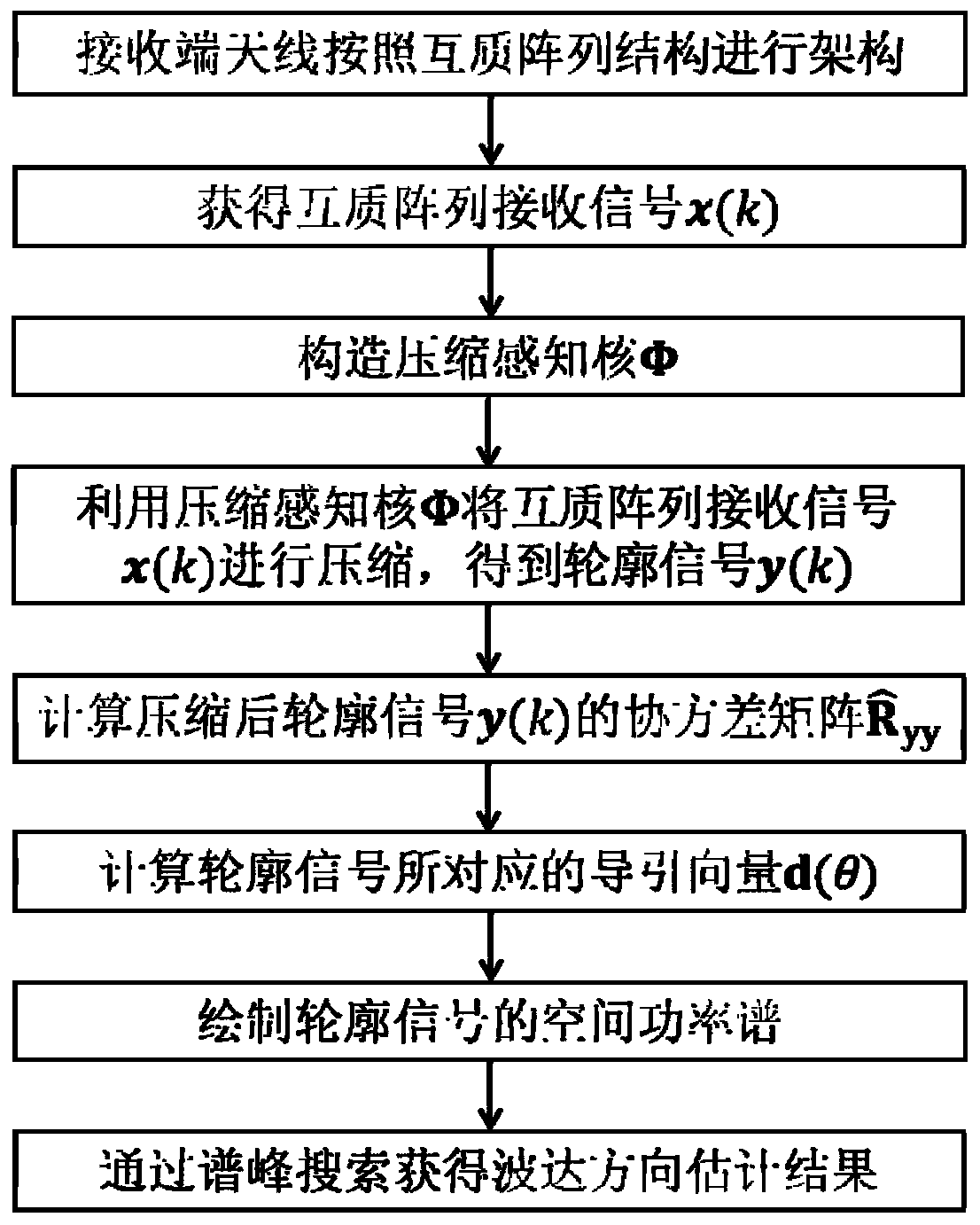
Figure 1 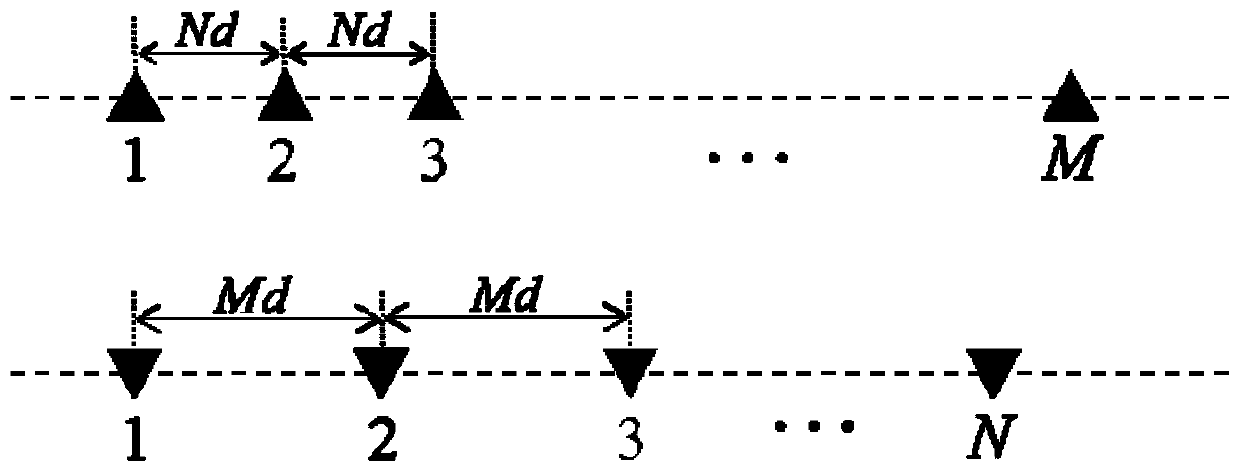
Figure 2 
Figure 3
Abstract
Description
technical field
[0001] The invention belongs to the technical field of signal processing, and in particular relates to the estimation of the direction of arrival of radar signals, acoustic signals and electromagnetic signals. Localization and object detection. Background technique
[0002] Direction-of-Arrival (DOA) estimation is an important branch in the field of array signal processing. It refers to the use of array antennas to receive airspace signals, and to realize the statistics of received signals through modern signal processing techniques and various optimization methods. Effective processing to realize signal DOA estimation has important application value in radar, sonar, voice, wireless communication and other fields.
[0003] Estimation accuracy is an important measure of DOA estimation performance. High-precision estimation results can not only provide effective incoming signal direction information for actual systems, but also save overall system overhead thr...
Examples
example 1
[0071] Simulation Example 1: We compare the performance of the method of the present invention through the characteristics of the spatial power spectrum. The method of using the coprime array contour signal proposed by the present invention will be compared with the spatial power spectrum corresponding to the uniform array received signal, the coprime array received signal and the uniform array contour signal to illustrate the advantages of the DOA estimation method in terms of estimation accuracy . In order to ensure a fair comparison, the uniform array used as a comparison also uses 36 antenna elements, that is, the array aperture is 35d. Both the uniform array profile signal and the coprime array profile signal use the same compressed sensing kernel.
[0072] The spatial power spectrum comparison chart of the present invention and the existing method in the case of sampling snapshot number K=50 is referred to Figure 4 . At this time, the number of sampling snapshots is ...
example 2
[0074] Simulation conditions and comparison content such as simulation example 1, the spatial power spectrum comparison diagram of the present invention and the existing method under the situation of sampling snapshot number K=20 is referred to Figure 5 . At this time, the number of sampling snapshots is smaller than the number of antenna elements. It can be seen that neither the 36×1-dimensional uniform array receiving signal method nor the coprime array receiving signal method can achieve DOA estimation, because the sampling snapshot is limited, which leads to the rank deficiency of the corresponding sampling covariance matrix; In contrast, the method of using 8×1-dimensional uniform array receiving signals and coprime array receiving signals can guarantee a full-rank sampling covariance matrix in this case, and thus can generate an effective spatial power spectrum. It is noted that the spatial power spectrum of the uniform array profile signal cannot distinguish signal so...