
A kind of blade treatment method
A processing method and blade technology, applied in welding equipment, manufacturing tools, welding/cutting media/materials, etc., can solve the problem of high manufacturing cost of cutting tools, achieve the effect of improving utilization rate, reducing manufacturing cost, and ensuring final performance
Patent Information
- Authority / Receiving Office
- CN · China
- Patent Type
- Patents(China)
- Current Assignee / Owner
- Publication Date
- 2021-02-05
Smart Images
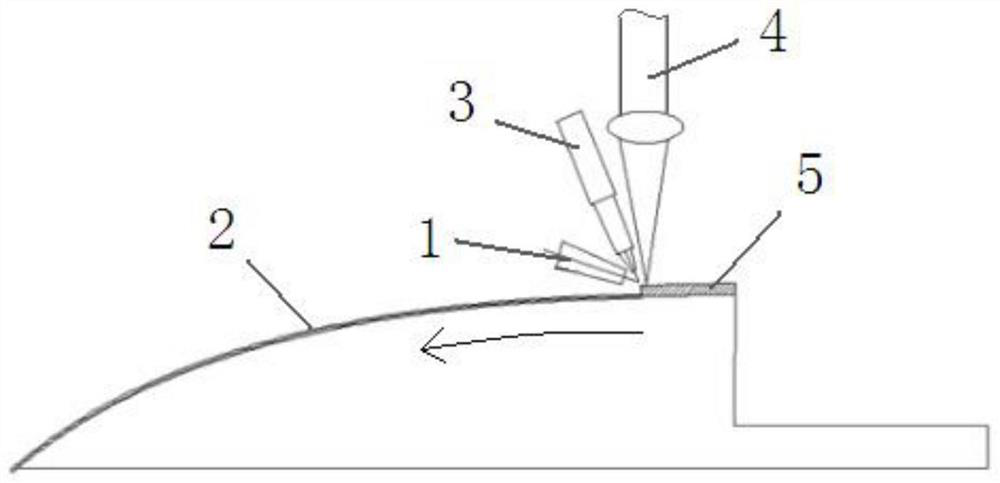
Figure 1 
Figure 2 
Figure 3
Abstract
Description
technical field
[0001] The invention belongs to the technical field of knife manufacturing, and in particular relates to a knife edge processing method. Background technique
[0002] Stainless steel is generally selected as the material for making knives in our country. In order to ensure the final performance of the knives, after the tool body is formed by stamping, its strength, hardness and wear resistance are improved through heat treatment technology. However, for knives made of ordinary martensitic stainless steel, the hardness of the cutting edge can only reach about 600HV after heat treatment and strengthening, and this hardness value can no longer meet the high hardness and high hardness that people should have for high-end knives. performance requirements such as wear resistance.
[0003] At present, the way many domestic enterprises solve the above problems is to directly select foreign high-quality steel as the tool material, such as using Japanese laminated ste...
Examples
Embodiment 1
[0036] combine figure 1 Shown, adopt method of the present invention, to select the 3Cr13 stainless steel of 2mm thickness for use as the cutter of base material to carry out the main process when cutting edge position processing is:
[0037] First, the preparation of the flux-cored welding wire 1 is carried out, and the outer diameter of the welding wire 1 is processed to 2 mm, which corresponds to the width of the blade 2 . Among them, 316L stainless steel pipe is selected as the steel strip for wrapping the agent. The weight percentage of the agent is: 15% TiC powder, 17% Cr powder, 0.8% Mo powder, 1.2% Si powder, 7% Ni powder, 0.2% C powder, 3% B powder, 0.5% fluoride powder, 0.5% chloride powder and the rest Fe powder.
[0038]Next, a combination of TIG welding and laser cladding is performed on the flux-cored wire on the upper surface of the blade. Along the length direction of the blade 2, with the help of the arc generated by the TIG welding torch 3, the flux cored w...