
Method and device for separating ethylene from refinery plant dry gas
A technology for refinery dry gas and ethylene, applied in ethylene production, chemical instruments and methods, purification/separation of hydrocarbons, etc. Low-level problems, to achieve the effect of avoiding loss, low cooling load, and increasing condensation temperature
Patent Information
- Authority / Receiving Office
- CN · China
- Patent Type
- Applications(China)
- Current Assignee / Owner
- Publication Date
- 2020-06-23
Smart Images
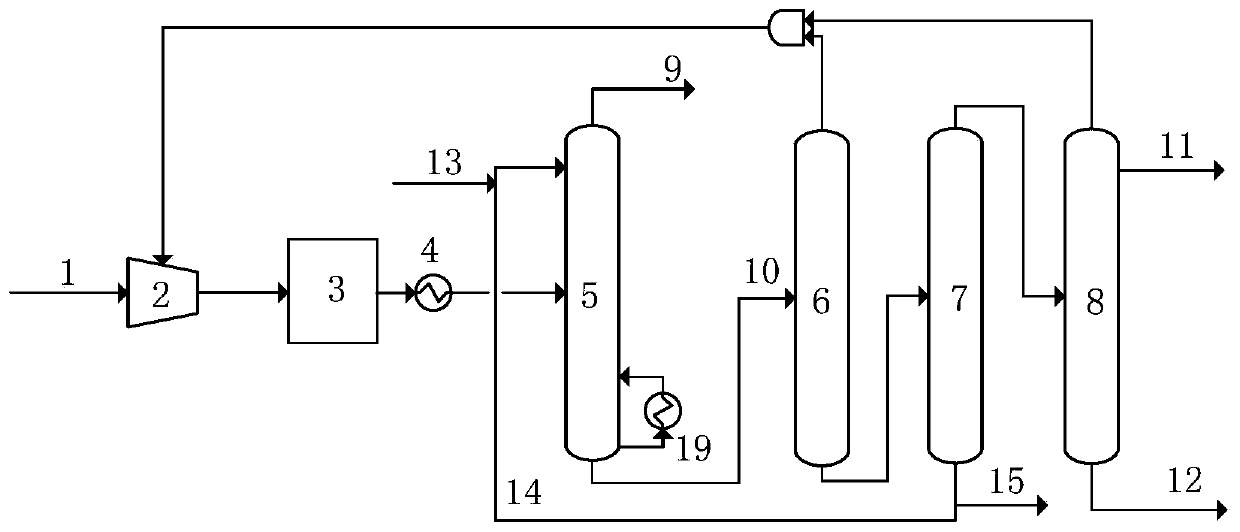
Figure 1 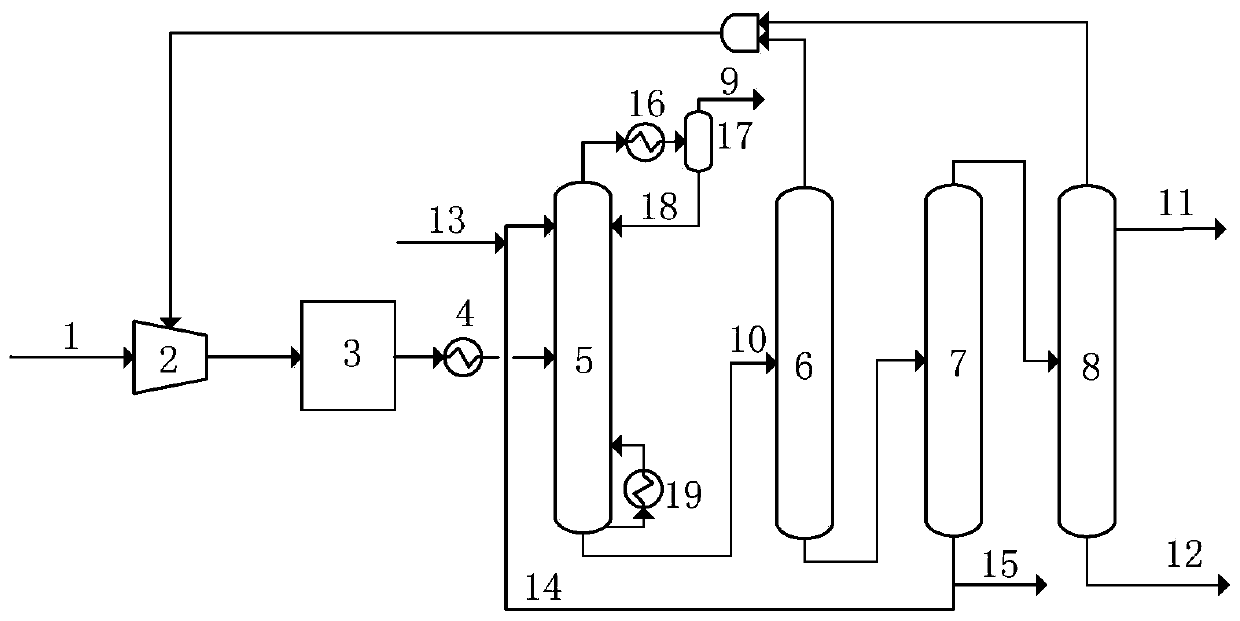
Figure 2 
Figure 3
Abstract
Description
technical field
[0001] The invention belongs to the field of chemical industry, and more specifically relates to a method and a device for separating ethylene from refinery dry gas. Background technique
[0002] Refinery dry gas is an important resource of petrochemical industry, mainly from primary and secondary processing of crude oil, such as atmospheric and vacuum distillation, catalytic cracking (FCC), catalytic cracking (DCC), hydrocracking, delayed coking, etc., among which The amount of dry gas from catalytic cracking is the largest, generally accounting for 3%-5% of crude oil processing volume, which contains a large amount of light hydrocarbon resources such as hydrogen, methane, ethane, ethylene, propane, and propylene. At present, the annual processing capacity of domestic catalytic cracking units exceeds 200Mt, and the annual output of catalytic dry gas is above 6.0Mt, which contains 0.6-1.0Mt of ethylene. Most of the refinery dry gas is burnt as industrial and...
Examples
Embodiment 1
[0056] use as figure 1 Separation flow diagram shown for separation of ethylene from refinery dry gas.
[0057] The separation device includes a compressor 2, a purification unit 3, a cooler 4, an oil absorption tower 5, a demethanizer 6, a depropanizer 7, and an ethylene rectification tower 8; 4. The oil absorption tower 5 is connected; the top of the oil absorption tower 5 is provided with a supplementary absorbent pipeline, the top of the tower is connected to the fuel pipe network, and the bottom of the tower is connected to the demethanizer 6; the top of the demethanizer 6 is connected to the second stage of the compressor , the bottom of the tower is connected to the depropanizer 7; the top of the depropanizer 7 is connected to the ethylene rectification tower 8, and the bottom of the tower is connected to the top of the oil absorption tower 5 and outside the boundary respectively, and the top of the ethylene rectification tower 8 is connected to the compressor 2 The se...
Embodiment 2
[0072] use as figure 2 Separation flow diagram shown for separation of ethylene from refinery dry gas.
[0073] The separation device includes a compressor 2, a purification unit 3, a cooler 4, an oil absorption tower 5, a demethanizer 6, a depropanizer 7, and an ethylene rectification tower 8; 4. The oil absorption tower 5 is connected; the top of the oil absorption tower 5 is provided with a supplementary absorbent pipeline, a condenser 16 and a separation tank 17, and a reboiler is provided at the bottom; the top of the tower is connected with the condenser 16 and the separation tank 17 in turn, and the separation tank 17. The top of the tank is connected to the fuel pipe network, the bottom of the tank is connected to the top of the oil absorption tower 5; the bottom of the tower is connected to the demethanizer 6; the top of the demethanizer 6 is connected to the second stage of the compressor, and the bottom of the tower is connected to the depropanizer 7 ; The top of ...