
Process for vacuum freeze drying of roses
A vacuum freeze-drying, rose technology, applied in the direction of drying solid materials, drying solid materials without heating, promoting the preliminary treatment of solid materials drying, etc. Flowers are completely dry and other problems, to achieve the effect of color stability
Patent Information
- Authority / Receiving Office
- CN · China
- Patent Type
- Applications(China)
- Current Assignee / Owner
- Publication Date
- 2020-09-29
Smart Images
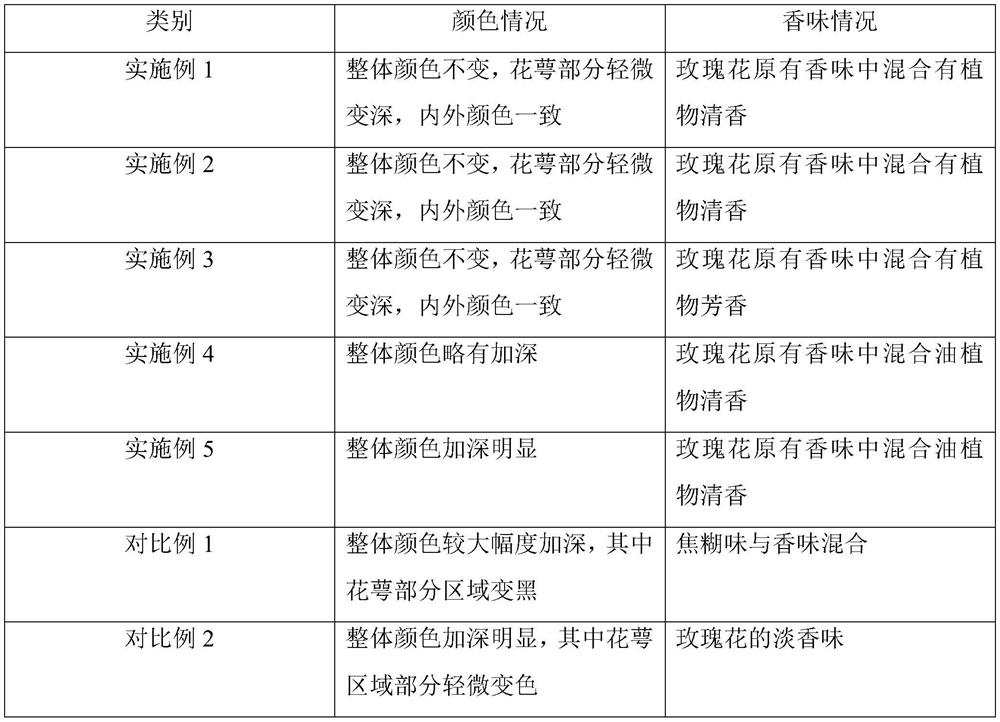
Figure 1 
Figure 2
Abstract
Description
technical field
[0001] The invention relates to the field of food processing, in particular to a process for vacuum freeze-drying roses. Background technique
[0002] Rose, belonging to the order Rosaceae, is a deciduous shrub of the family Rosaceae, with many needles on the branches, odd-numbered pinnate compound leaves, 5-9 leaflets, oval, with side thorns, and its flowers are mainly used for food and extraction of rose oil and rose oil. Used in cosmetics, food, fine chemical and other industries. "Materia Medica Text" said: "Rose, clear but not turbid, harmonious but not violent, softening the liver and refreshing the stomach, dispersing qi and activating blood, clearing and suffocating stagnation without any disadvantages of pungent, warm, rigid and dry. The most effective and the most tame, there are almost no other aromatic products.” Roses contain more than 300 kinds of chemical components, such as aromatic alcohols, aldehydes, fatty acids, phenols and essence-contai...
Examples
Embodiment 1
[0026] A vacuum freeze-drying process for roses, comprising the following steps:
[0027] S1 selects fresh roses, and requires the picking period to be no more than 24 hours, and washes the picked roses in clean water to obtain clean roses;
[0028] S2 put the cleaned roses in the atomized color-preserving solution for 35min, then place them in a vacuum chamber, and control the air pressure in the vacuum chamber to be 10kPa; the weight components of the color-preserving solution include 43 parts of ultrapure water , 17 parts of tartaric acid, 7 parts of jojoba oil and 7 parts of almond oil; using jojoba oil as a dispersant, carrying tartaric acid and almond oil into the petal cells of roses, while jojoba oil and almonds The combination of the good antioxidant properties of the oil and the antioxidant properties of tartaric acid can lower the solidification temperature of roses to a certain extent, so that roses can maintain the stability of the cells in the petals of the flowe...
Embodiment 2
[0033] The weight components of the color-preserving solution were changed to 40 parts of ultrapure water, 10 parts of tartaric acid, 5 parts of jojoba oil and 5 parts of almond oil, and all the other formulas and steps were the same as in Example 1.
Embodiment 3
[0035] The weight components of the color-preserving solution were changed to 50 parts of ultrapure water, 20 parts of tartaric acid, 10 parts of jojoba oil and 10 parts of almond oil, and all the other formulas and steps were the same as in Example 1.