
Extinguishing weak fluorescence detection system
A fluorescence detection, weak technology, applied in the direction of fluorescence/phosphorescence, measuring devices, material analysis through optical means, etc., can solve the problems that affect the accuracy, cannot be detected, and the energy of the excitation light is large, so as to reduce the energy proportion, Accurate detection results, reducing the effect of interfering fluorescence
Patent Information
- Authority / Receiving Office
- CN · China
- Patent Type
- Patents(China)
- Current Assignee / Owner
- Publication Date
- 2022-06-17
Smart Images
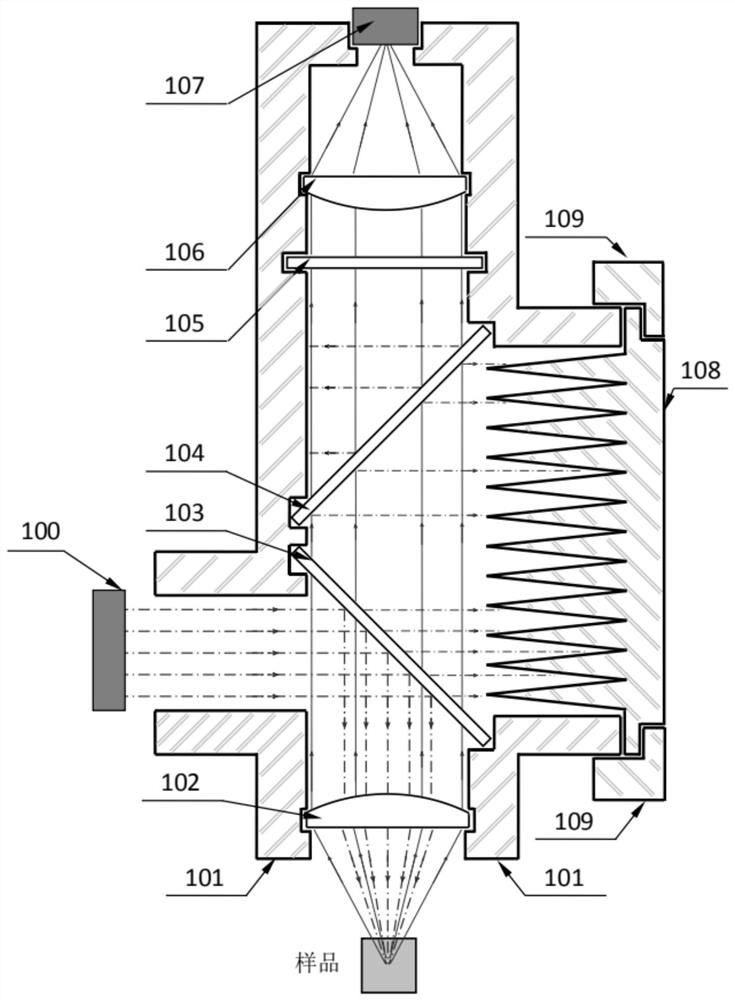
Figure 1 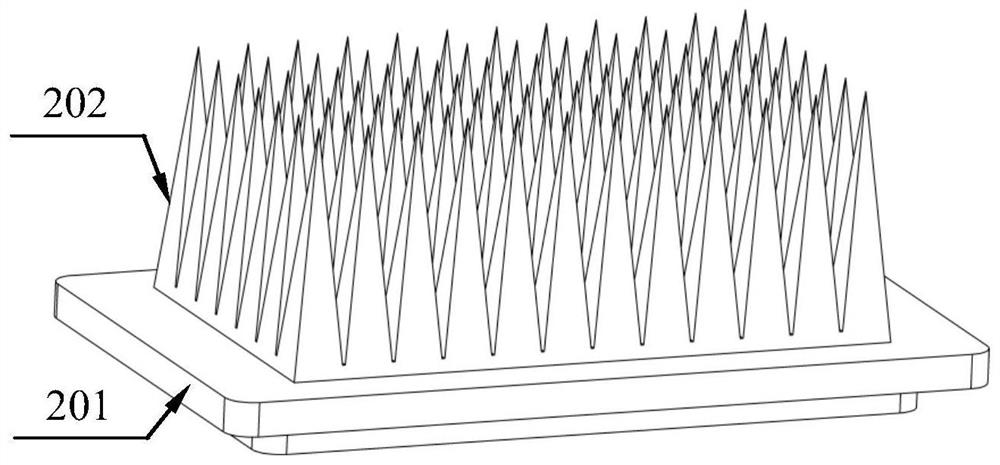
Figure 2 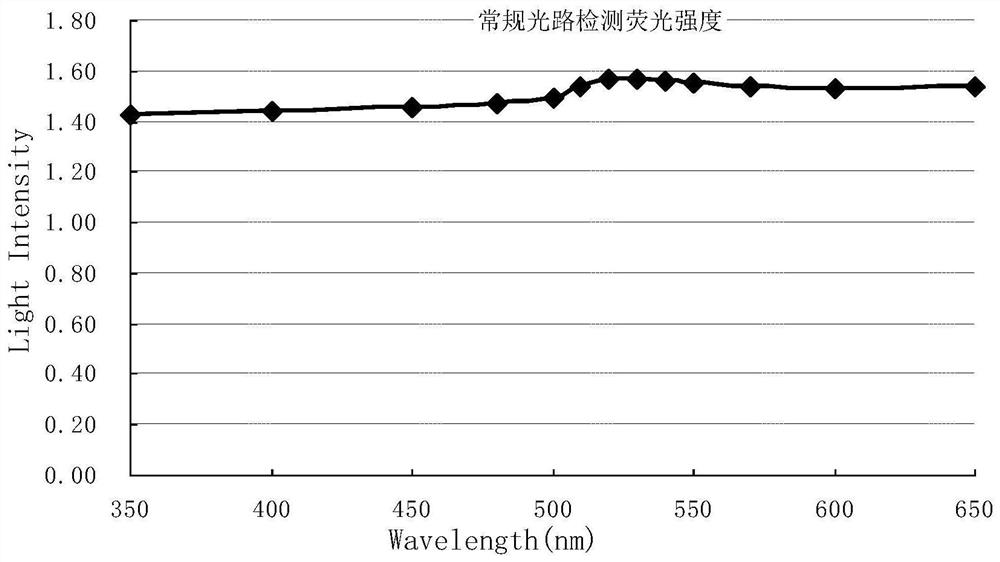
Figure 3
Abstract
Description
technical field
[0001] The invention relates to the technical field of optical equipment, in particular to an extinction type weak fluorescence detection system. Background technique
[0002] Fluorescence resonance energy transfer is an emerging molecular fluorescence detection technology that uses dipole interaction to transfer the energy of the donor excited state to the adjacent acceptor molecule. It has broad application prospects in biological macromolecular interaction, immunoassay, nucleic acid detection, etc. . Since the target fluorescence to be detected is not directly excited and converted by the excitation light, but the secondary fluorescence generated by the energy resonance transfer between the donor fluorescence and the adjacent acceptor, the fluorescence resonance energy transfer method generates the fluorescence resonance energy transfer method when the excitation light intensity is the same. The effective fluorescence intensity is much lower than the trad...
Examples
Embodiment 1
[0032] like figure 1 As shown, an extinction type weak fluorescence detection system in this embodiment includes: an excitation light optical path 100 , a light-shielding housing 101 , a fluorescence collecting lens 102 , a main dichroic mirror 103 , a secondary two A dichroic mirror 104, a bandpass filter 105, a converging lens 106, a photoelectric conversion detector 107, and a conical extinction filter 108;
[0033] The excitation light emitted by the excitation light path 100 is incident on the main dichroic mirror 103 in a parallel state, and then a part is reflected to the fluorescence collection lens 102, and then converged by the fluorescence collection lens 102 and then irradiated into the sample, and then incident on the main dichroic mirror. The other part of the excitation light on 103 passes through the main dichroic mirror 103 and then irradiates on the cone-surface light absorber 108, where it is dispersed and absorbed;
[0034] The fluorescence generated by th...
Embodiment 2
[0056] Compare the effects of Embodiment 1 of the present invention and the conventional fluorescence detection system, wherein, compared with Embodiment 1, the difference of the conventional fluorescence detection system is that there is no secondary dichroic mirror 104 and no conical surface quencher 108 therein.
[0057] The specific measurement method and process are as follows: before the detection, two sets of 13 interference narrow bandpasses with central wavelengths of 350nm, 400nm, 450nm, 480nm, 500nm, 510nm, 520nm, 530nm, 540nm, 550nm, 570nm, 600nm and 650nm are customized Filter, install narrow-band filters with different center wavelengths on the filter switching strip to form two sets of convenient and fast switching filter sets, which are respectively installed in the photoelectric conversion of the conventional fluorescence detection optical path and the fluorescence detection optical path of the present invention In front of the lens directly in front of the det...