
Methods and compositions for mitigating water production
a technology of compositions and water, applied in the field of hydrocarbon recovery, can solve the problems of affecting the environment, affecting the separation and disposition of produced water, and often producing water (or aqueous fluid) from oil and gas wells as non-desirable, so as to delay the breaking of viscosity and increase the viscosity of the treatment fluid composition
Patent Information
- Authority / Receiving Office
- US · United States
- Patent Type
- Patents(United States)
- Current Assignee / Owner
- Publication Date
- 2021-08-31
Smart Images
Figure 1 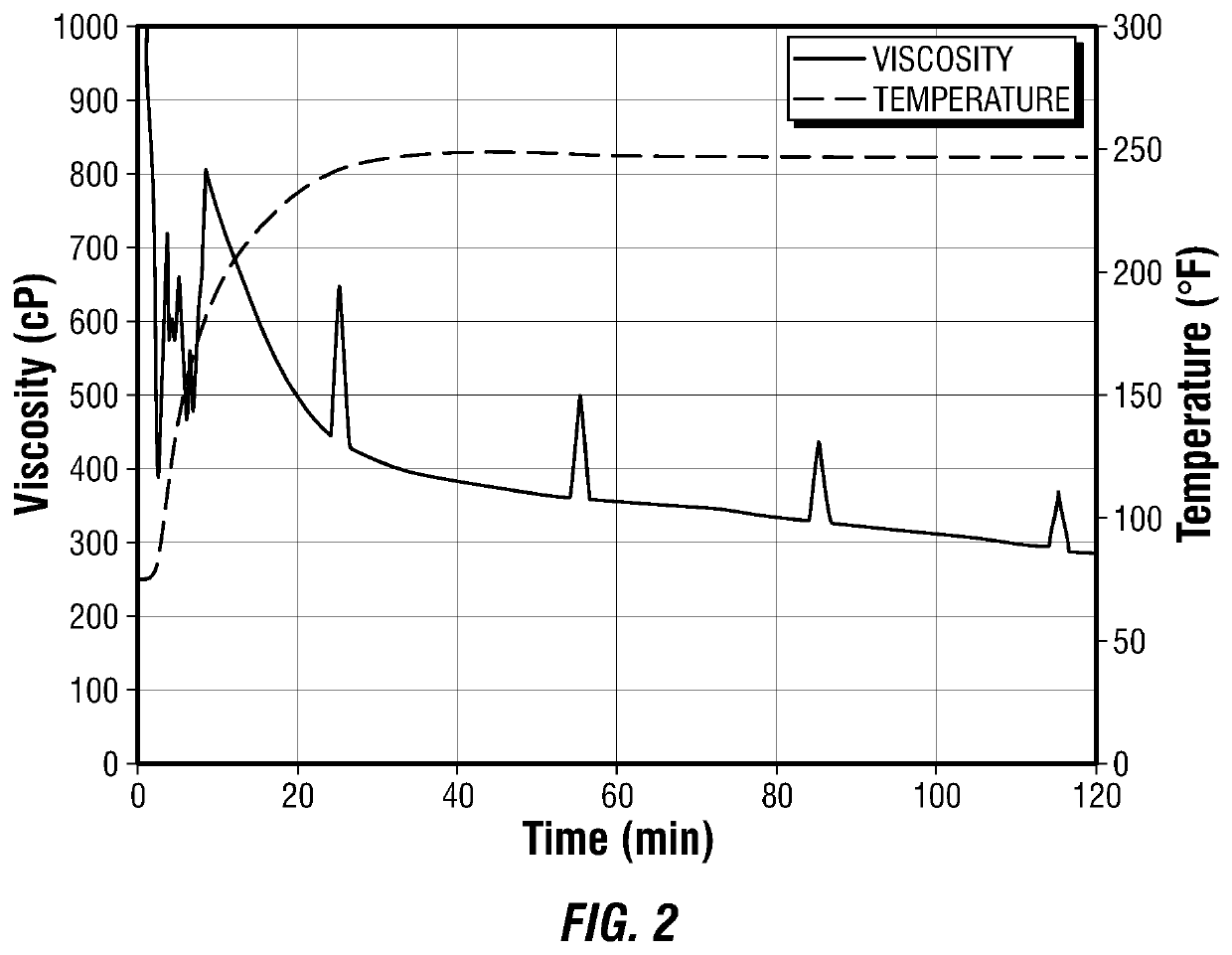
Figure 2 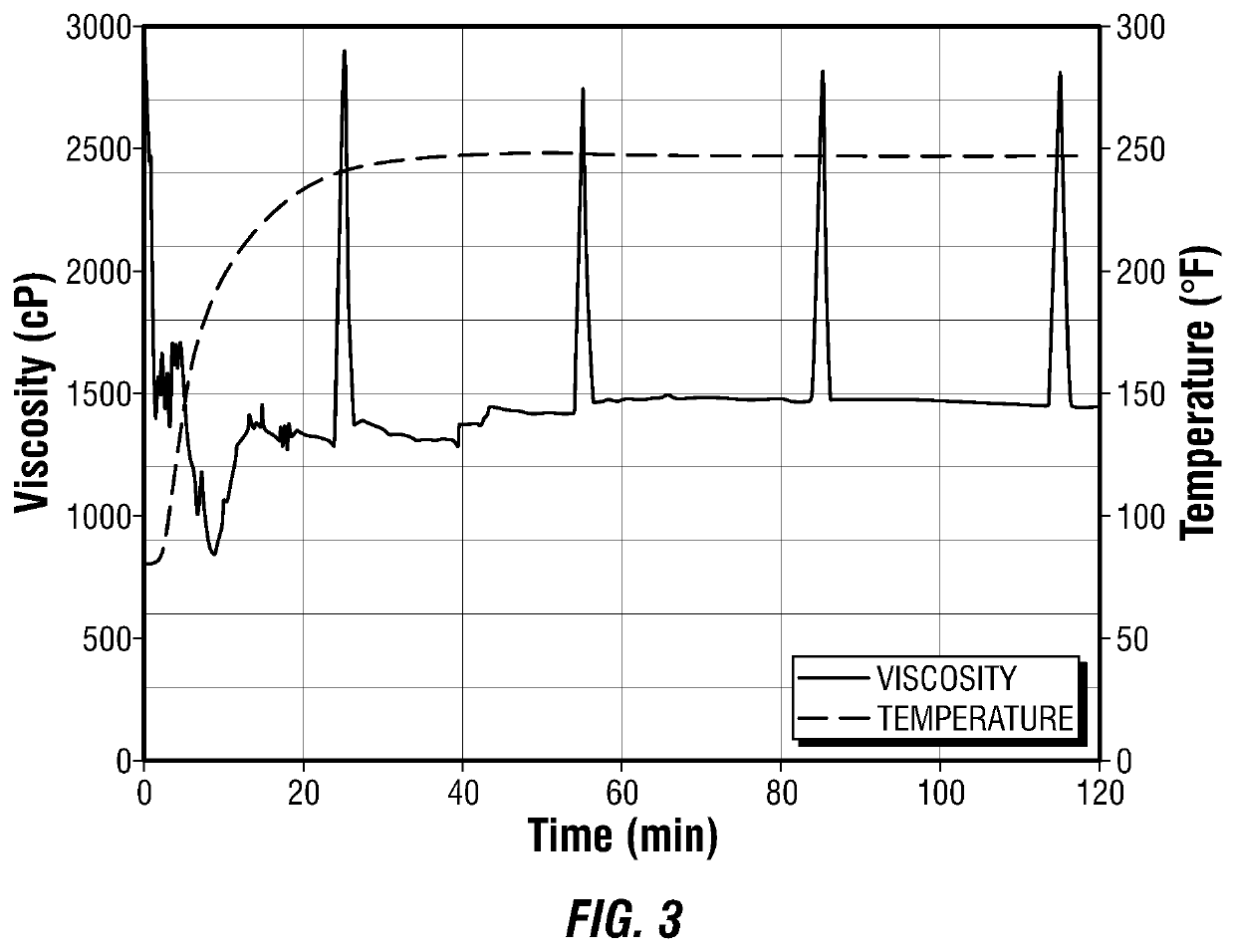
Figure 3
Abstract
Description
RELATED APPLICATION
[0001] The disclosure is related to, and claims priority from, U.S. Provisional Patent Application 62 / 791,271, filed on Jan. 11, 2019, the disclosure of which is incorporated herein by reference in its entirety.BACKGROUND1. Field
[0002] Embodiments generally relate to hydrocarbon recovery. More particularly, embodiments relate to methods and compositions for mitigating water production to facilitate hydrocarbon recovery.2. Description of the Related Art
[0003] Water (or aqueous fluids) is often produced from oil and gas wells as a non-desirable byproduct, especially when the oil and gas wells are near subterranean water sources or the wells are located offshore. In such environments, it is inevitable to completely shut off the produced water. Because water cannot be completely shut off during certain hydrocarbon production operations, the produced water is subsequently separated from the produced hydrocarbons. Once the produced water is separated from the produced hydr...
Examples
example 1
[0075]In one example embodiment, the treatment fluid composition was prepared with 100 to 500 milliliters (ml) of mineral oil (M5049 by Finoric, Houston, Tex.) having a flash point of greater than 210° F. mixed with 8 gallons per thousand gallons (gpt) of a phosphate ester-based gelling agent (ECONO OG-1 by Economy Polymers and Chemicals, Houston, Tex.), and 8 gpt of an iron-based crosslinking agent (ECONO OG-XL by Economy Polymers and Chemicals, Houston, Tex.). After mixing, the treatment fluid composition was heated to 250° F. Viscosity was measured using a viscometer (M5600 HPHT Rheometer by Grace Instrument Company, Houston, Tex.).
[0076]As shown in FIG. 2, the viscosity of the crosslinked treatment fluid composition was maintained greater than about 300 centipoise (cP) for at least 100 minutes at a shear rate of 100 s−1.
example 2
[0077]In one example embodiment, the treatment fluid composition was prepared with 100 to 500 ml of mineral oil (M5049 by Finoric, Houston, Tex.) having a flash point of greater than 210° F. mixed with 16 gpt of the phosphate ester-based gelling agent (ECONO OG-1 by Economy Polymers and Chemicals, Houston, Tex.), and 16 gpt of the iron-based crosslinking agent (ECONO OG-XL by Economy Polymers and Chemicals, Houston, Tex.). After mixing, the treatment fluid composition was heated to 250° F. Viscosity was measured using a viscometer (M5600 HPHT Rheometer by Grace Instrument Company, Houston, Tex.).
[0078]As shown in FIG. 3, the viscosity of the crosslinked treatment fluid composition was maintained greater than about 1,400 cP for at least 120 minutes at a shear rate of 100 s−1.
[0079]Examples 1 and 2 suggest that the viscosity of the treatment fluid composition can be adjusted by altering the quantities of the gelling agent and the crosslinking agent.
example 3
[0080]In one example embodiment, the treatment fluid composition was prepared with 100 to 500 ml of mineral oil (M5049 by Finoric, Houston, Tex.) having a flash point of greater than 210° F. mixed with 16 gpt of the phosphate ester-based gelling agent (ECONO OG-1 by Economy Polymers and Chemicals, Houston, Tex.) and 16 gpt of an iron-based crosslinking agent (ECONO OG-XL by Economy Polymers and Chemicals, Houston, Tex.). After mixing at room temperature, a firm gel was formed. Subsequently, about 10 ml of the firm gel was mechanically sheared in the presence of 100 ml of mineral oil.
[0081]Example 3 suggests that the crosslinked treatment fluid composition can be removed by a shearing force in a hydrophobic environment. The shearing force can be provided for example by applying positive hydraulic pressure into the wellbore. The shearing force may cause physical erosion to the crosslinked treatment fluid composition positioned in a high permeability streak adjacent to the wellbore, su...