
Silver halide photographic emulsion and silver halide photographic light-sensitive material using the same
a technology of silver halide and photographic emulsion, which is applied in the direction of optics, photosensitive materials, instruments, etc., can solve the problems of light-sensitive material, prone to silver halide conversion, and basically unstable epiaxial sensitization method, which uses silver chloride as one of the major constituents
Patent Information
- Authority / Receiving Office
- US · United States
- Current Assignee / Owner
- Publication Date
- 2002-10-17
- Estimated Expiration
- Not applicable · inactive patent
Smart Images
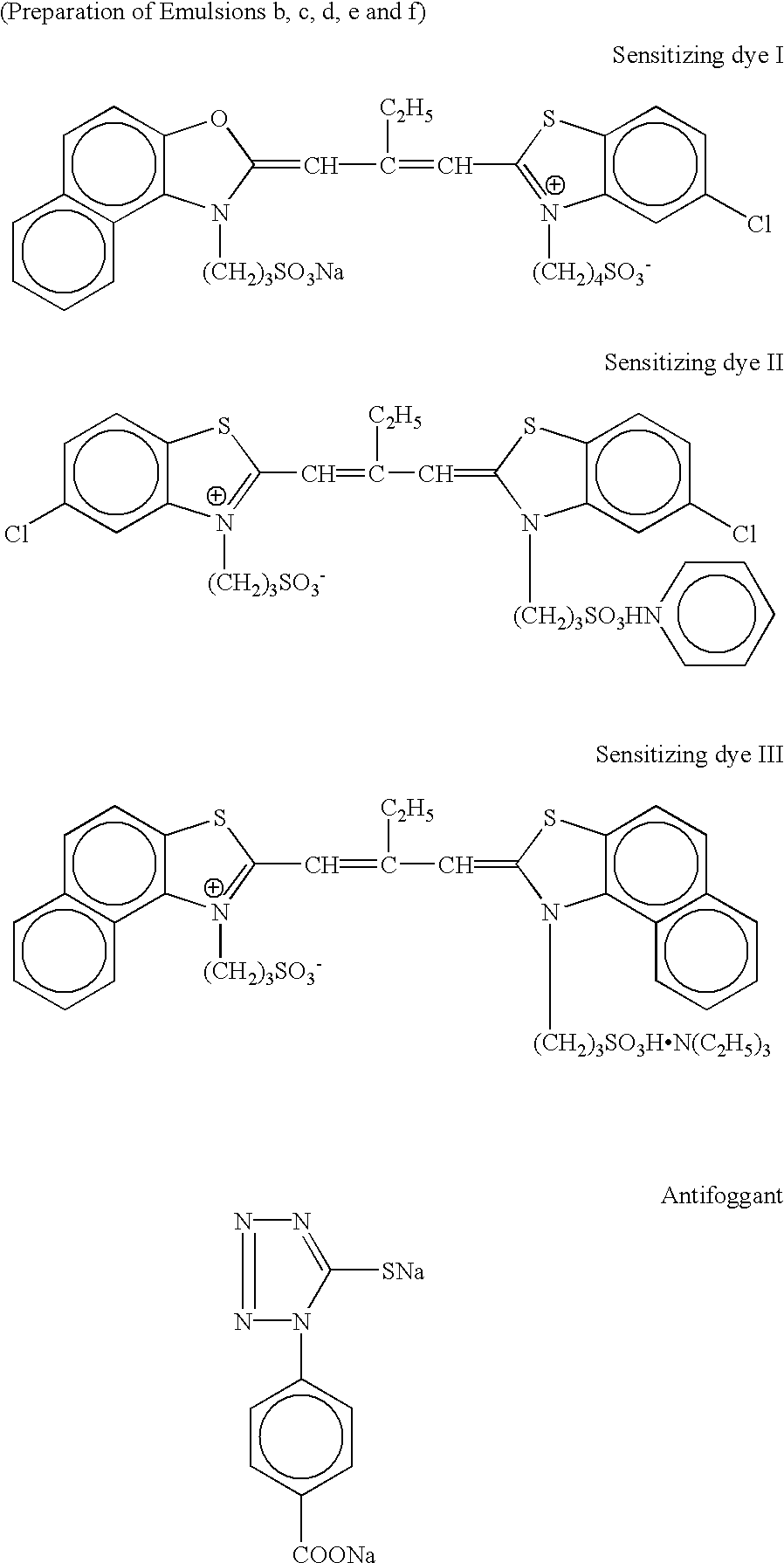
Figure 1 
Figure 2 
Figure 3
Abstract
Description
[0001] This application is based upon and claims the benefit of priority from the prior Japanese Patent Application No. 2001-003901, filed January 11, 2001, the entire contents of which are incorporated herein by reference.
[0002] 1. Field of the Invention
[0003] The present invention relates to a silver halide photographic emulsion and a silver halide photographic light-sensitive material using the same. In more detail, the present invention particularly concerns a high-speed silver halide photographic emulsion whose development proceeds fast, and to a silver halide photographic light-sensitive material using the same.
[0004] 2. Description of the Related Art
[0005] It is well known that to obtain a high-speed silver halide photographic light-sensitive material, tabular silver halide grains (hereinafter referred to as "tabular grains") are used. As a method for sensitizing such tabular grains, sensitizing methods using an epitaxial junction are disclosed in Jpn. Pat. Appln. KOKAI Publi...
Examples
example 1
[0207] The effects of the content of the silver chloride in epitaxial junction portions and the ratio of (111) faces in side surfaces of tabular grains in the present invention will be described.
[0208] (Preparation of Emulsion a)
[0209] 1,500 mL of an aqueous solution containing 4.1 g of KBr and 7.1 g of gelatin with an average molecular weight of 20,000 and having been adjusted the pH thereof to 4 was stirred while being maintained at 40.degree. C. An aqueous solution containing AgNO.sub.3 (8.4 g) and an aqueous solution containing halogen (containing 5.9 g of KBr and 1.1 g of KI) were added over 40 seconds by the double jet method. After 35.5 g of succinated gelatin with an average molecular weight of 100,000 was added, the pH was adjusted to 5 and then the temperature was raised to 58.degree. C. After an aqueous solution of AgNO.sub.3 (2.4 g) was added over 2 minutes, 59 mL of a 6.25 mol / L ammonium nitrate solution and 59 mL of a 1N sodium hydroxide solution were added. After ripe...
example 2
[0230] A description is given below on the advantage obtained by the use of the silver iodide content in epitaxial portions within the scope of the present invention, particularly on the advantage obtained by the addition of a silver iodobromide fine grain emulsion prepared immediately before its addition.
[0231] (Preparation of Emulsions r, s, t, u and v)
[0232] Emulsions r, s, t, u and v were prepared by changing the epitaxial junctions in Emulsions c, d, 1, o and q in Example-1 as follows, respectively. After reducing the temperature to 38.degree. C., 134 mg of benzimidazole was added to adjust the pH to 4.5. After addition of an aqueous KI (0.5 g) solution, sensitizing dyes I, II and III were added at a molar ratio of 6:3:1 in a ratio of 80% of the saturated covering amount. Note that the sensitizing dyes were used in the form of fine solid dispersions prepared by the method described in JP-A-11-52507. That is, 0.8 parts by weight of sodium nitrate and 3.2 parts by weight of sodiu...
example 3
[0238] The advantages of the emulsion of the invention exerted in a multi-layered color photographic lightsensitive material are set forth below.
[0239] Emulsions Em-A to Em-M were prepared by the following methods.
[0240] (Preparation method of Em-A)
[0241] 42.2L of an aqueous solution containing 31.7 g of low-molecular weight gelatin having a molecular weight of 15,000 and phthalated at a phthalation ratio of 97% and 31.7 g of KBr were vigorously stirred at 35.degree. C. 1,583 mL of an aqueous solution containing 316.7 g of AgNO.sub.3 and 1,583 mL of an aqueous solution containing 221.5 g of KBr and 52.7 g of a low-molecular weight gelatin having a molecular weight of 15,000 were added over 2 min by the double jet method. Immediately after the addition, 44.8 g of KBr were added. After that, the temperature was raised to 40.degree. C., and ripened. After the completion of the ripening, 923 g of a gelatin having a molecular weight of 100,000 and phthalated with a phthalation ratio of 9...