
Ceramic composite material, method for the production thereof, and pencil-type glow plug containing such a composite material
a composite material and composite material technology, applied in the field of ceramic composite materials, can solve the problems of requiring additional fillers, and achieve the effects of reducing the aging of the electrical resistivity, and improving the functional properties
Patent Information
- Authority / Receiving Office
- US · United States
- Patent Type
- Applications(United States)
- Current Assignee / Owner
- Publication Date
- 2005-07-14
- Estimated Expiration
- Not applicable · inactive patent
Smart Images
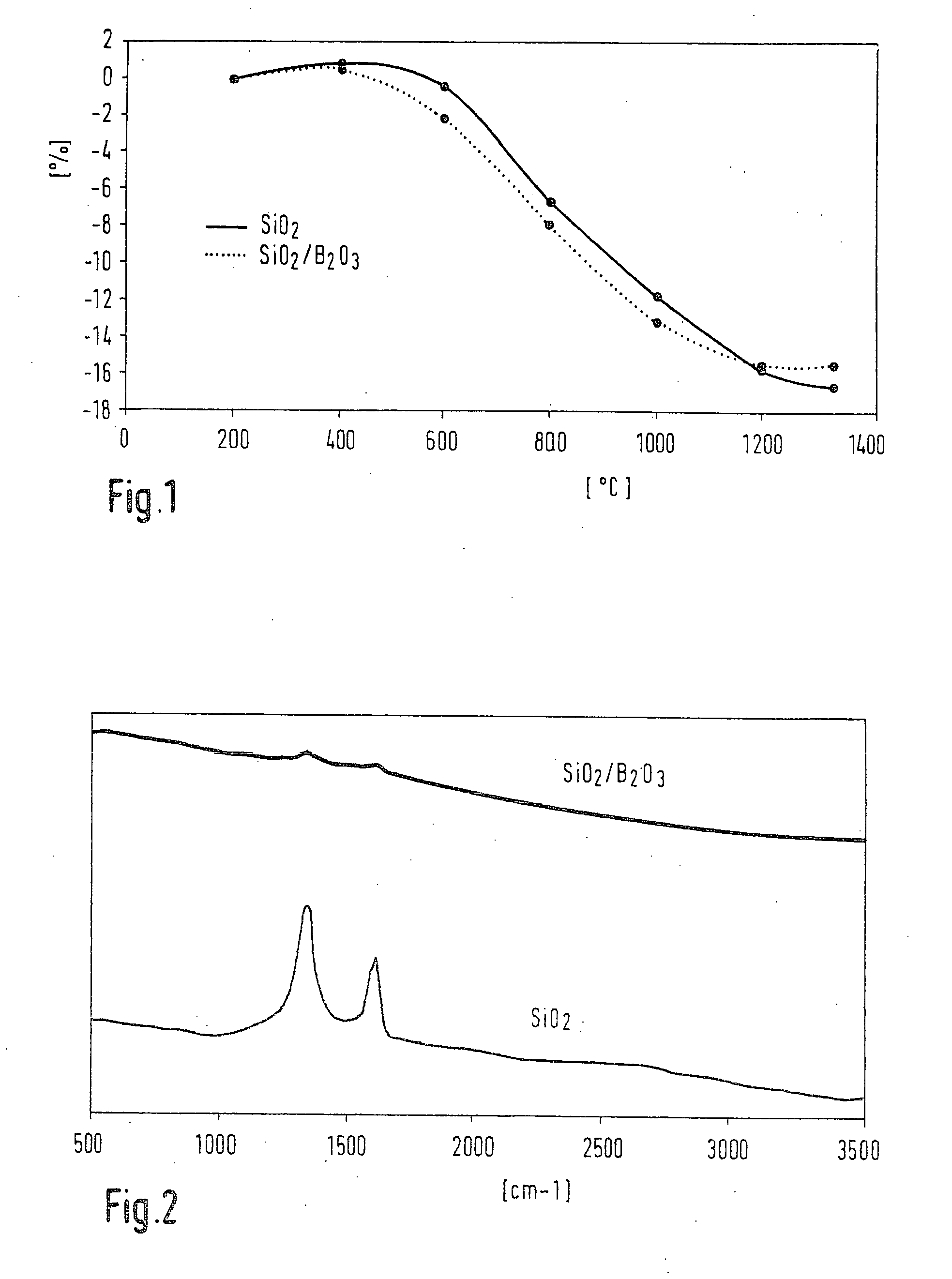
Figure 1 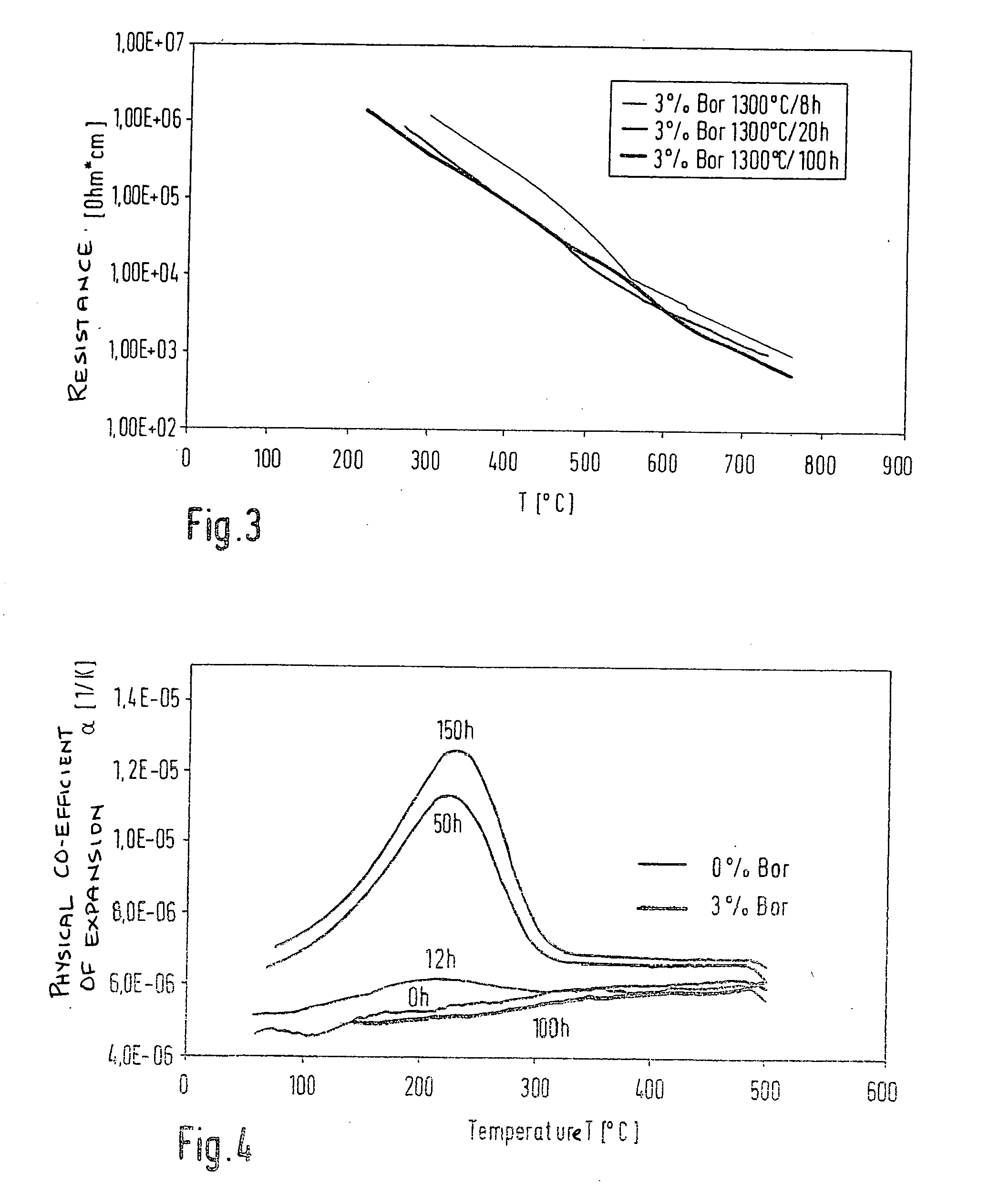
Figure 2
Abstract
Description
FIELD OF THE INVENTION
[0001] The present invention relates to a ceramic composite material, a method for manufacturing it and a sheathed-element glow plug containing such a composite material. BACKGROUND INFORMATION
[0002] In the manufacture of ceramic sheathed-element glow plugs, such as those described in German Published Patent Application Nos. 198 52 785 or 100 20 329, ceramic composite materials, in particular amorphous Si—O—C ceramics may be used, which are obtained through the partial pyrolysis of organoelement precursors. The precursor thermolysis method as compared to other manufacturing methods for ceramics, i.e., sintering, may involve a substantially lower process temperature and a simple working properties and moldability of polysiloxane resins. The procedure is also described in German Published Patent Application No. 195 38 695.
[0003] Furthermore, to manufacture molded articles from these ceramic composite materials additional fillers may be required because otherwi...
Examples
example 1
[0025] Two compounds are produced, for example, according to German Published Patent Application No. 195 38 695 having an identical volume fraction of fillers, one of them containing 75 vol.-% polymer (polysiloxane resin) and 25 vol.-% SiO2 and the other containing 75 vol.-% polymer (polysiloxane resin) and 35 vol.-% of a SiO2 / B2O3 mixture. The SiO2 / B2O3 mixture contains 80 wt.-% SiO2 and 20 wt.-% boron or B2O3.
[0026] The compounds are prepared by grinding the relevant starting powder, subsequent screening using a 150 μm mesh size, followed by cross-linking and molding via hot pressing.
[0027] Subsequently, the samples are pyrolyzed into compact samples at a heat-up time of 25 K / h to a final temperature of 1300° C.
[0028] In the pyrolysis to a final temperature of 1300° C., the sample containing no boron displayed a shrinkage in length Δ1 / 1 of −16.5%, a loss of mass Δm / m of −17.0% and an electrical resistivity of approximately 105 Ω•cm while the boron-containing sample had a shrink...
example 2
[0033] Again, based on the teaching of German Published Patent Application Nos. 195 38 695 or 100 20 392, boron-containing insulation compounds are produced for a ceramic sheathed-element glow plug, which are prepared, starting with appropriate ceramic starting mixtures, using a mixing and kneading process, followed by molding using transfer molding.
[0034] The composition of the different ceramic starting mixtures produced is within the ranges 50 to 80 vol.-% polysiloxane (including an addition of 1 wt.-% zirconium acetylacetonate, which is used as a catalyst for the cross-linking of the polysiloxane, e.g., in hot pressing), 0 to 10 vol.-% SiC as a filler, 0 to 20 vol.-% Al2O3 as a filler, 0 to 20 mol.-% MoSi2 as a filler and 3 wt.-% boron, which is used in the form of B2O3. In addition, a corresponding boron-free reference sample was produced for each of the samples having varying composition within these ranges.
[0035] After molding, the pyrolysis was performed at temperatures of...