
High gain resonant modulator system and method
a resonant modulator and high gain technology, applied in the field of high gain resonant modulator system and method, can solve the problems of inability to optimize analog applications, inability to manufacture hybrids, and inability to meet the requirements of high-gain resonant modulators, so as to improve the slope efficiency, improve the operation, and increase the analog link gain
Patent Information
- Authority / Receiving Office
- US · United States
- Current Assignee / Owner
- Publication Date
- 2006-04-20
- Estimated Expiration
- Not applicable · inactive patent
Smart Images
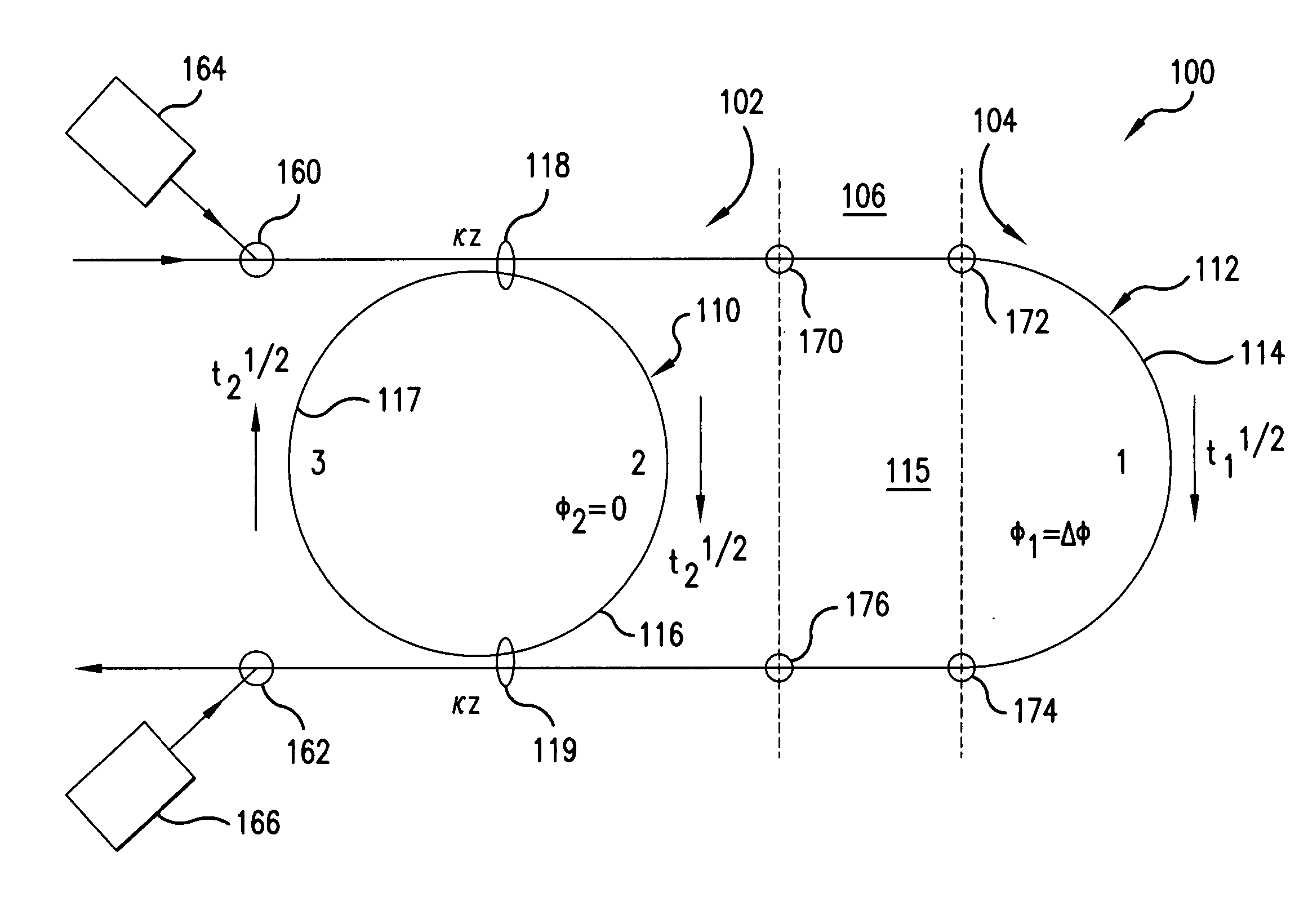
Figure 1 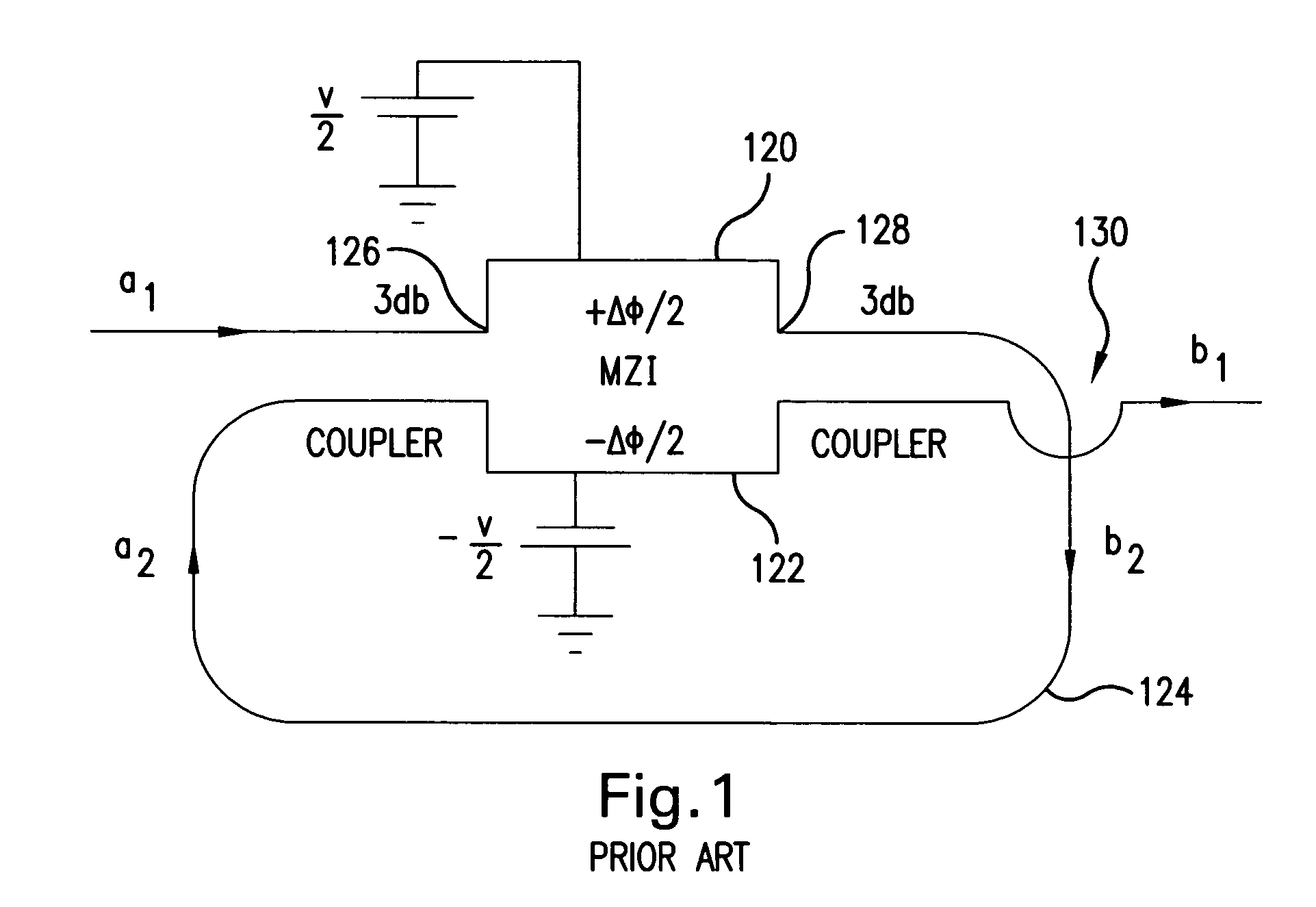
Figure 2 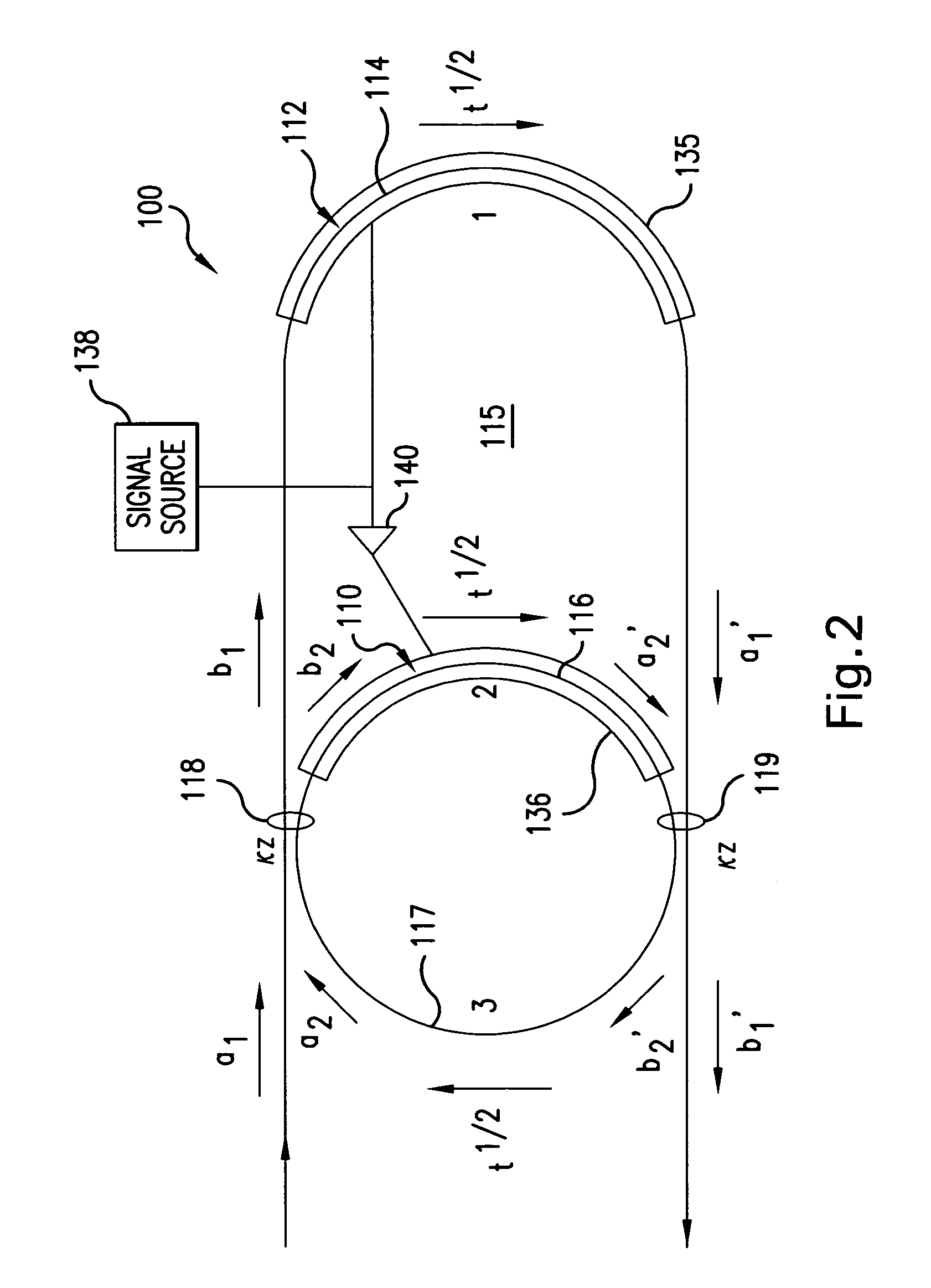
Figure 3
Abstract
Description
GOVERNMENT SUPPORT
[0001] The invention was made with government support under Grant / Contract No. F30602-00-C-0128 awarded by Defense Advanced Research Projects Agency (DoD). The government has certain rights in the invention.BACKGROUND OF THE INVENTION
[0002] Mach Zehnder interferometers (MZIs) often are used to modulate the amplitude or intensity of an optical signal. MZIs are most often deployed as modulators in digital links. However, they also have application in analog links, such as in multi- or sub-octave remote antenna links.
[0003] Generally, deployed MZI modulators are monolithic devices formed from an electro-optically active material such as lithium niobate. The MZIs have two couplers and two arms. Electrodes are provided for controlling the electric field in the region of the two arms. An input signal is divided between the two arms by a first coupler, with the divided signal passing through the two arms, and then recombined by the second coupler. Often, the arms have ...
Examples
Embodiment Construction
[0031] In general, for an arbitrary MZI, the total MZI phase shift Δφt, which is the phase difference between the arms of the interferometer, can be defined as:
Δφt=φ1−(−φ2)=sΔφt+(1−s)Δφt (1) [0032] where φ1 and −φ2 are the phase changes in arms 1 and 2, respectively, and s is a parameter describing the asymmetry of the MZI. In general, 0≦s≦1. For the arrangement shown in FIG. 1, eq.1 is satisfied by s=½.
[0033] For this arrangement, 3 dB couplers 126 and 128 divide the optical power of a single input in half. Stated in another way, κz is constrained to 45 deg, where κ is the coupling coefficient in the directional coupler and z is its length. It can be shown that these are the only conditions under which critical coupling, where the power output is 0, can be obtained for all values of Δφ, independent of κz.
[0034]FIG. 2 illustrates an optical resonant modulator, which has been constructed according to the principals of the present invention.
[0035] The optical resonant modulator 1...