
Cultured dairy products and methods of manufacture
Patent Information
- Authority / Receiving Office
- US · United States
- Current Assignee / Owner
- Publication Date
- 2006-12-21
- Estimated Expiration
- Not applicable · inactive patent
Smart Images
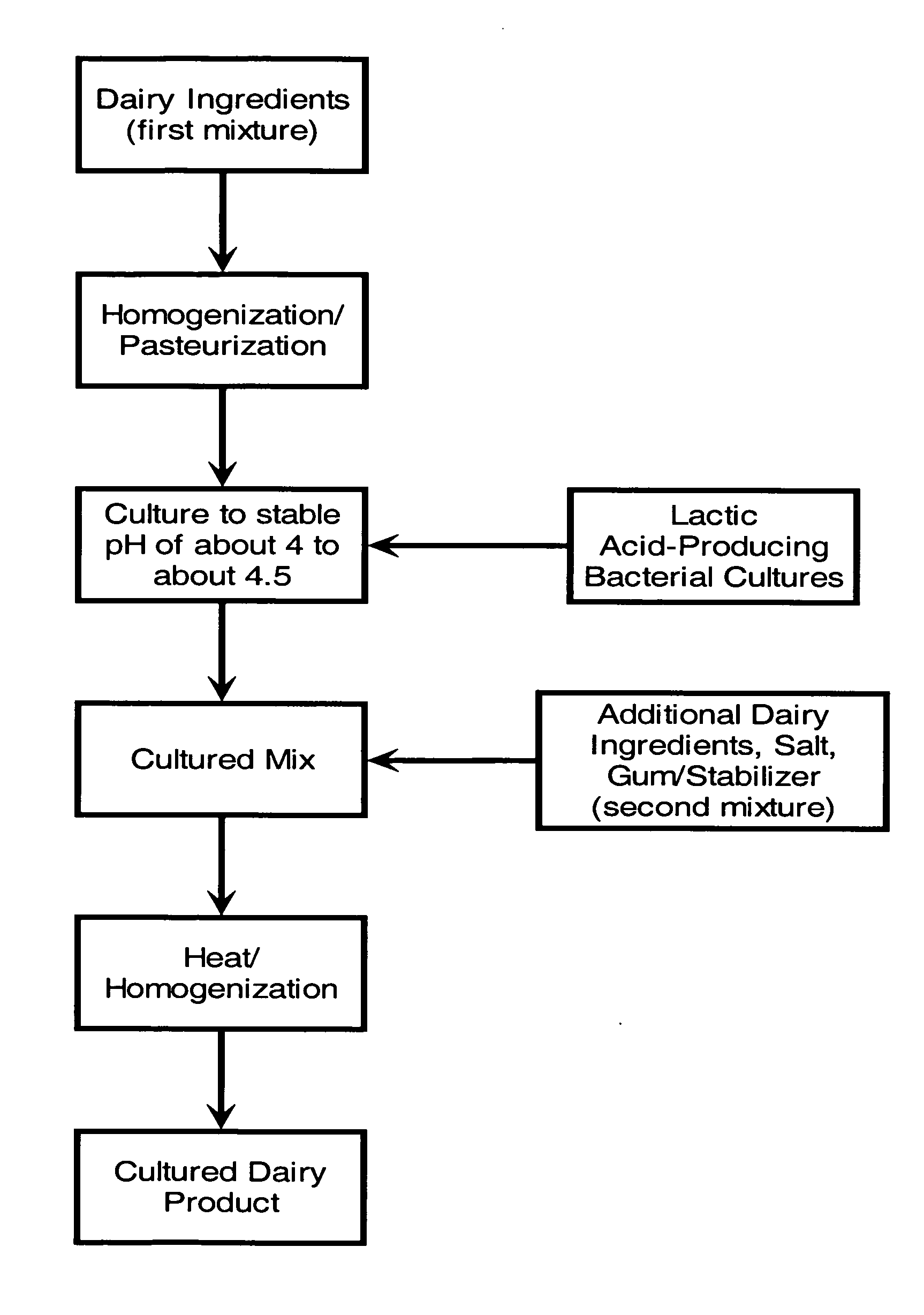
Figure 1 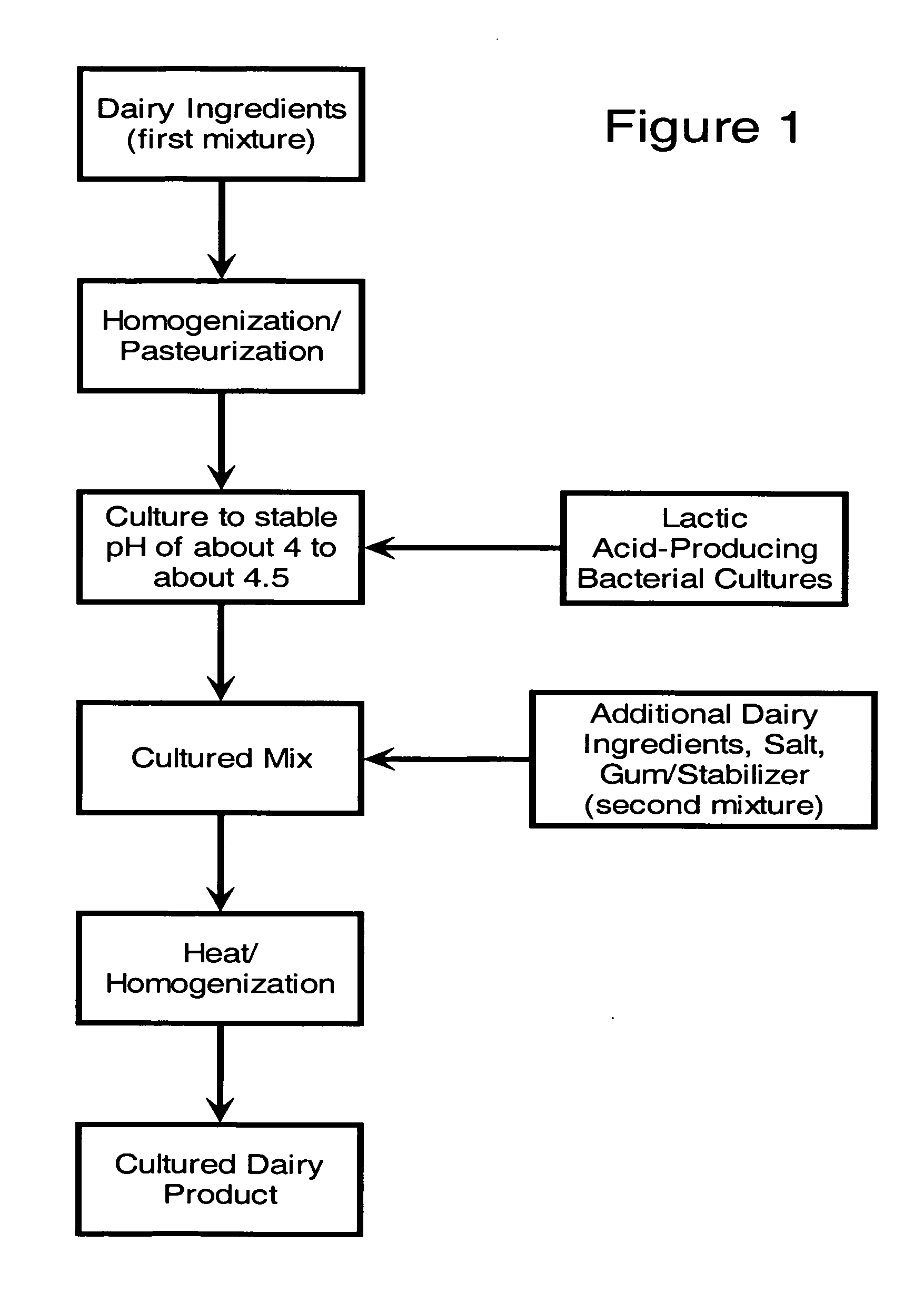
Figure 2
Abstract
Description
FIELD OF THE INVENTION
[0001] The present invention relates to cultured dairy products, particularly to cultured cream cheese products, and more particularly to cultured cream cheese compositions which are prepared without a whey-separation step and which have reduced levels of cultured dairy materials. The present invention also relates to methods of making such cultured dairy products. BACKGROUND OF THE INVENTION
[0002] Cream cheese is usually made by mixing sweet milk or skim milk with sweet cream to a desired fat content (usually about 10 to about 16 percent). The mixture is pasteurized, homogenized, and cooled to a setting temperature (typically about 62 to about 92° F.). It is then inoculated with lactic acid bacteria and incubated until sufficient acidity has developed to cause the separation of curd from whey. The coagulation process may, optionally, be aided by the addition of a small amount of rennet. After the curd is separated from whey (e.g., using a centrifugal separat...
Examples
example 1
[0033] An inventive full-fat cream cheese was prepared using the general method illustrated in the process flow diagram (FIG. 1). Pasteurized cream (39.6% butterfat) was cultured using about 1 percent of a lactic acid-producing bacterial culture (DSM Food Specialties, Milville, Utah) at about 72° F. to a steady-state pH of 4.43 (total time of about 12.5 hours). After heating to 180° F., ingredient additions were made as shown in the following recipe (based on 100 lbs finished product).
TABLE 1AIngredientAmount (lbs)Cultured Mix82.1Water8.2WPC (80% protein)5.1Whey Powder3.4Salt0.9Stabilizer / gum0.3TOTAL100.0
The whey protein concentrate (WPC) was from Glanbia Nutritional, Inc. (Monroe, Wis.); the whey powder was from American Milk Producers, Inc. (Jim Falls, Wis.; and the stabilizer / gum was locust bean gum from Danisco USA, Inc. (New Century, Kans.). After all ingredients were added, the blend was held for 10 minutes at 180 to 185° F. and subsequently homogenized at 3000 / 500 psi (fir...
example 2
[0036] An inventive reduced-fat cream cheese was prepared using the general method illustrated in the process flow diagram (FIG. 1). Milk and cream were blended, homogenized, and pasteurized to produce a dairy mix with the following composition:
TABLE 2AComponentAmount (%)Total Solids26.9Fat17.1Protein2.5Casein2.0Whey Protein0.5Lactose3.8
[0037] The dairy mix was cultured until the pH level reached steady state (pH 4.17). After heating from about 61 to about 180° F., ingredient additions were made as shown in the following recipe (based on 100 lbs finished product).
TABLE 2BIngredientAmount (lbs)Cultured Mix89.2WPC (80% protein)6.9Whey Powder2.5Salt0.9Stabilizer / gum0.5TOTAL100.0
The WPC and whey powder were the same as used in Example 1. The stabilizer / gum was a blend of about 80 percent locust bean gum (Danisco, USA, Inc., New Century, Kans.) and about 20 percent xanthan gum (CP Kelco, Chicago, Ill.). After all ingredients were added to the mix, the blend was held for 10 minutes a...
example 3
[0039] An inventive ultra-light cream cheese was prepared using the general method illustrated in the process flow diagram (FIG. 1). Milk and cream were blended, homogenized, and pasteurized to produce a dairy mix with the following composition:
TABLE 3AComponentAmount (%)Total Solids15.6Fat6.7Protein2.9Casein2.3Whey Protein0.6Lactose4.7
[0040] The dairy mix was cultured to a steady-state pH of 4.17. After heating from about 58 to about 180° F., ingredient additions were made as shown in the following recipe (based on 100 lbs finished product).
TABLE 3BIngredientAmount (lbs)Cultured Mix85.4WPC (80% protein)11.9Whey Powder1.3Salt0.9Stabilizer / gum0.5TOTAL100.0
[0041] The WPC, whey powder, and stabilizer / gum blend were the same as used in Example 2. After all ingredients were added to the mix, the blend was held for 10 minutes at about 180 to about 185° F. and subsequently homogenized at 3000 / 500 psi (first and second stage). Product was collected out and packaged. The inventive cream ...