

Opportunistic wireless mesh network methods
a wireless mesh network and wireless mesh technology, applied in the field of wireless mesh network methods, can solve the problems of inability to handle the randomness of large-scale wireless mesh network with lightweight nodes, inability to further change technologies, and difficulty in implementation, so as to achieve the effect of reducing overhead and improving performan
Patent Information
- Authority / Receiving Office
- US · United States
- Patent Type
- Applications(United States)
- Current Assignee / Owner
- Publication Date
- 2008-03-27
Smart Images
Figure 1 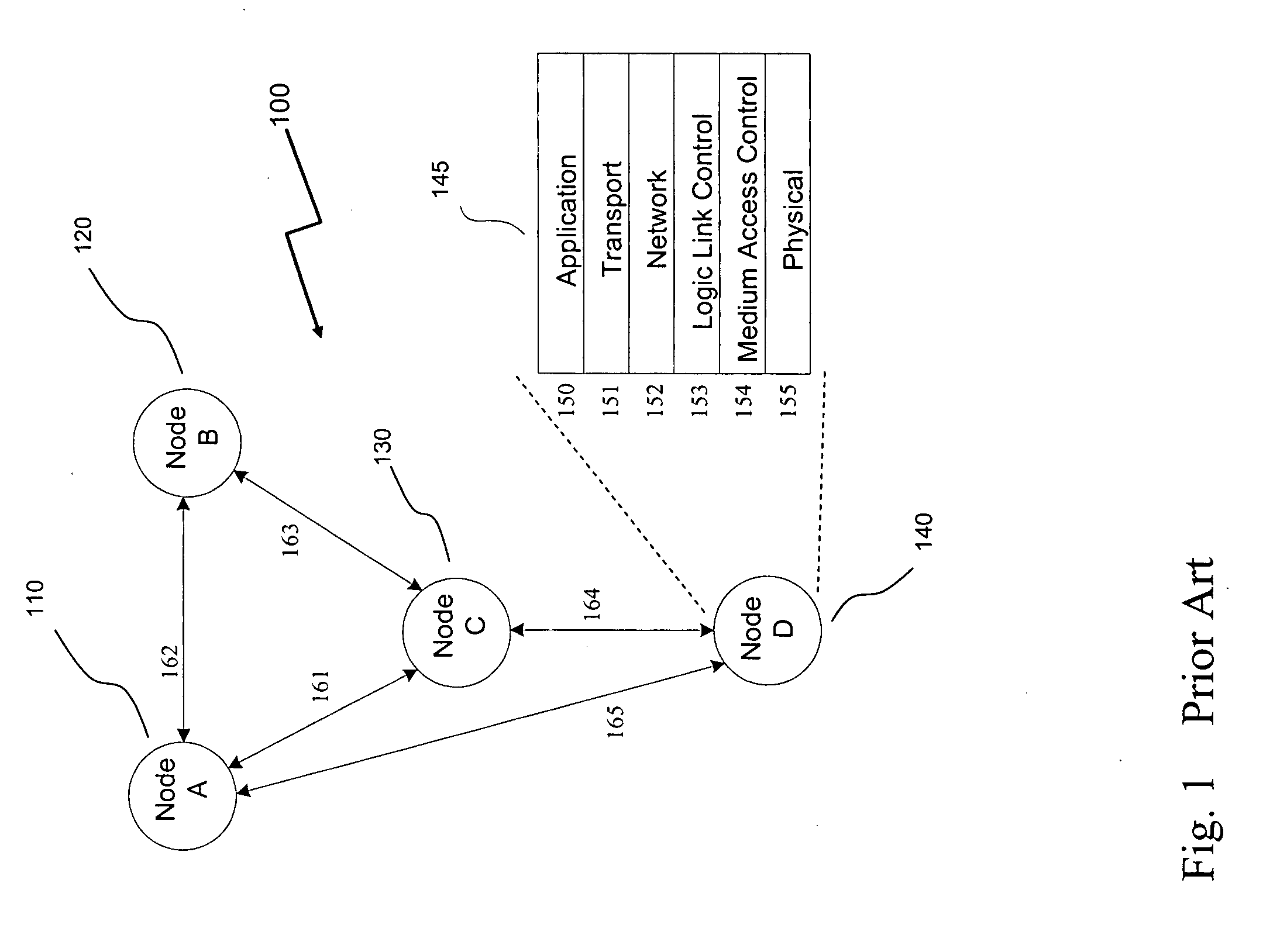
Figure 2 
Figure 3
Abstract
Description
[0001] This application claims the benefit of U.S. Provisional Patent Application No. 60 / 846,332 filed Sep. 22, 2006, the entire contents of which are incorporated herein by reference.FIELD OF THE INVENTION
[0002] The invention relates the field of wireless networking and communications. In particular, the randomness of networking conditions is handled opportunistically to achieve reliable and high-performance data communications.BACKGROUND OF THE INVENTION
[0003] Large-scale communication networks are typically supported by an infrastructure, which supports communication between distant individuals, for example the regular mail system, the telephone or electronic message system. In such communication networks, when a person dials a number or writes an address, the phone call, the letter or the electronic mail message is sent through an organized structure, which allows the path of the message to be predetermined, and hence tracked and managed, until it reaches its destination. The const...
Examples
Embodiment Construction
[0070]FIG. 1 illustrates a prior art example of wireless mesh networking by use of a network topology graph 100. Shown are wireless links 161 through 165, which connect four wireless network nodes, being Node A 110, Node B 120, Node C 130, and Node D 140, all of which are within acceptable transmission range of each other. This combination of wireless links (161 to 165) and nodes (110 to 140) forms a network topology graph 100. By adopting the OSI model, the networking architecture is divided into multiple hierarchical layers, shown in 145. In particular, the Physical Layer 155 transforms the digital bits into wireless signals, and vice versa. The Medium Access Control (MAC) layer 154 sets up virtual wired links over wireless medium, by means of interference control. The Link Logic Control (LLC) layer 153 performs some additional functionalities of the link layer, including multiplexing and demultiplexing protocols using the MAC layer. The Network Layer 152 of every node acts as a r...