
Method and system for quantitative assessment of verbal memory
a quantitative assessment and verbal memory technology, applied in the field of psychophysics, can solve the problems of many visual abnormalities that are unlikely to be discovered, many visual abnormalities are impaired by neural dysfunctions, and the onset of alzheimer's disease is not easy to detect, so as to improve the effect of simplifying the complex experimental paradigm
Patent Information
- Authority / Receiving Office
- US · United States
- Patent Type
- Applications(United States)
- Current Assignee / Owner
- Publication Date
- 2011-03-17
Smart Images
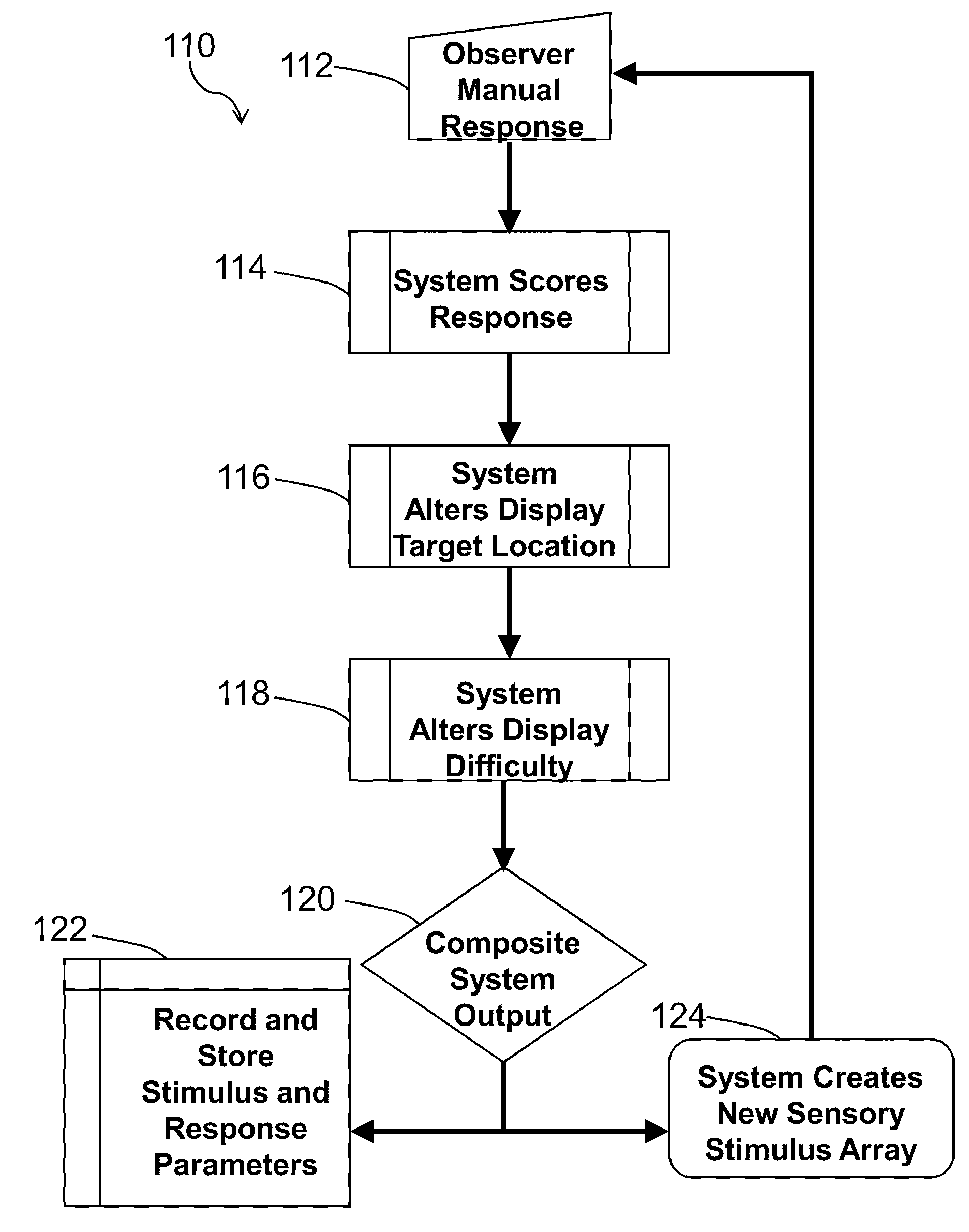
Figure 1 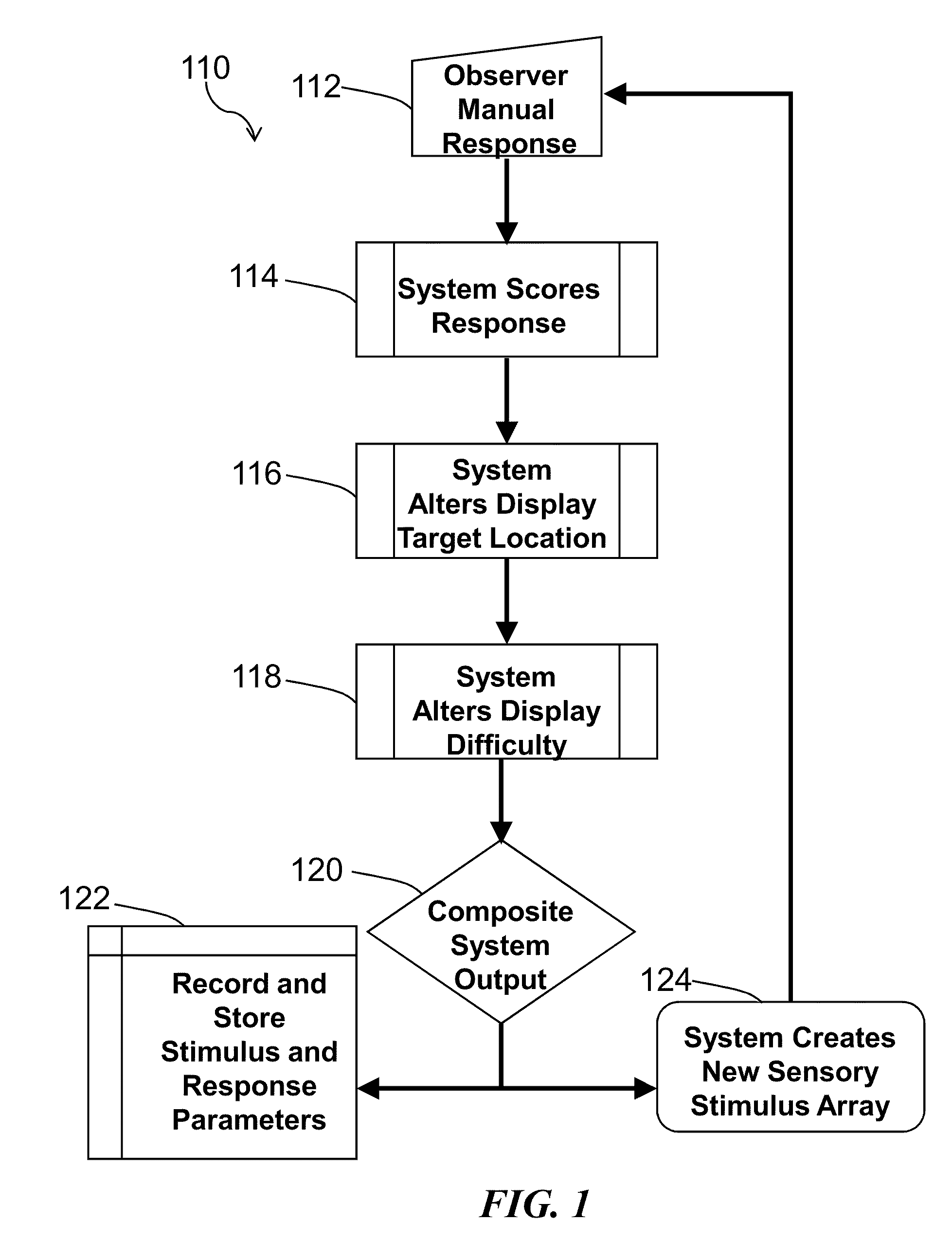
Figure 2 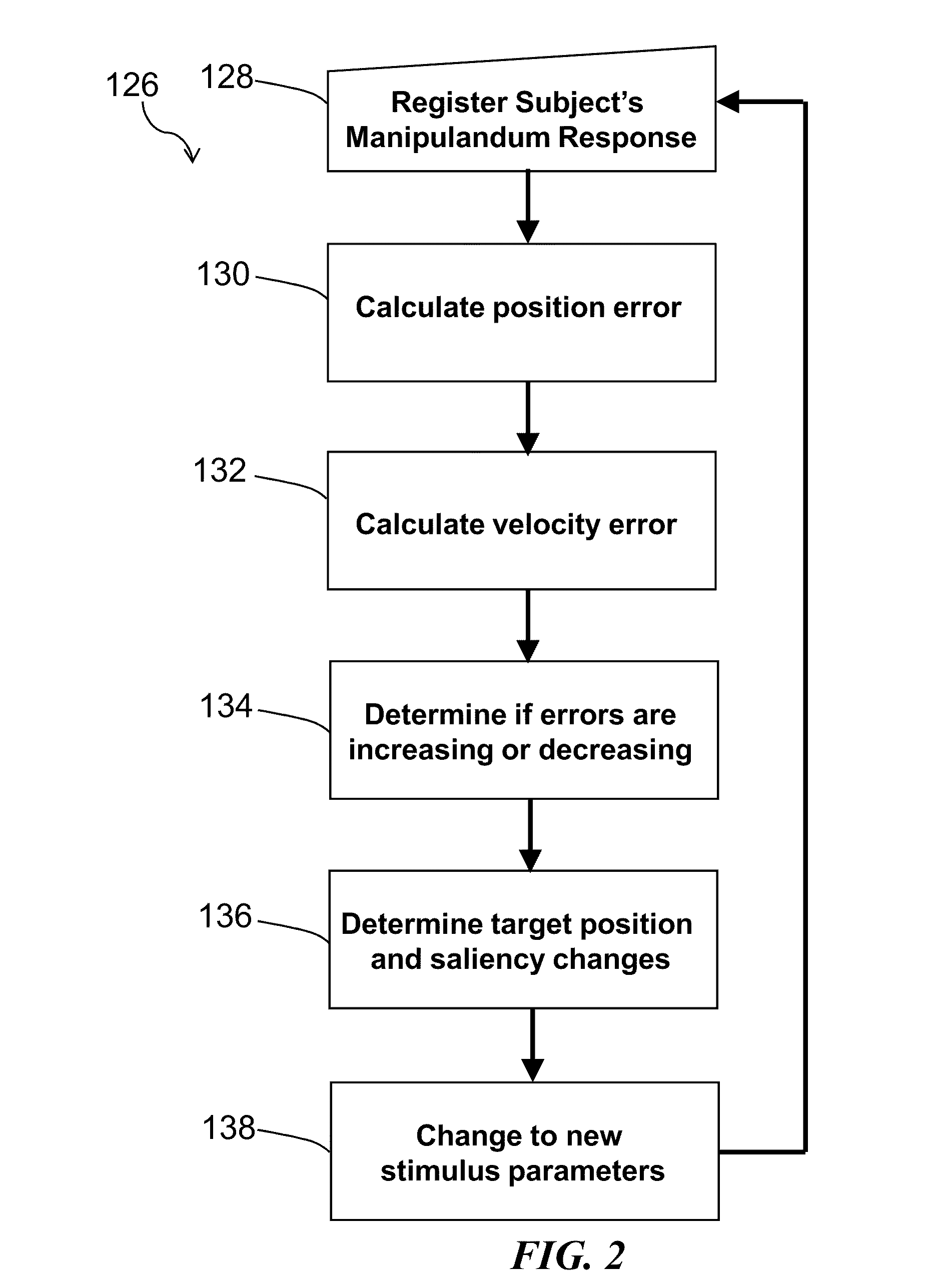
Figure 3
Abstract
Description
TECHNICAL FIELD
[0001] This disclosure relates in general to the field of psychophysics, and more particularly to perceptual abnormalities associated with sensory and motor processing, and even more particularly to quantitative assessment of functional impairment.BACKGROUND
[0002] Substantial literature exists describing cognitive and visual impairments due to neural dysfunctions, neurodegenerative diseases, and mental disorders. Visual functions, such as shape and motion processing, are impaired by neural dysfunctions. However, many visual abnormalities are unlikely to be uncovered during routine neurological examination.
[0003] A method and system for quantitative assessment of functional impairment enables for detection of and indicates diagnosis of a variety of neurological diseases and disorders. A system for sensory-motor quantitative neurocognitive assessment provides continuous feedback adjusted stimulation and its standardized scoring algorithms may provide for diagnosis for earl...
Examples
Embodiment Construction
[0113]The present disclosure is related to the subject matter disclosed in the following co-pending applications filed on Sep. 16, 2009 and each naming Charles Joseph Duffy as the inventor: Ser. No. 12 / 560,583 and entitled METHOD AND SYSTEM FOR QUANTITATIVE ASSESSMENT OF FUNCTIONAL IMPAIRMENT, Ser. No. 12 / 560,605 and entitled METHOD AND SYSTEM FOR QUANTITATIVE ASSESSMENT OF VISUAL MOTOR RESPONSE, Ser. No. 12 / 560,642 and entitled METHOD AND SYSTEM FOR QUANTITATIVE ASSESSMENT OF VISUAL CONTRAST SENSITIVITY, Ser. No. 12 / 560,683 and entitled METHOD AND SYSTEM FOR QUANTITATIVE ASSESSMENT OF VISUAL FORM DISCRIMINATION, Ser. No. 12 / 560,746 and entitled METHOD AND SYSTEM FOR QUANTITATIVE ASSESSMENT OF VISUAL MOTION DISCRIMINATION, Ser. No. 12 / 560,916 and entitled METHOD AND SYSTEM FOR QUANTITATIVE ASSESSMENT OF SPATIAL DISTRACTOR TASKS, and Ser. No. 12 / 561,010 and entitled METHOD AND SYSTEM FOR QUANTITATIVE ASSESSMENT OF LETTER IDENTIFICATION LATENCY.
[0114]In describing embodiments of the p...