
4-METHYL-1-PENTENE/a-OLEFIN COPOLYMER, COMPOSITION COMPRISING THE COPOLYMER AND 4-METHYL-1-PENTENE COPOLYMER COMPOSITION
a technology of a-olefin and copolymer, which is applied in the field of 4-methyl-1 pentene/a-olefin copolymer, a composition comprising the copolymer, can solve the problems of low stereoregularity polymer or low-molecular weight polymer, adverse influence as a sticky component, and reduce mechanical properties such as toughness and strength, and achieves the effect of flexibleness, toughness, and preferable mechanical properties
Patent Information
- Authority / Receiving Office
- US · United States
- Patent Type
- Applications(United States)
- Current Assignee / Owner
- Publication Date
- 2012-08-30
Smart Images
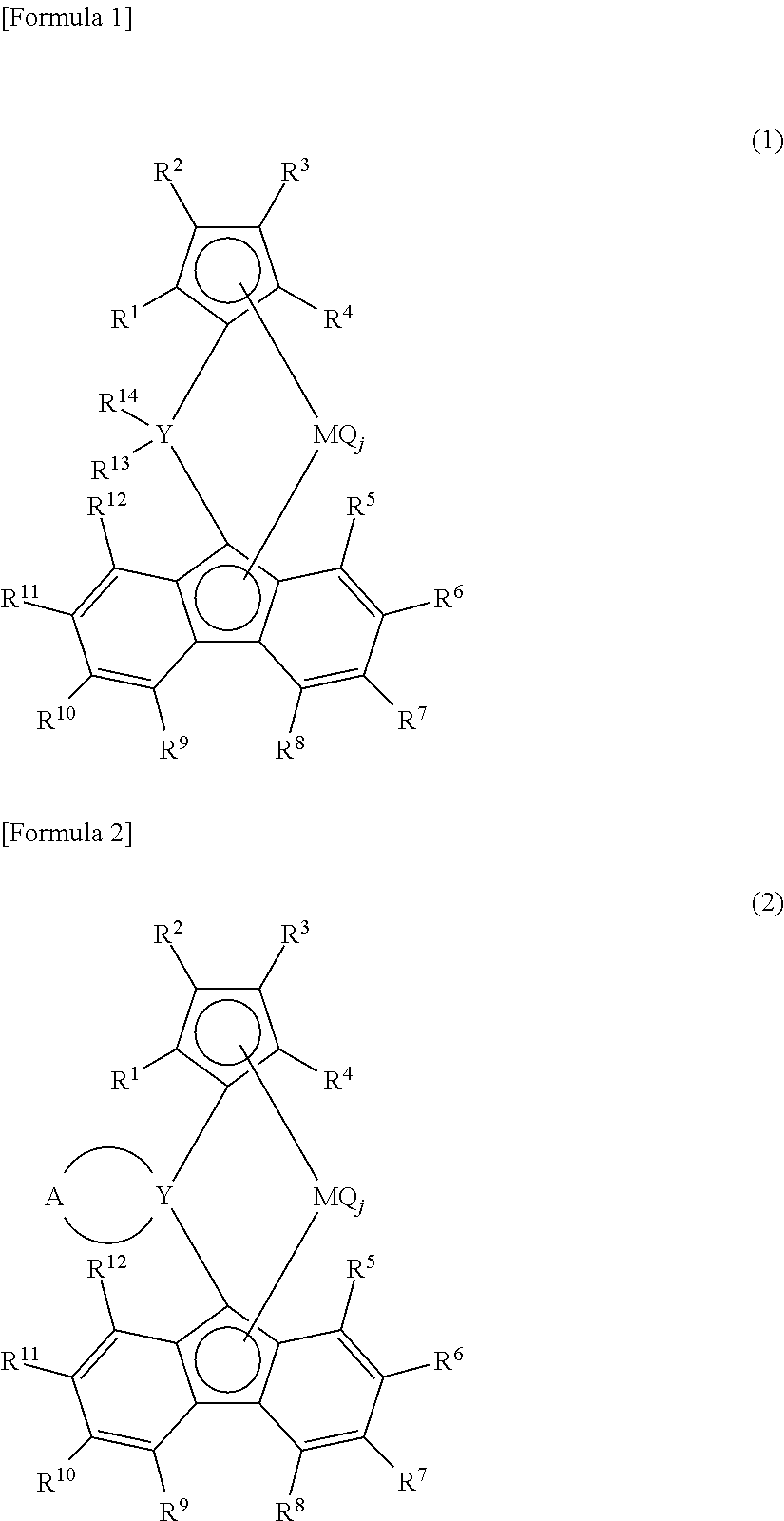
Figure 1
Abstract
Description
TECHNICAL FIELD
[0001] The present invention relates to a 4-methyl-1-pentene / α-olefin copolymer, a composition comprising the copolymer, an, article comprising the composition, and uses thereof.
[0002] In more detail, the present invention relates to a copolymer of 4-methyl-1-pentene and an α-olefin, the copolymer being excellent in flexibility, lightness, stress absorption, stress relaxation, scratch resistance, abrasion resistance, toughness, and mechanical properties, having no stickiness in molding operation and being excellent in the balance among these properties; and the present invention further relates to a composition comprising the copolymer and uses thereof.BACKGROUND ART
[0003] Olefin polymers, being excellent in processability, chemical resistance, electrical properties, mechanical properties, and the like, are processed to extrusion molded articles, injection molded articles, hollow articles, films, sheets, fibers, and the like, and are used in many applications including d...
Examples
example 1
[0489]Into a SUS autoclave with an agitating element having a volume of 1.5 L that had been sufficiently purged with nitrogen, at 23° C., 750 mL of 4-methyl-1-pentene was introduced. Into this autoclave, 0.75 mL of a toluene solution of 1.0 mmol / mL of triisobutylaluminum (TIBA1) was introduced, and the agitator was operated. Then, the autoclave was heated till the temperature of the mixture became 30° C., and pressurization using propylene was performed such that the total pressure became 0.74 MPaG. Then, 0.34 mL of a previously-prepared toluene solution containing 1 mmol in terms of Al of methylaluminoxane and 0.005 mmol of diphenylmethylene (1-ethyl-3-t-butyl-cyclopentadienyl) (2,7-di-t-butyl-fluorenyl)zirconiumdichloride was injected using nitrogen into the autoclave, thereby initiating polymerization. For the following 60 minutes, temperature of the autoclave was controlled such that the temperature of the mixture was 60° C. At 60 minutes past the initiation of the polymerizatio...
example 2
[0491]Into a SUS autoclave with an agitating element having a volume of 1.5 L that had been sufficiently purged with nitrogen, at 23° C., 750 mL of 4-methyl-1-pentene (4 MP1) was introduced. Into this autoclave, 0.75 mL of a toluene solution of 1.0 mmol / mL of triisobutylaluminum (TIBA1) was introduced, and the agitator was operated. Then, the autoclave was heated till the temperature of the mixture became 30° C., and pressurization using propylene was performed such that the total pressure became 0.68 MPaG. Then, 0.34 mL of a previously-prepared toluene solution containing 1 mmol in terms of Al of methylaluminoxane and 0.005 mmol of diphenylmethylene (1-methyl-3-t-butyl-cyclopentadienyl)(2,7-di-t-butyl-fluorenyl)zirconiumdichloride was injected using nitrogen into the autoclave, thereby initiating polymerization. For the following 60 minutes, temperature of the autoclave was controlled such that the temperature of the mixture was 60° C. At 60 minutes past the initiation of the polym...
example 3
[0493]Polymerization was performed in the same manner as in Example 2, except that the pressurization using propylene was performed such that the total pressure in the polymerization container was 0.35 MPaG.
[0494]The resultant polymer weighed 46.9 g, and the content of propylene in the polymer was 52.7 mol %. With regard to the polymer, Tm was not observed; the intrinsic viscosity [η] was 1.41 dL / g; the molecular weight distribution obtained by GPC was such that Mw was 285000, Mn was 143000, and Mw / Mn was 2.0; the extracted amount under methyl acetate was 0.2 wt %; YM was 3 MPa; ΔHS was 38; and the maximum value of tan δ was 3.4 (temperature giving the maximum value: 19° C.). Properties of the resultant polymer are shown in Table 1.