
Strategies for high throughput identification and detection of polymorphisms
a polymorphism detection and high throughput technology, applied in the field of molecular biology and genetics, can solve the problems of cumbersome and expensive, add enormous costs and development time, etc., and achieve the effect of efficient identification and reliably detecting polymorphisms in a complex, rapid and economical manner
Patent Information
- Authority / Receiving Office
- US · United States
- Patent Type
- Applications(United States)
- Current Assignee / Owner
- Publication Date
- 2012-12-13
Smart Images
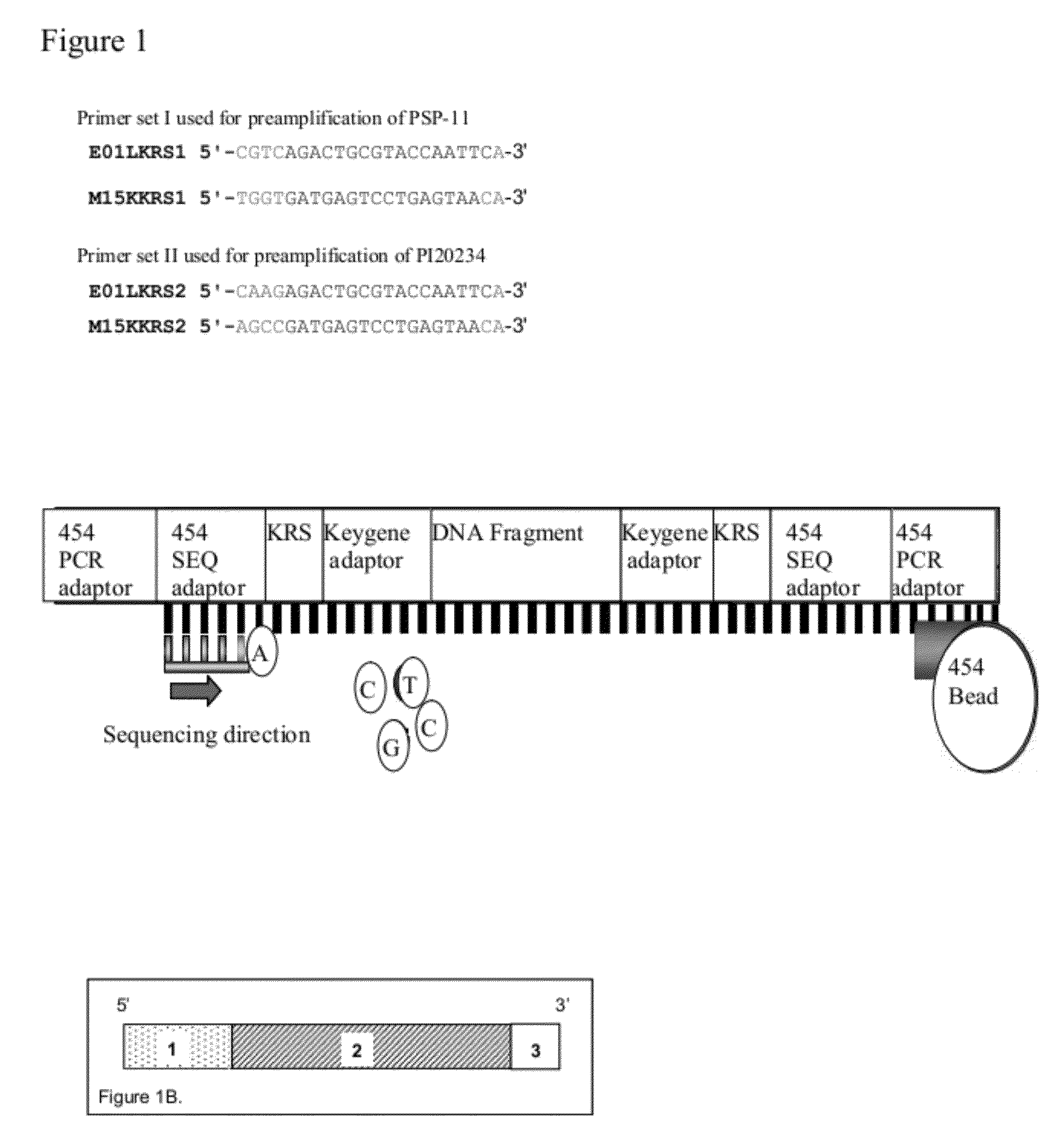
Figure 1 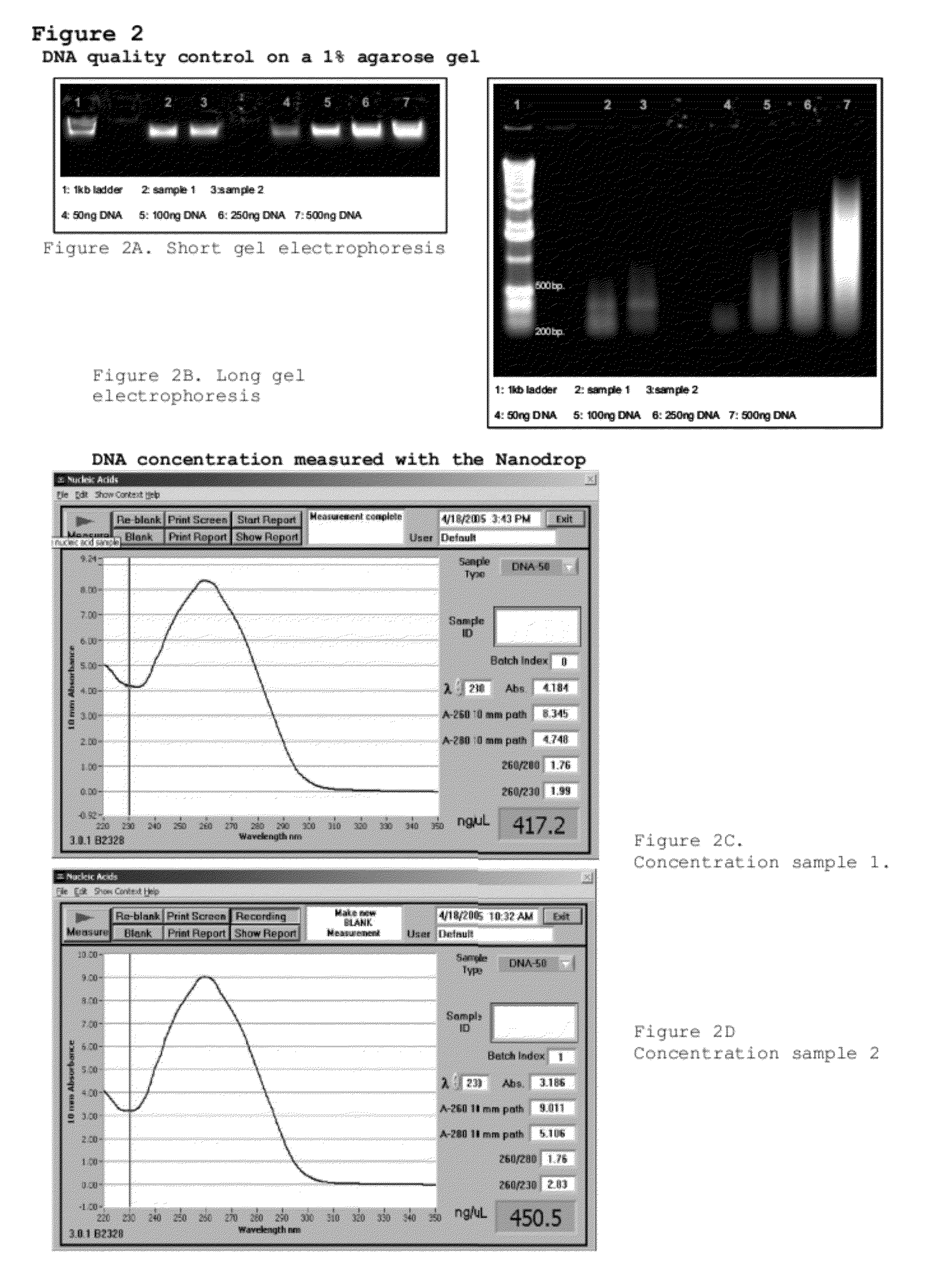
Figure 2 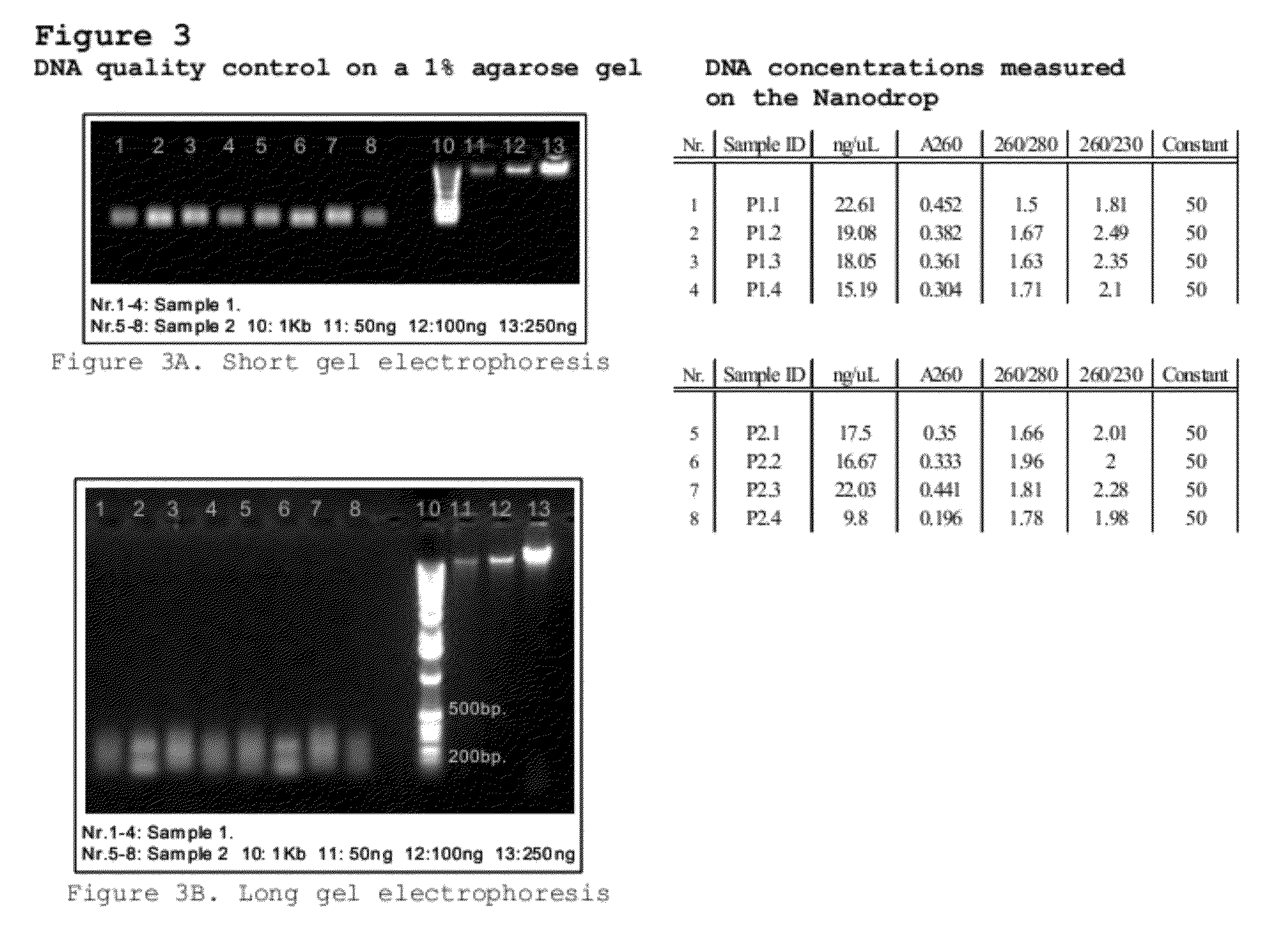
Figure 3
Abstract
Description
CROSS-REFERENCE TO RELATED PATENT APPLICATIONS
[0001] This application is a divisional of U.S. application Ser. No. 11 / 993,945 (National Stage of PCT / NL2006 / 000311), which claims priority from U.S. Provisional Application Ser. Nos. 60 / 693,053, filed Jun. 23, 2005, and 60 / 759,034, filed Jan. 17, 2006, and from European Application 06075104.7, filed Jan. 16, 2006. The entire contents of each of the aforementioned applications are incorporated herein by reference.TECHNICAL FIELD
[0002] The present invention relates to the fields of molecular biology and genetics. The invention relates to rapid identification of multiple polymorphisms in a nucleic acid sample. The identified polymorphisms may be used for development of high-throughput screening systems for polymorphisms in test samples.BACKGROUND OF THE INVENTION
[0003] Exploration of genomic DNA has long been desired by the scientific, in particular medical, community. Genomic DNA holds the key to identification, diagnosis and treatment of d...
Examples
example 1
[0136]EcoRI / MseI restriction ligation mixture (1) was generated from genomic DNA of the pepper lines PSP-11 and PI20234. The restriction ligation mixture was 10 times diluted and 5 microliter of each sample was pre-amplified (2) with EcoRI+1 (A) and MseI+1 (C) primers (set I). After amplification the quality of the pre-amplification product of the two pepper samples was checked on a 1% agarose gel. The preamplification products were 20 times diluted, followed by a KRSEcoRI+1(A) and KRSMseI+2(CA) AFLP pre-amplification. The KRS (identifier) sections are underlined and the selective nucleotides are in bold at the 3′-end in the primer sequence SEQ ID 1-4 below. After amplification the quality of the pre-amplification product of the two pepper samples was checked on a 1% agarose gel and by an EcoRI+3(A) and MseI+3(C) (3) AFLP fingerprint (4). The pre-amplification products of the two pepper lines were separately purified on a QiagenPCR column (5). The concentration of the samples was me...
example 2
Pepper
[0152]DNA from the Pepper lines PSP-11 and PI20234 was used to generate AFLP product by use of AFLP Keygene Recognition Site specific primers. (These AFLP primers are essentially the same as conventional AFLP primers, e.g. described in EP 0 534 858, and will generally contain a recognition site region, a constant region and one or more selective nucleotides in a selective region.
[0153]From the pepper lines PSP-11 or PI20234 150 ng of DNA was digested with the restriction endonucleases EcoRI (5 U / reaction) and MseI (2 U / reaction) for 1 hour at 37° C. following by inactivation for 10 minutes at 80° C. The obtained restriction fragments were ligated with double-stranded synthetic oligonucleotide adapter, one end of witch is compatible with one or both of the ends of the EcoRI and / or MseI restriction fragments. AFLP preamplification reactions (20 μl / reaction) with +1 / +1 AFLP primers were performed on 10 times diluted restriction-ligation mixture. PCR profile: 20*(30 s at 94° C.+60...
example 3
Maize
[0154]DNA from the Maize lines B73 and M017 was used to generate AFLP product by use of AFLP Keygene Recognition Site specific primers. (These AFLP primers are essentially the same as conventional AFLP primers, e.g. described in EP 0 534 858, and will generally contain a recognition site region, a constant region and one or more selective nucleotides at the 3′-end thereof.).
[0155]DNA from the pepper lines B73 or M017 was digested with the restriction endonucleases TaqI (5 U / reaction) for 1 hour at 65° C. and MseI (2 U / reaction) for 1 hour at 37° C. following by inactivation for 10 minutes at 80° C. The obtained restriction fragments were ligated with double-stranded synthetic oligonucleotide adapter, one end of witch is compatible with one or both of the ends of the TaqI and / or MseI restriction fragments.
[0156]AFLP preamplification reactions (20 μl / reaction) with +1 / +1 AFLP primers were performed on 10 times diluted restriction-ligation mixture. PCR profile: 20*(30 s at 94° C.+...